

Key Takeaways
Every problem you can't beat hides an inner saboteur called Part X
The enemy is built-in, not broken. Michels and Stutz, two veteran psychotherapists, argue that behind every recurring failure sits an active, irrational force they name Part X. It is not an illness or a wound from your childhood, it is a permanent part of every human being, like the heart or brain. Its single agenda is to convince you that change is impossible.
Its signature move is repetition. Part X takes an ordinary setback (loneliness, a rejection, a hard task) and inflates it until the wall in front of you reads "IMPOSSIBLE" in giant letters. A gifted teen soccer player who feared leaving home slowly lost her nerve on the field too. That spreading poison of impossibility, not any single lapse, is how Part X shrinks a life. The opposite part, they say, is your soul.
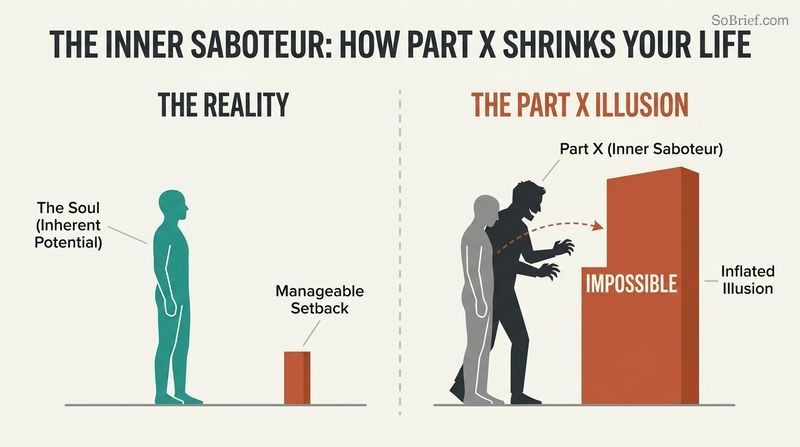
What's compelling here is the externalization. Naming self-sabotage as a distinct agent echoes acceptance and commitment therapy's "cognitive defusion" and internal family systems, which also treat destructive impulses as parts to observe rather than identities to inhabit. The claim that insight alone rarely cures, backed by seventy combined years of practice, tracks with meta-analyses showing behavioral activation often outperforms pure interpretation. The risk is reification: treating a metaphor as a literal cosmic being could let someone dodge responsibility or medical care. The authors hedge by calling Part X a construct people can feel, which is smart, since a felt model motivates action better than an abstract diagnosis.
You cannot think your way back to life; you need tools
Understanding is not the key. Both authors spent years frustrated by therapies that failed. Psychodynamic analysis traced problems to the past but left patients stuck; cognitive behavioral therapy tried to swap bad thoughts for realistic ones, yet the harsh inner voice steamrolled the logic. Michels describes his self-criticism as an undertow no evidence could counter. The book compares reading about the Life Force to reading a soup can label: useless until you taste the soup.
Tools bridge insight and action. A tool is a quick mental technique, under ten seconds, used at the exact moment a problem hits. You do not analyze whether it worked; you repeat it like practicing piano. Speed matters because it gives Part X less time to flood you with rationalizations. The point is doing, not knowing.
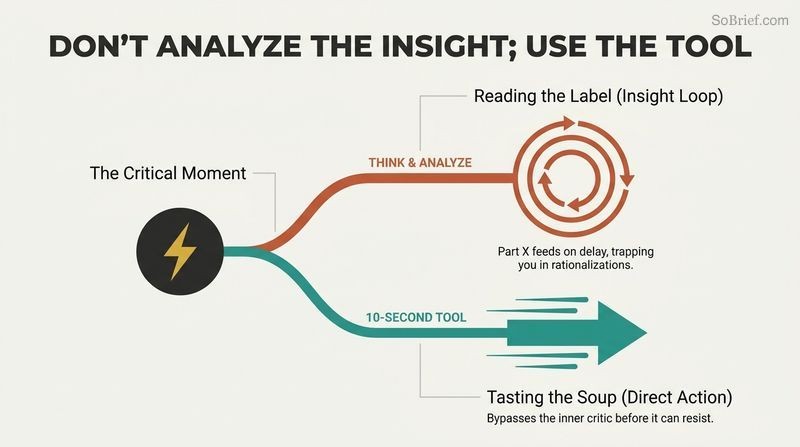
This lands a real punch against the "aha equals cure" myth. Research on rumination supports it: revisiting painful memories can deepen depression rather than resolve it, which is why the authors distrust endless past-focused talk. Their emphasis on brief, in-the-moment interventions resembles skills-based approaches like DBT, where patients drill concrete techniques rather than excavate origins. One caveat: dismissing all cognitive reframing overstates the case, since restructuring genuinely helps many. The deeper insight is that emotion is state-dependent. A truth known calmly at noon evaporates during a 2 a.m. panic, so you need something usable while drowning, not a lecture to recall afterward.
Catch and label Part X the instant it attacks; seeing is freeing
Labeling is the first line of defense. The moment you feel stuck, you say to yourself, "This is Part X." That simple act creates a buffer zone. The logic is elegant: if you can observe the enemy, you are not the enemy, which means you have just activated your soul, the free part that chooses how to see the world. Michels found that within a week of labeling his self-attacks, he felt lighter and gained a sense of choice he had never had.
Expect it everywhere, and expect to fail. Part X is an equal-opportunity saboteur, hijacking a party, a diaper change, a commute. Beginners miss most attacks; the authors say keep going anyway. Crucially, labeling in the present frees you from the past, unlike therapy that keeps you cataloging old grievances.
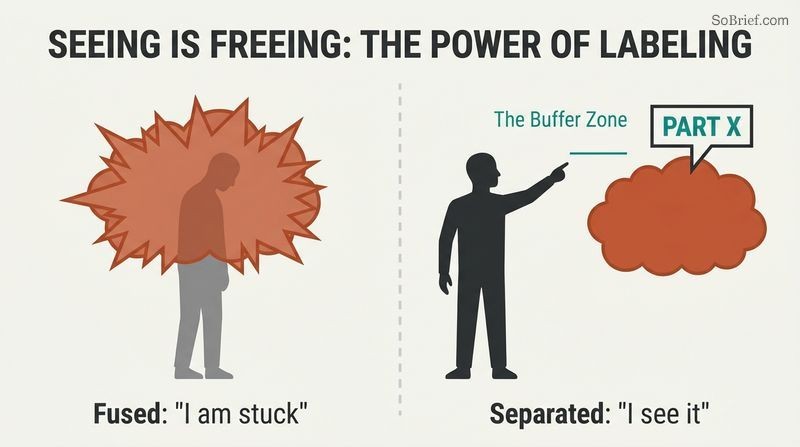
The move from fusion to observation is one of the most validated mechanisms in modern clinical psychology. Affect labeling, putting feelings into words, measurably dampens amygdala activity in neuroimaging studies by Lieberman and colleagues, giving neural weight to "name it to tame it." Mindfulness research shows similar decoupling between stimulus and reaction. The authors add a useful twist: labeling reframes blame. Instead of blaming your mother or your circumstances, you assign the sabotage to Part X and reclaim agency for the present. The honest touch is admitting you will miss most attacks at first, which prevents the perfectionism that quietly ends most self-help experiments.
The highest energies enter through the smallest, repeatable actions
Reject the lie that only dramatic moves count. Part X loves to tell you that change requires a grand gesture, then watches you quit after the crash diet fails. The authors flip this. Want to go back to school? Take one night class. Want to lose weight? Skip one dessert. Small steps matter because they can be repeated endlessly, creating a nonstop channel for forward motion.
Transitions are the secret battleground. Citing Rudolf Steiner, the book claims the most important things enter life through the smallest things. Life is a thousand tiny skirmishes a day: getting out of bed, ending a phone call, starting dinner. Inertia makes each shift hard. Picasso's line captures the discipline: inspiration has to find you already working.
This is habit science dressed in spiritual language. It parallels BJ Fogg's Tiny Habits and James Clear's argument that identity forms through small repeated votes, not heroic leaps. Behaviorally, small actions lower activation energy and exploit the progress principle, where minor wins compound motivation. The transitions insight is underappreciated: task-switching costs are well documented in cognitive psychology, and the friction of starting, not the task itself, is what defeats people. Where the authors go further than most productivity writers is framing tiny actions as spiritually charged conduits. That may sound grand, but the practical takeaway is bulletproof: shrink the step until starting is almost impossible to refuse.
Deprivation is a doorway to abundance, not a small death
The Black Sun tool tames impulses. When you crave the extra drink, the dopamine hit of the phone, or the impulse to lash out, Part X whispers that being deprived is intolerable, a kind of death. The tool exposes that lie. You feel the deprivation fully, then let go of the wanted thing and the whole outside world, turning to face the empty void inside. Instead of the expected annihilation, a Black Sun rises from that void and fills you with limitless energy that then overflows outward as giving.
Restraint transforms energy rather than wasting it. A hot-tempered gambler named Marty used it to stop raging at his family, and his self-control rippled outward until his whole household changed. The counterintuitive law: the more you give out, the fuller you feel.
Strip the mysticism and this is exposure therapy plus urge surfing. Addiction researchers like Alan Marlatt showed that cravings peak and subside like waves within minutes if you observe rather than obey them, which is exactly what facing the void accomplishes. The "deprivation equals death" lie maps onto distress intolerance, a documented driver of relapse across eating, spending, and substance disorders. The giving reversal has support too: twelve-step service work and studies on prosocial behavior show that focusing outward reduces self-focused craving. The vivid eclipse imagery is doing real cognitive work, giving the unconscious a symbol to grab in a ten-second window when reasoning fails.
Energy is created by engaging the world, not by hoarding rest
Withdrawal drains you; engagement generates fuel. A perpetually exhausted caterer named Beth believed energy was a fixed tank she was born with and had to protect, so she canceled plans, skipped work events, and napped for hours. The authors call this the trap: energy comes from meeting life's demands, and pulling back squanders it. Her sister, dealt a harder hand, stayed connected and stayed vital.
The Vortex accesses spiritual energy. Physical energy is finite and declines with age, but spiritual energy is limitless. The tool: picture twelve suns in a ring overhead, silently scream "help" to spin them into a gentle tornado, rise through it, and grow into an unhurried giant. This breaks the Paradox of Engagement, that you need energy to engage but engaging is what makes energy.
The core claim aligns strikingly with self-determination theory and behavioral activation for depression, where action precedes and produces motivation rather than the reverse. Waiting to feel energized before engaging is precisely backward; movement generates the very drive people think they lack. Beth's "finite tank" belief resembles the ego-depletion model of willpower, which has largely failed replication, suggesting energy is far more mindset-dependent than once thought. The distinction between purposeful rest and escapist withdrawal is clinically sharp: restorative rest has a next step, avoidant rest does not. The twelve-suns visualization is frankly odd, but its function, a fast somatic state-shift, is legitimate.
Trade false hope for hopefulness that needs no guaranteed outcome
False hope is the buried wish for magic. Ann spent her life hunting for the "right guy" who would rescue her from every dark mood. When she finally found him, the thrill faded and she crashed, proving the trap: false hope is the unconscious belief that some person, achievement, or windfall will exempt you from ever regulating your own mood. Getting it changes nothing, so despair follows.
The Mother tool restores hopefulness. Drawing on Jung's archetypes, the authors invoke the Mother, a cosmic force of unconditional love. You turn demoralization into a heavy black sludge, offer it up to a loving figure hovering above who absorbs it, then feel her unshakable faith in you. Hopefulness is optimism about the future without knowing what it holds, like a child eager to greet a new day.
The false-hope diagnosis is sharp psychology. Hedonic adaptation research confirms that lottery winners, promotion-getters, and newlyweds return to baseline happiness, and that outsourcing your emotional state to an external prize reliably backfires. The prescription echoes Viktor Frankl and Stockdale's paradox: durable hope is a stance, not a forecast. Invoking a maternal archetype resembles compassion-focused therapy, where patients cultivate an imagined perfectly nurturing figure to counter a savage inner critic, an evidence-supported technique for shame-prone people. The subtle move is reassigning responsibility for mood inward while sourcing the strength from something felt as beyond the self, which sidesteps the hollow ring of pure self-affirmation.
Let your wounded ego die so your open heart can be reborn
Victimhood is a trap of false specialness. Andrew, an insecure TV anchor, collected injuries as proof the world had singled him out. The authors argue we secretly believe we are special, entitled to the treatment we expect, and when reality disappoints, Part X offers a consolation prize: you are special because the universe targets you. Replaying the wound, which they call reinjury, keeps the pain alive.
The Tower tool converts pain into courage. The lie is that emotional pain can kill you, borrowed from our terror of physical death. The remedy is to let it kill you: feel the hurt shatter your heart, hear "only the dead survive," then float up a hollow tower into open sky, reborn. Repeat it three times, faster each time, until death and rebirth nearly fuse.
The reinjury concept is a pointed critique of catharsis theory. Contemporary research agrees: venting and repeatedly retelling grievances often entrenches anger rather than discharging it, and rumination predicts worse outcomes. The "specialness" analysis has teeth, connecting grievance identity to a fragile grandiosity, consistent with work linking narcissistic vulnerability to perceived victimhood. The death-and-rebirth ritual borrows from initiation myths and resembles psychodramatic exposure, deliberately amplifying feared emotion to prove survivability. One tension: for genuine trauma, forcing intense re-experiencing without stabilization can retraumatize, which is why trauma-informed clinicians titrate exposure carefully. As a tool for everyday slights and ego bruises, though, the logic is sound and unusually bracing.
Falling into holes is not failure; it is how your Life Force grows
Progress is cyclical, never a straight line. The authors are blunt where other gurus are rosy: you will never kill Part X. It always returns, dragging you back into holes of craving, exhaustion, despair, or hurt. Rather than despairing at this, they reframe it. Each time you use a tool to climb out, your Life Force expands. Two steps forward, one step back, with the trend rising.
Sisyphus was not cursed, he was training. They reinterpret the Greek myth of the man doomed to roll a boulder uphill forever. Outwardly futile, inwardly his strength grows with every cycle. The gods must roll it back down so he can get stronger. The true hero is not someone who never gets demoralized, but someone who reliably recovers, like Martin Luther King Jr. rising from deep despair to deliver his mountaintop speech.
This is the book's most psychologically mature move and its strongest defense against self-help disillusionment. By pre-loading the expectation of relapse, it inoculates against the abstinence violation effect, where one slip triggers total collapse because the person believed change should be permanent. Post-traumatic growth research supports the deeper claim that people often emerge from adversity with expanded capacity, not merely restored function. The Sisyphus reframe is genuinely original philosophy, closer to Camus's "one must imagine Sisyphus happy" than to the usual motivational fare. The practical payoff: veterans of many cycles stop fearing the next downturn and can even welcome it as raw material for growth.
A rising Life Force reveals Truth, Beauty, and Goodness as living forces
These are payoffs, not platitudes. As you use tools and your Life Force climbs, three principles the ancients called transcendentals stop being dry classroom words and become forces you feel. Truth exposes the lies Part X feeds you and, crucially, hurts, because facing your real failures burns. Beauty, which shimmers beneath even ordinary things like a plastic bag dancing in the wind, inspires you to fight. Goodness transforms evil rather than pretending to erase it.
Goodness is a verb, not a badge. The authors distinguish "good" (the dangerous illusion of purity that let Hitler slaughter in the name of virtue) from "Goodness" (the ongoing act of transmuting your inevitable evil). A civil rights leader who disarmed a man who spat on him by asking about his motorcycle embodied it, converting hatred into connection.
Reviving the classical triad of the transcendentals for a self-help audience is ambitious and mostly works because the authors insist these are experienced, not argued. The "good versus Goodness" distinction is philosophically serious, echoing Jung's warning that repressing the shadow, denying one's capacity for evil, is precisely what unleashes atrocity. Historians of genocide confirm perpetrators typically believe themselves virtuous. The claim that beauty and truth physically hurt has phenomenological support in research on the sublime and on awe, which can overwhelm and even destabilize. The weaker link is empirical: these are metaphysical commitments, not testable ones, best received as a meaning-making frame rather than proven science.
Give without gain to reconnect the fallen world and heal yourself
The higher use of tools is service. Most people drop a tool once their symptom clears, like leaving a play before the final act. The authors argue the deeper purpose is to keep ascending until you can perceive a Higher World, a realm of possibility our five senses miss, requiring a developed sixth sense which is the Life Force itself.
Spiritual generosity is the mechanism. They illustrate with a parable: hide from a neighbor who needs a jump so you can selfishly study this very book, and you end up drained and guilty. Give the book away to help his troubled son, and you feel alive. Self-absorption contracts; giving expands. The biggest multipliers are giving when you gain nothing, giving in secret, and helping at real personal cost.
The finale universalizes the giving principle that ran through every tool. It resonates with robust findings that prosocial spending and volunteering boost well-being more reliably than self-directed consumption, and with the "helper's high" documented in altruism research. The parable neatly dramatizes a paradox self-help usually ignores: relentless self-optimization can be its own contraction. The Kabbalistic notion of repairing a broken world, tikkun olam, gives the individual cosmic stakes, which some readers will find inspiring and others overreaching. Stripped to its behavioral core, the claim is defensible and rare in the genre: your own healing accelerates when you stop making it the point.
Analysis
Coming Alive is the second book from a Los Angeles therapist duo whose blunt, action-first method drew a Hollywood following and a New Yorker profile. Structurally it is a hybrid: four named tools, each anchored to a vivid patient story (a raging gambler, an exhausted caterer, a love-addicted woman, a victimized anchorman), wrapped in a metaphysical architecture of Part X, the Life Force, and a fallen Lower World awaiting repair. That architecture is both the book's power and its liability. The mythic framing (Black Suns, spinning suns, archetypal Mothers) makes the techniques memorable and gives the unconscious symbols to grip in crisis, but it also demands that skeptical readers suspend considerable disbelief. The authors preempt this shrewdly by insisting throughout that proof lies in use, not argument: try the tool, feel the result. Beneath the cosmology sits surprisingly rigorous behavioral psychology. The core moves, affect labeling, urge surfing, behavioral activation, exposure to feared emotion, compassion-focused imagery, and relapse-anticipation, all have empirical cousins in contemporary clinical research, even if the authors reach them through Jung, Plato, and kabbalah rather than randomized trials. Their most valuable contribution is temperamental: a refusal of the tidy transformation narrative. By insisting Part X never dies and progress is cyclical, they build psychological antifragility, protecting readers from the all-or-nothing collapse that ends most self-improvement efforts. The Sisyphus and Persephone reinterpretations elevate the book above genre convention into something closer to applied philosophy. Weaknesses are real: the metaphysics resist falsification, the anti-CBT and anti-insight stance overcorrects, and intense death-rebirth exposure could harm the genuinely traumatized without stabilization. But the throughline, that lasting vitality comes from repeated small actions and self-forgetting generosity rather than insight or acquisition, is both counter-cultural and well-supported. The book is best read as a motivational operating system, felt and practiced, not a scientific treatise.
Review Summary
Coming Alive received mixed reviews, with an overall positive reception. Many readers found the book's tools and techniques helpful for overcoming personal obstacles and improving their lives. Some appreciated the unique approach and practical exercises, while others felt the concepts were too abstract or spiritual. Critics noted the book's reliance on visualization and metaphysical ideas, which some found off-putting. Despite this, many readers reported significant personal growth and renewed energy after applying the book's principles. The authors' frank discussion of mental health issues and emphasis on active participation were widely praised.
People Also Read


Glossary
Life Force
Animating energy of full alivenessThe authors' term for an invisible, creative energy that makes a person feel fully alive, confident, and capable of putting their unique stamp on the world. Compared to Eastern concepts like prana or chi, it is felt rather than measured, accessed through action and tools rather than thought, and grows each time you overcome an inner obstacle.
Part X
Built-in inner saboteurA permanent, irrational force present in every human from birth whose sole goal is to block your growth by creating an overwhelming sense of impossibility. It works through impulses, exhaustion, despair, and hurt feelings, and keeps you stuck by making you repeat self-destructive choices. Recognizing it as separate from you activates your soul.
Labeling
Naming Part X in real timeThe foundational practice of catching Part X in the act and silently saying "This is Part X." Because you can only observe something you are separate from, labeling proves you are not Part X and activates the free part of you, creating distance and choice where there was automatic reaction.
The Black Sun
Tool for resisting impulsesA four-step visualization (Deprivation, Emptiness, Fullness, Giving) used the instant a self-defeating urge strikes. You feel the deprivation, release the wanted thing and the outside world, face the inner void, then let a Black Sun rise and fill you before its energy overflows outward as giving. It transforms craving energy into abundance.
The Vortex
Tool for exhaustion and energyA visualization used when you feel depleted, spaced out, or overwhelmed. You picture twelve suns in a circle overhead, silently scream "help" to spin them into a gentle tornado, rise through it, and grow into an unhurried giant. It taps limitless spiritual energy to break the paradox that engaging life requires energy that only engagement creates.
The Mother
Tool for despair and demoralizationA tool drawing on Jung's archetype of unconditional cosmic love. You turn demoralized thoughts into a heavy dark substance, offer it to a loving Mother figure hovering above who absorbs it, then absorb her unshakable faith in you. It replaces false hope with hopefulness, a positive stance toward an unknown future.
The Tower
Tool for hurt feelingsA tool for recovering from injury and victimhood, done in three steps (Death, Illumination, Transcendence) and repeated three times at increasing speed. You let the hurt shatter your heart and kill you, hear "only the dead survive," then float up a hollow tower into open sky, reborn. It converts the fear of emotional pain into courage.
False hope
Unconscious wish for rescuing magicThe hidden belief that some person, achievement, or event will permanently relieve you of the responsibility to regulate your own mood. Buried in the unconscious, it surfaces only when you attain the wished-for thing and feel let down, triggering demoralization. Contrasted with hopefulness, which needs no guaranteed outcome.
Transcendentals
Truth, Beauty, and Goodness as forcesThe ancient philosophical triad the authors present not as abstract concepts but as living forces that appear as your Life Force grows. Truth exposes Part X's lies, Beauty inspires you to fight, and Goodness transforms your inevitable evil into virtue. They function as emissaries of a Higher World and a guide to your highest potential.
Reinjury
Reliving a wound repeatedlyThe process by which Part X keeps a single injury painful by getting you to replay its details in your imagination, like rewatching a horror film. The original event is past, but the pain of reliving it is present, trapping you in victimhood. The authors argue this is why catharsis-style retelling often deepens rather than heals wounds.
FAQ
What's Coming Alive about?
- Focus on Personal Growth: Coming Alive by Barry Michels and Phil Stutz is centered on defeating your inner enemy, igniting creative expression, and unleashing your soul's potential.
- Understanding Part X: A key concept is "Part X," the inner adversary that blocks personal growth, manifesting as self-doubt and negative thinking.
- Practical Tools: The book introduces four tools—Black Sun, Vortex, Mother, and Tower—to help readers overcome limitations and engage more fully with life.
Why should I read Coming Alive?
- Transformative Insights: The book offers insights into overcoming personal challenges and reclaiming one's life.
- Practical Application: It provides actionable strategies that can be applied immediately to improve mental and emotional well-being.
- Expert Guidance: Written by experienced therapists, it shares professional insights and personal experiences on mental health and personal development.
What are the key takeaways of Coming Alive?
- Life Force Concept: Emphasizes the importance of the Life Force, an energy that enables individuals to feel fully alive and engaged.
- Defeating Part X: Understanding and identifying Part X is crucial for overcoming emotional obstacles.
- Tools for Transformation: The four tools are designed to help individuals navigate emotional challenges and unlock their potential.
What is Part X in Coming Alive?
- Inner Enemy Concept: Part X is the inner enemy that sabotages personal growth, manifesting as self-doubt and negative thoughts.
- Impact on Life: It can lead to a "living death," where individuals feel stuck and unable to pursue their goals.
- Recognizing Part X: Understanding and identifying Part X is crucial for overcoming emotional challenges.
How does the Black Sun tool work in Coming Alive?
- Purpose of the Black Sun: It helps resist self-defeating impulses, transforming feelings of deprivation into fullness and energy.
- Four Steps: The process involves Deprivation, Emptiness, Fullness, and Giving, helping individuals access their inner Life Force.
- Overcoming Impulses: Encourages a shift from seeking external gratification to nurturing internal abundance.
How does the Vortex tool work in Coming Alive?
- Energy Source: The Vortex helps access unlimited spiritual energy when feeling overwhelmed or exhausted.
- Three Common Situations: Useful in situations of paralysis, spacing out, and feeling overwhelmed, providing a way to regain energy and clarity.
- Using the Vortex: Involves visualizing a circle of twelve suns and summoning a vortex to feel expansive and energized.
What is the Mother tool in Coming Alive?
- Transforming Negative Thoughts: Visualizes negative thoughts as a toxic substance, releasing them to a nurturing figure, the Mother.
- Building Emotional Resilience: Develops confidence based on the ability to recover from negative feelings.
- Connection to Inner Resources: The Mother represents unconditional love and support, helping reconnect with inner strength.
How does the Tower tool work in Coming Alive?
- Embracing Pain for Growth: Involves experiencing hurt feelings intensely, leading to a metaphorical rebirth filled with light and energy.
- Facilitating Emotional Release: Helps release pent-up emotions and gain clarity, leading to personal growth.
- Creating a Habit of Resilience: Regular use builds resilience, making it easier to navigate future challenges.
What are some effective strategies to combat Part X in Coming Alive?
- Labeling Part X: Recognize its presence and influence, creating a separation between you and negative thoughts.
- Using the Tools: Employ tools like the Black Sun and Vortex to regain control and access your Life Force.
- Engagement with Life: Actively engage with life, pursuing meaningful activities and connections.
What is the significance of the Life Force in Coming Alive?
- Core Concept: Described as an immortal, creative energy that allows individuals to feel fully alive and engaged.
- Accessing the Life Force: Requires overcoming obstacles created by Part X, using tools to combat self-doubt.
- Transformative Power: Connecting with the Life Force leads to a profound sense of possibility and purpose.
What are the best quotes from Coming Alive and what do they mean?
- “To live is the rarest thing in the world. Most people exist, that is all.”: Encourages tapping into the Life Force for a vibrant life.
- “You must choose to inspire yourself.”: Highlights the importance of proactive engagement with life.
- “Eternal vigilance is the price of liberty.”: Stresses the need for constant awareness in combating Part X.
How can I apply the concepts from Coming Alive in my daily life?
- Daily Practice of Tools: Incorporate tools like the Black Sun and Vortex into your routine to guide you back to your Life Force.
- Awareness of Part X: Regularly check in to identify when Part X influences your thoughts and actions.
- Engagement with Life: Commit to engaging with life fully, pursuing meaningful activities and connections.
Download PDF
Download EPUB
.epub digital book format is ideal for reading ebooks on phones, tablets, and e-readers.








































