


Key Takeaways
You're not sexually broken — the world taught you the wrong story
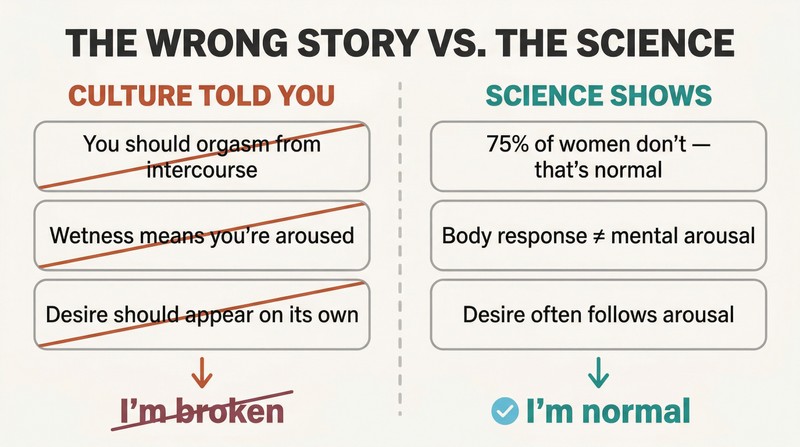
Western culture has lied about female sexuality for centuries — treating it as "Men's Sexuality Lite." Women were told they should orgasm during intercourse, that wetness equals arousal, and that desire should appear spontaneously. When their experience didn't match, they concluded something was wrong with them.
The science tells a radically different story. About 75% of women don't reliably orgasm from intercourse. Genital response often doesn't match subjective arousal. Many women only want sex after pleasurable things are already happening. None of this is dysfunction — it's normal female sexuality operating exactly as designed. More than half of Nagoski's 187 students wrote some version of "I am normal" as their single most important class takeaway.
Your brain has sexual brakes, not just an accelerator — release them
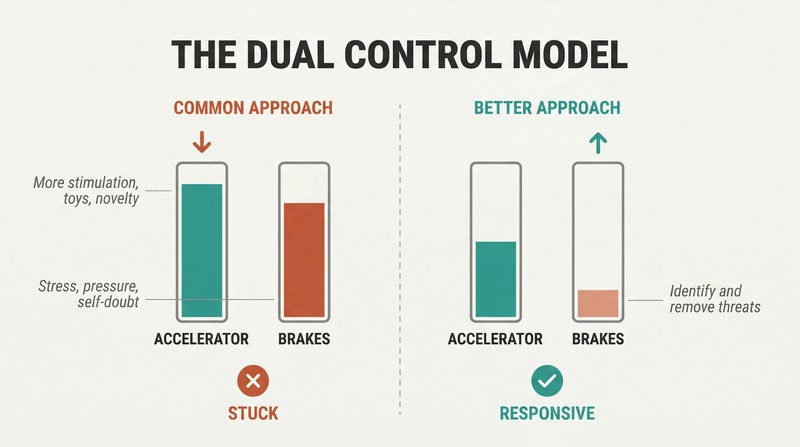
The dual control model, developed at the Kinsey Institute, reveals that sexual response runs on two separate systems. The Sexual Excitation System (accelerator) sends "turn on" signals when your brain detects sex-related stimuli. The Sexual Inhibition System (brakes) sends "turn off" signals when it detects potential threats — STIs, stress, relationship tension, or even worrying about taking too long to orgasm.
Sensitive brakes predict sexual problems more than anything else. In a survey of 226 women, brake sensitivity was the strongest predictor of arousal difficulty, low desire, and orgasm problems. Yet people instinctively try adding more stimulation — toys, novelty, porn — when what's really needed is identifying and removing what's hitting the brakes: stress, performance pressure, or self-consciousness.
Redesign the context around sex, not the technique
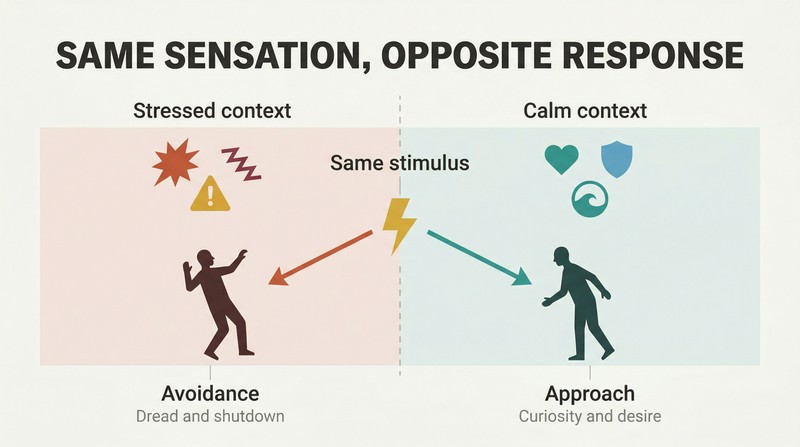
Context means far more than candles and lingerie. It includes both your external circumstances (where, with whom, how safe you feel) and your internal brain state (stressed or calm, trusting or worried). In a pivotal neuroscience study, stimulating the same brain region in rats produced curiosity and approach behavior in a calm environment — but avoidance and dread in a stressful one with bright lights and Iggy Pop blasting at random volumes.
This explains puzzling sexual experiences. Tickling feels flirtatious when you're aroused but irritating when you're angry — same sensation, opposite perception. A partner doing housework might feel sexy in a solid relationship but merely satisfying when you've been resentful. For most people, the best sexual context combines low stress, high affection, and explicit eroticism.
Wetness is not arousal — women show only 10% genital-brain overlap
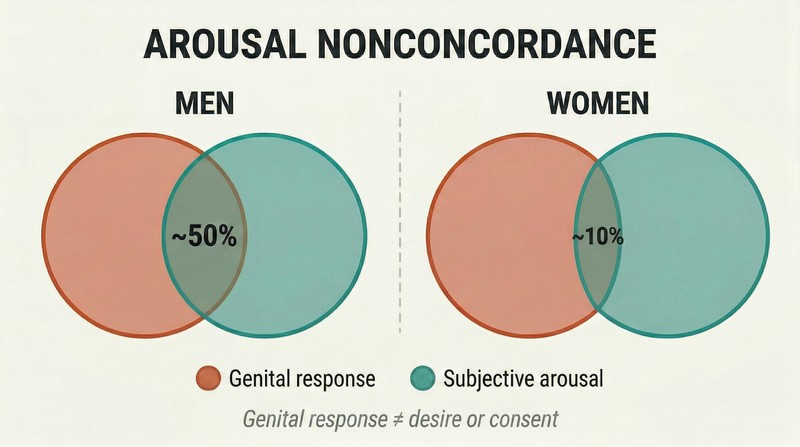
Arousal nonconcordance means your genitals can respond to something sex-related without you feeling turned on — or you can feel aroused without genital response. Research shows men have roughly 50% overlap between genital response and subjective arousal; for women, it's about 10%. Nagoski uses a restaurant analogy: your genitals point out every restaurant you pass ("We could eat here"), while your brain decides whether you actually want to stop.
Misunderstanding this has dangerous consequences. In Fifty Shades of Grey, the hero tells the heroine "See how much your body likes this" when she described feeling "demeaned, debased, and abused." Lubrication during unwanted contact doesn't indicate consent or pleasure — it means the stimulus was sex-related, nothing more. Always listen to a person's words, not their genitals.
Desire follows pleasure, not the other way around
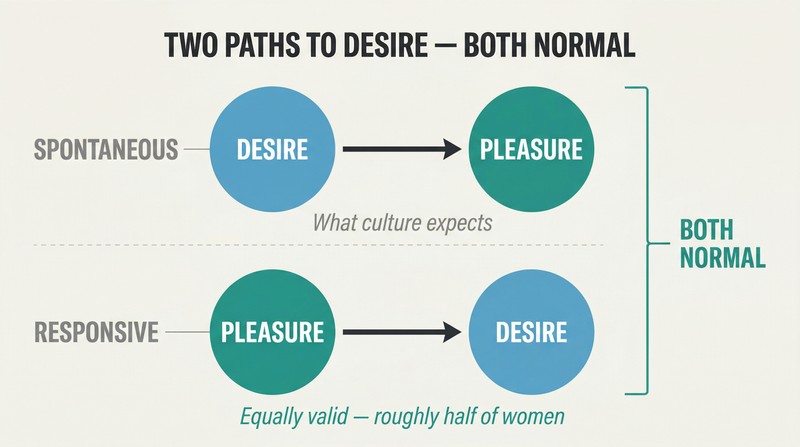
Responsive desire means wanting sex only after pleasurable stimulation has already begun — emerging in response to pleasure rather than anticipating it. This is completely normal, possibly characterizing about half of women. Yet the FDA approved Flibanserin to "treat" low desire despite the drug producing less than one additional "satisfying sexual event" per month above placebo, with roughly 88% of participants seeing no benefit.
The trial participants weren't broken. One told Cosmo, "Once I started, it wasn't an issue. It was getting me started" — textbook responsive desire, healthy and normal. Sex isn't a biological drive like hunger; nobody ever died from lack of sex. It's an incentive motivation system, like curiosity. The belief that desire must appear spontaneously turns normal women into patients.
Complete the stress cycle before you try to have good sex
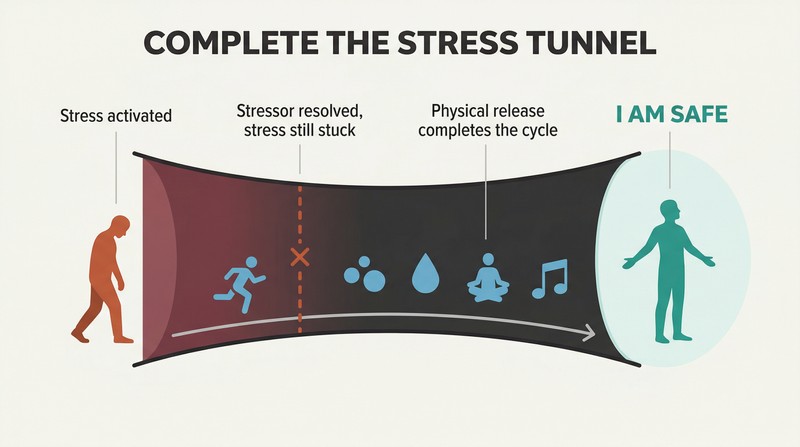
Dealing with your stressors is not the same as dealing with your stress. Nagoski's campus sex educators organized a spectacular event, resolved the stressor, and still felt equally stressed — because their bodies still thought they were being chased by a lion. The physiological stress response was activated but never discharged.
Completing the cycle means physical release. Evidence-based methods include:
1. Physical activity (the most efficient strategy)
2. Affection and social connection
3. A good cry or primal scream
4. Meditation, yoga, or body scans
5. Creative expression or body self-care
The stress response evolved to complete — fight the predator, escape, celebrate survival. Modern life constantly interrupts that cycle. When you let it finish, your brain shifts from "I am at risk" to "I am safe," freeing your sexual response system.
Self-criticism is stress — and stress slams on the sexual brakes
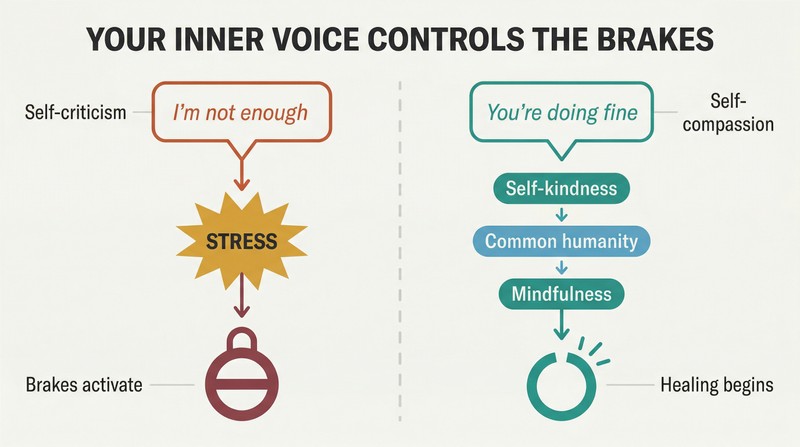
Your body treats self-attack like an external predator. When you think "I'm so fat" or "I'm a failure," your brain processes it through areas linked to behavioral inhibition — the same brakes that shut down sexual response. Cortisol spikes, the stress system activates, and desire evaporates. A review of 57 studies across two decades confirmed that women who feel worse about their bodies have less satisfying, riskier sex with less pleasure and more pain.
The antidote is self-compassion, not self-esteem. Self-compassion has three components: self-kindness (treating yourself gently), common humanity (seeing suffering as shared rather than isolating), and mindfulness (nonjudgmental awareness). Unlike self-esteem, it's unconditional. A practical test: never say anything to yourself that you wouldn't say to your best friend.
70%+ of women rarely orgasm from penetration — that's normal
The clitoris sits at a distance from the vagina — packed with nearly double the nerve endings of a penis — which is why vaginal penetration is inefficient clitoral stimulation. Research has found that the distance between clitoris and urethra predicts how reliably a woman orgasms during intercourse. It's anatomical engineering, not dysfunction. About 80 – 90% of women who masturbate do so with little or no vaginal penetration.
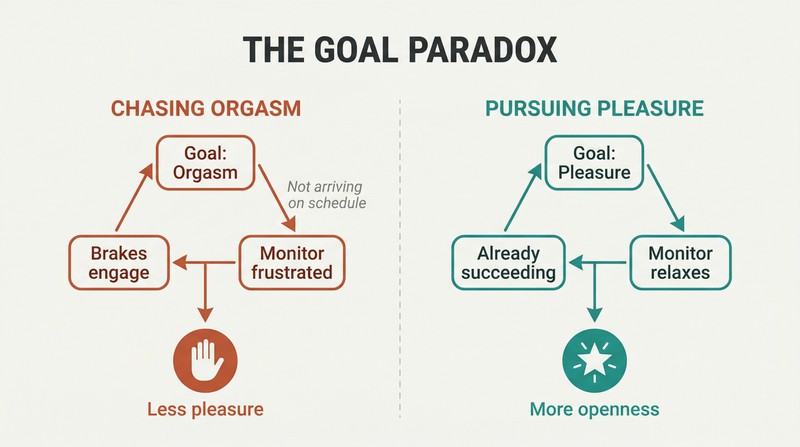
Orgasm frustration is self-defeating. Nagoski describes a "little monitor" in your brain that tracks your effort-to-progress ratio toward a goal. When orgasm doesn't arrive on schedule, the monitor grows frustrated — and frustration hits the brakes harder. The solution: change the goal from orgasm to pleasure. When pleasure is already the destination, you're already succeeding, and the monitor relaxes.
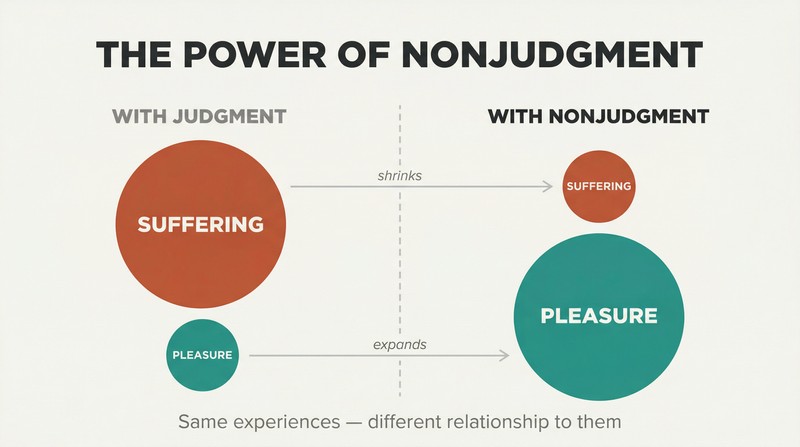
It's not how you feel — it's how you feel about how you feel
Nonjudging is the strongest predictor of how much anxiety symptoms disrupt daily life — not symptom severity, not even awareness of symptoms. In one study, people less impacted by generalized anxiety didn't have fewer symptoms; they were simply more nonjudging of those symptoms. This transfers directly to sexuality: sexual mindfulness predicted sexual satisfaction, especially in women.
Nonjudging transforms both suffering and pleasure. When you notice self-critical thoughts during sex ("Am I taking too long?") without labeling them good or bad, they lose their power to hit the brakes. And when you notice pleasure without judging it as selfish or undeserved, something unexpected happens. As one student told Nagoski, tears in her eyes: "If you don't judge it, it grows."
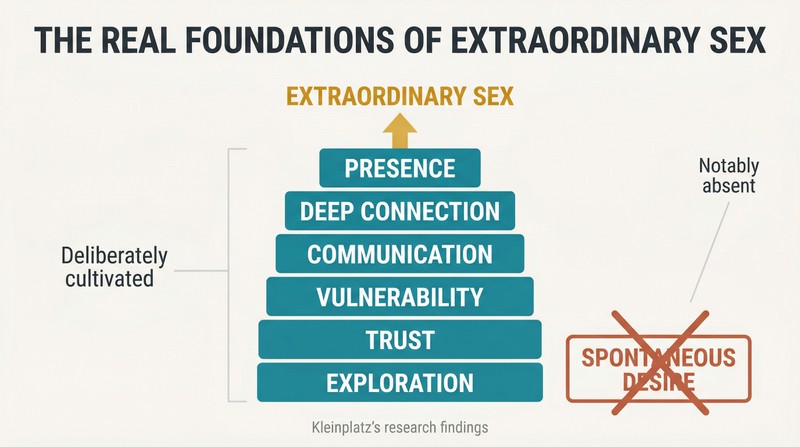
Extraordinary sex requires trust and presence, not spontaneous desire
Researcher Peggy Kleinplatz studied people with extraordinary sex lives and found eight key components: being present and embodied, deep connection, extraordinary communication, authenticity, transcendence, exploration, and vulnerability. Strikingly absent from the top components: spontaneous desire. Even among people with magnificent sex, responsive desire is normal.
Sustaining desire long-term requires deliberate priority. Couples who maintain strong sexual connections over decades share two qualities: deep friendship and treating sex as a priority. Whether through creating closeness (Gottman's approach) or maintaining productive distance (Perel's approach), both schools agree that passion doesn't happen automatically in long-term relationships. It emerges when couples take deliberate control of context.
Analysis
Nagoski's synthesis occupies a unique position in science communication: she translates findings established in sexology journals for decades — the dual control model since the late 1990s, nonconcordance research since the 1980s — into frameworks laypeople can immediately apply. The persistent gap between scientific consensus and public understanding of female sexuality is itself a phenomenon worth examining. It exists not because the science is obscure but because cultural scripts about sexuality function as what cognitive scientists call strong priors — beliefs so deeply embedded they override contradictory evidence, even for clinicians.
The book's most theoretically sophisticated move is importing Berridge's affective neuroscience — the liking/wanting/learning distinction developed in addiction research — into everyday sexual experience. This allows Nagoski to explain phenomena that confound both partners and therapists: why someone can crave sex they don't enjoy (wanting without liking), why genital response occurs during unwanted contact (learning without liking or wanting), and why women's context sensitivity isn't a deficiency but a feature of a more nuanced appraisal system.
The weakest empirical ground lies in the responsive desire framework, where the research base is thinner than for the dual control model. Nagoski acknowledges this, but the concept's clinical utility may outpace its formal validation — a familiar tension in translational science. The Flibanserin case study is devastating precisely because it shows how a thin evidence base for responsive desire allowed pharmaceutical companies to medicalize normal variation.
Perhaps most underappreciated is Nagoski's demonstration that body shame activates literal stress physiology — cortisol elevation, behavioral inhibition pathways — which suppresses sexual response through the same brake mechanism that responds to external threats. This transforms body positivity from a moral exhortation into a neurological intervention with measurable downstream effects on arousal, desire, and orgasm. The implication is that cultural reform and individual sexual satisfaction are not separate projects but the same project operating at different scales.
Review Summary
Come As You Are receives praise for its empowering approach to female sexuality, debunking myths and normalizing diverse experiences. Readers appreciate the scientific backing and practical advice for improving sexual well-being. The conversational writing style is divisive, with some finding it engaging and others patronizing. Critics note a focus on heterosexual, monogamous relationships and repetitive content. Many readers recommend it as essential reading for understanding women's sexuality, though some find the self-help aspects overwhelming. Overall, the book is lauded for its body-positive message and potential to transform readers' relationships with their sexuality.
People Also Read










Glossary
Dual control model
Sexual accelerator-and-brakes brain systemA model of sexual response developed by Erick Janssen and John Bancroft at the Kinsey Institute proposing that the brain has two separate systems governing sexual arousal: the Sexual Excitation System (accelerator), which responds to sex-related stimuli, and the Sexual Inhibition System (brakes), which responds to perceived threats. Sexual response is the net result of both systems operating simultaneously.
Sexual Excitation System (SE)
Brain's sexual acceleratorThe component of the dual control model that constantly scans the environment for sex-related stimuli—things you see, hear, smell, touch, taste, or imagine—and sends 'turn on' signals to the genitals. Its sensitivity varies from person to person as a relatively stable trait, with about 16% of women scoring in the high-sensitivity range.
Sexual Inhibition System (SI)
Brain's sexual brakesThe component of the dual control model that scans for reasons not to be aroused—STI risk, social consequences, performance worry, stress—and sends 'turn off' signals. It has two sub-components: a 'foot brake' responding to immediate threats and a 'hand brake' reflecting chronic worry about sexual performance. Sensitive brakes are the strongest predictor of sexual problems in women.
Arousal nonconcordance
Genital-brain arousal mismatchThe phenomenon where genital response (blood flow, lubrication) does not match subjective experience of arousal. Research shows approximately 50% overlap in men and only about 10% in women. Genital response indicates something is sex-related (a learned, automatic response), not that it is desired, pleasurable, or consented to. The restaurant analogy illustrates this: genitals say 'this is a restaurant' without commenting on whether you want to eat there.
Responsive desire
Desire emerging from pleasureA desire style in which sexual interest emerges only after pleasurable stimulation has already begun, rather than appearing spontaneously out of the blue. Estimated to characterize about half of women, with much of the remainder experiencing context-dependent desire. Nagoski argues responsive desire is completely normal and healthy, not a disorder requiring medication, despite pharmaceutical industry framing.
Emotional One Ring
Brain's unified emotion-processing systemNagoski's term (referencing Lord of the Rings) for the cluster of brain systems—liking, wanting, and learning—in the mesolimbic cortex that processes all emotional and motivational states simultaneously, including sex, stress, love, disgust, and pleasure. Because all these emotions compete and interact in the same neural territory, stress can suppress sexual response, and love can amplify it.
The little monitor
Internal effort-to-progress trackerNagoski's metaphor for the brain mechanism that monitors progress toward goals by comparing effort invested against progress made. It sets a 'criterion velocity'—an expected rate of progress. When progress falls short, it generates frustration, then anger, and eventually despair. In sexual contexts, this explains why goal-focused pursuit of orgasm becomes self-defeating: frustration hits the brakes.
Chasing dynamic
Desire-gap escalation between partnersA destructive relationship pattern where one partner's repeated sexual initiation and the other's repeated refusal escalate each other. The higher-desire partner feels rejected, increasing their pursuit; the lower-desire partner feels pressured, increasing resistance. Nagoski's recommended intervention is removing sex from the relationship entirely for a set period to break the cycle and eliminate performance pressure.
Spectatoring
Anxious self-monitoring during sexThe act of worrying about your body or sexual performance while having sex, rather than attending to pleasurable sensations. Instead of being present in the experience, the person mentally observes and evaluates themselves. Spectatoring activates the brakes and is addressed through mindfulness practice—noticing when attention wanders from sensation and gently redirecting it back.
Solace sex
Sex to soothe attachment anxietySex motivated by the desire to prove you are loved, typically occurring when attachment bonds feel threatened. Coined by therapist Sue Johnson, solace sex is described as 'soothing but unerotic'—it provides relief from separation anxiety rather than genuine pleasure. It explains why some people experience intense sexual desire in unstable relationships but reduced desire when relationships stabilize.
FAQ
What's Come As You Are about?
- Focus on Female Sexuality: Come As You Are by Emily Nagoski delves into the science of female sexuality, aiming to dispel myths and provide a clearer understanding of how women's sexual responses function.
- Dual Control Model: The book introduces the dual control model, explaining sexual arousal through the interplay of a sexual accelerator and brakes.
- Contextual Influence: It emphasizes the significant role of context—both external and internal—in shaping sexual desire and arousal.
Why should I read Come As You Are?
- Empowering Knowledge: The book offers evidence-based insights that empower women to understand their bodies and sexual responses, promoting a healthier relationship with their sexuality.
- Debunking Myths: Nagoski challenges harmful myths about female sexuality, such as the misconception that genital response equals desire.
- Practical Advice: It includes exercises and worksheets to help readers apply the concepts to their own lives, enhancing sexual wellbeing.
What are the key takeaways of Come As You Are?
- All Bodies Are Unique: Nagoski highlights the diversity of female anatomy and sexual response, emphasizing that everyone's genitals are made of the same parts, organized differently.
- Arousal Nonconcordance: This concept explains that genital response does not always match subjective arousal, which is normal and should be understood.
- Context Matters: The book stresses the importance of context in sexual arousal and pleasure, influencing how women experience their sexuality.
What is the Dual Control Model in Come As You Are?
- Accelerator and Brakes: The model describes sexual arousal as governed by the Sexual Excitation System (accelerator) and the Sexual Inhibition System (brakes).
- Individual Differences: Each person has unique sensitivities in their accelerator and brakes, affecting their sexual response.
- Practical Implications: Understanding this model helps identify whether sexual difficulties stem from insufficient stimulation to the accelerator or excessive stimulation to the brakes.
What is arousal nonconcordance, and why is it important in Come As You Are?
- Definition: Arousal nonconcordance refers to the mismatch between physiological responses and subjective feelings of arousal.
- Cultural Misunderstandings: Many believe genital response indicates sexual enjoyment, leading to misconceptions and feelings of inadequacy.
- Implications for Sexual Health: Recognizing this concept helps women understand their bodies better and reduces anxiety about their sexual responses.
How does stress affect sexual desire according to Come As You Are?
- Stress Hits the Brakes: Stress generally reduces sexual interest for most people by activating the brakes in the dual control model.
- Chronic vs. Acute Stress: Chronic stressors lack a clear beginning and end, complicating the completion of the stress response cycle.
- Completing the Cycle: Effective stress management involves completing the stress response cycle through activities like physical exercise or affection.
How does context influence sexual desire in Come As You Are?
- Emotional and Environmental Factors: Both emotional states and environmental contexts significantly impact sexual desire and arousal.
- Creating a Positive Context: Strategies for fostering sexual desire include reducing stress and enhancing emotional intimacy.
- Personalization of Experiences: Understanding unique contexts allows individuals to tailor their sexual experiences for enhanced pleasure.
What are some practical strategies from Come As You Are?
- Therapeutic Masturbation: This practice helps women explore their bodies and understand what feels pleasurable.
- Mindfulness Techniques: Mindfulness exercises enhance sexual pleasure by focusing on bodily sensations without judgment.
- Communication with Partners: Open dialogue about desires and boundaries is crucial for improving sexual satisfaction.
What is the significance of responsive desire in Come As You Are?
- Understanding Responsive Desire: It is characterized by wanting sex in response to pleasurable stimuli rather than spontaneously.
- Normalizing Variability: Responsive desire is common among women, countering the myth that all women should experience spontaneous desire.
- Encouraging Exploration: Recognizing responsive desire encourages women to explore their sexuality authentically.
What are the cultural messages about female sexuality discussed in Come As You Are?
- Moral Message: This message suggests that women who enjoy sex are "damaged goods," promoting shame around sexual desire.
- Medical Message: It frames women's sexuality as potentially diseased, leading to unnecessary medical interventions.
- Media Message: The media perpetuates feelings of inadequacy, suggesting women must conform to unrealistic standards.
How can I improve my sexual wellbeing based on Come As You Are?
- Practice Self-Compassion: Replace self-criticism with self-kindness, recognizing it as an invasive weed in the garden of sexual wellbeing.
- Create Positive Contexts: Build contexts low in stress and high in affection to enhance sexual pleasure and desire.
- Engage in Mindfulness: Mindfulness helps individuals become more aware of their feelings, navigating sexual experiences with ease.
What are the best quotes from Come As You Are and what do they mean?
- “Your genitals are telling you something, and you can trust them.”: Encourages women to trust their physiological responses, understanding they don't always equate to desire.
- “Pleasure is the measure.”: Emphasizes judging sexual experiences by the pleasure they bring, not societal standards.
- “You are normal. Beautiful.”: Reassures women that their experiences and bodies are valid, challenging stigma around female sexuality.
About the Author
Other books by Emily Nagoski


Download PDF
Download EPUB
.epub digital book format is ideal for reading ebooks on phones, tablets, and e-readers.








































