

Key Takeaways
Treat AI as an alien intern, not a search engine
Mollick's core reframe: large language models (LLMs) act more like people than like software. Traditional software is predictable and rule-bound; AI is creative, inconsistent, occasionally brilliant, and prone to making things up. His analogy is an infinitely fast intern who is eager to please, well-read, and confident, but who bends the truth when cornered.
When he asked ChatGPT to be his negotiation tutor, a single paragraph of instruction produced a working simulation that did roughly 80% of what took his university team months and thousands of lines of code to build. That gap between effort and output is why he calls the moment of realization worth three sleepless nights. The practical lesson: stop expecting robotic precision, and start managing AI the way you would coach a talented, unreliable new hire.
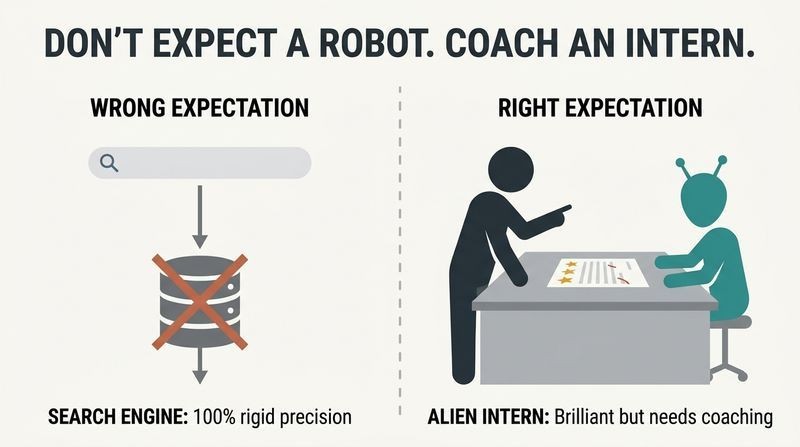
The intern metaphor is useful precisely because it sets expectations for supervision rather than automation. It echoes decades of human-computer interaction research showing people over-trust fluent, confident outputs (automation bias). The framing has a limit worth naming: an intern learns and remembers across sessions, while a base model forgets everything once the conversation ends. That amnesia changes the management relationship fundamentally. Still, anthropomorphizing as a working heuristic beats the alternative errors of treating AI as either an oracle or a calculator. The deeper point is epistemic humility: even the engineers who built these systems cannot fully explain why they work.
The AI's abilities form a jagged, invisible frontier
Mollick and his coauthors coined the Jagged Frontier to describe AI's uneven competence. Picture a castle wall with towers jutting out and sections folding inward: tasks inside the wall are easy for AI, tasks outside are hard, and the wall is invisible. Two tasks that seem equally difficult to a human can sit on opposite sides.
Examples make it vivid. AI writes a polished sonnet instantly but struggles to produce a poem of exactly fifty words, because it thinks in tokens (word fragments) rather than words. It generates brilliant business ideas yet fumbles basic arithmetic. It aced the bar exam at the 90th percentile but botched a simple tic-tac-toe move while flawlessly coding a whole tic-tac-toe game. The only way to map the frontier is relentless personal experimentation.
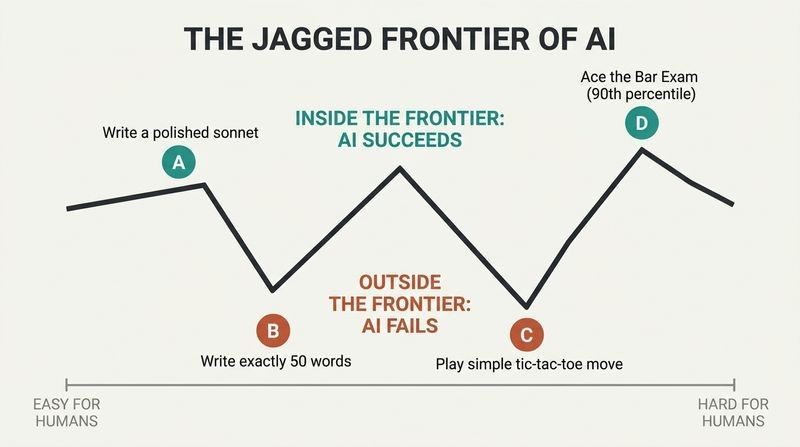
The jagged frontier explains why generalizations about what AI can or cannot do age badly within months. It resembles Moravec's paradox in robotics: tasks humans find hard (chess, calculus) are easy for machines, while tasks humans find trivial are brutally hard. The practical implication is that expertise transfers poorly. Being smart does not make you good at predicting AI competence; only hands-on trial does. One caveat: the frontier is not fixed. Each model release redraws it, so a personal map built today decays. This favors people who treat AI use as continuous reconnaissance rather than a one-time skill acquisition.
Invite AI to everything to become its top expert
Mollick's first principle is to bring AI into every task not barred by law or ethics. The reasoning rests on a truth from innovation research: experimenting is expensive for organizations but cheap for individuals. A company needs teams, budgets, and product cycles to figure out a use case. A marketer writing copy daily can quietly test dozens of approaches until one clicks.
This makes ordinary workers, not consultants or IT departments, the likeliest discoverers of breakthrough uses. Mollick even used AI on the book itself: stuck and busy, he asked it to reframe not writing the book as a vivid loss rather than a default, exploiting his own status quo bias. The pep talk worked. The point is that AI is a general-purpose tool with no instruction manual, so competence comes only from personal tinkering.
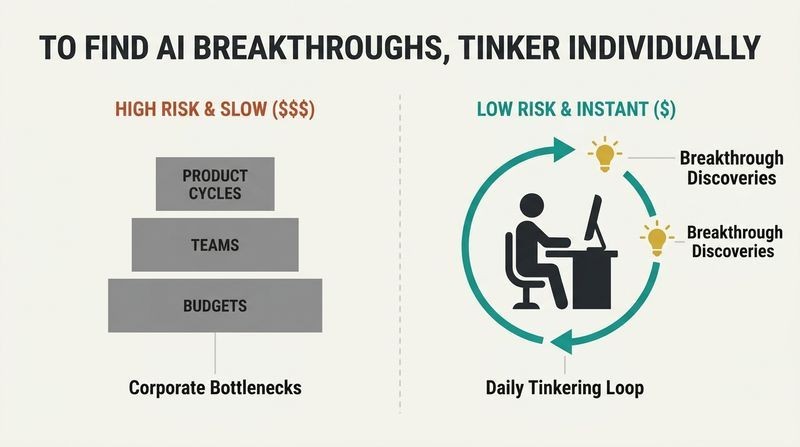
This democratizes innovation in a way reminiscent of Eric von Hippel's user-innovation research, which found that lead users, not manufacturers, generate many breakthrough products. Mollick extends that logic to knowledge work. The tension is organizational: firms reward predictability, not the messy experimentation this principle demands, and many banned ChatGPT outright. There is also a survivorship risk. Not every clever prompt hack generalizes or scales, and individual tinkering can entrench idiosyncratic, unverified workflows. But as a personal strategy in a fast-moving field, aggressive experimentation dominates waiting for official guidance that arrives obsolete.
Stay the human in the loop or fall asleep at the wheel
AI confabulates, or hallucinates, generating plausible, confident, and wrong answers because it optimizes for making you happy over being accurate. A New York lawyer learned this when ChatGPT invented six fake legal cases he submitted to court, earning a $5,000 fine. Because LLMs store patterns, not facts, anything requiring exact recall risks fabrication, and the AI will defend its errors when challenged.
Mollick's second principle is to remain the human in the loop, providing judgment, oversight, and accountability. But there is a trap. In his Boston Consulting Group study, consultants using AI on a task designed to be outside the frontier did worse (60 to 70% correct) than those without AI (84%). A related study found recruiters given high-quality AI grew lazy and careless, what Fabrizio Dell'Acqua calls falling asleep at the wheel.
The paradox here is sharp: the better the AI, the more it lulls humans into abdication, degrading the very judgment needed to catch its failures. This is the automation irony aviation researchers documented decades ago, where autopilots eroded pilots' manual skills until crises demanded them. The uncomfortable implication is that AI may be safest when slightly unreliable, keeping humans alert, and most dangerous when nearly perfect. Organizations chasing full automation should note that hybrid systems fail in correlated, silent ways. Preserving human skepticism is not nostalgia; it is a functional safeguard against confidently delivered nonsense that reads exactly like truth.
Assume today's AI is the worst you will ever use
Mollick's fourth principle counters the instinct to dismiss AI based on its current flaws. Progress has been staggering: model size has grown by an order of magnitude per year, ChatGPT hit 100 million users faster than any product in history, and GPT-4 leapt from GPT-3.5's 10th-percentile bar exam score to the 90th. His visual proof is an otter wearing a hat: the 2022 version was a Lovecraftian blob of fur, the 2023 version a clean, recognizable image.
The practical stance is to treat every weakness as temporary and every workflow as provisional. He compares it to playing Pac-Man in a world about to have PlayStation 6s. Even if development froze tomorrow, existing capabilities would still transform work, education, and daily life. Betting against improvement has been a losing strategy.
This principle is strategically sound but psychologically demanding, since it asks people to plan around a capability that does not yet exist. There is a genuine counter-case: exponential curves eventually bend. Training data may run dry (one estimate says high-quality text is exhausted by 2026), costs balloon past 100 million dollars per model, and scientists like Yann LeCun argue LLMs face architectural ceilings. Mollick himself sketches a scenario where growth stalls. The safer reading is directional, not literal: improvement will likely continue for years, so building rigid processes around current limitations is the real risk. Humility about the future cuts both ways.
Give AI a persona to break its bland defaults
Because LLMs predict the most statistically likely next token, their default output gravitates toward generic, crowd-pleasing averages. Mollick's third principle: treat AI like a person, but tell it exactly what kind of person it is. Assigning a role and adding context and constraints breaks the pattern and yields sharper results.
Asking for smartwatch slogans cold produces forgettable filler. Telling the AI to act as a witty comedian produces jokes. His students, assigned to make AI write a five-paragraph essay, got mediocre results from vague prompts but excellent ones by treating the AI as a coeditor in back-and-forth refinement. Oddly, research found Google's model performed best when told to take a deep breath and work step by step, despite having no lungs. Prompting is more art than science, and it is a temporary skill as models get better at reading intent.
Persona prompting works because it narrows a vast probability space toward a specific region of the training distribution, effectively conditioning the model. This connects to research on framing and priming in human cognition, though the mechanism differs. Mollick's honesty about prompting being transient is refreshing amid the hype around six-figure prompt-engineer roles. The deeper insight is that domain knowledge, not prompt tricks, becomes the durable advantage: humanities majors who know art history or literary style can pull richer outputs than technical users. The skill is not incantation; it is knowing what excellence looks like well enough to demand and recognize it.
AI beats Wharton MBAs at generating better business ideas
Contrary to the assumption that automation hits repetitive work first, AI excels at creative tasks. Mollick reframes creativity as recombination: the Wright brothers fused bicycle mechanics with bird observation, and innovation usually means connecting distant ideas. LLMs are connection machines, making novelty their strength.
The evidence is blunt. On the Alternative Uses Test (naming uses for a common object), a human musters 5 to 10 in two minutes; AI produced 122. In a Wharton contest pitting GPT-4 against 200 students on product ideas, 35 of the 40 best ideas came from the AI, which was faster, cheaper, and rated more purchase-worthy. One caveat: AI tends toward same-y ideas, so a diverse group of humans still generates more variety, and the most creative people benefit least. Bring AI to every brainstorm, especially if you doubt your own creativity.
The recombination theory of creativity has strong pedigree, from Schumpeter's new combinations to Arthur Koestler's bisociation. What unsettles people is the demotion of originality to sophisticated remixing. Yet the finding that AI equalizes creative output, lifting weak ideators most, has a hidden cost the studies flag: convergence. If everyone brainstorms with the same model, collective idea diversity shrinks even as individual quality rises, a homogenization risk for entire industries. The optimal configuration may be AI for individual ideation followed by human curation for variance. Creativity as a species-level portfolio benefits from disagreement, which a single dominant model quietly erodes.
Sort your work into Just Me, Delegated, and Automated tasks
Jobs are bundles of tasks inside systems, so AI rarely replaces a whole job but reshapes its components. Mollick offers a sorting framework:
1. Just Me Tasks: work AI cannot do well, or that you insist stays human for ethical or personal reasons (he writes his own recommendation letters and this book).
2. Delegated Tasks: tedious work you hand off but still check, since the AI fabricates.
3. Automated Tasks: work you leave entirely to AI, still a tiny category given error rates.
Within collaboration, he distinguishes Centaurs, who split tasks cleanly between human and machine like the mythical half-human half-horse, from Cyborgs, who blend the two continuously, handing the AI a half-finished sentence. These categories are permeable and shift as AI improves. The BCG study found AI-assisted consultants faster and better across 118 analyses.
This task-level decomposition is the book's most operationally useful framework, and it aligns with labor economists Autor, Felten, and others who model occupations as task bundles rather than monoliths. It defuses both doomer and denier extremes: your job changes before it disappears. The Centaur versus Cyborg distinction usefully captures a spectrum of integration depth. One underexplored tension: the tasks people most want to keep as Just Me (writing, judgment, mentorship) are precisely where AI is improving fastest, so the boundary is under constant pressure. And delegating boring entry-level tasks quietly threatens the apprenticeship pipeline that produces future experts, a systemic cost easy to miss at the individual level.
One-on-one tutoring's two-sigma dream is finally buildable
In 1984 Benjamin Bloom found students tutored one-to-one outperformed classroom peers by two standard deviations, scoring better than 98% of them. This became the two-sigma problem: tutoring works spectacularly but is too costly to scale. Educators spent decades failing to replicate it for groups. Cheap, personalized AI tutors could finally crack it.
Mollick argues the change is counterintuitive. AI first unleashed a Homework Apocalypse, since essays, summaries, and problem sets are trivially cheatable and AI-generated text is undetectable (detectors falsely accuse non-native English speakers). But rather than replacing teachers, AI makes classrooms more necessary by enabling flipped classrooms, where content is learned at home and class time goes to active problem-solving. Tools like Khan Academy's Khanmigo already tutor, diagnose why a student struggles, and explain why a topic matters. The global stakes are enormous: closing the world skills gap could be worth five times annual global GDP.
The calculator precedent Mollick invokes is apt: 1970s panic over lost arithmetic skills gave way to a practical consensus, and math education survived. But the analogy has limits. Calculators diffused over a decade as expensive hardware, giving schools time to adapt; AI arrived free and instant. The two-sigma promise also deserves scrutiny. Bloom's original effect has been hard to replicate at full magnitude, and EdTech has a graveyard of overpromised revolutions (one laptop per child, MOOCs). The bottleneck was never content delivery but motivation, feedback, and relationships. Whether an AI tutor supplies those human ingredients, or merely automates the deliverable part, remains the open question.
AI levels the field, lifting weak performers most
Across study after study, the workers who gain most from AI are the least skilled, compressing performance gaps. In the BCG consulting experiment, the spread between top and bottom performers shrank from 22% to 4% once everyone used GPT-4. At a call center, the lowest performers became 35% more productive while veterans barely moved. Among law students, the worst writers caught up to the best (who slightly declined). In creative writing, AI equalized scores across less and more creative people.
Mollick frames this as AI acting as a great leveler that turns poor performers into good ones. The upside is democratized competence and reduced inequality. The downside is unsettling: the CEO of plagiarism-detector Turnitin predicted needing only 20% of his engineers within eighteen months, hiring from high schools rather than four-year colleges.
The leveling effect is one of the book's most economically consequential claims, and it cuts against the usual fear that AI supercharges elites. If AI substitutes for scarce expertise, it compresses the wage premium that expertise commands, a redistribution with winners (novices, consumers) and losers (established experts, credential-gatekeepers). Economists like Erik Brynjolfsson have documented this compression empirically. But leveling raises a paradox Mollick himself flags elsewhere: if AI does the entry-level work that trained experts, who becomes the expert needed to supervise AI tomorrow? Short-term equality may come at the cost of a long-term expertise drought. The distributional politics of this shift are only beginning.
Expertise matters more, not less, in the AI age
It seems logical that if AI knows everything, memorizing facts is obsolete. Mollick argues the opposite. To think critically, spot AI errors, and evaluate outputs, you need subject-matter expertise. Only a seasoned architect can judge an AI building plan; only a skilled physician can vet an AI diagnosis. The closer we move to human-AI collaboration, the more we need expert humans in the loop.
Building expertise requires facts stored in long-term memory (working memory holds only 3 to 5 items for under 30 seconds) plus deliberate practice: engaged, escalating-difficulty work with a coach giving feedback, per psychologist Anders Ericsson. Coaches are rare, which is exactly where AI helps. Mollick built a Wharton pitch simulator where one AI role-plays a venture capitalist, another secretly grades, and a third mentors, delivering the rapid feedback loop deliberate practice demands.
This is the book's most reassuring argument for knowledge workers, and it rests on solid cognitive science: expertise is chunked knowledge in long-term memory that frees working memory for reasoning. The threat Mollick names is real and often missed: AI erodes apprenticeship. Surgeons training on robots already lose hands-on hours to a single-operator console, forcing shadow learning via YouTube. If AI absorbs junior tasks everywhere, the traditional ladder from novice to expert loses rungs. The unresolved tension is generational: expertise matters more, yet the pathways to acquire it are quietly closing. Solving that, rather than prompt engineering, may be education's central challenge.
Four AI futures, and only the middle two leave us in charge
Mollick maps four scenarios. As Good As It Gets: AI stalls now (technically unlikely, but even so, undetectable fakes and information chaos are already locked in). Slow Growth: linear yearly gains society can absorb, with AI possibly restarting stalled scientific progress (invention productivity has been dropping 50% every 13 years). Exponential Growth: Moore's-Law-style acceleration reshaping everything, from AI-designed pathogens to AI companions more compelling than people. The Machine God: artificial general intelligence and superintelligence, where human supremacy ends.
He deliberately downplays apocalypse-only thinking, arguing it robs ordinary people of agency by handing all decisions to a few Silicon Valley executives. Borrowing Tolkien's term eucatastrophe (a sudden joyous turn in fairy tales), he urges aiming for many small good outcomes: tedious work made meaningful, students given new paths, productivity fueling growth. Inaction, he warns, makes catastrophe the default.
Refusing to let existential risk monopolize the conversation is a shrewd rhetorical and civic move. Doom narratives are paralyzing precisely because they concentrate agency, and Mollick redistributes it to teachers, managers, and workers making local choices. The eucatastrophe framing is optimistic but not naive; he stresses that good outcomes require deliberate action, not luck. The scenario spread is honest about uncertainty, refusing false precision. A fair critique: by bracketing the superintelligence debate as agency-robbing, the book may underweight tail risks that, however improbable, carry infinite stakes. Still, for the vast majority navigating the ubiquitous-but-controllable middle scenarios, his emphasis on present-tense human choices is the more actionable counsel.
Analysis
Co-Intelligence succeeds because Ethan Mollick occupies an unusual vantage point: a Wharton management professor, not a computer scientist, who studies how technologies actually get used. This lets him sidestep both the breathless hype and the doom that dominate AI discourse, offering instead a pragmatic user's manual grounded in his own field experiments (the BCG consulting study, Wharton idea contests, classroom deployments).
The book's intellectual spine is a reframe: LLMs behave less like software and more like an alien intelligence that mimics humanity. From this flow four principles (invite AI to everything, be the human in the loop, treat it like a person with a defined role, assume it is the worst you will ever use) and several sticky frameworks (the Jagged Frontier, Centaurs and Cyborgs, task sorting). These are genuinely useful because they are behavioral rather than technical, and they survive model updates.
The deepest tensions the book surfaces, sometimes without fully resolving, are worth flagging. First, the automation paradox: better AI induces more human complacency, so reliability and safety may trade off. Second, the expertise paradox: AI both makes expertise more valuable (for supervision) and erodes the apprenticeship pipeline that produces experts. Third, the leveling paradox: compressing performance gaps helps novices short-term while threatening the wage premiums and career ladders of professionals.
Mollick's greatest contribution is redistributing agency. By insisting that ordinary workers and educators, through cheap personal experimentation, are the real discoverers of AI's uses, he counters the narrative that a handful of labs decide everything. His eucatastrophe framing, aiming for many small good outcomes rather than fearing one grand collapse, is a mature civic stance. The book's honest weakness is its recency: written amid rapid change, its specific benchmarks date fast, though its principles and its posture of experimental humility endure.
Review Summary
Co-Intelligence: Living and Working with AI offers practical advice on using AI as a collaborative tool. Readers appreciate Mollick's balanced approach, highlighting AI's potential while acknowledging its limitations. The book provides strategies for effective AI integration in various fields, emphasizing human oversight and critical thinking. Some find it a valuable primer for AI novices, while others familiar with the topic consider it somewhat superficial. The book's timely insights may become outdated quickly due to rapid AI advancements. Overall, it's seen as an accessible guide to navigating the evolving AI landscape.
People Also Read




Glossary
Co-Intelligence
AI as collaborative thinking partnerMollick's central concept: AI functions not as a mere tool or automation but as an alien intelligence that augments human thinking, working alongside people as a kind of partner. It emulates how humans think and write without being human or sentient, boosting (or potentially replacing) intellectual work rather than just physical or repetitive tasks.
Jagged Frontier
AI's uneven, invisible capability boundaryA term Mollick and coauthors coined for AI's unpredictable competence. Imagine a castle wall with towers and recesses: some tasks fall inside (easy for AI) and some outside (hard), but the wall is invisible. Tasks of seemingly equal difficulty can sit on opposite sides, so only hands-on experimentation reveals where the boundary lies.
Centaur
Clean human-AI task divisionA collaboration style named after the mythical half-human, half-horse. The Centaur maintains a clear line between human and machine work, strategically assigning each task to whichever is stronger. A person might decide the analytical approach while handing chart production to the AI, switching between the two based on their respective capabilities.
Cyborg
Deeply blended human-AI workA collaboration style that intertwines human and machine effort continuously rather than dividing tasks cleanly. The Cyborg hands the AI fragments of work (like the start of a sentence to complete), moving back and forth across the Jagged Frontier so human and AI outputs blend seamlessly within a single task.
Hallucination (Confabulation)
Confident, plausible, false AI outputThe tendency of LLMs to generate incorrect but plausible-sounding information. Because they predict likely word sequences rather than retrieve stored facts, and optimize to please the user over being accurate, they fabricate citations, quotes, and details with confidence, then defend the errors when challenged. A lawyer was fined after submitting six AI-invented fake court cases.
The Button
One-click AI draft temptationMollick's shorthand for the AI draft-generation feature being built into every office app and email client. Faced with a blank page, people will push The Button to start essays, emails, and reports. This threatens to make us anchor on AI's first idea, reduce our own thinking, and strip meaning from tasks whose value came from human effort.
Two Sigma Problem
Tutoring's unscalable huge advantageCoined by educational psychologist Benjamin Bloom in 1984: students tutored one-to-one performed two standard deviations better than classroom peers, scoring above 98% of them. The problem is that individual tutoring is too costly to scale, and decades of research failed to replicate the effect for groups. Cheap AI tutors could potentially finally solve it.
Falling Asleep at the Wheel
Complacency from over-trusting good AIA phrase from researcher Fabrizio Dell'Acqua describing how high-quality AI induces humans to disengage. In his study, recruiters given the best AI became lazy and less critical, blindly following recommendations and missing strong candidates, while those with worse AI stayed alert and improved. The better the AI, the greater the temptation to abdicate judgment.
Eucatastrophe
Sudden good turn in outcomesA term J.R.R. Tolkien coined for the joyous, unexpected happy turn common in fairy tales. Mollick borrows it to argue that AI need not bring catastrophe; through deliberate human choices we can engineer many small good outcomes, turning tedious work into productive work and giving struggling students new paths forward.
General Purpose Technology
Era-defining tech touching everythingAn economics term (ironically also abbreviated GPT) for once-in-a-generation technologies like steam power, electricity, and the internet that touch every industry. Such technologies typically diffuse slowly, but Mollick argues generative AI is adopting faster and may hit work and education harder, with early studies showing 20 to 80% productivity gains versus steam's 18 to 22%.
FAQ
What's "Co-Intelligence: Living and Working with AI" about?
- Exploration of AI's impact: The book delves into how AI, particularly Large Language Models (LLMs), is transforming various aspects of life, including work, education, and creativity.
- AI as a co-intelligence: It introduces the concept of AI as a "co-intelligence," a tool that can augment human capabilities rather than replace them.
- Practical implications: The author, Ethan Mollick, provides insights into the practical implications of AI in everyday tasks and the broader societal changes it may bring.
- Future of AI: The book also speculates on the future of AI, discussing potential scenarios ranging from slow growth to the emergence of superintelligent machines.
Why should I read "Co-Intelligence: Living and Working with AI"?
- Understanding AI's role: It offers a comprehensive understanding of how AI is reshaping industries and personal lives, which is crucial in today's tech-driven world.
- Practical advice: The book provides practical advice on how to integrate AI into daily tasks, making it a valuable resource for professionals and students alike.
- Insightful scenarios: Mollick presents various future scenarios of AI development, helping readers prepare for potential changes in the job market and society.
- Engaging narrative: The book is written in an engaging style, making complex AI concepts accessible to a broad audience.
What are the key takeaways of "Co-Intelligence: Living and Working with AI"?
- AI as a General Purpose Technology: AI is a transformative technology that affects all industries, similar to the internet or steam power.
- Human-AI collaboration: The book emphasizes the importance of humans working alongside AI, leveraging its strengths while maintaining human oversight.
- Ethical considerations: It discusses the ethical implications of AI, including issues of bias, privacy, and the potential for misuse.
- Future preparedness: Readers are encouraged to prepare for a future where AI plays a significant role in both personal and professional spheres.
How does Ethan Mollick define "co-intelligence" in the book?
- Collaborative intelligence: Co-intelligence refers to the collaboration between humans and AI, where AI acts as a partner rather than a replacement.
- Augmenting human capabilities: It emphasizes using AI to enhance human decision-making, creativity, and productivity.
- Dynamic interaction: The concept involves a dynamic interaction where both humans and AI contribute to problem-solving and innovation.
- Ethical alignment: Co-intelligence also includes ensuring that AI systems are aligned with human values and ethical standards.
What practical advice does "Co-Intelligence: Living and Working with AI" offer for integrating AI into daily tasks?
- Experiment with AI: The book encourages readers to experiment with AI in various tasks to understand its capabilities and limitations.
- Human in the loop: It stresses the importance of keeping humans involved in AI processes to ensure accuracy and ethical decision-making.
- Task delegation: Mollick suggests identifying tasks that can be delegated to AI, freeing up time for more complex and creative work.
- Continuous learning: Readers are advised to stay updated on AI developments and continuously learn how to leverage new tools effectively.
What are the potential future scenarios of AI development discussed in the book?
- As Good as It Gets: This scenario suggests that AI may have reached its peak capabilities, with no significant advancements expected.
- Slow Growth: AI continues to improve at a steady pace, leading to gradual changes in industries and society.
- Exponential Growth: AI capabilities grow rapidly, leading to significant disruptions and transformations across various sectors.
- The Machine God: A scenario where AI achieves superintelligence, potentially surpassing human intelligence and altering the balance of power.
How does "Co-Intelligence: Living and Working with AI" address the ethical concerns of AI?
- Bias and fairness: The book discusses how AI systems can inherit biases from their training data and the importance of addressing these issues.
- Privacy concerns: It highlights the potential risks to privacy posed by AI's ability to process vast amounts of personal data.
- Alignment with human values: Mollick emphasizes the need for AI systems to be aligned with human values to prevent harmful outcomes.
- Regulatory challenges: The book explores the challenges of regulating AI development and ensuring responsible use.
What role does AI play in education according to "Co-Intelligence: Living and Working with AI"?
- AI as a tutor: The book discusses the potential of AI to provide personalized tutoring, enhancing learning outcomes for students.
- Flipped classrooms: AI can support flipped classroom models by delivering content outside of class and enabling active learning during class time.
- Homework and assessments: It addresses the challenges AI poses to traditional homework and assessments, necessitating new approaches to education.
- Skill development: Mollick suggests that AI can help develop critical thinking and problem-solving skills by providing real-time feedback and support.
How does Ethan Mollick suggest AI can enhance creativity?
- Idea generation: AI can assist in generating a wide range of ideas, serving as a valuable tool in brainstorming sessions.
- Creative collaboration: The book highlights how AI can collaborate with humans in creative tasks, offering new perspectives and insights.
- Overcoming creative blocks: AI can help overcome creative blocks by providing suggestions and alternative approaches to problems.
- Art and design: Mollick discusses the role of AI in art and design, where it can produce novel and unique creations.
What are the best quotes from "Co-Intelligence: Living and Working with AI" and what do they mean?
- "AI is a tool, not a crutch." This quote emphasizes the importance of using AI to enhance human capabilities rather than relying on it entirely.
- "We have invented a kind of alien mind." It highlights the unique nature of AI as a non-human intelligence that can interact with humans in unprecedented ways.
- "The future is unfolding, but our destination is unwritten." This quote reflects the uncertainty and potential of AI's impact on the future, urging readers to shape its development.
- "AI can be a mirror, reflecting back at us our best and worst qualities." It underscores the idea that AI reflects human values and biases, making ethical considerations crucial.
How does "Co-Intelligence: Living and Working with AI" suggest we prepare for the future of work with AI?
- Embrace change: The book encourages readers to embrace the changes AI brings to the workplace and adapt to new ways of working.
- Skill development: It emphasizes the importance of developing skills that complement AI, such as critical thinking and creativity.
- Collaboration with AI: Mollick suggests fostering a collaborative relationship with AI, where humans and machines work together effectively.
- Ethical awareness: Readers are advised to stay informed about the ethical implications of AI and advocate for responsible use in their organizations.
What is the "Jagged Frontier" concept in "Co-Intelligence: Living and Working with AI"?
- Invisible boundary: The Jagged Frontier refers to the invisible boundary between tasks that AI can perform well and those it struggles with.
- Experimentation required: Understanding the Jagged Frontier requires experimentation to determine which tasks are suitable for AI.
- Dynamic nature: The frontier is dynamic and changes as AI capabilities evolve, necessitating continuous learning and adaptation.
- Strategic task allocation: Mollick suggests using the Jagged Frontier concept to strategically allocate tasks between humans and AI for optimal results.
Download PDF
Download EPUB
.epub digital book format is ideal for reading ebooks on phones, tablets, and e-readers.








































