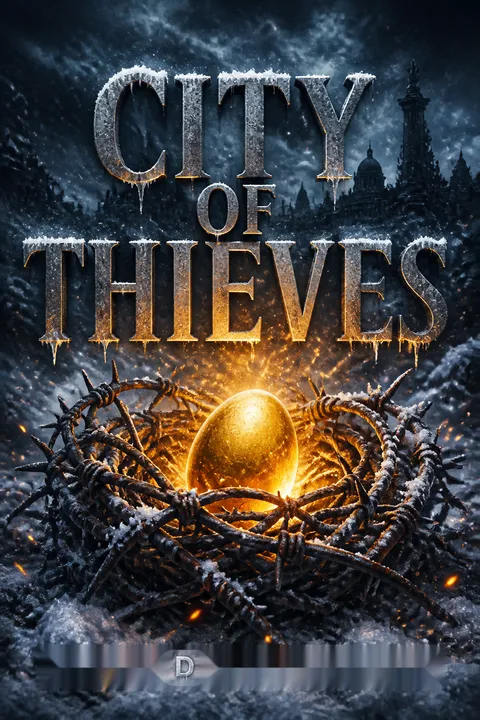

Plot Summary
Siege's Bitter Winter Hunger
Leningrad, 1942: the city is encircled by German forces, and its people are starving, freezing, and desperate. Seventeen-year-old Lev Beniov, left behind when his mother and sister flee, survives on ration bread and dreams of heroism. The city's transformation is brutal—pets and pigeons vanish, wood is stripped from buildings for fuel, and rumors of cannibalism become reality. Lev, a self-described runt and insomniac, is shaped by deprivation and guilt over his family's absence. One night, a dead German paratrooper falls from the sky, and Lev and his friends loot the body, seeking warmth and sustenance. Their small act of rebellion is interrupted by soldiers, and Lev is arrested, thrust into a world where every choice is a matter of life and death.
Arrested in the Crosses
Thrown into the infamous Crosses prison, Lev faces darkness, silence, and the terror of execution. His cellmate is Kolya Vlasov, a charismatic, talkative Red Army deserter with a penchant for literature, chess, and irreverence. Kolya's easy confidence and humor contrast Lev's anxiety, and the two form an uneasy alliance. They share meager food and stories, and Kolya's presence becomes a lifeline in the oppressive gloom. The next morning, both are dragged before a mysterious colonel, their fates uncertain. The city's cruelty is matched by the randomness of survival, and Lev's journey is no longer his own—he is swept into a current of violence, absurdity, and unexpected camaraderie.
The Colonel's Deadly Bargain
Colonel Grechko, a brutal but oddly charismatic NKVD officer, offers Lev and Kolya a reprieve from execution. His daughter is to be married, and the wedding cake requires a dozen eggs—impossible to find in besieged Leningrad. The colonel's deal is simple: find the eggs by Thursday, or forfeit their lives and ration cards. The task is both absurd and deadly, a scavenger hunt through a city of starvation and suspicion. Armed with a curfew waiver and a handful of rubles, Lev and Kolya are thrust together, their survival dependent on each other's wits and resilience. The colonel's daughter, skating on the frozen Neva, becomes a symbol of hope and unattainable beauty amid the city's ruin.
Egg Hunt in Ruins
Lev and Kolya's quest leads them through the Haymarket, where the black market thrives on desperation. They encounter swindlers, rumors, and the ever-present threat of violence. The city's decay is everywhere—bodies in the streets, children painting over street signs to confuse the enemy, and the constant specter of betrayal. Their search is fruitless; eggs are a myth, and every lead ends in disappointment or danger. The camaraderie between Lev and Kolya deepens, their banter a shield against despair. Yet, beneath the humor, Lev's insecurities and Kolya's bravado mask the trauma and hunger that define their existence.
Cannibals and Market Lies
A promising lead brings Lev and Kolya to a giant's apartment, where the promise of eggs turns into a nightmare. The apartment is a front for cannibals, and the discovery of human remains nearly costs them their lives. Kolya's quick thinking and Lev's terror-fueled flight save them, but the encounter leaves them shaken and haunted. The city's moral boundaries have collapsed, and survival demands both luck and ruthlessness. Their escape is a small victory, but the horror lingers, a reminder that the line between hunter and hunted is perilously thin in Leningrad's siege.
Kirov's Rubble and Regret
Returning to the Kirov, Lev finds his home reduced to rubble by German bombs. The loss is devastating—friends, neighbors, and the last vestiges of his childhood are gone. Kolya pulls him away, insisting on survival over mourning. They seek shelter with Sonya, Kolya's former lover, and her circle of exhausted surgeons. The city's destruction is mirrored in Lev's internal landscape; grief and guilt threaten to overwhelm him. Yet, in Sonya's apartment, warmth and fleeting comfort offer a brief respite. The siege has made orphans of them all, and the only way forward is through the ruins.
Sonya's Shelter and Longing
Sonya's apartment becomes a haven for Lev and Kolya, a place of laughter, sex, and fragile community. Lev is both comforted and tormented by the intimacy he witnesses—Kolya and Sonya's lovemaking, the camaraderie of the surgeons, and the small rituals of survival. Lev's longing for connection is palpable, his self-doubt sharpened by hunger and loss. The group debates politics, history, and the future, their arguments a way to keep despair at bay. The city outside is a graveyard, but inside, life persists in small, stubborn ways.
The Last Rooftop Chicken
A rumor leads Lev and Kolya to a rooftop chicken coop, where they find a dying boy and a single, bedraggled chicken. The boy, Vadim, is too far gone to save, but he gives them the chicken—a symbol of hope and futility. Back at Sonya's, the chicken, named Darling, becomes the focus of desperate optimism. Yet, the realization that Darling is a rooster, not a hen, shatters their hopes of finding eggs. The absurdity of their quest is laid bare, and the group is forced to confront the limits of hope in a world governed by hunger and death.
Darling Soup and Disillusion
With no eggs forthcoming, the group makes soup from Darling, sharing a rare meal that tastes of lost summers. The fleeting comfort is undercut by the knowledge that survival often means sacrificing hope itself. Lev's chess skills and Kolya's stories become their only currency, distractions from the relentless cold and gnawing hunger. The city's suffering is mirrored in their own, and the boundaries between right and wrong, possible and impossible, blur further. The soup is both a feast and a funeral, a reminder that in Leningrad, every small comfort is paid for in loss.
March to Mga's Ghost
With no eggs in the city, Kolya insists they travel to Mga, a poultry collective behind German lines. Their march is grueling—through snow, past corpses, and into the heart of occupied territory. They join a band of partisans, including the enigmatic sniper Vika, whose presence unsettles Lev. The journey is marked by violence, betrayal, and the constant threat of death. Lev's relationship with Kolya deepens, their banter now laced with genuine affection and mutual dependence. The search for eggs becomes a journey into the heart of darkness, where survival is measured in moments and every choice is a gamble.
Partisans, Snipers, and Betrayal
Among the partisans, Lev and Kolya witness the complexities of resistance—heroism, suspicion, and the ever-present risk of betrayal. Vika, both alluring and dangerous, becomes Lev's guide and obsession. The group's mission to assassinate a notorious Nazi officer, Abendroth, intertwines with Lev and Kolya's quest. Betrayal from within leads to the death of comrades, and Lev is forced to confront the reality that survival often means sacrificing others. The lines between friend and foe, right and wrong, blur in the snowbound forests, and Lev's innocence is stripped away by violence and necessity.
Prisoners and the German Test
Captured by German forces, Lev, Kolya, and Vika are herded with other prisoners, subjected to humiliating tests of literacy and usefulness. The Germans' casual cruelty is on full display—those who can read are executed, while the illiterate are sent to labor camps. Lev, Kolya, and Vika feign ignorance to survive, their fates hanging on a lie. The episode is a microcosm of the siege's moral chaos, where intelligence and talent become liabilities, and survival depends on deception and luck. The trio's bond is tested, and Lev's sense of self is further eroded by the arbitrary violence of war.
Chess with the Devil
Kolya arranges a chess match between Lev and the sadistic Nazi officer Abendroth, wagering their lives and a dozen eggs on the outcome. The game is a battle of wits and wills, Lev's skill pitted against Abendroth's arrogance. As the match unfolds, Lev is forced to act—not just as a player, but as an assassin. In a moment of desperation and courage, he kills Abendroth, saving Kolya and Vika. The escape is chaotic and bloody, and Lev's transformation from passive survivor to active participant is complete. The eggs, finally won, are both prize and burden, a symbol of all they have lost and endured.
Escape into the Frozen Woods
Fleeing through the woods, Lev, Kolya, and Vika are pursued by German patrols. The journey is marked by exhaustion, injury, and the ever-present threat of death. Kolya is wounded by friendly fire as they near Leningrad, and Vika chooses to part ways, returning to the fight as a partisan. Lev's feelings for Vika are left unresolved, their brief connection a casualty of war. Kolya's injury is grave, and Lev is left to carry both the eggs and the weight of their journey back to the colonel.
Kolya's Last Smile
Kolya's wound proves fatal, and Lev is forced to watch his friend die en route to the hospital. Their final moments are marked by humor, regret, and a deep, unspoken love. Kolya's death is both senseless and inevitable, a reminder that in war, even the strongest bonds are fragile. Lev is left alone, changed by loss and the knowledge that survival often comes at the expense of those we love. The eggs, once a symbol of hope, are now a bitter reminder of all that has been sacrificed.
The Colonel's Wedding Feast
Lev delivers the eggs to the colonel, only to discover that others have succeeded as well—their quest, once so urgent, is now just one among many. The wedding feast is a grotesque celebration amid the city's suffering, and Lev is left with a sense of emptiness and disillusion. The colonel's advice—to keep silent and survive—rings hollow in the face of all Lev has endured. The eggs, once a lifeline, are now just food for a party, their meaning lost in the chaos of war.
Aftermath and Endings
The siege ends, but Lev's journey is far from over. He survives the war, becomes a journalist, and reflects on the friends and loves lost along the way. Sonya becomes a companion, but Kolya's absence is a wound that never heals. Lev's reunion with Vika, years later, is a moment of hope and renewal—a reminder that even in the aftermath of horror, life persists. The story closes on the possibility of love and the enduring need to remember, to bear witness, and to find meaning in survival.
Analysis
City of Thieves is a novel that uses the absurdity of a scavenger hunt for eggs during the siege of Leningrad to explore the deepest questions of survival, morality, and human connection in the face of atrocity. Through the unlikely partnership of Lev and Kolya, Benioff crafts a story that is both darkly comic and profoundly moving, capturing the surreal logic of war where the search for a wedding cake ingredient becomes a matter of life and death. The novel's power lies in its refusal to offer easy answers—heroism and cowardice, love and violence, hope and despair are all intertwined, and survival often comes at the expense of innocence and integrity. The use of chess as a recurring motif highlights the strategic, often arbitrary nature of survival, while the framing of the story as a remembered narrative underscores the importance of memory and storytelling in making sense of trauma. Ultimately, City of Thieves is a meditation on the ways in which ordinary people are forced to become extraordinary by circumstances beyond their control, and how, even in the darkest times, humor, friendship, and the search for meaning can offer a fragile but enduring hope.
Review Summary
Most reviewers gave City of Thieves high praise, highlighting the compelling friendship between protagonists Lev and Kolya as the novel's greatest strength. Set during the Siege of Leningrad, readers appreciated Benioff's balance of dark humor with harrowing wartime realities. The absurd quest for a dozen eggs was widely celebrated as an inventive premise. Many noted the vivid historical detail and emotional depth. A few reviewers found the story somewhat detached or overly sentimental, preventing full immersion, but nearly all recommended it enthusiastically.
People Also Read







Characters
Lev Beniov
Lev is a seventeen-year-old Jewish boy, awkward, introspective, and plagued by self-doubt. Orphaned by war, he is shaped by hunger, loss, and the relentless cold of besieged Leningrad. Lev's journey is one of transformation—from passive observer to active participant in violence and survival. His relationships with Kolya and Vika draw out his courage, vulnerability, and capacity for love. Lev's psychoanalysis reveals a young man desperate for meaning, connection, and redemption, yet burdened by guilt over his family's fate and the compromises survival demands. By the end, Lev is both hardened and humanized, his innocence lost but his empathy intact.
Kolya Vlasov
Kolya is Lev's foil—tall, handsome, and endlessly talkative, with a gift for humor, literature, and bravado. A Red Army deserter accused of cowardice, Kolya masks his fear with charm and irreverence. His psychological complexity lies in his contradictions: he is both a cynic and a romantic, a fighter and a lover, a liar and a loyal friend. Kolya's relationship with Lev is transformative, drawing out Lev's courage and grounding Kolya's own restlessness. His death is a profound loss, underscoring the randomness and cruelty of war. Kolya's legacy is one of laughter, resilience, and the enduring power of friendship.
Vika
Vika is a young woman disguised as a boy, a partisan sniper whose skill and ruthlessness are matched by her emotional reserve. She is both alluring and intimidating, her beauty hidden beneath grime and fatigue. Vika's psychoanalysis reveals a survivor shaped by trauma, loss, and the necessity of violence. Her relationship with Lev is fraught with tension, desire, and mutual respect. Vika's refusal to be defined by gender or circumstance makes her both a symbol of resistance and a deeply human character. Her parting with Lev is bittersweet, a reminder that love and survival are often at odds in war.
Colonel Grechko
The colonel is an NKVD officer whose power is absolute and whose morality is ambiguous. He is both executioner and benefactor, capable of kindness and cruelty in equal measure. His demand for eggs is both absurd and deadly, a test of resourcefulness and obedience. The colonel's psychoanalysis reveals a man shaped by violence, loss, and the arbitrary exercise of power. His relationship with Lev and Kolya is transactional, yet tinged with a strange paternalism. The colonel embodies the contradictions of authority in wartime—ruthless, pragmatic, and ultimately indifferent to individual suffering.
Sonya
Sonya is a surgeon and Kolya's former lover, offering Lev and Kolya shelter, warmth, and a glimpse of normalcy amid chaos. Her kindness is practical, her humor dark, and her resilience remarkable. Sonya's psychoanalysis reveals a woman hardened by loss, yet still capable of tenderness and desire. Her relationship with Kolya is both nostalgic and transactional, a brief respite from the siege's brutality. Sonya's presence in Lev's life is a reminder of what has been lost and what might still be possible.
Vadim
Vadim is the last guardian of a rooftop chicken coop, a child rendered ancient by hunger and grief. His refusal to abandon his dead grandfather or the last chicken is both tragic and heroic. Vadim's psychoanalysis reveals the siege's toll on the young—the loss of hope, the stubborn clinging to ritual, and the quiet acceptance of death. His gift of the chicken to Lev and Kolya is an act of generosity amid despair, a fleeting moment of connection in a world of isolation.
Vika's Partisan Commander (Korsakov)
Korsakov is the leader of the partisan band, a man defined by suspicion, violence, and the relentless logic of survival. His relationship with Vika is professional, marked by mutual respect and the shared burden of command. Korsakov's psychoanalysis reveals a man who has sacrificed personal morality for the greater good, whose authority is both necessary and corrosive. He is a reminder that resistance is as much about compromise as it is about heroism.
Abendroth
Abendroth is the embodiment of Nazi cruelty—intelligent, cultured, and utterly ruthless. His love of chess is a metaphor for his approach to war: calculated, detached, and deadly. Abendroth's psychoanalysis reveals a man who has rationalized atrocity, whose charm masks a capacity for unimaginable violence. His encounter with Lev is a battle of minds and wills, and his death is both a victory and a trauma for Lev.
The Colonel's Daughter
Though she appears only briefly, the colonel's daughter represents all that is lost and longed for in Leningrad—a future, a celebration, a life beyond hunger and war. Her skating on the Neva is a vision of grace amid ruin, and her wedding is the absurd goal that drives Lev and Kolya's quest. She is both a real person and a symbol, her presence haunting the narrative as a reminder of what survival is for.
The Cannibal Giant
The cannibal giant is a figure of horror, a man who has abandoned all morality in the face of starvation. His apartment is a charnel house, and his violence is both personal and emblematic of the city's collapse. The giant's psychoanalysis reveals the siege's capacity to strip away humanity, turning neighbor against neighbor and survival into savagery.
Plot Devices
The Absurd Quest
The central plot device is the colonel's demand for a dozen eggs—a task both absurd and impossible in besieged Leningrad. This quest serves as a vehicle for exploring the city's devastation, the collapse of morality, and the resilience of hope. The eggs are a MacGuffin, their pursuit driving the narrative and forcing Lev and Kolya into ever more dangerous and revealing situations. The absurdity of the quest highlights the randomness of survival and the ways in which meaning is constructed amid chaos.
Dual Protagonists and Contrasts
The narrative is structured around the relationship between Lev and Kolya—opposites in temperament, background, and outlook. Their banter, arguments, and mutual dependence provide both comic relief and emotional depth. The contrast between Lev's introspection and Kolya's bravado allows for exploration of themes of courage, cowardice, and the search for meaning. Their evolving friendship is the emotional core of the story, and their differences drive both conflict and growth.
Foreshadowing and Irony
The narrative is rich with foreshadowing—Lev's guilt over his family, Kolya's fatalism, the recurring motif of chess as both game and metaphor for survival. Irony pervades the story: the eggs, once so vital, are ultimately meaningless; the skills that should save them (intelligence, literacy) become liabilities; and the moments of greatest hope are often preludes to loss. The use of irony underscores the unpredictability of war and the ways in which meaning is constantly undermined by circumstance.
Chess as Metaphor
Chess recurs throughout the narrative as both literal game and metaphor for the choices Lev and Kolya must make. The match with Abendroth is the climax of this motif—a battle of minds that mirrors the larger struggle for survival. Chess becomes a way to explore themes of sacrifice, calculation, and the limits of control. The game's rules and strategies are echoed in the characters' decisions, and the outcome is both a victory and a trauma.
Narrative Framing and Memory
The novel is framed as a story told by Lev in old age, reflecting on the events of his youth. This structure allows for reflection, irony, and the exploration of memory's role in survival. The act of storytelling becomes a way to make sense of trauma, to honor the dead, and to find meaning in suffering. The narrative's self-awareness—its acknowledgment of invention, omission, and the limits of truth—underscores the importance of bearing witness and the impossibility of fully capturing the past.
Download PDF
Download EPUB
.epub digital book format is ideal for reading ebooks on phones, tablets, and e-readers.








































