
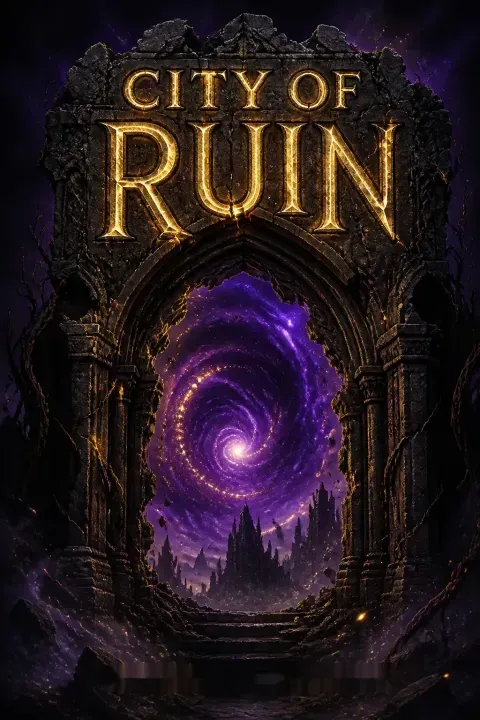


Plot Summary
Prologue
A creature called Fury,4 once named Fleurie, has been entombed beneath the earth for centuries, chained in iron and left to rot after King Gherahn's authorities tortured her. Though her body has decayed to nearly nothing but bones and sinew, her immortal soul refuses to die.
She exists in darkness, sustained by rage and the whispers of the Ancient Ones,12 who promise that a man from the East3 is coming to free her. She was once called Beauty and Love, but centuries of isolation have forged her into something else entirely: a weapon of vengeance waiting to be unleashed upon the world that buried her alive.
The prologue establishes Fleurie as both victim and threat. Her immortality becomes a curse rather than a gift when paired with isolation and sensory deprivation. The psychological horror of being conscious while one's body decays for three centuries speaks to the story's broader themes about the cost of eternal life. The Ancient Ones' whispers introduce divine manipulation as a driving force. Fleurie's transformation from Beauty to Fury mirrors how trauma reshapes identity, and her impending release sets up the central tension: will she be a tool for Thamaos's resurrection or something else entirely?
Blood Offerings at Dawn
In the ancient Rite Hall of Min-Thuret temple, the Prince with No Name3 kneels for hours, slicing his palm repeatedly to bleed into a ritual bowl. He has captured Colden Moeshka,5 the Frost King, and recovered the God Knife from Raina Bloodgood,1 but his body is starving, having refused to consume souls since the battle in the Northlands.
Thamaos12's voice finally drifts into the hall, chastising the prince for failing to kill all the Witch Walkers yet rewarding him for the prizes brought home.
The dead god issues two commands: capture Un Drallag,2 the legendary sorcerer Alexus Thibault, to use as a siphoned power source, and unearth the imprisoned godling Fury4 from the Un Moritra ruins. Both tasks are nearly impossible, but Thamaos12 promises the prince an eternal throne over a united Tiressia.
The blood ritual establishes the prince's parasitic relationship with Thamaos: he literally drains himself for a god who offers only conditional approval. His refusal to consume souls despite starving reveals a buried moral conflict, the faint remnant of the man he was before Thamaos hollowed him out. This tension between duty and conscience will define his arc. Thamaos's commands set the entire plot in motion: the hunt for Alexus and the unearthing of Fleurie are the twin engines driving the antagonist's storyline.
A God Answers in Anger
Deep in Frostwater Wood, Alexus2 and the rune witch Callan18 perform a summoning ritual on nine ancient stones. Alexus2 bleeds onto hot metal, drawing runes of connection, faithfulness, and fealty, the same pattern he once used as Thamaos12's servant.
The forest detritus whirls into a towering humanoid form through which Thamaos12 speaks. When Alexus2 accuses him of manipulating the Prince of the East,3 Thamaos12 laughs and promises his resurrection is inevitable. Then Raina,1 sensing danger through their runic bond, rushes into the clearing.
Thamaos12's creature locks eyes with her and explodes with recognition and hatred, slamming against Callan18's protective wards as it vows that no distance or realm will keep her from his wrath. Callan18 breaks the salt circle, and the creature collapses.
This scene transforms Thamaos from an abstract threat into a personal one for Raina. His visceral reaction to her presence suggests she has thwarted his plans before in ways not yet understood, planting seeds for the time-travel revelation in the finale. Alexus's willingness to kneel and bleed for a god he loathes demonstrates the pragmatic ruthlessness beneath his reformed exterior. The ritual also introduces the mechanics of god-summoning, which will prove crucial later.
Finn's Devastating Return
At dawn, Finn Owyn10 stumbles upon the campsite and trains his bow on a figure emerging from Alexus2's tent. When Raina1 lowers her hood, he weeps with joy, believing she has been dead for weeks.
He kisses her passionately before noticing the half-naked Witch Collector2 standing at the tent's entrance, scratch marks from Raina1's fingernails visible across his scarred back. Finn10's joy curdles into fury. He punches Alexus,2 draws his bow again, and demands answers. Raina1 admits she was with Alexus2 willingly.
Finn10's pain transmutes into cruelty: he grabs her wrists to silence her signing, calls her a whore, and Alexus2 intervenes with a death threat. Hel9's arrival defuses the violence temporarily, but Finn10 ultimately walks away, telling Raina1 she will need luck to survive without him.
Finn's arc in this scene is a study in how grief curdles into possessive rage. His love for Raina is real but entangled with ownership: he cannot accept her agency in choosing another man. His silencing of her hands mirrors the broader theme of Raina's voice being denied by those who claim to love her. Alexus's protective violence draws a sharp contrast with the man he used to be, even as his territorial behavior reveals that ancient possessiveness still smolders beneath the surface.
Neri's Bargain by Moonlight
On the shores of Hampstead Loch, Raina1 carves runes into sand and summons Neri.7 The wolf-god appears as a crystalline, towering form, frost spreading wherever he steps. He offers a deal: if she helps resurrect him, he will grant her the power to see past the Brotherhood's barriers and spy on the Prince of the East.3
Raina1 refuses, unwilling to bind herself to a god. But Neri7 plants a seed, telling her that answers about the prince3's plans lie with Colden.5 Later, bleeding into her scrying dish, Raina1 peers through Colden5's eyes in the Queziran dungeon.
She sees Fleurie4 — a decayed, skeletal woman with a single streak of dark red hair, wearing an iron collar, lying in a cell fit for a princess. The corpse speaks: she is Fury, and she is a god.
Raina's encounter with Neri introduces the central moral puzzle of the series: are the gods worth trusting, and what price is acceptable for power? Her refusal shows growth from the reckless grief that drove her toward revenge in the previous book. The revelation of Fleurie as the third weapon completes Joran's earlier warning about the prince's trifecta, while the visual horror of Fleurie's decayed body underscores the grotesque cost of immortality without preservation.
The Crypt at Un Moritra
The prince,3 accompanied by his captain Thresh and physician Bronwyn,15 enters the crumbling ruins of Un Moritra monastery. The iron gate shimmers with Thamaos12's ancient magick, which parts for the prince3 as though recognizing him. They descend into a lightless dungeon reeking of rot.
At the end of the corridor, a skeletal hand reaches through iron bars. Fleurie4 — once called Fury — lifts her head, her rheumy eyes darting wildly. She is little more than animated bones held together by rotting sinew and a furious will.
The prince3 crouches, smiles warmly, and speaks her true name, something no one has ever offered him. He tells her that her father sent him to make her a deal: her freedom in exchange for her aid. She has already seen this future and knows she will accept.
The prince's retrieval of Fleurie carries dark irony: he offers her the name and freedom he himself has been denied for centuries. The magick recognizing him hints at a connection to Thamaos deeper than mere service. Fleurie's foreknowledge establishes her as a tragic figure caught in a deterministic loop; she knows what horrors her cooperation will enable but is powerless to refuse because the alternative is eternal solitary disintegration. Her compliance is not consent but survival.
The Memory Catcher's Revelation
In Malgros's shadowed quarters, Zahira16 takes Raina,1 Nephele,6 and Hel9 to see Ingrid, the Memory Catcher. Ingrid pricks their fingers, tastes their blood, and delivers devastating news: both sisters lived in Malgros as children, memories their parents suppressed.
Their father Rowan had mysterious absences lasting weeks, sometimes a month. Later, Zahira16 uncovers enlistment records proving their mother Ophelia was not a Northlander at all but a Summerlander mage who studied at the Hall of Holies under Fia Drumera.13
She met Rowan while displaced at the Northland Watch barracks, became pregnant with Nephele,6 and chose to leave her homeland to raise a family in the valley. The revelation fractures Nephele6's denial and forces Raina1 to confront the abyss in her mind, which feels newly awakened and waiting.
The suppressed memories raise profound questions about parental protection versus deception. Rowan and Ophelia's lies were arguably benevolent—hiding dangerous truths to give their daughters a normal life—but the cost is daughters who do not know themselves. The abyss's awakening alongside these revelations suggests that Raina's mysterious ability was not merely hidden but actively suppressed, perhaps by Ophelia's glamouring. The theme of buried identity resonates across every character: the prince's forgotten name, Alexus's buried past, Fleurie's entombed body.
The Rune Reversed in Blood
At the Bitter Barrel tavern, Finn10 leads Raina1 and Hel9 to a man named Gavril20 who claims to know General Vexx14's location. The moment Hel9 leaves for water, Gavril20 reveals himself as an Eastland sorcerer assassin. He slits Finn10's throat with a blade so swift Raina1 barely registers the spray of blood before Finn10 collapses, choking.
Gavril20 stabs Raina1 in the ribs, pins her to the floor, and rips open her dress to expose the rune above her heart. With a dagger heated in the fireplace, he presses the glowing blade to her mark, chanting as the bond reverses. Alexus,2 miles away at Brear Hall, collapses in agony as the connection shreds. Raina1's consciousness fades, but not before she manages to send a single plea through the bond: Help.
The reversal of the rune is the book's most brutal turning point, weaponizing intimacy itself. Gavril's attack literalizes the fear that has haunted Raina since she accepted the bond: that connection creates vulnerability. The scene's horror lies not just in the physical violence but in the psychological theft—the erasure of emotional truth. Finn's near-death at the hands of a man he trusted to help reflects the recurring theme of betrayal by those who seem allied, while Hel's helplessness outside the magickally sealed door mirrors Raina's lifelong struggle to be heard.
A Stranger's Loving Gaze
Raina1 wakes in the lighthouse loft with her sister hovering nearby. The rune is a burned, half-erased scar. When Alexus2 enters the room, she sees only the Witch Collector2 — the dark-cloaked figure who rode into her valley to collect witches for the Frost King.5
Memories of their weeks together feel like fever dreams, unreal and untrustworthy, while her old hatred pulses with visceral certainty. Yet fragments surface unbidden: his hands on her body, his whispered Elikesh, the way he said I love you.
Alexus2 feels her conflict through the tattered remains of the bond. At a formal dinner, he declares he will not give her up easily. Meanwhile, Finn10 survives thanks to Raina1's desperate healing, and when he wakes, he tells her to go to the Summerlands, promising he will wait for her if she returns.
The severed bond externalizes a psychological truth about trauma: when memory becomes untrustworthy, we default to our oldest, most deeply grooved emotional patterns. Raina's hatred feels authentic because it predates the complication of love. Her cognitive dissonance—knowing intellectually that she loved him while feeling only contempt—mirrors the experience of dissociation. Finn's grace in releasing her, despite his earlier cruelty, shows genuine growth and reframes their relationship as one of deep friendship rather than romantic possession.
The Lady Belladonna Sails
With the Northland Watch hunting them, the group needs passage across the Malorian Sea. Joran8 vanishes into the city and returns with Dedrick Terrowin's ship, the Lady Belladonna, enveloped in an unnatural white fog that renders it invisible to the fleet.
He also brings Nephele6 a burlap sack containing Admiral Rooke's severed head, fulfilling her wish for vengeance. The ship races across the sea at impossible speed, the fog parting only for them.
During the voyage, Raina1 struggles with her fractured feelings, stealing Alexus2's tunic to sleep in while denying her need for him. Alexus2 needles her with playful arrogance, trading her coldness for warmth through sheer persistence. By the time they reach Summerland waters, the frost between them has begun to thaw.
Joran's impossible feats—stealing a ship, beheading a guarded admiral, creating supernatural fog—strain credibility until the later revelation that he is possessed by Neri. Retrospectively, this section becomes a masterclass in dramatic irony. Alexus's strategy for winning Raina back—refusing to accept her hatred as permanent, treating her coldness as a temporary wound rather than a fixed state—demonstrates emotional intelligence earned through centuries of loss. He understands that feelings, like magick, can be rewoven.
The God Wearing Joran's Skin
In a cemetery in the Aki-Ra Quarter, as Raina1 burns a village house to create a diversion for rescuing Alexus,2 Nephele6 confronts Joran8 about the unnatural snow extinguishing the flames. He drops the pretense.
Snow swirls around his collapsing body, and Neri7 rises in his true form: a towering, crystalline wolf-god with amber eyes and clawed hands. He reveals he has been inhabiting Joran8 since Hampstead Loch, using the water witch8's body to help the group survive.
He presents his heart remnant — a pulsing ruby pendant he carved from his own chest centuries ago — and proposes a deal to Nephele:6 she will resurrect him, and in exchange, he will restore Colden5's frost power and free him from the prince3's dungeon. Nephele,6 desperate to save her king, agrees, binding Neri7 to her service for her lifetime.
Nephele's deal with Neri is a Faustian bargain wrapped in strategic necessity. She gains a god's power and servitude, but the cost is permanent entanglement with a being whose moral compass is predatory at best. Neri's willingness to become bound to a mortal woman for her lifetime reveals loneliness beneath his arrogance; gods, too, crave connection. The possession of Joran raises uncomfortable questions about consent and bodily autonomy that the narrative leaves deliberately unresolved, complicating any simple reading of Neri as ally or villain.
Wrath in the Viper's Den
After Alexus2 is captured by Dread Vipers and tortured in an underground cell, Raina,1 Hel,9 and Rhonin11 infiltrate the Aki-Ra Quarter. Nephele6 wraps them in a shielding construct to prevent the Vipers from nullifying their magick.
They descend into a dungeon where Alexus2 hangs chained to a wall, his face bloodied. Raina1's restraint shatters. She launches fire at the four guards, burning them alive as Hel9 finishes them with a sword. Rhonin11 rips through the floorboards above to widen their escape route.
Raina1 clasps Alexus2's face and carries all four of them through her abyss to safety, the connection between them feeling raw but present. Later, she heals his wounds in a copper tub, the intimacy of her touch slowly bridging the chasm the reversed rune had carved between them.
Raina's unrestrained violence in the rescue scene is not presented as heroic but as terrifying and liberating. The fire that kills the Vipers is the same element that destroyed her village, and her willingness to wield it now signals a profound internal shift: she has stopped fearing the thing that took everything from her. Alexus's helplessness—the mighty sorcerer reduced to a bloodied captive—inverts their typical dynamic and forces Raina to become the protector, accelerating her emotional reconnection to him through necessity rather than choice.
The Fire Queen's Welcome
At the City of Ruin, Alexus2 summons Queen Fia Drumera13 by burning runic messages into her magickal veil. The ancient Fire Queen,13 small and barefoot but radiating lethal power, opens a doorway and welcomes them.
In her terraced palace, Fia13 tells Raina1 and Nephele6 that she knew their mother Ophelia personally, a promising mage who chose love over her studies. More startlingly, Fia13 theorizes that Raina1's abyss ability resembles realm walking, the legendary gift of Loria's descended — suggesting their father Rowan may have carried divine blood he kept hidden.
Fia13 warns Raina1 to be careful, as realm walking was never meant to be used the way Raina1 has been wielding it. The revelation leaves both sisters reeling, their identities further unmade.
Fia's revelations continue the book's systematic dismantling of Raina's understanding of herself. Each new truth about her parents—they lived in Malgros, her mother was a Summerlander mage, her father may have been descended from a goddess—fractures her sense of origin and inheritance. The warning about careful use of her power functions as dramatic foreshadowing. Fia herself embodies the cost of godly entanglement: she has been immortal and alone for three centuries because of Neri's curse, yet she governs with steady compassion rather than bitterness.
A Prince's Desperate Kiss
In his chambers, the prince3 bathes and clothes Colden,5 then proposes an alliance: rule Tiressia together, uniting the fractured continents under one throne. Colden5 refuses, telling the prince3 he would need to become an entirely different man — one who does not murder innocents or serve a dead god's whims.
Their argument climaxes when the prince,3 desperate, kisses Colden5 with three decades of suppressed longing. Colden5 kisses him back, deeply, but then pulls away.
He tells the prince3 that what he felt was desire, not love, and that he could learn to love him only if the prince3 proved willing to sacrifice something of himself. The prince,3 unable or unwilling to defy Thamaos,12 lets Colden5 return to his cell. That same night, he orders Fleurie4 to portal them to the Summerlands to capture a Dread Viper.
The prince and Colden's dynamic operates as a dark mirror of Raina and Alexus's romance. Both relationships grapple with whether a person can be redeemed through love. Colden's refusal to accept the prince's terms unless he fundamentally changes is wise rather than cruel; he understands that desire without moral transformation is merely appetite. The prince's inability to choose Colden over Thamaos reveals that his identity has been so thoroughly consumed by the dead god that even genuine longing cannot override his programmed obedience.
Power Restored, Chains Unlocked
Neri7 appears in Colden5's dungeon cell, frost coating the iron bars. He offers to restore the ice power he stole on Winter Road and to unlock the cell door, fulfilling his deal with Nephele.6 Colden,5 suspicious but pragmatic, accepts the curse's return. The familiar cold floods his veins once more.
Neri7 opens the door, but Colden5 refuses to leave immediately; he senses the prince3 plans something significant tonight and wants to witness it. Neri7 departs, frustrated but bound by the deal's terms. Meanwhile, the prince3 has used the captured Dread Viper to learn to nullify magick through siphoning, and General Vexx14 has returned from Malgros carrying a grisly trophy. The prince3 announces they leave for Mount Ulra within the hour.
Colden's decision to remain captive when freedom is offered demonstrates a shift from self-preservation to strategic patience. His centuries of political maneuvering have taught him that information is often more valuable than escape. Neri's frustration with Colden's refusal underscores the god's transactional worldview: he cannot comprehend a choice that is not purely self-interested. The convergence of timelines—Fleurie's deal reaching its deadline, the prince's preparations, Vexx's return—creates a tightening narrative vise.
The Grove of the Gods Trembles
Fleurie4 portals the prince,3 Vexx,14 and a chained Colden5 to the Grove of the Gods on Mount Ulra. Beneath the whispering leaves of the requiem trees, the prince3 drives the God Knife into the earth at Thamaos12's marker and begins a blood summoning.
The dead god's voice whispers that a sacrifice of vital blood will speed his restoration; he demands the prince3 use Colden.5 Torn, the prince3 initially refuses, but Thamaos12's compulsion is too strong. He prepares to bleed the Frost King.5 Suddenly, Raina,1 Alexus,2 and Nephele6 burst into the clearing.
Alexus2's magick is instantly nullified by the prince3's siphoned Viper power. Neri7 stalks forward and tells the nameless prince3 that he knows who he truly is, a revelation that makes Fleurie4 tremble with suppressed knowledge.
The resurrection scene crystallizes the book's central conflict: free will versus divine compulsion. The prince's brief resistance to Thamaos's command proves a sliver of his original self survives, but it is insufficient to overcome centuries of conditioning. The grove itself, filled with the trees of dead gods, becomes a character: the whispering leaves and trembling earth suggest the natural world recoils from what is being done. Neri's claim to know the prince's identity plants a revelation that will not bear fruit until the next book.
Vengeance Burns the Sacred Grove
Raina1's eyes find Vexx14's walking staff, and the world stops. Impaled on its tip is Finn10's head, his dark curls and familiar features preserved by foul magick. Every suppressed grief, every guilt about leaving him, every failure to see him in the waters, coalesces into something cold and absolute. She drags Vexx14 deeper into the grove as Alexus2 screams her name.
She burns him from the feet up, slowly, listening to his screams until fire pours from his mouth and eyes and he becomes ash. When the red haze clears, the Grove of the Gods is ablaze. Ancient trees scream as the spirits within them flee. Fleurie4 tears open a portal, reaching for Raina,1 signing in her language to trust her. Their magicks collide, and the world unravels.
Raina's vengeance is not cathartic but catastrophic. The narrative refuses to frame her killing of Vexx as triumphant; the fire that consumes him also destroys something sacred and irreplaceable. Her loss of control directly results from the accumulation of unprocessed trauma: her mother's murder, her village's destruction, Finn's death, the violation of her rune. Fleurie's intervention, using sign language she should not know, confirms a connection between the two women that transcends the present timeline, planting the final clue before the twist.
Three Hundred Years Unmoored
Raina1's abyss and Fleurie4's portal tear at each other, ripping Raina1 away from everything she knows. She lands hard on crumbled stone in a moonlit city that is familiar yet wrong. Min-Thuret's golden dome gleams nearby, but the guards wear older uniforms, the buildings are newer.
Guards capture her, calling her a trespasser and murderer for killing one of their own in the ruins. They drag her before Prince Elias Gherahn3 — the Prince of the East, younger, his face unscarred, his name not yet forgotten. Barefoot and dismissive, he orders her taken to the library, to the master of the School of Night and Dawn.
A naked man rises from a silver bath, unscarred and unmarked by runes. He does not recognize her. When she rushes to embrace him, he shoves her against a wall and throws her in a dungeon. He is Alexi of Ghent, Un Drallag the Gatherer.
The time-travel twist recontextualizes the entire story. Raina has not just traveled through space but fallen into the past of the man she loves, at a time when he was the monster he warned her about. The prince having a name (Elias Gherahn) and a recognizable face completes the thematic loop: everyone was someone before circumstances unmade them. Alexi's violence toward Raina, after three hundred years of Alexus's tenderness, forces the most brutal confrontation yet with the question she has been avoiding: can she love the man if she cannot accept who he was?
Analysis
City of Ruin is fundamentally about the terror and necessity of being known. Every major character grapples with hidden identities: Raina1's suppressed magick and family history, Alexus2's centuries of buried atrocities, the prince3's stolen name and erased past, Fleurie4's entombed body and sealed tongue. The novel argues that the self is not a fixed thing but a palimpsest, layer upon layer of choices, traumas, and inheritances, and that love is the act of seeing through all those layers to something true beneath. The runic bond literalizes this: when the mark is burned away, Raina1 does not forget what she felt for Alexus,2 but the emotional truth of it becomes inaccessible, as though the feeling and the fact have been surgically separated. This is the novel's most sophisticated insight: that love is not merely emotion but knowledge, the integration of experience into identity. The time-travel twist at the climax elevates this theme into the metaphysical. Raina1 is thrown into the past of the man she loves, forced to confront the version of him that existed before three centuries of remorse and reform. The question the ending poses is whether love can survive the full truth of who someone has been, not just who they have become. It is a question the novel refuses to answer, leaving Raina1 in a dungeon cell, staring at a man who wears her lover's face but carries none of his memories. The political conflict between the Northlands, Summerlands, and Eastland Territories serves as backdrop for a more intimate war: the battle between who we are, who we were, and who we might yet become.
Review Summary
City of Ruin received mixed reviews, with many praising its intense romance, plot twists, and character development. Readers enjoyed the expanded world-building and multiple POVs. Some found the pacing slow in the first half but were captivated by the ending's cliffhanger. The book was noted for its increased spice level compared to the first installment. Critics mentioned excessive length and repetitive scenes. Overall, fans of fantasy romance appreciated the blend of magic, adventure, and steamy moments, while others felt the plot was overshadowed by romantic elements.
People Also Read
Characters
Raina Bloodgood
Seer, Healer, and God Knife KeeperA non-speaking Northland witch whose voice was stolen in childhood. She communicates through sign language and possesses a rare combination of magicks: Sight (scrying), healing, fire, and an emerging ability she calls her abyss, which allows her to transport herself and others across space and, apparently, time. Her parents suppressed knowledge of her power for most of her life. She is driven by fierce protectiveness for those she loves and a deep need to understand her own identity, which has been built on family secrets. Her relationship with Alexus2 transforms her from a woman consumed by vengeance toward the Witch Collector2 into someone capable of profound love, though that love is repeatedly tested by violence, betrayal, and the reversal of their runic bond. Her defining struggle is reconciling who she thought she was with who she is becoming.
Alexus Thibault
Ancient sorcerer, reformed Eastland weaponOnce known as Alexi of Ghent and Un Drallag the Gatherer, he spent his early centuries as Thamaos12's enforcer, committing atrocities in the god's name. He defected, caged the god Neri7 inside his own body for three hundred years, and became the Witch Collector for the Frost King5. His magick is vast and varied: he commands energy, can fly, and channels power through runes. He carries an iron key around his neck whose significance he cannot remember. Scars cover his body, each a memory of violence done or endured. Raina1's love has begun to heal the calcified guilt of centuries, but he fears her witnessing the full truth of his past. He is patient, strategic, and capable of terrifying violence when those he loves are threatened, yet his gentleness with Raina1 reveals a capacity for tenderness he thought long dead.
The Prince of the East
Nameless Soul Eater, Thamaos's puppetA cursed being who must consume souls to survive, his true name and origins were stolen by Thamaos12 centuries ago. He believes he is working toward uniting Tiressia under his rule, but he is Thamaos12's instrument, his will eroded by the dead god's constant psychic manipulation. His body produces red, blood-like shadows that swirl around him. He is capable of cruelty and murder on a massive scale, yet his encounters with Colden5 reveal a buried capacity for desire and perhaps even love. His tragedy is that the man he once was—a prince named Elias Gherahn—still exists somewhere beneath the soul-eating monster, glimpsed only in brief moments of resistance to Thamaos12's commands. He does not know his own history, including his connection to Fleurie4.
Fleurie
Thamaos's godling daughter, portalistThe daughter of Thamaos12 and a mortal sorceress, she was Alexus2's first love when they were teenagers at the School of Night and Dawn. Her father denied her true name, calling her Fury as a mockery of her rebellious spirit. After attempting to overthrow King Gherahn's throne, she was tortured and entombed for three centuries, her immortal body decaying but never dying. She possesses the rare ability to open portals, a power her father sought to weaponize. A deal with the prince3 binds her to help him, though she despises what she must do. She knows far more about the future than she can speak, silenced by a magickal torque Thamaos12 placed on her before his death. Her knowledge of Raina1—including the ability to sign her language—suggests a connection across time that has not yet been explained.
Colden Moeshka
Frost King, immortal Northland rulerThe king of the Northlands, bound to Alexus2 by a Summerlander magick that ties their lives together. Once a mortal soldier under Neri7, he was cursed with immortality and ice powers as punishment for Asha's love, then stripped of those powers by Neri7 on Winter Road. He is charming, irreverent, and uses humor as both weapon and shield. His long history with the prince3 includes a single night of passion thirty years prior, a memory that haunts them both. His relationship with Nephele6 is one of mutual comfort rather than exclusive love, and he encourages her to find a partner who can give her what his immortality prevents. Despite his captivity, he maintains his defiant wit and strategic mind, refusing to be merely a pawn in Thamaos12's game.
Nephele Bloodgood
Vast magick mage, Colden's paramourRaina1's older sister, taken from the valley on Collecting Day eight years before the story begins. She trained under Alexus2 at Winterhold, becoming a skilled practitioner of vast magick: the ability to project will across space through constructs and shields. She is pragmatic, fierce, and carries deep guilt over the years she missed with her family, believing she should have been there to protect them. Her relationship with Colden5 is affectionate but not exclusive; she sees him as safe harbor rather than destiny. Her decision to make a deal with Neri7—accepting his servitude for her lifetime in exchange for Colden5's freedom—reveals both her courage and her willingness to sacrifice her own peace for those she loves.
Neri
God of the North, wolf spiritThe ancient god of the Northlands, who once warred against Thamaos12 but was killed by Urdin and condemned to the Shadow World. His spirit was caged inside Alexus2 for three hundred years until Raina1 unwittingly helped free him. He manifests as a towering wolf-man with crystalline white skin, amber eyes, and clawed hands. He is arrogant, predatory, and transactional, viewing mortals as tools to be bargained with. His curse on Colden5 and Fia13—granting them immortality but keeping them apart—was born of jealousy over the goddess Asha. Yet he has proven capable of aiding the group, possessing the water witch Joran8 to guide them. His desire to be resurrected drives his machinations, and his deal with Nephele binds him to her service in exchange for life.
Joran Dulevia
Water witch, Neri's unwilling vesselA water witch and bowyer from the Iceland village of Reede. He is arrogant, abrasive, and deeply skilled with both archery and water magick, though his attitude alienates him from the group. He once spent a night with Nephele6 after a wedding at Winterhold, a fact that creates ongoing tension between them. Unbeknownst to everyone for most of the book, he has been possessed by Neri7 since Hampstead Loch, his body used as the god's vessel. His actual personality and will are suppressed during this time, making him an unwitting sacrifice to Neri7's agenda.
Helena Owyn
Warrior, Raina's devoted friendFinn10's younger sister and Raina1's closest friend. She is a skilled swordswoman with limited fire magick, fierce in battle and fiercely loyal. Her relationship with Rhonin11 develops from wary ally to genuine romantic interest over the course of the journey. She lost her mother in the Eastlander attack on Silver Hollow and nearly lost her brother to Gavril20's blade. Her strength lies in physical combat rather than magick, making her vulnerable in certain fights but invaluable in situations where magick is nullified. She provides emotional grounding for Raina1, often translating her signs for others and advocating for her when tensions rise.
Finn Owyn
Raina's childhood love, blacksmithRaina1's best friend since childhood and her first lover. He is a talented blacksmith and hunter who never wanted to leave the valley, content with a simple life Raina1 outgrew. His love for her is genuine but entangled with possessiveness; he cannot accept her choice to be with Alexus2 and reacts with cruelty when confronted with it. Despite this, he joins the journey south, unable to let Raina1 and Hel9 face danger without him. His near-death at Gavril20's hands becomes the catalyst for Raina1's most destructive rage. He ultimately releases Raina1 from any obligation to him, telling her to go to the Summerlands, a moment of grace that redeems his earlier bitterness.
Rhonin Shawcross
Former Eastland spy, Mena's grandsonA massive, magickless warrior who defected from the Eastland army after discovering his commander's atrocities. He is Bronwyn Shawcross15's son and Mena19's long-lost grandson, connections that give him deep ties to both sides of the conflict. He carries the guilt of having served the prince3 and fears for his mother and siblings still in Quezira. His gentle nature belies his formidable physical strength, and his developing romance with Hel9 reveals a romantic idealism beneath his soldier's exterior. He has been learning Raina1's sign language, a quiet demonstration of his commitment to their found family.
Thamaos
Dead God of the East, puppet masterThe long-dead god of the Eastern Territories, killed by Urdin centuries ago and bound to the Shadow World. He communicates with the Prince of the East3 through blood rituals, manipulating him toward resurrection. He is cruel, calculating, and views everyone—including his own daughter Fleurie4—as tools to be used. His power still lingers in the living world, enough to open gates at Un Moritra and to speak through summoned constructs. His goal is to be resurrected so he can reclaim dominion over Tiressia, using the prince3 as both instrument and future subordinate.
Fia Drumera
Fire Queen, cursed immortal rulerThe queen of the Summerlands, made immortal and gifted with devastating fire power by Neri7's curse three centuries ago. She was once in love with Colden5, but Neri7's curse keeps them apart; if they come too close, the competing magicks could destroy everything around them. She rules the City of Ruin with steady grace, protected by a magickal veil and an elite guard of Dread Vipers who can nullify enemy magick. She knew Raina1 and Nephele6's mother Ophelia, and her revelations about their family history help the sisters understand their heritage. Despite her power, she governs with compassion rather than tyranny.
General Vexx
Eastland general, sadistic enforcerThe Prince of the East3's general, a scarred and weathered soldier who takes pleasure in cruelty. He wears a raven named Crux on his shoulder and carries a walking staff on which he displays his victims. His attack on Winterhold and his pursuit of Raina1 and Alexus2 make him one of their most personal enemies. He represents the banality of evil: a man who follows orders with enthusiasm rather than reluctance, who turns murder into theater. His grisly trophy—Finn10's severed head—becomes the trigger for Raina1's most devastating unleashing of power.
Bronwyn Shawcross
Healer, conflicted Eastland servantRhonin11's mother and Mena19's daughter, she left the Northlands decades ago on a spy mission and never returned, becoming the prince3's physician. She tends Fleurie4's healing body and secretly aids Colden5 where she can without revealing her divided loyalties. Her position is precarious: she serves the prince3 out of necessity to protect her other children still in Quezira, but her heart remains with the North. She is skilled with herbs and medicinals rather than magickal healing, making her dependent on her wits to survive the dangerous game she plays.
Zahira Osane
Former captain, Malgros allyA retired Northland Watch captain who lives at Starworth Tor with her partner Yazmin17. She is tall, commanding, and can see through glamours, a rare gift that makes her invaluable. Her friendship with Alexus2 spans years, and she provides safe harbor for the group in Malgros, using her connections to secure supplies, information, and forged papers. She eventually joins the journey to the Summerlands, unwilling to let her friends face danger without her experience.
Yazmin
Apothecary, Zahira's partnerZahira16's gentle partner, a former apothecary who maintains extensive gardens at Starworth Tor. She provides birthbane tonic to Raina1 and offers emotional warmth to the weary travelers.
Callan Terzerak
Rune witch, ritual guardianA rune witch from the Mondulak Range with half their head shaved and marked with runes. They serve as Alexus2's ritual guardian during the Thamaos12 summoning and later advise Raina1 on bonded magick. Their steady presence provides magickal expertise and calm in crises.
Mena Shawcross
Elder witch, Rhonin's grandmotherAn elderly witch from Silver Hollow who survived the Eastlander attack. She is Bronwyn15's mother and Rhonin11's grandmother, a connection that brings her joy after losing her daughter decades ago. She gives the group a protective blessing before they depart.
Gavril
Eastland sorcerer assassinAn Eastland sorcerer sent to Malgros to capture or kill Raina1 and Alexus2. He poses as a drunken informant to lure Finn10, then slits Finn10's throat, stabs Raina1, and burns her rune to reverse the bond. He escapes after Raina1 wounds him.
Plot Devices
The God Knife
Resurrection tool, Thamaos's bone bladeA ritual blade made from Thamaos12's own bone, crafted centuries ago with a white granite hilt and an amber Stone of Ghent set into it. Un Drallag2 (Alexus) was its original Maker. It is bound by Summerlander magick to a Keeper—first Raina1's father Rowan, then Raina1 herself after his death—meaning it will always return to her no matter how far it is thrown. The prince3 stole it during the battle at Winterhold. It is the only remnant that can resurrect Thamaos12, requiring the blade to be driven into the earth at the god's grave marker in the Grove of the Gods, combined with a blood ritual and potentially a sacrifice.
The Runic Bond
Shared power and emotion between loversA magickal mark carved by Alexus2 into Raina1's skin above her left breast, linking their minds, emotions, and magick. Through the bond, they can share dreams, sense each other's feelings and locations, and combine their power for greater effect. The bond also creates a subliminal connection that allows each to experience the other's memories and nightmares. It can be reversed by a ritual that burns the mark from the flesh, severing the emotional connection and leaving the bonded pair as strangers or enemies, dependent on their pre-existing feelings. The bond represents both the deepest intimacy and the greatest vulnerability between Alexus2 and Raina1.
Raina's Abyss
Space-time transportation abilityA dark void in Raina1's mind that first appeared after her mother's death and the subsequent release of her suppressed magick. She initially feared it as a threat, but learned it allows her to transport herself and others across space by visualizing a destination she has seen. She can carry multiple people through it simultaneously. The ability requires focus and is physically draining. During the climax, when her abyss collides with Fleurie4's portal magick, it reveals an even more profound capability: time travel. Fia Drumera13 theorizes the ability may be realm walking, a gift of Loria's descended, meaning Raina1 may carry divine blood.
Neri's Heart Remnant
Ruby pendant for godly resurrectionA glowing red stone set in gold, worn as a pendant. It is a piece of Neri7's actual heart, carved from his chest before his death as a means of ensuring his potential resurrection. His liegemen hid it in a temple in Malgros for centuries but failed to use it when he was killed by Urdin. Neri7, while possessing Joran8's body, retrieved it from its hiding place. The remnant functions similarly to the God Knife for Thamaos12: it is the physical piece of the god required to perform a resurrection ritual. Nephele6 wears it after making her deal with Neri7, and it represents her binding obligation to bring him back to life.
Fleurie's Portaling
Spatial gates bound to QueziraFleurie4's inherited godling ability allows her to tear openings in reality and travel between two points she can visualize through farsight. Unlike Raina1's abyss, her portals are bound to her point of origin: she can travel anywhere temporarily but will always be drawn back to Quezira, her father's domain. Her power requires immense concentration and was unreliable during her initial healing period. The prince3 intends to use her to reach the Grove of the Gods and, eventually, to capture Alexus2. Her portaling magick colliding with Raina1's abyss during the climax creates the time displacement that sends Raina1 three hundred years into the past.
FAQ
Synopsis & Basic Details
What is City of Ruin about?
- Journey to the Summerlands: The story follows Raina Bloodgood, a witch with the gift of Sight, and Alexus Thibault, a powerful sorcerer known as the Witch Collector, as they lead a band of survivors from the Northland Break towards the Summerlands. Their mission is to reach the City of Ruin and seek the aid of Queen Fia Drumera against the Prince of the East.
- Facing Ancient Threats: The group discovers that the Prince is being guided by the spirit of the dead god Thamaos and plans to resurrect him using the stolen God Knife and the captive Frost King, Colden Moeshka. They must race against time to stop this resurrection and prevent the Prince from conquering Tiressia.
- Unraveling Hidden Pasts: Along their perilous journey across land and sea, characters confront their own hidden histories, developing powers, complex relationships, and the blurred lines between hero and villain, all while navigating betrayal, loss, and unexpected alliances.
Why should I read City of Ruin?
- Deep Character Exploration: The novel delves into the psychological and emotional complexities of its characters, particularly Raina and Alexus, exploring their trauma, motivations, and evolving relationship through a unique magical bond. Readers who enjoy character-driven fantasy will find rich inner lives to explore.
- Intricate Worldbuilding & Magic: Charissa Weaks expands the world of Tiressia, introducing new regions like the Summerlands and its distinct magic system, ancient gods, and hidden histories. The exploration of different magical abilities, from Sight and vast magick to sifting and portalism, adds layers of intrigue.
- High-Stakes Plot & Romance: Combining a race-against-time quest to prevent a god's resurrection with a passionate, complex fantasy romance, the book offers both thrilling action and intense emotional connection. The blend of political intrigue, mythological elements, and romantic tension keeps the pages turning.
What is the background of City of Ruin?
- Post-War Tiressia: The story is set centuries after major conflicts like the Land Wars and the battle between gods Urdin and Thamaos, which left the empire physically divided and politically fractured. The Eastern Territories, Northlands, and Summerlands exist as distinct, often wary, regions.
- Ancient Gods & Magic Systems: The world is shaped by the history and remnants of powerful, often self-serving, ancient gods like Thamaos (East) and Neri (North), and goddesses like Loria (creation) and Asha (Summerlands). Magic varies by region, with distinct abilities like the North's Witch Walkers (Sight, healing, fire, common) and the Summerlands' magi (vast magick, sifting, portalism).
- Political Intrigue & Hidden Power: The Eastern Territories are ruled by a Prince seeking to unite Tiressia under his dominion, while the Northlands are recovering from attack and the Summerlands are protected by Queen Fia Drumera and her powerful magi. Hidden histories, like the true nature of the God Knife and the lineage of certain characters, play crucial roles.
What are the most memorable quotes in City of Ruin?
- "I've been dead to the world since the bitter winter after Urdin and Thamaos killed one another.": This opening line from Fury immediately establishes a sense of ancient history, deep-seated vengeance, and the long-lasting impact of godly conflicts, setting a dark and epic tone for the narrative.
- "You are Tiressia's worst liar, Raina Bloodgood.": Spoken by Finn to Raina, this quote encapsulates her internal conflict and the difficult choices she makes, highlighting the theme of deception (both self-inflicted and external) and the painful consequences of hidden truths in relationships.
- "You bow to no one... Not ever. Especially not to me.": Alexus's powerful declaration to Raina during an intimate moment reveals his deep respect for her autonomy and strength, contrasting his own past as a servant of gods and kings and underscoring the theme of true partnership versus control.
What writing style, narrative choices, and literary techniques does Charissa Weaks use?
- Multiple Perspectives: The narrative primarily follows Raina and Alexus, often shifting between their third-person limited perspectives. This allows readers access to their individual thoughts, feelings, and experiences, highlighting their internal struggles and contrasting viewpoints. Occasional chapters from the Prince and Fury provide crucial insights into the antagonists' plans and motivations.
- Sensory and Evocative Prose: Weaks employs rich, descriptive language that appeals strongly to the senses, particularly touch, smell, and sight. Descriptions of magic, environments (like the misty wood, the shining city, the dusty desert, the glowing thermal pool), and physical sensations (pain, pleasure, cold, heat) are vivid and immersive.
- Symbolism and Motif: Recurring symbols like fire (Raina's power, Fia's curse, destruction, passion), water (Joran's magic, the sea, cleansing, the abyss), light (Alexus's magic, stars, hope, revelation), and darkness/shadows (the Prince, the abyss, hidden pasts, danger) are woven throughout the text, adding thematic depth and reinforcing character arcs.
Hidden Details & Subtle Connections
What are some minor details that add significant meaning?
- The Prince's Library Recollection: The Prince's inexplicable urge to enter the Min-Thuret library and the fleeting, sensory memories he experiences there (Chapter 3) subtly hint at his connection to Alexus's past as the headmaster and archivist. This foreshadows the reveal of his true identity and the depth of Thamaos's manipulation, suggesting his lost memories are tied to this specific location and Alexus's history within it.
- Mari's Connection to Finn: The seemingly minor character of Mari, the house girl at Starworth Tor, is shown providing Finn with comforts and spending time with him (Chapter 35). This detail, initially appearing as simple kindness, gains significance when Neri later reveals that his remnant was hidden in a temple near Village Hill (Chapter 52), implying Mari's family or connections might be tied to this location or even Neri's liegemen, adding a layer of hidden history to her character and the setting.
- The Dread Viper's Horns: The description of the Dread Vipers carrying animal horns (Chapter 47) initially seems like a cultural detail. However, after the chaos in the armory bazar (Chapter 48), the horns are blown as a signal, revealing their function as a communication device to rally other Vipers. This subtle detail highlights their coordinated military structure and the immediate danger the group faces once discovered.
What are some subtle foreshadowing and callbacks?
- Raina's Abyss and Realm Walking: Early descriptions of Raina's abyss as a "beckoning void" and a "chasm" (Chapter 4, 8) foreshadow its true nature as a means of travel. Fia's later discussion of realm walking and its connection to Loria's descended (Chapter 65) provides a potential explanation for Raina's ability to "sift" or "move" across space and time (Chapter 49, 51, 57, 74, 75), subtly linking her power to ancient, possibly divine, lineage.
- Joran's Shifting Demeanor: Joran's increasingly complex interactions with Nephele, moving from simple antagonism to subtle flirtation and protectiveness (Chapters 8, 19, 20, 29, 31, 41, 42, 44, 46, 52, 54, 60, 64), foreshadow the reveal that Neri is inhabiting his body (Chapter 52). The moments where Joran seems "off" or has unusual knowledge (Chapter 44, 47) are callbacks to Neri's presence, hinting at the god's manipulation long before it's explicitly stated.
- The Prince's Name and Identity: Colden's repeated taunts about the Prince having "no name" (Chapter 14, 61) and his observation that the Prince doesn't remember his past foreshadow the reveal of his true name, Elias Gherahn (Chapter 76). This confirms Colden's early intuition that the Prince's lack of memory is a significant, perhaps manipulated, aspect of his identity, tied to his lineage and Thamaos's influence.
What are some unexpected character connections?
- Ophelia and Fia Drumera: The discovery that Raina and Nephele's mother, Ophelia Moren-Sar, was a Summerlander and a student at the Hall of Holies under Fia Drumera (Chapter 65) is a significant and unexpected connection. This reveals a hidden lineage for the sisters, explaining their powerful magickal potential and providing a direct link to the very queen they seek aid from, transforming their quest into a journey tied to their family history.
- Colden and the Prince's Past Encounter: The revelation that Colden and the Prince shared a night together thirty years prior (Chapter 14, 61) is a surprising and emotionally complex connection. This past intimacy, though seemingly forgotten or dismissed by the Prince, adds a layer of personal history to their current adversarial relationship and Colden's imprisonment, highlighting the Prince's capacity for both charm and cruelty.
- Mena and Rhonin's Family Tie: The moment Mena Shawcross recognizes Rhonin as her grandson (Chapter 12) is a poignant and unexpected family connection. This links the Northland village elder, who aided Raina and Nephele, directly to Bronwyn, the Prince's healer and Rhonin's mother, revealing a hidden family network that spans the divided territories and adds depth to Bronwyn's conflicted loyalty.
Who are the most significant supporting characters?
- Nephele Bloodgood: Raina's sister is crucial not only as a core member of the group and a developing vast magick user but also due to her hidden Summerlander heritage and her pivotal, dangerous deal with Neri (Chapter 60). Her relationship with Joran/Neri becomes a key subplot, and her protective strength is vital to the group's survival and Raina's emotional support.
- Colden Moeshka: The captive Frost King is central to the Prince's plan for resurrection and Alexus's immortality (Chapter 14, 32, 63). His interactions with the Prince reveal layers of the antagonist's character, and his eventual escape and return of power (Chapter 63) are critical turning points, demonstrating his resilience and importance beyond being a mere pawn.
- Joran Dulevia: Initially appearing as a prickly water witch, Joran's significance explodes with the reveal that Neri is inhabiting his body (Chapter 52). His actions, guided by Neri, are instrumental in the group's journey (fog shield, ship theft, killing Rooke, locating Alexus, providing snow) and his complex dynamic with Nephele adds a compelling personal stake to Neri's resurrection plot.
Psychological, Emotional, & Relational Analysis
What are some unspoken motivations of the characters?
- The Prince's Search for Identity: Beyond Thamaos's influence, the Prince's deep-seated, unspoken motivation is a longing to understand his forgotten past and true name (Chapter 1, 14, 61). This vulnerability is hinted at in moments of confusion and his reaction to Colden's taunts, suggesting a core desire for self-knowledge beneath his ruthless ambition, possibly manipulated by Thamaos.
- Alexus's Fear of Loss: While Alexus explicitly states his fear of losing Raina (Chapter 59, 62), an unspoken motivation is the deep-seated trauma from losing Fleurie and his wife/child centuries ago (Chapter 18, 38, 60). This past pain fuels an almost irrational protectiveness over Raina, driving his actions and decisions, sometimes overriding strategic logic, as seen in his reaction to her abyss power and his willingness to risk himself for her.
- Nephele's Need for Control: Beneath her protective strength and loyalty to Raina, Nephele harbors an unspoken need for control, stemming from feeling powerless during the valley attack and her parents' hidden lives (Chapter 12, 25). This motivates her intense focus on mastering vast magick and her willingness to make a dangerous deal with Neri (Chapter 60), seeking agency in a chaotic world.
What psychological complexities do the characters exhibit?
- The Prince's Fragmented Self: The Prince exhibits psychological complexity through his fragmented identity, torn between the ruthless persona shaped by Thamaos and the buried memories of the man he once was (Chapter 3, 17, 61, 72). His moments of inexplicable emotion or recollection suggest a subconscious struggle against the god's influence, highlighting the psychological toll of memory manipulation and soul consumption.
- Raina's Trauma and Shifting Identity: Raina's psychological complexity is evident in her processing of trauma (the attack, her mother's death, Finn's injury) and the rapid shifts in her identity as she gains powers and confronts hidden truths about her heritage and relationships (Chapter 8, 10, 11, 25, 35, 39, 40, 50, 53, 65). Her struggle to reconcile her past self with her present abilities and the conflicting emotions she feels for Alexus and Finn showcase the psychological impact of profound change and loss.
- Alexus's Burden of Eternity: Alexus carries the psychological burden of centuries of memory, loss, and past actions as Un Drallag (Chapter 18, 24, 34, 38, 53, 59). His struggle to reconcile his past as a "villain" with his present desire to be a "hero" for Raina creates internal conflict. His ability to compartmentalize emotions (Chapter 30) and his deep-seated fear of attachment reflect the psychological toll of immortality and repeated loss.
What are the major emotional turning points?
- Raina's Breakthrough with the Bond: Raina's ability to finally cross "the abyss" and connect with Alexus through the bond during Thamaos's summoning (Chapter 8) is a major emotional turning point. It signifies her overcoming fear, deepening their connection, and allowing her to fully feel Alexus's emotions, including his love, which profoundly impacts her feelings for him.
- Finn's Confrontation and Departure: Finn's discovery of Raina and Alexus's relationship and his subsequent heartbroken departure (Chapter 9, 10, 11) is a pivotal emotional turning point for Raina. It forces her to confront the reality of her changed feelings and the painful consequences of her choices, marking a definitive break from her past life and relationship in the valley.
- Alexus's Declaration of Love: Alexus whispering "I think I'm falling in love with you" over a sleeping Raina (Chapter 32) is a significant emotional turning point for him. It represents a conscious acknowledgment of his deep feelings, a breaking down of the emotional walls built over centuries, and a commitment to fighting for their relationship despite the risks and his past trauma.
How do relationship dynamics evolve?
- Raina and Alexus: From Captor/Captive to Deep Love: Their relationship evolves dramatically from one based on necessity and initial antagonism (Witch Collector/Witch Walker) to a profound, complex love fueled by a magical bond, shared trauma, and mutual protection (Chapters 2, 4, 8, 9, 13, 19, 21, 26, 27, 31, 32, 36, 37, 38, 39, 43, 44, 53, 57, 58, 62). The reversal of the rune temporarily disrupts this, forcing them to rebuild trust and connection based purely on choice and feeling (Chapter 38, 39, 43, 53, 62).
- Raina and Finn: From First Love to Painful Separation: Raina and Finn's relationship transforms from a comfortable, lifelong first love to a painful separation marked by betrayal, misunderstanding, and ultimately, a bittersweet acceptance of their divergent paths (Chapters 9, 10, 11, 35, 39, 40, 56). Finn's near-death experience and his eventual understanding of Raina's feelings allow for a moment of reconciliation, but their future together remains uncertain.
- Nephele and Joran: From Antagonism to Intrigue/Deal: The dynamic between Nephele and Joran shifts from constant bickering and mutual dislike to a complex mix of wary intrigue, reluctant respect, and undeniable attraction (Chapters 8, 19, 20, 29, 31, 41, 42, 46, 52, 54, 60, 64). This evolution is heavily influenced by Neri's presence in Joran's body and Nephele's dangerous deal with the god, adding layers of manipulation and high stakes to their interactions.
Interpretation & Debate
Which parts of the story remain ambiguous or open-ended?
Witch Walker Series


About the Author

Download PDF
Download EPUB
.epub digital book format is ideal for reading ebooks on phones, tablets, and e-readers.








































