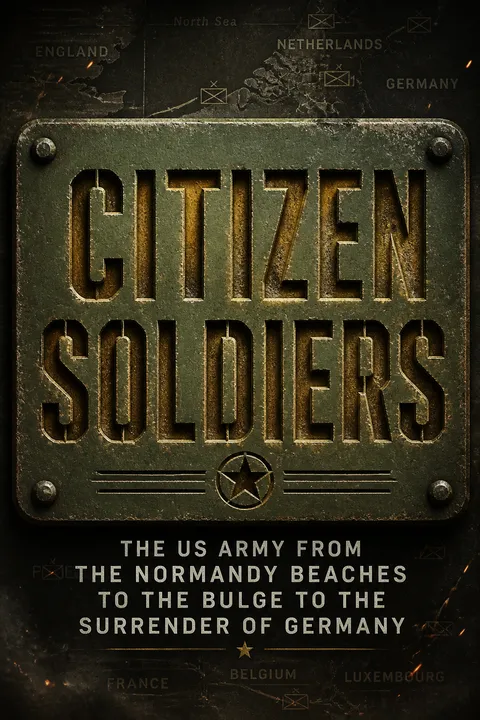

Key Takeaways
1. The Crucible of Citizen Soldiers
He was certain that the spoiled sons of democracy couldn't stand up to the solid sons of dictatorship.
Democratic youth transformed. The rapid expansion of the US Army from 160,000 in 1939 to over 8 million in 1944 required turning ordinary citizens into combat leaders. While Hitler believed democratic soldiers were too soft to withstand the fanatical, highly trained Wehrmacht, American junior officers and NCOs quickly adapted.
Grassroots leadership excels. Unlike the rigid German command structure, the American military fostered decentralized decision-making. When senior officers were killed or incapacitated, young lieutenants, sergeants, and even privates stepped up to lead.
Bonding under fire. The ultimate strength of the American army lay in unit cohesion and mutual trust rather than blind obedience.
- The transition of "pink-cheeked youth" into hardened, ruthless combat veterans.
- The reliance on "walking fire" and small-unit tactics developed on the fly.
- The profound sense of responsibility junior officers felt for their men's survival.
2. The Tyranny of Terrain and Intelligence Failures
In one of the greatest intelligence failures of all time, neither G-2 (intelligence) at US First Army nor the Supreme Headquarters Allied Expeditionary Force (SHAEF) G-2, nor any division S-2 (special staff intelligence) had ever thought to tell the men who were going to fight the battle that the dominant physical feature of the battlefield was the maze of hedgerows that covered the western half of Normandy.
The hedgerow trap. Allied planners completely overlooked the Norman bocage, assuming aerial photos showed easily jumpable English-style hedges. Instead, GIs encountered ancient, two-meter-high earthen mounds topped with dense trees, which the Germans had spent months transforming into interlocking defensive fortresses.
Tactical adaptation required. Standard military manuals offered no solutions for fighting in these leafy, sunken tunnels. The infantry had to learn by doing, suffering heavy casualties as they fought yard-by-yard through an average of fourteen hedgerows per kilometer.
Combined-arms innovation. To break the stalemate, the army developed new small-unit tactics that integrated tanks, engineers, and infantry.
- The creation of specialized "rhino tanks" equipped with steel teeth to plow through earthen walls.
- The installation of external tank-infantry phones to coordinate blind armor with ground troops.
- The use of white phosphorus mortar rounds to blind and flush out dug-in German machine-gun nests.
3. Industrial Might and Mechanical Ingenuity
The Americans were infinitely better at recovering damaged tanks and patching them up.
Quantity over quality. General George Marshall made a deliberate strategic choice to prioritize mass production over individual weapon superiority. While German Panther and Tiger tanks possessed heavier armor and devastating 88-mm guns, the lighter American Sherman tanks were produced in staggering numbers.
Grassroots mechanical genius. The American army capitalized on the civilian skills of its soldiers, many of whom had worked in gas stations and body shops. Maintenance battalions worked miracles near the front lines, stripping wrecked vehicles and welding salvaged armor onto active tanks.
Logistical superiority. The reliability and abundance of American equipment ultimately wore down the German war machine.
- The US produced over 88,000 tanks compared to Germany's 24,000 during the war.
- Sherman tanks had double the operational range and required far less maintenance than heavy German armor.
- The ubiquitous "deuce-and-a-half" truck and jeep provided unmatched tactical mobility.
4. The Double-Edged Sword of Air Supremacy
The Jabos were a burden on our souls.
Total sky dominance. Allied fighter-bombers, particularly the P-47 Thunderbolts, ruled the skies over Europe, paralyzing German daytime movements. These "Jabos" forced the Wehrmacht to move reinforcements and supplies almost exclusively under the cover of darkness or foul weather.
The tragedy of shorts. While strategic bombing paved the way for major breakthroughs like Operation Cobra, it carried a horrific cost in friendly fire. Misaligned bomb runs and drifting smoke caused heavy casualties among American frontline divisions, killing hundreds of GIs, including Lieutenant General Lesley McNair.
Tactical air-ground integration. The development of close air support revolutionized battlefield tactics.
- Equipping tanks and forward observers with VHF radios to talk directly to pilots.
- Using colored smoke and orange panels to mark friendly front lines.
- The devastating psychological impact of napalm and rocket-firing Typhoons on German armor.
5. The Logistics of Rapid Advance
Too many vehicles were driving too far away from the ports and beaches.
The supply bottleneck. Following the spectacular breakout from Normandy, the Allied armies raced across France faster than planners had ever anticipated. This rapid advance created a severe supply crisis, as fuel and ammunition had to be trucked hundreds of miles from the Normandy beaches.
The Red Ball Express. To keep the spearheads moving, the Allies created an improvised, round-the-clock truck transport system. Despite the heroic efforts of thousands of drivers, the sheer distance eventually starved Patton's Third Army and Hodges's First Army of the fuel needed to breach the Siegfried Line in late 1944.
Strategic consequences. The supply paralysis allowed the retreating Wehrmacht to regroup and man the formidable defenses of the German border.
- The failure to quickly open the port of Antwerp prolonged the war into the winter of 1945.
- Patton's tanks were left dry just miles from the German border, halting a potential early victory.
- The broad-front strategy was compromised by the necessity of rationing fuel between Montgomery and Patton.
6. The Meat Grinder of Attrition
The forest was a helluva eerie place to fight.
The Hurtgen horror. The battle for the Hurtgen Forest was one of the most costly and ill-advised campaigns in US Army history. In the dark, dripping pine woods, American forces lost their advantages in mobility, air power, and artillery, resulting in over 33,000 casualties for virtually no strategic gain.
The Fort Driant debacle. Patton's obsession with capturing the heavily fortified city of Metz led to a bloody, humiliating defeat at Fort Driant. The subterranean concrete fortress proved impervious to heavy bombers and direct tank fire, forcing GIs into terrifying, close-quarters tunnel warfare.
Lessons of static warfare. These brutal campaigns of attrition shattered the myth of easy victory and exposed the limits of frontal assaults against prepared defenses.
- The terrifying lethality of German "tree bursts" that showered infantry with wooden splinters and shrapnel.
- The psychological toll of combat exhaustion, which left veteran divisions completely depleted.
- The realization that fortified positions must be bypassed and neutralized rather than assaulted head-on.
7. The Stand of the Few at the Bulge
Ami, you and your comrades are brave men.
Surprise in the Ardennes. On December 16, 1944, Hitler launched his final, desperate counteroffensive through the lightly defended Ardennes forest. Achieving complete tactical surprise, three German armies smashed into green and battle-weary American divisions, aiming to capture Antwerp and split the Allies.
The delay of the spearheads. Despite the initial panic and retreat of rear-echelon units, the German timetable was shattered by the stubborn resistance of isolated American squads and platoons. Small groups of GIs stood their ground at critical crossroads, denying the German panzers the roads they desperately needed.
Key defensive stands. The heroic actions of small units allowed the Allies to rush massive reinforcements to the shoulders of the Bulge.
- Lieutenant Lyle Bouck's eighteen-man I&R platoon holding off an entire German paratrooper battalion for a full day at Lanzerath.
- The defense of Elsenborn Ridge by the 2nd and 99th divisions, blocking the northern route of the SS panzers.
- The legendary encirclement and defense of the vital crossroads town of Bastogne by the 101st Airborne and 10th Armored.
8. The Brutality of Winter Warfare
The extreme cold, fatigue, boredom, and hazard became maddening.
The winter of 1945. The fighting in January 1945 was dominated by the worst European winter in forty years. Soldiers on both sides faced sub-zero temperatures, deep snow, and freezing rain, which proved to be as lethal and demoralizing as the enemy's weapons.
The toll of exposure. Trench foot, frostbite, and pneumonia hospitalized thousands of GIs, stripping rifle companies of their strength. Men lived in frozen foxholes for weeks without fires, hot food, or dry clothing, their weapons frequently freezing solid in the middle of firefights.
Survival and adaptation. To survive, the infantry had to develop primitive winter-warfare techniques on the fly.
- Using stolen civilian bedsheets as makeshift snow camouflage.
- Using TNT and trench knives to blast foxholes into the rock-hard, frozen earth.
- The constant, exhausting necessity of stomping feet through fourteen-hour winter nights to prevent amputation.
9. The Triumph of Initiative at Remagen
The sight of the bridge still spanning the Rhine brought no cheers.
The gateway to Germany. On March 7, 1945, elements of the 9th Armored Division reached the cliffs overlooking Remagen and discovered the Ludendorff railroad bridge still standing. Recognizing a fleeting opportunity, Lieutenant Karl Timmermann led his company onto the bridge under intense machine-gun and artillery fire.
Decentralized command in action. Despite the imminent threat of the bridge being blown beneath them, the GIs raced across, cutting demolition wires and capturing the German defenders. General William Hoge made the bold, unauthorized decision to exploit the crossing, ignoring orders to head south.
The collapse of the Rhine barrier. The capture of the bridge shattered the German defensive line and accelerated the end of the war.
- The construction of the longest floating pontoon bridge in military history under continuous enemy fire.
- The deployment of massive antiaircraft defenses to protect the bridge from desperate German jet and V-2 attacks.
- The rapid crossing of nine American divisions, establishing an unshakeable bridgehead on the east bank.
10. The Moral Awakening of Liberation
Now I know why I am here!
Discovering the camps. As the Allied armies swept deep into Germany in April 1945, they uncovered the horrific reality of the Nazi concentration camp system. The discovery of camps like Nordhausen, Ohrdruf, Buchenwald, and Dachau shocked the battle-hardened GIs, who had previously viewed the war with detached cynicism.
The shock of reality. The sight of thousands of living skeletons, mass graves, and unspeakable human degradation transformed the soldiers' understanding of the conflict. It replaced their homesickness and war-weariness with a profound, righteous anger and a clear sense of moral purpose.
The legacy of testimony. General Eisenhower insisted on personally visiting the camps and forcing local German civilians to witness and bury the dead, ensuring the atrocities could never be dismissed as mere wartime propaganda.
- The immediate mobilization of military resources to feed, clothe, and treat the surviving victims.
- The permanent shift in the GIs' attitude toward the German population, from friendly curiosity to cold condemnation.
- The realization that the victory of the citizen soldiers was not just a geopolitical triumph, but a rescue of human civilization.
Review Summary
People Also Read


About the Author
Other books by Stephen E. Ambrose




Download PDF
Download EPUB
.epub digital book format is ideal for reading ebooks on phones, tablets, and e-readers.








































