

Key Takeaways
Your paradigm, not your intelligence, dictates the results you get
The hidden program runs your life. Proctor defines a paradigm as a cluster of habits lodged in the subconscious mind that silently governs nearly all behavior. This is why brilliant, credentialed people sometimes go broke while high-school dropouts build empires. They know how to do better, but their programming won't let them act on that knowledge.
Proctor's own life is Exhibit A. At 26 he earned $4,000 a year and owed $6,000. Within five years he was making over $1 million running companies across several cities, without formal education or business experience. He couldn't explain why. He calls this unconscious competence: succeeding without knowing the cause, which means the success is non-transferable. Only after nine years of study did he trace it back to one variable, the paradigm, the master control most self-help ignores.
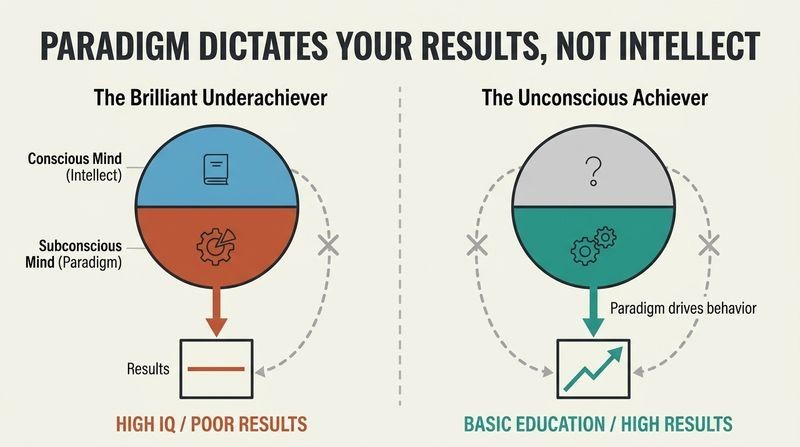
The claim echoes behavioral science: roughly 40 to 45% of daily actions are habitual, per Duke researcher Wendy Wood, so Proctor's emphasis on automaticity is well-grounded. Where he overreaches is the near-total dismissal of intellect and circumstance. Structural factors (capital, timing, networks) shape outcomes too, and attributing a dropout's millions purely to inner programming risks survivorship bias. Still, the reframe is useful. Instead of asking 'what do I need to learn?' the paradigm lens asks 'what am I already conditioned to do automatically?' That shift from information-gathering to behavior-rewiring is the book's genuine contribution, and it anticipates modern habit literature by decades.
Positive thinking is theater; only repetition rewrites the subconscious
You built it through reps, so change it through reps. Proctor is blunt that affirmations and visualization done once are illusions. A paradigm was installed the same way a child learns to walk or say their name: patient, spaced repetition over years. To overwrite it, you feed the subconscious the new idea relentlessly.
His practice is almost absurd by conventional standards. He read the same copy of Napoleon Hill's Think and Grow Rich daily since 1963. He listened to Earl Nightingale's essay on attitude perhaps ten thousand times. His friend Pat, meanwhile, read a new book every week, stayed broke, and never knew herself. The distinction: information gathering versus paradigm change. As Proctor puts it, reading a great book a second time reveals not something new in the book but something new in you. Awareness is manufactured through repetition.
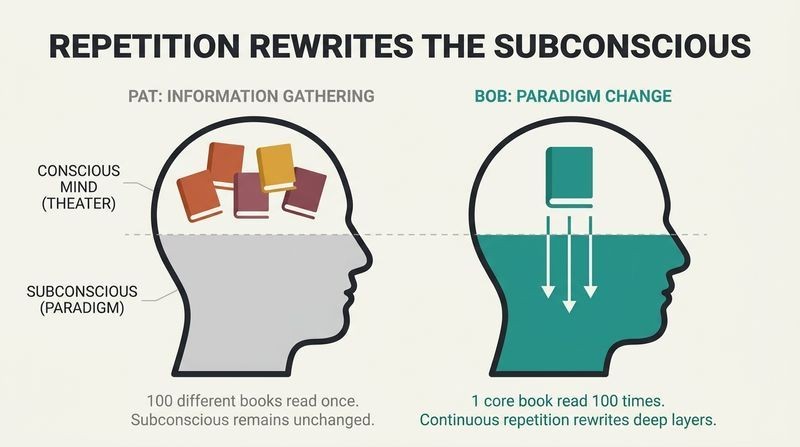
Neuroscience lends partial support. Spaced repetition strengthens synaptic consolidation, and repeated exposure genuinely reshapes automatic responses (the basis of exposure therapy and skill myelination). The mere-exposure effect shows repetition breeds preference and belief, which is precisely why Proctor invokes advertising and, provocatively, propaganda. The caveat: repetition without active engagement produces rote familiarity, not transformation. Simply replaying an audio ten thousand times risks habituation, where the brain tunes out. What likely mattered in Proctor's case was repetition plus emotional involvement and note-taking, effortful processing. The mechanism is sound, but the dosage he models is extreme and probably works because it forced sustained attention, not because of raw count alone.
Your subconscious is a thermostat that yanks you back to baseline
Why diets, budgets, and resolutions snap back. Proctor borrows from cybernetics, the science of control systems studied by Norbert Wiener, and Maxwell Maltz's Psycho-Cybernetics. A thermostat set to seventy degrees fires the furnace when the room cools and shuts off when it warms. Your paradigm does the same to your performance, weight, and income.
Consider the person seventy pounds overweight who diets, loses ten pounds, then quietly drifts back to the old eating. The paradigm registered the deviation and corrected course, exactly like an autopilot nudging a plane back on heading after turbulence. Roughly nine of ten dieters fail, Proctor argues, because they fight an invisible enemy without naming it. The lesson: a diet is really an attempt to write a new paradigm. Change the thermostat setting itself, or the system will always reel you home.
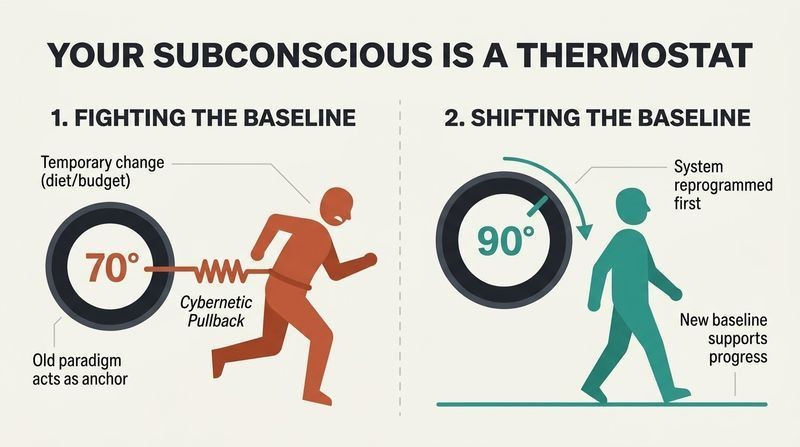
This maps cleanly onto contemporary research. Set-point theory in physiology describes how the body defends a weight range through metabolic and hormonal feedback, and behavioral economists document 'goal reversion' after willpower depletion. The thermostat metaphor is arguably more actionable than raw willpower advice because it reframes relapse as predictable system behavior rather than personal failure, reducing shame. One limitation: Proctor treats the setpoint as almost purely psychological, sidelining biological drivers like leptin and ghrelin. The richest interpretation combines both. Identity-based habit change, as James Clear frames it, is essentially resetting the thermostat by changing who you believe you are, not just what you do.
Chase C-type goals that scare you and defy all logic
Rank your goals A, B, and C. Proctor sorts ambitions into three tiers:
1. A-type: things you already know how to do (buying a new car identical to your old one). No growth.
2. B-type: things you think you can do if conditions line up. Still visible.
3. C-type: what you deeply want but have no idea how to achieve. It scares you.
Only C-type goals draw out your latent power, because goals are for growing, not getting. The one prerequisite is desire, not knowing the how. In 1973, alone with no money or staff, Proctor wrote 'I'm going to build a company that operates all over the world.' Today it reaches 89 countries. He invokes Hillary summiting Everest and the Wright brothers achieving flight, breakthroughs that were, at the time, completely illogical. Being realistic, he argues, is just obeying your paradigm.
There is real psychological muscle here. Locke and Latham's decades of goal-setting research confirm that specific, difficult goals outperform easy or vague ones, and stretch goals can trigger higher engagement. Proctor's 'want it, don't question how' also aligns with the entrepreneurial principle of effectuation, acting toward a vision while assembling means along the way. The danger, well documented, is that audacious goals without feedback loops breed burnout, unethical shortcuts, or the sunk-cost trap. Everest also kills people, a fact he acknowledges. The wise reading: pursue C-type goals, but pair the illogical vision with logical iteration. Vision sets direction; disciplined experimentation keeps you alive to reach it.
Beliefs are just evaluations, so re-evaluate them on purpose
The insight that unlocked everything for Proctor. For years he couldn't understand why his life had transformed. Over a meal, his mentor Val Vanderwall said something that hit like a bell: our belief system rests on our evaluation of something, and when we re-evaluate, the belief itself changes.
Suddenly Proctor understood what all those repeated recordings and books had done. They weren't feeding him facts; they were forcing him to re-evaluate who he was. He shifted from 'useless character with no future' to someone capable. Most beliefs, he argues, are inherited nonsense with no foundation, absorbed in childhood before we could reason. He also distinguishes conscious from subconscious belief: you can believe you can earn more (in your intellect) yet stay broke, because the belief hasn't been planted deep enough to drive action. He calls that gap a failure of praxis, the integration of belief and behavior.
This prefigures cognitive behavioral therapy almost exactly. CBT's core move is identifying automatic beliefs, examining the evidence, and re-evaluating, which reliably shifts emotion and behavior. Proctor's 'beliefs are evaluations' is essentially Ellis and Beck in folk language. The conscious-versus-subconscious split also tracks dual-process theory (Kahneman's System 1 and System 2): knowing something rationally does not guarantee your fast, automatic system agrees. Where Proctor is vaguer than clinicians is method. CBT uses structured evidence-testing and behavioral experiments; Proctor leans on repetition and emotional immersion. Both aim to close the belief-behavior gap, but the therapeutic tradition offers more falsifiable tools for someone who finds pure repetition insufficient.
Own the gap between stimulus and response instead of reacting
React and you hand over your power. Drawing on Viktor Frankl, the psychiatrist who survived Nazi concentration camps and wrote Man's Search for Meaning, Proctor stresses that between any event and your answer to it lies a space, sometimes a millisecond, where you choose to respond or react. React, and you've surrendered control to whoever pushed your buttons.
His most vivid proof is a maximum-security prison. A man dubbed the 'mad dog,' seven and a half years in solitary, disrupted Proctor's sessions by scoffing and making animal noises. Rather than react in fear, Proctor walked to the back and coolly told him he could earn money faster than the man could steal it, then reminded him he'd be driving away while the inmate returned to his cell. The man went quiet, sat up front the next month, and eventually rebuilt his life. Responding, not reacting, changed both men.
Frankl's 'space' has become a cornerstone of mindfulness-based interventions, and neuroscience supports it: labeling an emotion (affect labeling) measurably dampens amygdala reactivity, buying the pause Proctor describes. His practical add-ons (asking 'why would they say that?' and refusing to accept the premise) are cognitive reappraisal techniques with solid evidence for regulating anger. The prison anecdote is compelling but also a survivorship story, one dramatic success we hear about. The broader teachable point stands: reactivity is a trained reflex, and like any reflex it can be retrained through awareness. The first step Proctor names, noticing that you are reacting, is exactly where metacognitive training begins.
Desire is proof of ability; wanting it means you can do it
The want and the capacity arrive together. Proctor leans on Napoleon Hill: if you have genuine desire for something, you already possess the latent ability to achieve it; no desire, no ability. You won't crave what you truly cannot become. A poor kid can desire a few million in the bank and reach it, even if they feel no pull toward Bezos-level wealth.
For Proctor, wanting isn't greed; it's spirit seeking expression. We don't actually want to get, we want to grow: to run faster, jump higher, sell more. That's why he rejects his grandmother's advice to be satisfied with what you have. Dissatisfaction, he argues, is a creative state. And crucially, you never need to know the how in advance. Hillary didn't know how to reach Everest's summit until he stood on it. The way reveals itself once you commit to the destination.
There is motivational truth here that self-determination theory partly validates: intrinsic desire predicts persistence and performance far better than external pressure. Desire also directs attention, and attention shapes what opportunities we notice (the reticular activating system, popularly cited in this genre). But the strong claim, that desire guarantees latent ability, is where skeptics push back. Plenty of people passionately want outcomes that talent, physiology, or circumstance foreclose. The honest reframe: desire is necessary but not sufficient. It's the fuel, not the engine or the road. What Proctor gets right is that most people fail from insufficient want, quitting before capacity develops, not from a genuine ceiling on ability.
Money rewards service and multiple income streams, never raw effort
Wealth is a paradigm setting, not a work rate. Proctor insists money is earned by providing service, not by laboring, and its amount follows a formula: the need for what you do, your ability to do it, and the difficulty of replacing you. Taylor Swift earns while sleeping because millions replay her recordings; she's nearly irreplaceable at what she does.
On a 25-hour flight to Kuala Lumpur, Proctor realized the millionaires he knew shared one trait: none relied on a single income source, a truth stretching back to the ancient Babylonians. A job, however well paid, is one stream. So he built MSI Connect, a network for creating multiple sources of income. He also warns: never let someone else set your ceiling. When a boss flatly told him he couldn't earn $100,000, Proctor knew his time there was ending. Money magnifies who you already are, so decide your own number.
The 'multiple streams' thesis has aged well. Studies of self-made millionaires (Tom Corley's work is often cited) find most cultivated several income sources, and modern portfolio-career and passive-income movements echo it. The service-based formula also resembles economic scarcity value: pay rises with demand and non-substitutability, standard labor economics dressed in motivational language. The weaker spot is the implication that anyone can readily build streams; capital, skills, and risk tolerance are unevenly distributed, and diversifying too early can dilute focus before a first stream is solid. Still, the core reframe, that income tracks value delivered and replaceability rather than hours suffered, is a genuinely liberating correction to the effort-equals-reward myth.
If you feel comfortable, you're not growing, you're stuck
Discomfort is the receipt for growth. Proctor treats comfort as a warning light. Whenever he pursues something new, he expects it to feel unpleasant, and if it doesn't, he knows he's coasting sideways. He describes the mental tug-of-war as an X idea (the entrenched paradigm) evicting a Y idea (the new goal, like quitting a job to start a business). Keep emotionally engaging the Y idea and eventually it becomes the new X, comfortable and automatic.
He compares it to learning to drive: the clutch, brake, and gearshift once felt terrifying, then dissolved into unconscious ease. Earl Nightingale called the ideal state 'constructive discontent,' perpetually wanting to improve, never satisfied yet genuinely happy because you're moving in your chosen direction. Growth, in this frame, is a permanent construction site. Personal development has no finish line; your results are always under renovation.
This aligns tightly with the concept of desirable difficulty in learning science: conditions that feel harder often produce deeper, more durable skill. It also mirrors the growth-mindset research of Carol Dweck, where embracing struggle rather than avoiding it predicts achievement. Proctor's X-to-Y transition is essentially the automaticity curve of skill acquisition, effortful becoming effortless with reps. A useful caution: not all discomfort signals growth. Chronic stress without recovery erodes performance (the difference between eustress and distress). The skill is discriminating productive strain from harmful overload. Proctor's instinct to lean into discomfort is right, but the healthiest version cycles challenge with consolidation, much like athletic training alternates stress and rest.
Run a daily gratitude ritual to change the frequency you broadcast
A three-part morning reset. Proctor built a simple practice, once scribbled on a coffee-shop napkin for his partner Sandy Gallagher:
1. Write down ten things you're grateful for.
2. Send love to three people who are bothering you.
3. Relax for five minutes and ask for guidance for the day.
His logic is emotional physics. Whatever bad energy you send toward someone must first pass through you, so resentment poisons the sender. Deliberately sending love puts you in what he calls a loving vibration, which is all you can then attract. Sandy's family thought she was crazy on a Hawaii trip, then adopted the ritual themselves. Quoting Wallace Wattles, Proctor calls gratitude the entire process of mental adjustment. When a problem surfaces, the fastest correction isn't solving it externally but re-tuning the state you're operating from.
Strip away the vibration language and this is one of the most empirically robust interventions in positive psychology. Robert Emmons's gratitude-journaling studies show measurable gains in well-being, sleep, and even immune markers. Sending compassion to difficult people closely resembles loving-kindness meditation, which Barbara Fredrickson's research links to increased positive emotion and vagal tone. The 'poison passes through the sender' framing is a folk version of the finding that rumination and hostility harm the ruminator's cardiovascular health. Where the metaphysics ('attract' outcomes) outruns evidence, the behavioral core does not. The practice works regardless of whether one accepts the frequency theory, which makes it low-risk and unusually high-yield.
Lock in an accountability partner and study 30 minutes daily for 60 days
Turn insight into a lifelong habit. Proctor closes with a concrete regimen: read this material 30 minutes every morning for 60 to 90 days with a partner who holds you to it. Earl Nightingale called an accountability partner your 'success insurance policy,' and Proctor practices it daily, texting Sandy his written affirmations so neither wants to disappoint the other's respect.
He frames procrastination as simply the absence of decision, and prescribes an unusual cure: two people take turns reading aloud the decision chapter of Think and Grow Rich for sixty days. He distinguishes interest from commitment (borrowing from Ken Blanchard): the interested act only when convenient, the committed act regardless. His eight closing principles include developing awareness, deciding, committing totally, focusing (he suggests staring at a candle flame to train the will), and visioneering, mentally rehearsing the achieved goal until the mind holds it in orderly focus.
The accountability prescription is one of the best-supported tools in behavior change. The American Society of Training and Development famously found that a specific accountability appointment raised goal-completion odds dramatically, and social commitment devices (from Alcoholics Anonymous sponsors to fitness apps) exploit our aversion to letting a respected person down. The candle-flame concentration drill resembles focused-attention meditation, shown to strengthen sustained attention networks. Framing procrastination as undecided rather than lazy is a subtle but powerful reattribution that removes moral judgment and points to a fixable act. The 60-to-90-day window also roughly matches habit-formation research, where automaticity plateaus, on average, around 66 days per Phillippa Lally's study.
Analysis
Bob Proctor's book is the distilled, seminar-tested core of a philosophy he spent six decades refining after Think and Grow Rich rescued him from poverty in 1961. Its single organizing claim, that a subconscious 'paradigm' overrides intelligence, education, and willpower, is both its strength and its blind spot. The strength is that it correctly locates the leverage point of change in automatic behavior rather than conscious knowledge, anticipating by decades the habit science of Wood, Duhigg, and Clear. The blind spot is a near-total interiorization of causation: if outcomes flow only from inner programming, then structural, biological, and chance factors vanish, and failure becomes purely a mindset defect. This is empowering for the person with agency to spare and quietly cruel to the person facing genuine external constraint.
Methodologically, the book mixes durable psychology with unfalsifiable metaphysics. Frankl's stimulus-response gap, Maltz's cybernetics, gratitude journaling, accountability partnering, and spaced repetition all have empirical backing. The 'law of vibration,' thought as omnipresent energy, and the attraction framing do not, and Proctor presents them with the same certainty. A discerning reader can extract enormous value by treating the vibration talk as evocative metaphor for attention, emotion, and expectancy, all of which demonstrably shape behavior and perception.
What gives the book unusual credibility within its genre is Proctor's transparency about his own long confusion. He was 'unconsciously competent,' rich without knowing why, and spent nine years reverse-engineering the cause. That intellectual honesty, plus the memorable prison and EGOT-producer stories, keeps it from feeling like pure sloganeering. The practical spine, identify your paradigm, rewrite it through emotional repetition, chase goals that scare you, respond rather than react, and enforce it with accountability, is sound and executable. The reader's job is to keep the tools and lightly hold the cosmology.
Review Summary
"Change Your Paradigm, Change Your Life" receives mixed reviews. Many readers find it inspiring and filled with valuable insights on personal growth, mindset shifts, and achieving success. They appreciate Proctor's emphasis on gratitude, self-worth, and finding one's purpose. However, some criticize it as repetitive, lacking practical advice, and rehashing common self-help concepts. The book's religious undertones and references to "vibrations" and "energies" are divisive. Despite the varied opinions, many readers acknowledge Proctor's passion and engaging style, finding at least a few useful takeaways.
People Also Read



Glossary
Paradigm
Subconscious habit-cluster controlling behaviorProctor's central term for a multitude of habits fixed in the subconscious mind that governs almost all habitual behavior, including how you view yourself, money, and opportunity. Largely inherited and installed through childhood repetition, it operates automatically beneath conscious awareness and overrides knowledge or willpower. Because it was built by repetition, it can only be rewritten by repetition.
Unconscious competence
Succeeding without knowing whyProctor's description of high performers who produce excellent results but cannot articulate the cause, so they cannot teach or transfer their success. His own rise from debt to millions felt like this until he identified the paradigm as the hidden driver. He contrasts it with conscious understanding, which makes success repeatable and transferable.
C-type goal
Goal you can't yet imagine achievingThe top tier of Proctor's A-B-C goal system. A-type goals are things you already know how to do (no growth); B-type goals seem achievable if conditions align; C-type goals are things you deeply want but have no idea how to reach. Only C-type goals force paradigm change and draw out latent potential. The sole prerequisite is genuine desire, not a known method.
Law of vibration
Everything moves on a frequencyProctor's claimed primary law of the universe: everything is in constant motion and thought is energy operating on a frequency. He argues the law of attraction is secondary to it, since you can only attract what you are already in vibrational harmony with. Changing your dominant thoughts and feelings changes your frequency and therefore what comes to you.
Praxis
Integrating belief with behaviorProctor uses this to name the gap between believing something consciously and acting on it. You can intellectually believe you can earn more yet stay broke because the belief has not been planted in the subconscious. Praxis is achieved through repetition and emotional visualization, at which point belief finally manifests as consistent action and results.
Multiple Sources of Income (MSI)
Several parallel income streamsProctor's wealth principle, embodied in his MSI Connect venture, holding that wealthy people throughout history never relied on a single income source. A job is one stream regardless of pay. Building multiple streams, often through joint ventures and affiliate arrangements, is presented as the accessible path to financial freedom for ordinary people.
Visioneering
Mentally rehearsing the achieved goalProctor's term for deliberately using imagination to live through the accomplishment of a goal in advance, holding a single image on the screen of the mind until it feels real. It brings order to a scattered mind and, in his framing, attracts the needed resources. Closely tied to Neville's idea of 'thinking from the end,' seeing yourself already there.
Power life script
Recorded present-tense description of desired lifeA technique where you write out, in vivid present-tense detail, the life you want, beginning with gratitude ('I am so happy and grateful now that...'), then record it in your own voice and replay it. Because you trust your own voice, repeated listening rescripts the fearful inner chatter and plants the new vision in the subconscious.
Constructive discontent
Happy but perpetually wanting improvementA phrase Proctor attributes to Earl Nightingale describing the ideal growth state: never fully satisfied, always pushing to improve, yet genuinely happy because you are moving in your chosen direction. It reframes dissatisfaction as a creative engine rather than a problem, and pairs with Proctor's belief that comfort signals stagnation.
FAQ
What's "Change Your Paradigm, Change Your Life" about?
- Core Concept: The book by Bob Proctor focuses on the idea that our paradigms, or mental programs, control our habitual behaviors and, consequently, our life outcomes.
- Paradigm Shift: It emphasizes the importance of changing these paradigms to achieve personal and professional success.
- Systematic Approach: Proctor provides a systematic method to change paradigms, which involves understanding, repetition, and emotional engagement.
- Life Transformation: The book aims to help readers transform their finances, health, career, relationships, and overall life by altering their paradigms.
Why should I read "Change Your Paradigm, Change Your Life"?
- Personal Development: It offers insights into why traditional personal development methods may not work and how paradigm shifts can lead to sustainable success.
- Practical Guidance: The book provides practical steps and exercises to help readers change their paradigms and improve their lives.
- Expert Insights: Bob Proctor, a renowned personal development expert, shares knowledge previously available only in exclusive seminars.
- Holistic Improvement: It covers various aspects of life, including financial freedom, emotional well-being, and personal growth.
What are the key takeaways of "Change Your Paradigm, Change Your Life"?
- Paradigms Control Behavior: Our paradigms are deeply ingrained mental programs that dictate our habitual actions and results.
- Repetition is Key: Changing a paradigm requires constant, spaced repetition of new ideas and behaviors.
- Emotional Involvement: To effectively change a paradigm, one must emotionally engage with the desired change.
- Goal Setting: Setting and achieving goals involves understanding and altering paradigms to align with desired outcomes.
How does Bob Proctor define a paradigm in "Change Your Paradigm, Change Your Life"?
- Mental Program: A paradigm is a mental program that has almost exclusive control over our habitual behavior.
- Subconscious Influence: It resides in the subconscious mind and influences nearly all of our actions.
- Generational Habits: Paradigms consist of habits passed down from generation to generation.
- Worldview Impact: They shape how we view ourselves, the world, and opportunities.
What is the process for changing a paradigm according to Bob Proctor?
- Awareness: First, become aware of the existing paradigm and its impact on your life.
- Decision: Make a committed decision to change the paradigm, understanding it will require effort and persistence.
- Repetition: Use constant, spaced repetition of new ideas to replace the old paradigm.
- Emotional Engagement: Emotionally involve yourself with the new paradigm to ensure it takes root in the subconscious.
What role does gratitude play in "Change Your Paradigm, Change Your Life"?
- Mental Adjustment: Gratitude is described as the entire process of mental adjustment and atonement.
- Daily Practice: Proctor suggests a daily practice of writing down things you are grateful for to shift your mindset.
- Positive Vibration: Gratitude puts you in a positive vibration, attracting more good into your life.
- Problem Solving: It helps in overcoming disturbances and challenges by focusing on what you have rather than what you lack.
How does Bob Proctor suggest handling fear and anxiety in "Change Your Paradigm, Change Your Life"?
- Understanding Fear: Fear is a result of doubt and worry, which stem from ignorance.
- Faith as a Solution: Developing understanding through study leads to faith, which is the opposite of fear.
- Emotional Expression: Fear manifests as anxiety, but faith leads to well-being and positive expression.
- Focus on Study: Continuous study and understanding of oneself and universal laws help overcome fear.
What is the significance of decision-making in "Change Your Paradigm, Change Your Life"?
- Commitment to Change: Decision-making is crucial for committing to change and setting new paradigms.
- Overcoming Procrastination: Making decisions helps eliminate procrastination and accelerates progress toward goals.
- Irrevocable Commitment: Proctor emphasizes the importance of making irrevocable commitments to achieve desired outcomes.
- Goal Achievement: Decisions align actions with goals, ensuring consistent progress and success.
What are the best quotes from "Change Your Paradigm, Change Your Life" and what do they mean?
- "If I want to be free, I've got to be me." This quote emphasizes the importance of authenticity and self-awareness in achieving freedom.
- "The only prerequisite to making a decision is, do you want to?" It highlights the power of desire and decision-making in achieving goals.
- "All success is 5 percent strategy, 95 percent mindset." This underscores the importance of mindset over mere strategy in achieving success.
- "Gratitude is the attitude that hooks you up to your source of supply." It suggests that gratitude connects you to abundance and positive outcomes.
How does Bob Proctor relate paradigms to cybernetics in "Change Your Paradigm, Change Your Life"?
- Control Systems: Paradigms function like cybernetic mechanisms, controlling behavior and maintaining equilibrium.
- Thermostat Analogy: Just as a thermostat regulates temperature, paradigms regulate behavior and results.
- Behavioral Patterns: Paradigms dictate habitual actions, similar to how cybernetic systems maintain set points.
- Change Process: Understanding and altering paradigms involves resetting the "thermostat" to achieve desired outcomes.
What is the role of imagination in "Change Your Paradigm, Change Your Life"?
- Creative Tool: Imagination is a powerful tool for visualizing and creating the life you desire.
- Thinking from the End: Proctor encourages thinking from the end, seeing yourself already in possession of your goals.
- Emotional Involvement: Imagination helps emotionally engage with your desired outcomes, making them more attainable.
- Visioneering: It involves exercising the imagination to bring order to the mind and attract desired results.
How can "Change Your Paradigm, Change Your Life" help achieve financial freedom?
- Multiple Income Streams: Proctor advocates for creating multiple sources of income to achieve financial freedom.
- Paradigm Shift: Changing your money paradigm can remove boundaries on how much you can earn.
- Service Orientation: Money is earned by providing service, not just by working harder.
- Financial Education: The book emphasizes the importance of understanding money and its laws to achieve financial success.
About the Author
Other books by Bob Proctor



Download PDF
Download EPUB
.epub digital book format is ideal for reading ebooks on phones, tablets, and e-readers.








































