


Plot Summary
The Pulse Strikes Boston
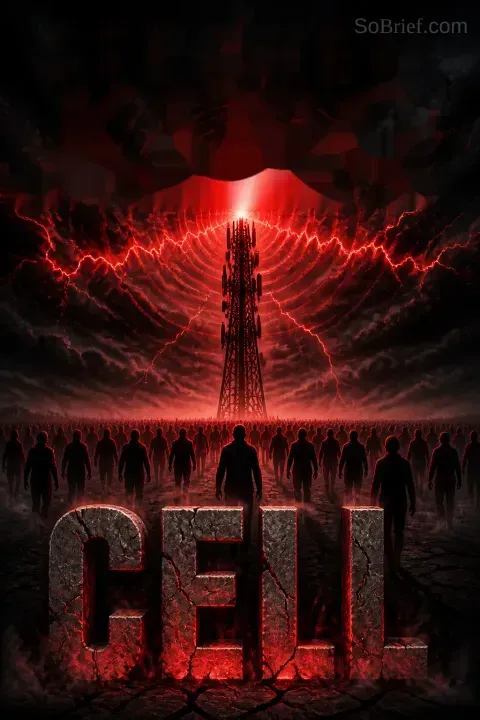
Clay Riddell1 is walking along Boylston Street, elated after selling his first graphic novel, when he stops at an ice cream truck. A woman in a power suit answers her cell phone and abruptly attacks the vendor, her face contorting into a feral snarl. A teenage girl with a peppermint-colored phone lunges and tears into the woman's throat with her teeth.
Another girl, who only overheard the call, runs screaming into a lamppost, her mind shattered. Explosions echo, planes fall from the sky, and a man on the Common bites a dog's ear off. Clay1 uses a glass paperweight he bought for his estranged wife11 to bludgeon the attacking girl unconscious. As chaos consumes downtown Boston, he realizes the violence began when people used their cell phones.
The inciting event weaponizes the mundane act of answering a call. King posits technology as a hidden vulnerability, transforming everyday connection into a vector for apocalyptic madness. The randomness of who succumbs and the immediate, primal violence create a world where trust evaporates. Clay's artist eye records horror precisely, but his emotional detachment begins cracking as he sees the human reduced to its basest impulses, setting up the novel's central question: what remains when the mind is wiped clean?
Lobby of the Dead
Clay1 teams up with Tom McCourt,2 a small, spectacled man he met during the carnage. At the Atlantic Avenue Inn, they find the doors locked, but a blood-spattered girl named Alice Maxwell3 begs to be let in, fleeing a pursuing madman. Clay1 kills her attacker with a butcher knife. Inside, the desk clerk, Mr. Ricardi,12 insists on staying at his post.
That night, Alice3 reveals her mother went crazy on a cell phone and tried to kill her. By morning, Ricardi12 has hanged himself with a drape cord, a plastic bag over his head. The group, now three, scavenges sandwiches and water. They decide to leave Boston before the fires consume it, heading north toward Malden and an uncertain future.
The hotel becomes a microcosm of the old world's collapse: locked doors, futile attempts at order, and the quiet surrender of Ricardi, who chooses the risk of death over the risk of change. Alice's arrival injects both vulnerability and fierce survival instinct. Her attachment to a baby sneaker as a talisman reveals the mind's desperate need for an anchor when everything else is stripped away—a child's ritual of security that will carry her through the coming darkness.
The Flock Awakens
At Tom's2 house in Malden, the trio watches dawn reveal a terrifying new pattern. The phone-crazies are no longer randomly violent but move together in silent streams, like migrating birds. A mechanic named George breaks into the garden, calmly uses a wheelbarrow to smash open a pumpkin, and eats it. An old man tries the same trick but gets too close; George snaps his neck without hesitation, then resumes eating.
Thousands of these "phoners" flow toward the town center. They have stopped murdering each other indiscriminately. Instead, a group mind is emerging. They claim the daylight hours, retreating at dusk to unknown roosting places, while the survivors inherit the night — becoming the "Flashlight People."
The flocking behavior marks a terrifying evolution from anarchy to organization. King draws on sociobiology, suggesting that beneath our rational selves lies a deep programming that can reassert itself. The phoners' switch from indiscriminate violence to coordinated group movement implies a new kind of consciousness, one that may not need the old humanity at all. For the survivors, the day now belongs to the enemy, a shift that turns them into nocturnal refugees.
Nickerson's Kitchen
Needing weapons, the group breaks into the home of Arnie Nickerson, a gun enthusiast across the street. In the kitchen, Clay1 finds Beth Nickerson slumped in a corner, her legs savaged with bite marks, her skull missing its top. Nearby lies her daughter Heidi, neck broken, a cell phone covered in orange daisy decals beside her hand.
Beth used a rolling pin to kill her phoner daughter, then shot herself with a .45 revolver. Clay1 takes the gun and ammunition, covering the woman's soiled skirt with a small gesture of dignity. In the basement, they find a stash of rifles, pistols, and a Russian automatic weapon. Alice3 arms herself with a pistol, and Tom2 takes a rifle. They head north, armed and frightened.
The Nickerson kitchen crystallizes the domestic apocalypse in a single room. A mother's last act—killing her transformed child and then herself—is both unspeakable and entirely understandable. The gaudy cell phone on the floor indicts the device as a Trojan horse delivered into the heart of family life. Clay's retrieval of the gun is a necessary desecration; he is crossing a line from observer to participant in the violence, understanding that the old moral rules no longer apply.
Gaiten's Rebooted Horde
At Gaiten Academy, Clay,1 Tom,2 and Alice3 meet Headmaster Charles Ardai5 and his sole remaining student, Jordan.4 Ardai5 leads them to Tonney Field at night, where a thousand phoners lie packed together, eyes open but unseeing, while easy-listening music drifts from dozens of boomboxes. The boomboxes are not wired together — the phoners are rebroadcasting the music telepathically.
Jordan,4 a computer prodigy, explains: the Pulse wiped their brains like a hard drive, but now they are rebooting, developing group telepathy and tool use. Clay1 hears faint music emanating directly from a phoner's throat. Ardai5 argues they must be destroyed before they become unstoppable. He proposes using propane trucks to incinerate the flock while they sleep.
Gaiten Academy serves as the narrative's intellectual center, where the phoners' transformation is given a chillingly plausible mechanism. Jordan's analogy of the brain as organic hardware, susceptible to a malicious signal, reframes the apocalypse as a technological plague. The music adds a surreal banality to the nightmare, as if the death of humanity is being scored for a dentist's waiting room. Ardai's moral certainty foreshadows the brutal calculus of war.
Propane Pyre
Using the Head's5 knowledge that the phoners are comatose at night, Clay1 and Tom2 steal two propane trucks from a Citgo station. They drive onto the field among the sleepers. Clay1 shoots the tank with Beth Nickerson's .45. The explosion is instantaneous and immense, a blossoming fireball that consumes hundreds of bodies and sets the bleachers ablaze.
The heat is so intense they barely escape. As they flee, a telepathic scream of agony rises from the burning flock — the first evidence that the group mind can feel collective pain. Then, from distant towns, answering groans echo through the night: other flocks have felt the death of their kind. The group realizes they have declared war.
This moment is the point of no return. The deliberate immolation of a thousand formerly human beings, however justified by self-preservation, stains them irrevocably. The telepathic death cry suggests the phoners possess not just consciousness but a shared nervous system, a single organism now wounded. The moral clarity that drove the act curdles into dread as the scale of the retaliation becomes imaginable. King asks whether genocide, even in defense, can ever leave the perpetrators unchanged.
The Raggedy Man's Verdict
The next day, a new flock arrives, led by a disfigured black man in a Harvard hoodie — the Raggedy Man,6 a telepathic spokesman for the phoner collective. He and his followers surround Cheatham Lodge, then force Headmaster Ardai5 to write the word "insane" in fourteen languages before driving a fountain pen into his eye.
They leave the group untouched but marked as pariahs, shoving into their minds a single command: go north to Kashwak, a no-cell zone where normies are gathering. That night, Clay,1 Tom,2 Alice,3 and Jordan4 bury Ardai5 in his victory garden, reciting a psalm. The Raggedy Man6 appears to Clay1 in the morning mist and speaks through Clay's1 own voice, repeating the order to leave.
The Raggedy Man represents the emergent superego of the phoner collective, a terrible caricature of authority learned from a Harvard sweatshirt and ancestral memories of Latin justice. The execution of Ardai, made to perform his own death ritual, demonstrates the phoners' growing control over physical reality and their chilling sense of theatrical punishment. The branding of the survivors as 'insane' inverts the moral order: the sane are now the deviants, the untouchables.
Alice's Dying Message
On the road north, a pair of normies, Gunner and Harold, seek revenge on "the Gaiten bunch," whom they blame for phoner reprisals. Gunner hurls a cinderblock from a speeding car, crushing the side of Alice's3 head. She lies dying in an apple orchard, clutching the baby sneaker that has been her emotional anchor.
Before she fades, the Raggedy Man6 briefly hijacks her voice and delivers a cruel message to Clay:1 his son10 is with the phoners. She dies at dawn, murmuring fragments of childhood and memory. Clay,1 Tom,2 and Jordan4 bury her under an apple tree, placing the sneaker in her hand, then continue north toward Kent Pond, shattered but driven by grief.
Alice's death is the emotional fulcrum of the novel, a senseless casualty in a war that has turned normie against normie. Her life was tethered to a child's shoe, a symbol of lost innocence she squeezed like a prayer. The Raggedy Man's use of her dying voice to wound Clay reveals the phoners' capacity for psychological cruelty. Her burial in an orchard, with a psalm and a sneaker, is a small ritual of humanity in a world that has forgotten them.
Come Get Me
Clay1 reaches his old house in Kent Pond and finds a note taped to the storm door, written by his twelve-year-old son Johnny.10 The note explains that Johnny10 fled with friends after his mother Sharon11 became a phoner. At the Town Hall, Clay1 discovers another note from Johnny,10 saying everyone is heading to Kashwak, a rumored safe zone.
The note confirms Sharon11 is one of the flock. Clay1 resolves to go to Kashwak despite all warnings of a trap. Tom2 and Jordan4 initially decide to head west, but after a tearful farewell they are psychically compelled north and reunite with Clay,1 along with three other flock-killers: Dan Hartwick,7 Denise Link,8 and Ray Huizenga,9 all branded as insane and herded by the phoners.
The notes from Johnny function as a ghostly voice from the old world, tethering Clay to his fatherhood even as that role becomes impossible. The scrawled plea is the purest expression of love and desperation. Clay's choice to follow it, knowing the destination is likely a slaughterhouse, demonstrates that parental love can override all survival logic. The forced reunion underscores the phoners' growing power to manipulate human will.
The Chute Narrows
As the group is herded toward the Northern Counties Expo, Ray Huizenga9 reveals he has rigged the back of a school bus with quarry explosives and a cell-phone detonator. He then snatches Clay's1 revolver and shoots himself, ensuring the phoners cannot read his plan from his mind.
Clay1 finds the detonator phone and a slip of paper with a number in his pocket, kept from telepathic scan only by sheer mental static. The group is forced to drive to the Expo, passing thousands of phoners. The Raggedy Man6 greets them mockingly but fails to detect the bomb. They are locked inside Kashwakamak Hall for the night, listening to classical music boom outside while they await execution at dawn.
Ray's suicide is a self-sacrifice that subverts the phoners' telepathic surveillance. His pragmatism provides the final tool of resistance. The cell-phone bomb is a brilliant irony: the very technology that destroyed the world becomes the means of striking back. The phoners' blind spot reveals a critical limit to their hive mind: they rely on what they can extract from human minds, and they can be fooled by omission.
Kashwakamak Hall
The Expo midway is a half-constructed carnival of horrors. Beyond the Parachute Drop, a sea of phoners fills the grassy mall, their eyes fixed on the arriving bus. The group is herded into Kashwakamak Hall and the doors lock behind them. Through high windows they watch the phoners settle into their nightly trance while Pachelbel and Vivaldi boom from speakers.
They know that at dawn they will be placed on platforms and executed for the entertainment of the flock, their deaths broadcast telepathically as a warning. Jordan4 notices a blinking red light atop the Parachute Drop — a battery-powered cell tower the carnies had installed. It means a cell call might still get through inside the dead zone.
The Expo setting is a grotesque parody of American entertainment—a midway of broken rides and a hall that once held bingo games now turned into a death-row holding cell. The phoners' evolution to classical music suggests a chilling aesthetic refinement. The blinking light on the Parachute Drop is both a literal and symbolic beacon, a reminder that the old world's jury-rigged technology might still offer a loophole, but only if someone is willing to take a terrifying risk.
Jordan's Bomb Run
Jordan4 squeezes through a broken window and sneaks through the sleeping phoners to the school bus. He finds the explosives and the cell phone with three bars of signal. He drives the bus slowly, then accelerates straight into the heart of the flock, scrambling back to the Hall just as the mob gathers around it. Clay1 dials the number on the slip.
The explosion is cataclysmic — a sphere of fire that vaporizes the Raggedy Man6 and tears through thousands of phoners. Kashwakamak Hall's roof catches fire, but the group escapes through a gaping hole in the wall. They flee north in a water-purification van, leaving the burning Expo behind. Clay1 decides to stay behind to search for Johnny.10
Jordan's drive is the novel's most heroic act, a child forced into the role of a weapon of mass destruction. The explosion, triggered by a cell phone call, closes the loop that began with the Pulse—destruction born from the same technology that ended the world. The physical obliteration of the Raggedy Man is satisfying but hollow; he was merely a pseudopod. The victory is partial, messy, and traumatizing.
Johnny Found
Clay1 walks south along Route 160, passing broken phoners who mutter fragmented words — evidence that the worm in the Pulse is degrading their programming. In Gurleyville, he spots a small figure in a Red Sox T-shirt sitting on a curb. It is Johnny,10 but the boy is a vacant shell: mute, incontinent, crawling under beds to sleep, screaming nightly at some invisible agony.
His eyes hold no recognition. Clay1 takes him to a caretaker's cottage by the Springvale Logging Museum, caring for him like an infant. He lives with the hollow ghost of his son,10 remembering the toddler who once called him "Dieey." The Pulse has left nothing but a body that eats, sleeps, and wanders.
The reunion is the novel's darkest moment, far more painful than death. Johnny is not dead, not a phoner, but something worse: a consciousness so thoroughly erased that only animal instincts remain. Clay's devotion mirrors any parent caring for a profoundly damaged child, but the absence of any flicker of the boy he raised is a slow-motion grief. The nightly screaming suggests the new programming is itself broken, a corrupted file looping endlessly.
Save to System
Clay1 remembers Jordan's4 theory: the brain, like a protected computer, may "save to system" before a wipe, preserving the original personality somewhere deep. He also recalls the mutating Pulse, now producing phoners who can speak and remember fragments. Using a scavenged cell phone, Clay1 dials 911 — the phoners' own conversion trigger — and presses it to Johnny's10 ear, murmuring their old toddler game: "Fo-fo-you-you."
He hopes the new, corrupted version of the Pulse will clash with the old programming, consuming it and allowing Johnny's10 original self to resurface from deep memory. The book ends suspended in that moment of terrible hope, the phone transmitting into his silent son's10 brain in a snow-spattered cottage.
The ending is an act of radical faith disguised as technological desperation. Clay's use of the cell phone—the instrument of destruction—as a potential instrument of healing completes the novel's ambivalent relationship with technology. 'Fo-fo-you-you' reclaims a human ritual from the digital noise, a father's voice against the machine. The open ending refuses certainty, mirroring the randomness of the apocalypse itself: some things work, some don't, and you can only try. It is a quiet prayer to the god of backups and batteries.
Analysis
Stephen King's 'Cell' is a blistering critique of our technological dependency wrapped in a zombie-apocalypse narrative. The Pulse functions as a dark mirror: the very devices that promised connection and safety become the vectors of our undoing, stripping away everything but a primal survival drive. King draws on Freud's id and Konrad Lorenz's theories of innate aggression to argue that beneath the thin veneer of civilization lies a 'red core' of murderous impulse, waiting to be activated. The phoners' evolution from mindless killers to telepathic flock organisms is a terrifying speculation on what might replace us — a collective intelligence that has no need for individuality, art, or love.
The novel's true heart, however, is not the monsters but the survivors. Clay's1 odyssey across a ruined New England is a father's quest that transcends the genre trappings. The notes from Johnny10 — spelled in a child's handwriting, begging 'COME GET ME' — are more powerful than any horror set-piece. The group that coalesces around Clay1 becomes a makeshift family: Tom's2 quiet decency, Alice's3 fierce courage, Jordan's4 brilliant mind, even Ray's9 final sacrifice. They represent the human capacity for loyalty and love in the face of erasure.
The ending resists easy closure. Clay's1 decision to press a cell phone to his son's10 ear one last time, murmuring their private toddler-language, is an act of faith that the original self can be restored from some deep backup. It is a prayer to the ghost in the machine, and King leaves us suspended in that liminal space between hope and despair. 'Cell' ultimately asks what is worth saving when the world ends, and answers: the voice that calls your name.
Review Summary
Cell by Stephen King received mixed reviews. Many readers enjoyed the fast-paced opening and unique take on zombies, praising King's storytelling and character development. However, some found the plot lacking and criticized the ending. The novel's premise of cell phones turning people into violent creatures resonated with readers, reflecting fears about technology's impact on society. While not considered King's best work, many fans found it entertaining and thought-provoking, appreciating its exploration of human nature and survival in a post-apocalyptic world.
People Also Read




Characters
Clayton Riddell
Graphic novelist turned survivor leaderAn artist from Maine who has just sold his first graphic novel when the Pulse hits. Separated from his wife Sharon11 and deeply devoted to his twelve-year-old son Johnny10, Clay is a reluctant leader whose visual imagination processes horror into narrative. He evolves from a passive observer to a determined but morally compromised man capable of mass killing to protect his group. His love for Johnny10 is the lodestar that guides every decision, even when that love demands terrible sacrifices. Resourceful and resilient, he carries guilt over his failed marriage and a gnawing fear that his son10 has become a phoner.
Tom McCourt
Clay's loyal friend and moral compassA short, spectacled gay man whom Clay1 meets during the Boston chaos. Tom's quiet courage and dry humor mask a childhood scarred by fanatical religious upbringing. He becomes Clay's1 closest friend and the emotional anchor of the group, caring for Alice3 and Jordan4 with gentle pragmatism. His cat Rafe, who knocked his cell phone off a counter and broke it, inadvertently saved his life. Tom's arc involves shedding old fears and finding a family among strangers, though he struggles with the violence required to survive.
Alice Maxwell
Teenage survivor with a talismanA fifteen-year-old girl who escapes her phoner mother during the Pulse. Resourceful and brave, she latches onto a discarded baby sneaker as a talisman, squeezing it in moments of terror. Alice serves as the group's moral center, her youth forcing the adults to protect something beyond themselves. She takes on a fierce, almost maternal role toward Jordan4. Her death is a devastating blow that hardens the survivors' resolve.
Jordan
Child prodigy and computer theoristA twelve-year-old scholarship student at Gaiten Academy, brilliant with computers and cybernetics. He theorizes that the Pulse is a program that wiped human brains and that the phoners are rebooting, developing telepathy as a glitch in the code. Orphaned and devoted to Headmaster Ardai5, Jordan is forced by tragedy into actions far beyond his years, including driving an explosive-laden bus into a phoner flock. His intellectual clarity provides the group with crucial understanding of their enemy.
Charles Ardai
Elderly headmaster turned strategistThe acting Headmaster of Gaiten Academy, an English professor and classicist. Ardai observes the phoner flock on the soccer field nightly, deducing their trance state and their telepathic evolution. He convinces Clay's1 group to destroy the flock with propane, arguing it is extermination, not murder. His execution by the Raggedy Man6, forced to write 'insane' in fourteen languages before driving a pen into his eye, becomes a martyrdom that galvanizes the survivors.
The Raggedy Man
Telepathic spokesman of the phoner hordeA disfigured black man in a tattered Harvard hoodie who emerges as the face of the phoner collective. He is not an individual but a pseudopod—a human-looking projection of the flock's group mind. He communicates telepathically, speaks through others' mouths, and enforces the phoners' brutal justice. His chilling mixture of blankness and malevolence makes him a terrifying antagonist, embodying the notion that the new humanity has no room for the old.
Dan Hartwick
Sociology professor and fellow flock-killerA gray-haired academic from Haverhill, Massachusetts, who destroyed two phoner flocks with his group before being branded insane and herded north. Dan provides intellectual ballast and weary analysis of the phoners' evolving society. His theories about vengeance versus justice illuminate the phoners' motivations.
Denise Link
Pregnant survivor with fierce faithA woman from Haverhill whose husband was among the first phoners. Pregnant and determined, Denise combines maternal vulnerability with steel resolve. She refuses to let the apocalypse strip her of hope or her belief in a higher power, serving as the group's spiritual anchor in dark moments.
Ray Huizenga
Working-class bomb-maker and martyrA former road-crew worker from Groveland, Ray knows how to handle dynamite. He rigs the school bus with quarry explosives and a cell-phone detonator, then commits suicide to hide his plan from phoner telepathy. His sacrifice provides the group their only weapon against the Kashwak flock.
Johnny Riddell
Clay's son, the quest's objectClay's1 twelve-year-old son, who owned a red cell phone with a Monster Club ringtone. He flees Kent Pond after his mother11 becomes a phoner, leaving notes begging his father1 to come get him. His fate drives the entire narrative, representing both the stakes of survival and the possibility of restoration.
Sharon Riddell
Clay's estranged wife turned phonerA teacher at Kent Pond Elementary, separated from Clay1 but still loved. She becomes a phoner after using Johnny's10 cell phone to check on her diabetic mother. Clay1 glimpses her among the Kashwak flock, her white silk blouse streaked with blood and dirt, a haunting emblem of all that has been lost.
Mr. Ricardi
Hotel clerk who cannot leave his postThe prissy, bald desk clerk at the Atlantic Avenue Inn who initially refuses to let Clay1 and Tom2 inside. He later hangs himself in his office, choosing the risk of death over the risk of change—a quiet elegy for those who cannot adapt to the new world.
Plot Devices
The Pulse
Signal that erases and rewrites human mindsA mysterious signal transmitted through global cell phone networks at 3:03 p.m. on October 1. It wipes clean the higher functions of anyone exposed, reducing them to a murderous core, then begins a slow reboot that produces telepathic, flocking creatures called phoners. The signal continues broadcasting from an unknown source, mutating over time as a computer worm corrupts its code. It becomes both the apocalypse's cause and, paradoxically, the potential key to restoring a victim's original personality if applied in a new, degraded form.
Cell Phone Detonator
Bomb trigger circumventing telepathyRay Huizenga9 rigs a cell phone to detonate quarry explosives hidden in the back of a school bus. Because everyone's mind is saturated with thoughts of cell phones since the Pulse, the phoners fail to detect Ray's9 specific plan when scanning his thoughts. Clay1 later uses the phone to call the detonator number, triggering the explosion that destroys the Kashwak flock. The device embodies the novel's central irony: the technology that ended civilization becomes the weapon of last resort against its inheritors.
The Worm
Corrupting glitch that breaks the new programmingJordan4 theorizes that a computer worm exists within the Pulse signal, causing progressive degradation of the phoner reboot. Its effects manifest as phoners who cannot fully integrate into the flock mind: they mutter disjointed words, fight each other, wander aimlessly, or simply drop dead. The worm's mutations accelerate over time, suggesting that the phoner phenomenon may be self-terminating. It also gives Clay1 hope that a new, corrupted version of the Pulse could overwrite Johnny's10 damaged programming and allow his original self to reemerge from deep memory.
Parachute Drop Cell Tower
Pirate tower providing signal in the dead zoneCarnies at the Northern Counties Expo installed a battery-powered cell tower atop the Parachute Drop ride to maintain phone service in the otherwise dead zone of Kashwak. The phoners, gleaning the 'No-Fo' knowledge from normie minds, believed no cell calls could work past the conversion checkpoint. This oversight allows Clay's1 phone to get three bars of signal, enabling the bomb call. The blinking red light at the top of the ride becomes a literal beacon of hope in the darkness, a remnant of old-world ingenuity that the new order failed to account for.
Propane Trucks
Weaponized industrial vehicles for mass killingAt Gaiten Academy, Clay1 and Tom2 steal two propane delivery trucks from a Citgo station and drive them onto Tonney Field among the sleeping phoner flock. Clay1 shoots one tank, igniting a firestorm that consumes hundreds. This act establishes the template for fighting the phoners—striking while they sleep, using their comatose vulnerability against them—and marks the group as 'flock-killers,' sealing their fate as targets of the phoners' vengeance. The method is later echoed by the larger bomb at Kashwak.
FAQ
Synopsis & Basic Details
What is Cell about?
- Sudden, violent chaos: A mysterious signal transmitted through cell phones turns people into mindless, violent beings, causing society to collapse.
- Survival and escape: A small group of survivors, including a comic artist, a middle-aged man, and a teenage girl, must navigate this new, dangerous world.
- Search for answers: The survivors journey north, seeking safety and trying to understand the nature of the event that has destroyed civilization.
Why should I read Cell?
- Intense, visceral horror: Stephen King masterfully creates a terrifying and chaotic world, exploring the depths of human depravity and the fragility of civilization.
- Compelling characters: The story features a diverse cast of characters, each with their own motivations and struggles, making their journey both relatable and emotionally engaging.
- Thought-provoking themes: Cell delves into themes of technology, addiction, societal collapse, and the nature of good and evil, prompting readers to question the world around them.
What is the background of Cell?
- Technological anxiety: The novel taps into contemporary anxieties about cell phone dependence and the potential for technology to be used for destructive purposes.
- Post-apocalyptic setting: The story is set in a world that has rapidly descended into chaos, reflecting a common fear of societal collapse and the breakdown of order.
- Cultural commentary: King uses the story to comment on the increasing reliance on technology and the potential for it to dehumanize and isolate individuals.
What are the most memorable quotes in Cell?
- "Put it in Dark Wanderer, sweetheart.": This recurring line, spoken by Clay's mental image of his wife, highlights the power of memory and the struggle to hold onto the past.
- "Things have changed. They can't keep us out.": This quote, spoken by Tom, encapsulates the shift in power dynamics and the breakdown of societal norms after The Pulse.
- "We're putting as many of them out of their misery as fast as we can.": Officer Ashland's chilling statement reveals the brutal pragmatism that has become necessary in the face of the new reality.
What writing style, narrative choices, and literary techniques does Stephen King use?
- Visceral and graphic: King employs vivid and often disturbing imagery to depict the violence and chaos of the post-Pulse world, immersing the reader in the horror.
- Character-driven narrative: The story is told primarily through the perspectives of Clay, Tom, and Alice, allowing readers to connect with their emotional journeys and struggles.
- Foreshadowing and suspense: King uses subtle hints and recurring motifs to build tension and foreshadow future events, keeping the reader engaged and on edge.
Hidden Details & Subtle Connections
What are some minor details that add significant meaning?
- The paperweight: The glass paperweight with dandelion fluff, initially a gift for Clay's wife, becomes a weapon and a symbol of lost connection and the fragility of beauty.
- The Sesame Street theme: The amplified music from the Mister Softee truck, initially a symbol of childhood innocence, becomes a haunting reminder of a lost world.
- The broken cell phones: The discarded and shattered cell phones along the road serve as a visual representation of the destructive power of technology and the end of the old world.
What are some subtle foreshadowing and callbacks?
- The dog biting: The initial scene of a man biting a dog's ear foreshadows the later acts of cannibalism and violence, highlighting the breakdown of human behavior.
- The "Rast!" cry: The recurring, inarticulate cry of aggression foreshadows the loss of language and reason, and the descent into primal instincts.
- The Currier & Ives print: The framed print on the dead bellman's ass is a callback to the old world, highlighting the absurdity of the situation and the loss of civility.
What are some unexpected character connections?
- Clay and Tom: The unlikely friendship between Clay, the artist, and Tom, the pragmatic everyman, highlights the importance of human connection in the face of chaos.
- Clay and Alice: The bond between Clay and Alice, a father figure and a surrogate daughter, reveals the need for family and protection in a world without order.
- The phone-crazies and the normies: The shared experience of The Pulse creates a strange connection between the phone-crazies and the normies, blurring the lines between victim and aggressor.
Who are the most significant supporting characters?
- Officer Ulrich Ashland: His brief appearance provides a glimpse into the breakdown of law and order and the desperate measures taken by those trying to maintain control.
- Mr. Ricardi: The desk clerk's fear and adherence to rules highlight the absurdity of clinging to old norms in a world that has fundamentally changed.
- Doris Gutierrez: The head housekeeper, though unseen, represents the ordinary people caught in the chaos, and her fate is left ambiguous, adding to the sense of unease.
Psychological, Emotional, & Relational Analysis
What are some unspoken motivations of the characters?
- Clay's guilt: Clay's determination to find his son is fueled by a deep sense of guilt over his separation from his family and his inability to protect them.
- Tom's need for order: Tom's pragmatic approach and desire for structure stem from a need to control the chaos and find a sense of purpose in a world that has lost all meaning.
- Alice's desire for connection: Alice's quick adaptation and her need to be part of a group stem from a deep-seated fear of being alone and a desire for a sense of belonging.
What psychological complexities do the characters exhibit?
- Clay's artistic detachment: Clay's ability to observe and analyze the chaos around him, often with an artist's eye, reveals a psychological detachment that helps him cope with the horror.
- Tom's suppressed emotions: Tom's humor and pragmatism mask a deep well of fear and grief, which occasionally surfaces in moments of vulnerability.
- Alice's precocious maturity: Alice's ability to adapt and make difficult decisions reveals a maturity beyond her years, but also a deep-seated trauma that she struggles to process.
What are the major emotional turning points?
- The death of Power Suit Woman: The brutal and sudden death of the woman at the Mister Softee truck marks the beginning of the characters' understanding of the new world's savagery.
- The discovery of Mr. Ricardi's suicide: The discovery of the desk clerk's suicide highlights the despair and hopelessness that have taken hold in the aftermath of The Pulse.
- The destruction of the flock at Gaiten Academy: The group's decision to use fire to destroy the flock at Gaiten Academy marks a turning point in their moral compass, forcing them to confront the consequences of their actions.
How do relationship dynamics evolve?
- From strangers to family: The initial bond between Clay, Tom, and Alice evolves into a deep, familial connection, highlighting the importance of human relationships in the face of chaos.
- From allies to friends: The relationship between Clay and Tom deepens from a pragmatic alliance to a genuine friendship, built on mutual respect and shared experiences.
- From mentor to peer: The relationship between Clay and Alice evolves from a mentor-mentee dynamic to a more equal partnership, as Alice's insights and resilience become increasingly valuable.
Interpretation & Debate
Which parts of the story remain ambiguous or open-ended?
- The origin of The Pulse: The novel never fully explains the source or purpose of The Pulse, leaving the reader to speculate about its origins and the motivations behind it.
- The nature of the phone-crazies: The extent to which the phone-crazies are controlled by The Pulse or are acting on their own primal instincts remains ambiguous, raising questions about free will and determinism.
- The fate of Johnny and Sharon: The ending leaves the fate of Clay's son and wife uncertain, forcing the reader to grapple with the possibility of their loss and the ambiguity of hope.
What are some debatable, controversial scenes or moments in Cell?
- The use of violence: The graphic and often brutal violence in the novel raises questions about the limits of acceptable behavior in a post-apocalyptic world.
- The decision to destroy the flock at Gaiten Academy: The group's decision to use fire to destroy the flock at Gaiten Academy is a morally ambiguous act, forcing readers to consider the ethics of survival.
- The ending: The open-ended nature of the ending, with its lack of resolution and the uncertain fate of the characters, has been a source of debate among readers.
Cell Ending Explained: How It Ends & What It Means
- Clay's desperate gamble: Clay's decision to use the cell phone on Johnny is a desperate gamble, reflecting his refusal to give up hope and his willingness to risk everything for his son.
- The ambiguity of hope: The ending leaves the reader with a sense of uncertainty, highlighting the ambiguity of hope and the possibility that even in the face of despair, there is still a chance for redemption.
- The cyclical nature of violence: The ending suggests that the cycle of violence and destruction may continue, even as the characters try to find a way to survive and rebuild.
About the Author
Other books by Stephen King






Download PDF
Download EPUB
.epub digital book format is ideal for reading ebooks on phones, tablets, and e-readers.








































