
Key Takeaways
1. Inequality is Categorical, Not Natural: Rooted in Human Cognition and Social Power.
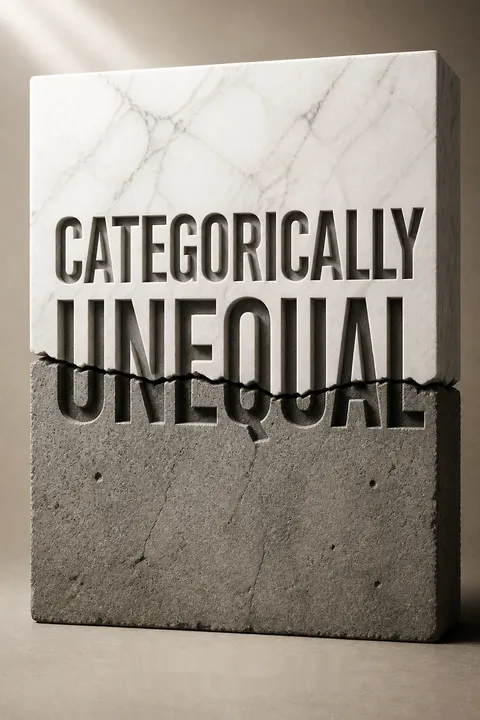
All stratification processes boil down to a combination of two simple but powerful mechanisms: the allocation of people to social categories, and the institutionalization of practices that allocate resources unequally across these categories.
Human cognition drives categorization. Inequality isn't an inherent feature of society but a deliberate construction, starting with our brains' natural tendency to categorize. We are "cognitive misers," using mental shortcuts (schemas) to classify people based on ascribed (birth) and achieved (life experience) traits, often associating these categories with emotional valences that lead to prejudice and stereotypes. This fundamental process allows for the creation of "in-groups" and "out-groups," which are then evaluated along dimensions of warmth and competence.
Exploitation and opportunity hoarding. Once categories are formed, inequality is perpetuated through two core mechanisms: exploitation and opportunity hoarding. Exploitation occurs when one group takes resources produced by another without fair compensation, while opportunity hoarding involves restricting access to scarce resources, often through exclusion. These mechanisms are reinforced by "emulation," where groups copy social distinctions, and "adaptation," where daily behaviors align with ranked categories, making inequality "durable" and self-reproducing.
Dehumanization enables extreme inequality. The most severe forms of categorical inequality, like slavery, are enabled when out-groups are perceived as neither warm nor competent, leading to contempt and even dehumanization at a neural level. This psychological foundation, coupled with the "fundamental attribution error" (blaming individuals for systemic failures) and the "actor-observer effect" (attributing one's own failures to external factors), allows dominant groups to justify and maintain their privileged position, often by controlling the "framing" of social reality and the creation of social and cultural capital.
2. The "Great U-Turn" Reversed Decades of Egalitarian Capitalism.
By the end of the twentieth century all of the declines in inequality achieved under the New and Fair Deals had been wiped out and the United States had unambiguously returned to levels of inequality not seen since the laissez-faire era of the 1920s.
Post-war prosperity was broadly shared. From 1945 to 1975, the United States experienced a period of "egalitarian capitalism," characterized by falling poverty rates, rising median incomes, and decreasing inequality. This era was shaped by New Deal policies that regulated markets, supported workers, and established a social safety net, funded by progressive taxation. The post-war consensus aimed to promote economic growth while ensuring a more equitable distribution of wealth.
Structural shifts triggered a reversal. Beginning in the 1970s, a "Great U-Turn" occurred, driven by three powerful developments: computerization, market expansion (globalization), and fragmentation of consumer markets. Computerization led to manufacturing job losses and the "downsizing" of white-collar roles, while globalization intensified competition for labor. Market fragmentation fostered flexible production and downward pressure on wages, collectively dismantling the institutional arrangements that supported egalitarian capitalism.
Wealth reconcentrated at the top. The most striking outcome of this shift was the dramatic reconcentration of income at the top. Between 1973 and 2000, the share of income going to the top 10% of taxpayers rose by 31%, the top 5% by 45%, and the top 1% nearly doubled, increasing by 91%. This meant that while the poor and middle classes saw stagnant or modest income growth (often requiring two earners), the wealthiest segments experienced unprecedented gains, returning the nation to pre-Depression levels of inequality.
3. Racial Stratification Persists Through Evolving Mechanisms and Mass Incarceration.
In other words, whether whites care to admit it or not, they have a selfish interest in maintaining the categorical mechanisms that perpetuate racial stratification.
Jim Crow's legacy and northern discrimination. Before the Civil Rights era, racial inequality was enforced by Jim Crow laws in the South and a de facto system of private discrimination in the North, particularly through residential segregation. Federal programs like the FHA, Social Security, and the GI Bill were "racialized" to exclude African Americans, denying them access to wealth-building opportunities and social safety nets. This history created a deep-seated inertia in both social institutions and white cognitive structures, making racial stratification resistant to simple legal reforms.
Subtle discrimination replaces overt racism. Despite legal prohibitions against discrimination, racial inequality persisted by moving "underground" into more subtle and clandestine forms. Audit studies consistently reveal discrimination against African Americans in housing, lending, labor, and product markets. This "discrimination with a smile" often relies on indirect cues like "linguistic profiling" or residential location, allowing whites "plausible deniability" while effectively denying blacks equal access to resources.
Mass incarceration as a new mechanism. A profoundly impactful post-civil rights mechanism is the "prison industrial complex." Fueled by politically racialized "wars on crime and drugs," incarceration rates for black men skyrocketed, disproportionately affecting the poor and less educated. This mass imprisonment has devastating consequences:
- Invisible inequality: It artificially depresses black unemployment and inflates wage statistics by removing low-wage earners from official data.
- Double stigmatization: A criminal record severely limits employment and earnings for black men, compounding existing racial prejudice.
- Family disruption: It undermines marriage, increases divorce rates, and contributes to single-parenthood, domestic violence, and the spread of HIV-AIDS within black communities.
4. Latinos, Especially Mexicans, Are Being Racialized into a New Underclass.
The evidence reviewed in this chapter suggests that U.S. policies are moving Mexican Americans steadily away from their middle position in the economic hierarchy and toward formation as an underclass.
Historical racialization and labor exploitation. Mexicans, the nation's second-oldest minority, were racialized early on, particularly after the Treaty of Guadalupe Hidalgo in 1848. They were often framed as "indolent" and "unassimilable," serving as a disposable labor force for industries like agriculture and railroads. Periods of economic downturn, like the Great Depression, saw mass deportations, demonstrating their precarious status as "unwanted" citizens despite their labor contributions.
Immigration policy shifts create an "underground" workforce. The termination of the Bracero Program and the imposition of numerical limits on Western Hemisphere immigration in the 1960s drastically reduced legal avenues for Mexican entry. This inadvertently transformed Mexican migration from a circular, regulated flow into an increasingly undocumented and settled population. The Immigration Reform and Control Act (IRCA) of 1986, while offering some legalization, militarized the border and criminalized employer hiring of undocumented workers, inadvertently increasing the number of vulnerable, exploitable individuals.
Demonization and deepening disadvantage. Post-IRCA policies, coupled with alarmist media framing and political rhetoric (e.g., "alien invaders," "Aztlan Plot"), intensified the demonization of Latinos. This led to increased discrimination in labor and housing markets, a decline in Latino wages relative to whites and even blacks, and rising poverty rates. The 1996 welfare and immigration reforms further curtailed access to public services for legal and illegal immigrants, pushing children out of school to boost family incomes. The "unlawful presence" felony proposal in 2006 threatened to massively expand the prison industrial complex for Latinos, solidifying their position as a deeply exploited and excluded "underclass."
5. The Political Economy Was Remade to Favor the Affluent Over the Poor.
When Martin Gilens (2005) used national surveys administered between 1981 and 2002 to determine the policy preferences for poor, middle-class, and affluent voters, he found that on issues where preferences differed by class, legislative outcomes were strongly associated with the preferences of the affluent, had a weak relationship to those of the middle class, and bore no relationship at all to the opinions of the poor.
Civil rights fractured the New Deal coalition. The Democratic Party's embrace of civil rights in the 1960s, aimed at dismantling Jim Crow and deracializing the welfare state, inadvertently shattered the New Deal coalition. Southern Democrats and northern blue-collar workers, alienated by these changes, shifted their allegiance to the Republican Party. This political realignment empowered conservatives to systematically dismantle the progressive economic policies of the New Deal era, initiating a profound restructuring of the American political economy.
Weakening labor and safety nets. The post-1960s era saw a deliberate weakening of labor's bargaining power.
- Anti-union legislation: The Taft-Hartley (1947) and Landrum-Griffin (1959) Acts curtailed union power, and President Reagan's breaking of the air traffic controllers' strike (1981) signaled a new era of employer aggression.
- Minimum wage decline: The real value of the minimum wage steadily eroded, reaching its lowest point since the 1940s by 2005, ensuring that even full-time work couldn't lift a family of four out of poverty.
- Frayed safety nets: Per capita spending on unemployment benefits and social services for the poor plummeted, with the 1996 welfare reform (PRWORA) drastically reducing welfare rolls and food stamp access, effectively privatizing poverty.
Tax cuts for the rich, debt for the poor. The political economy was further skewed by a dramatic shift in the tax burden. Progressive taxation, a hallmark of the New Deal, was dismantled, with top income and capital gains tax rates slashed, particularly under Republican administrations. This disproportionately benefited the wealthy, while the poor saw their tax burden rise. Simultaneously, declining incomes and reduced social supports forced more Americans into unprecedented levels of consumer debt, with punitive bankruptcy laws making financial recovery increasingly difficult.
6. Gender Stratification Persists, Creating Divergent Destinies for Women.
The feminist revolution has played out in quite different ways at the top and bottom of the American class structure.
Ambivalent sexism and occupational ghettos. Gender stratification, rooted in biological differences, relies on framing women as warm but less competent, leading to "ambivalent sexism" (hostile and benevolent forms). Historically, this translated into occupational segregation, with women confined to "caring labor" within households or "pink-collar ghettos" in the workforce. The "gendering" of white-collar jobs after 1900, through deskilling and explicit "marriage bars," created a "glass ceiling" that limited women's earnings and mobility, leading to a "pollution theory" where female presence devalued occupations.
Feminist gains, but persistent gaps. The feminist movement of the 1960s and 70s successfully outlawed most forms of gender discrimination, leading to a significant shift in attitudes and a surge in female labor force participation. Women's earnings relative to men improved, and occupational segregation declined. However, a substantial earnings gap persists, with industrial location and occupation accounting for a large portion of the difference. This suggests that while overt discrimination has lessened, women remain concentrated in lower-paying fields or lower strata within professions, even with comparable education.
Diverging destinies by class. The impact of these changes has been starkly different for women across the class spectrum.
- Affluent women: Benefited from increased educational and career opportunities, leading to higher incomes, more stable and egalitarian marriages (often with other professionals), and the ability to outsource household labor and childcare. They gained greater autonomy and control over their life trajectories.
- Lower-class women: Faced stagnant earnings, limited occupational mobility in blue-collar and service sectors, and a decline in "marriageable" men due to joblessness and incarceration. This led to rising rates of single-parenthood and continued burdens of traditional household labor, exacerbating their economic vulnerability and limiting their children's life chances.
7. America's Intersecting Inequalities Make It the Most Stratified Developed Nation.
By almost any measure, the United States is unambiguously a more class-stratified place than it was before 1975.
A unique landscape of inequality. The United States stands out among developed nations for its extreme level of income inequality, far exceeding most OECD countries. This is not because its capitalist markets generate more "raw" inequality before taxes, but because its institutional mechanisms for redistribution (taxes and social welfare programs) are far less effective. The "Great U-Turn" after 1975 saw a dramatic shift from a relatively egalitarian society to one where wealth and income are increasingly concentrated at the top.
Class as the dominant cleavage. While gender was the primary driver of income stratification in 1950, explaining 74% of variance, its influence steadily declined to less than 25% by 2005. Conversely, class (proxied by education) rose dramatically, explaining 18% of variance in 1950 to 62% in 2005. Race, while fluctuating, remained a persistent factor, explaining around 4-8% of income variance. This indicates a fundamental shift in the structure of American inequality, with class-based mechanisms now playing the most significant role.
Intersectional disadvantages and a rigid system. The rising importance of class does not diminish the impact of race and gender; rather, these categorical inequalities increasingly operate through access to education, the crucial resource in a knowledge-based economy. Racial segregation in schools, the disproportionate incarceration of black men, and policies that push Latino children out of school perpetuate educational disparities. Similarly, gendered occupational choices and the "two-tiered" family system reinforce class divisions among women. This complex interplay of race, class, and gender creates a rigid "ecology of inequality," where the affluent are insulated from social problems, and the disadvantaged face compounding barriers to upward mobility, making America a deeply unequal society.

Download PDF
Download EPUB
.epub digital book format is ideal for reading ebooks on phones, tablets, and e-readers.








































