
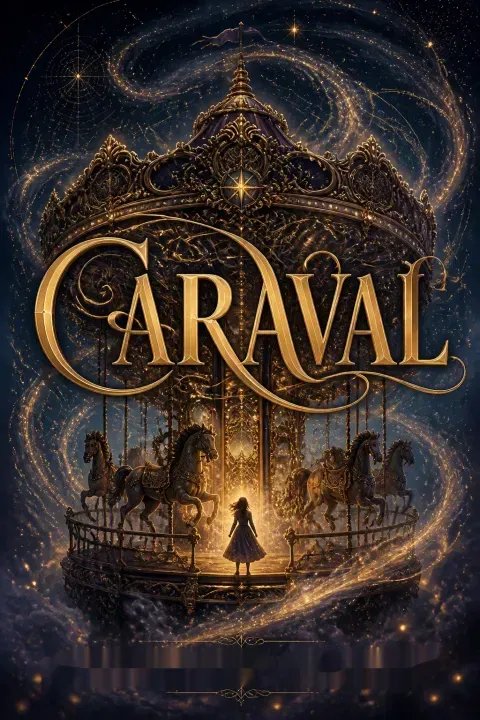


Plot Summary
Drugged on Black Sand
Scarlett Dragna1 has written to Caraval Master Legend6 for seven years, hoping to experience the magic her grandmother once described. When his gilded letter arrives with three tickets, she finds her sister Tella2 entangled with a handsome sailor named Julian3 in their father's barrel room.
Governor Dragna4 catches them and strikes Tella2 across the face as punishment for Scarlett's1 imagined disobedience. He announces Scarlett's1 wedding to an unnamed count in ten days. That night on Del Ojos Beach, Scarlett1 tries to bribe Julian3 with the tickets to abandon Tella.2
But Tella2 and Julian3 have already conspired. Julian3 presses a drugged cloth to Scarlett's1 face. She collapses onto the black sand, her sister's2 apology the last thing she hears before unconsciousness claims her.
The opening establishes the Dragna sisters' trauma-bonded dynamic. Scarlett sees emotions in colors and has learned survival through compliance. Tella has learned manipulation and risk-taking. Their father's punishment system (hurting one sister for the other's crimes) creates toxic codependency where each sister's survival depends on the other's behavior. The kidnapping, though framed as betrayal, is actually Tella's desperate act of love: she knows Scarlett would never choose freedom over safety, so she removes the choice. The drugging mirrors how abuse victims often need external force to escape their abusers.
The Fake Engagement
Scarlett1 wakes on a raft sailing toward Isla de los Sueños, Legend's6 private island. Julian3 rows them through icy pink-turquoise waters, but their boat sinks offshore. Julian3 slices off Scarlett's1 heavy gown with his knife so she can swim to the white-sand beach.
Tella2 is nowhere to be found. Freezing and half-dressed, Scarlett1 follows Julian3 through an abandoned village of hatbox-shaped shops until they reach the entrance to Caraval: a towering wooden mansion ringed by an iron fence. A girl on a unicycle asks for their tickets.
Julian3 produces them and lies that Scarlett1 is his fiancée, since the third ticket was meant for her future husband. Scarlett1 plays along. They receive the rules: nothing inside is real, but getting swept too far away can lead to madness or death.
Julian's lie about the engagement is a brilliant narrative device: it creates dramatic irony (the audience knows the pretense while Scarlett navigates its consequences) and establishes the central tension between Scarlett's duty to her real fiancé and her growing feelings for Julian. The warning about 'getting swept away' functions as both a literal game rule and thematic foreshadowing. Scarlett's physical vulnerability (nearly drowning, losing her dress) mirrors her emotional exposure entering this world where nothing is what it seems.
Donatella Dragna, First Clue
Scarlett1 and Julian3 race to La Serpiente de Cristal inn before sunrise locks them out. Scarlett1 convinces the innkeeper to let Julian3 inside by invoking Legend's6 name, earning them a shared room with two doors.
Scarlett's1 first clue arrives in an envelope: a green glass key bearing her sister's2 name and a hidden poem revealing Tella2 was last seen with Legend.6 The five clues must be solved to find her, and the winner receives one wish. Scarlett1 locates Tella's2 room but hears a man's voice inside and her sister2 demanding she stay out.
Hurt and confused, Scarlett1 sleeps in the hallway. A tattooed young man named Dante8 offers her his room. The next evening, Scarlett1 finds Tella's2 room ransacked by other players hunting for clues. A pregnant girl steals Scarlett's1 gathered belongings, including precious earrings from her vanished mother.
Scarlett's isolation in the hallway after Tella's rejection crystallizes their imbalanced relationship: Scarlett has built her identity around protecting Tella, but Tella doesn't reciprocate with the same devotion. This sets up the eventual revelation that Tella orchestrated everything. The ransacking of Tella's room introduces the game's predatory nature: other players treat Tella's disappearance as a puzzle, not a crisis. Scarlett's instinct to gather and protect her sister's belongings contrasts with the vultures who see only clues, establishing her as someone who loves rather than competes.
Nigel's Painted Prophecy
Scarlett1 and Julian3 travel to Castillo Maldito, a golden palace lit by enormous hourglasses. Scarlett1 enters the tent of Nigel,11 a fortune-teller whose body is covered in prophetic tattoos. His incense compels her to admit she finds Julian3 the most attractive person she has ever seen.
When she asks about her future husband, Nigel11 warns the count5 is not a good man and may never become one. She asks where to find Tella.2 Nigel's11 answer: follow the boy with a heart made of black. Outside, Scarlett1 buys an Elixir of Protection from a perfume shop, paying with her father's4 name.
She then follows Julian3 into a dying garden and discovers a hidden staircase beneath a neglected fountain. Below ground, tunnels stretch in multiple directions. Screams echo through the stone corridors, and a red-lipped performer warns Scarlett1 to leave before madness claims her.
Nigel's prophecy operates on multiple levels. The 'boy with a black heart' initially seems to be Julian (selfish, dishonest), then Dante (who has a literal black heart tattoo), but ultimately describes Legend himself. Scarlett's compelled confession about Julian's attractiveness reveals feelings she has suppressed beneath her duty to her fiancé. The tunnels represent the unconscious: a place where fear amplifies and hidden truths emerge. The screaming woman (later revealed as part of the performance) demonstrates how Caraval blurs the line between staged cruelty and genuine suffering.
Trading Days of Life
Scarlett1 meets Aiko,9 a histographer who records Caraval through drawings. Aiko9 leads her to a dress shop where Scarlett1 purchases two gowns, paying with two days of her life. The shopgirl explains that at sunrise, Scarlett's1 body will die for two full days.
As Scarlett1 weakens, Aiko9 shoves sugar cubes into her mouth and pushes her toward the inn. Dante8 intercepts her in the stairwell, desperate because his sister Valentina is also missing. Julian3 appears and knocks Dante8 away. He carries Scarlett1 to their room, where she is dying.
Julian3 slices his finger and presses his blood to her lips, then draws her blood and tastes it himself. The exchange transfers a day of his life to her. Scarlett1 feels his emotions through the blood connection as he cradles her against his chest. She realizes she wants more than safety: she wants him.
The blood exchange scene transforms their relationship from transactional partnership to genuine intimacy. Julian's sacrifice, giving part of his life for hers, proves his feelings exceed his mission. Scarlett's experience of his emotions (awe, protectiveness, pain) through the blood magic allows her to trust him in a way her trauma usually prevents. The dress shop payment system literalizes what abuse victims know intuitively: every choice costs pieces of yourself. Scarlett's willingness to pay with time rather than confess her deepest fear or desire shows she has learned from her father that secrets must be guarded, even at great cost.
Legend Wears Julian's Face
During her death-sleep, Scarlett1 dreams vividly. Aiko9 appears and opens her journal, a record of every Caraval ever played. Scarlett1 witnesses the story of Rosa, a young woman who fell in love with Legend6 during a previous game. After Legend6 discarded her, Rosa threw herself from a balcony to her death.
The dream shows Rosa's funeral procession: mourners in black, rose petals falling, and Rosa's devastated fiancé, a younger Dante.8 Then Scarlett1 sees Legend6 himself watching from the crowd, his face finally visible beneath his signature top hat. It is Julian's3 face.
When Scarlett1 wakes, she finds herself wrapped in Julian's3 arms. She pulls away in horror, now believing the boy she was falling for is actually the monstrous Legend,6 who seduces women and drives them to suicide as revenge for her grandmother Annalise's ancient betrayal.
This dream sequence functions as the novel's midpoint revelation, though it is partially misleading. The reader and Scarlett are given evidence that seems conclusive: Julian's face on Legend's body. The Rosa story parallels what could happen to Tella, raising the stakes. The revelation also introduces the grandmother backstory: Legend loved Annalise, she betrayed him, and now he seeks revenge on her descendants. Scarlett's immediate recoil from Julian upon waking, despite the intimacy they shared before her death, illustrates how her trust issues can be weaponized against her. The game exploits her trauma history: having been betrayed by her mother's abandonment and her father's cruelty, she expects betrayal.
The Tunnels' Bloody Secret
Scarlett's father4 has arrived on the island, his lavender-and-rotten-plum cologne preceding him through the halls of La Serpiente. In a panic, Scarlett1 follows Julian3 through a hidden passage in Tella's2 fireplace into the tunnels. There she finds Julian3 standing over Dante's8 severed, bloody body.
Scarlett1 tries to flee, convinced Julian3 killed him. Julian3 pins her and rips open his shirt to reveal a white rose tattoo matching Dante's8 black one. He explains Rosa was his sister, not Dante's8 fiancée as the game portrayed. Dante8 was a performer helping Julian3 infiltrate Caraval to stop Legend6 from destroying more lives.
Then Julian3 confesses the deeper truth: Legend6 is his brother. Scarlett's father's4 footsteps echo through the tunnels. Julian3 pulls Scarlett1 into a cramped hiding chamber that feeds on fear, shrinking until they press together, hearts racing.
This scene recasts the entire narrative. Julian transforms from mysterious love interest to traumatized avenger. His revelation about Legend being his brother explains his insider knowledge and his guilt: he stayed with Caraval too long while his brother became a monster. The fear-sensitive room externalizes Scarlett's psychological state: the more she panics, the more trapped she becomes. Julian's instruction to relax (which makes the room expand) mirrors the emotional work of trust: you must release fear to create space. The father's arrival elevates the external stakes while the internal revelation shifts the emotional landscape.
The Hat Shop Trap
Scarlett1 pieces together the fifth clue: buttons, which have appeared throughout the game, lead to a hat shop shaped like a top hat. She wears a gown covered in buttons, delivered in a black box she assumes is Legend's6 final challenge. Julian3 argues the shop feels wrong, too obvious.
Inside, Scarlett1 meets a striking man with an eye patch and crimson cravat. She shows him her collection of buttons. He kisses her hand and calls her his fiancée. The man is Count Nicolas d'Arcy.5 Scarlett's father4 emerges from the back of the shop with the tailor.
Julian3 shoves over a display, grabs Scarlett,1 and they flee through silver rain. The count5 and the governor4 pursue them through the streets. Scarlett1 realizes the buttons were never Legend's6 clue at all: the dress box came from the Count,5 the note signed with 'D' for d'Arcy, not Donatella.2
The button reveal demonstrates how Scarlett's assumptions led her into a trap. She interpreted the game through Legend's lens when her fiancé was playing his own manipulation alongside Legend's. The Count's polish and charm in the shop (kissing her hand, his cultured bearing) contrast sharply with his later complicity in her father's violence, illustrating how abusers often present appealing surfaces. Scarlett's escape with Julian despite having her 'safe' future standing right before her shows how far she has moved from the girl who wanted only security. The rain washing away magic echoes her disillusionment.
Scarred for Her Freedom
Scarlett's father4 and the Count5 capture her and Julian3 in the tunnels beneath La Serpiente. Governor Dragna4 holds a knife to Julian's3 throat. Scarlett1 begs him to stop. Her father4 slashes the blade across Julian's3 face from jaw to eye, creating a wound that will leave a permanent scar.
He then announces Scarlett1 must share her room with the Count,5 who has 'paid quite a sum' for her. In the room, the Count5 begins undressing. Scarlett1 grabs the fireplace poker, then remembers the Elixir of Protection. She retrieves the vial from her wardrobe as Julian,3 who was hiding inside, tumbles out unconscious from his injury.
Scarlett1 sprays the elixir into the Count's5 face. He collapses, limbs going numb and useless. Scarlett1 ties him to the bed and helps Julian3 up. The elixir will wear off in two hours. They escape into the final night of the game.
This scene is Scarlett's definitive break from victimhood. She has watched her father hurt others (Tella, Felipe, Julian) her entire life while feeling powerless. The poker and the elixir become instruments of agency. Her father's attempt to force consummation with the Count reveals marriage as a commercial transaction: she is property being transferred. Scarlett's rejection of this fate, using tools she acquired through her own risk-taking (trading secrets for the elixir), completes her transformation from passive survivor to active fighter. The Count's paralysis literalizes what Scarlett has overcome: the numbing terror that kept her compliant.
The Carousel's Vanishing Center
Scarlett1 realizes roses, not buttons, are the true fifth clue. She and Julian3 find a carousel covered in blood-red roses where an organist plays mournful songs for donations. When Scarlett1 asks for something pretty, the carousel spins, petals flying. She finds Legend's6 symbol hidden beneath a top-hat-shaped rosebush.
When she touches it, the carousel's center vanishes into darkness. Julian3 presses his pocket watch into her palm. Inside is etched the coordinates of a boat that will take her anywhere. His strained voice on the watch's recording confesses he is sorry, that the game was never just a game for him.
Scarlett1 wraps the chain around her neck and jumps. She plunges into cold underground water, swims to soapstone stairs guarded by two agonized statues, and emerges in a jade-lit cavern where a young man7 in a velvet top hat waits for her, applauding.
The carousel jump literalizes the 'leap of faith' clue while functioning as a threshold between the game's surface and its dark heart. Julian's gift of the pocket watch, with its pre-recorded confession and escape coordinates, suggests he anticipated he might not survive what comes next. The magical constraints that prevent performers from speaking certain truths force him to encode his honesty in objects rather than words. Scarlett's willingness to jump demonstrates her evolution: the cautious girl who couldn't make a bargain in the clock shop now hurls herself into darkness. The pocket watch becomes a talisman of trust.
Julian Falls
The man7 in the cavern introduces himself as Legend. He is elegant, manic, younger than expected. Scarlett1 demands her wish for finding Tella.2 Legend7 laughs and refuses, claiming she has not won because she hasn't truly found her sister yet. Julian3 appears, perfectly dry and unharmed.
Legend7 reveals that Julian3 has been working with him the entire game, that Dante8 and Valentina were performers, and Rosa was merely 'an unfortunate girl who got too swept away.' Julian3 looks at Scarlett1 with cold indifference. Then Scarlett1 plays the pocket watch recording.
Julian's3 voice confesses he couldn't tell her the truth because magic prevented him. Legend's7 expression shifts to fury. He pulls out a knife and stabs Julian3 in the chest. Julian3 collapses, blood bubbling from his lips. He dies in Scarlett's1 arms.
This scene represents the emotional nadir. The double betrayal (Julian as Legend's pawn, then Julian's death) seems to confirm Scarlett's worst fears about trust. Yet the pocket watch recording undermines the betrayal: it proves Julian's feelings were real even when his performance said otherwise. His death echoes the earlier blood exchange scene, completing the circle. Scarlett's hands on his wound mirror her earlier helplessness watching her father hurt Tella. But this time she does not passively witness: she fights, she tries to save him. The revelation that performers can die and resurrect during the game is withheld from both Scarlett and the reader, making the grief genuine.
Donatella Steps Off the World
Scarlett1 follows Legend's7 directions up a winding staircase to a rimless balcony under an endless sky. Tella2 waits there in a pale nightdress, healthy and delighted to see her. But she refuses to leave. She has fallen in love with a man named Daniel DeEngl, a bastard lord who has promised to marry her and protect them both.
Scarlett1 tries to explain that Legend6 has manipulated Tella2 as revenge against their grandmother. Tella2 won't believe it. Then Governor Dragna4 and Count d'Arcy5 arrive. Tella2 realizes Daniel is actually Legend7 when he coldly admits he lied about everything.
Devastated, Tella2 backs toward the balcony's edge. Scarlett1 begs her to stop. Tella2 whispers that she would rather die at the edge of the world than live a miserable life on Trisda. She blows Scarlett1 a kiss and steps backward into the night. Her body falls. The blood pools on the street below.
Tella's 'death' is the story's most brutal test. Scarlett has structured her entire identity around protecting her sister. To watch Tella choose death (especially after Scarlett has just watched Julian die) devastates her completely. Yet there is dramatic irony here that Scarlett cannot see: Tella's speech about preferring death to Trisda echoes the exact rhetoric of someone who has planned her own escape. The balcony itself recalls Rosa's death, suggesting a cyclical pattern that the story will ultimately break. Legend's cruelty in forcing Scarlett to witness this mirrors their father's punishment system: making one sister suffer for the other's choices.
The Letters Tella Left
Scarlett1 cradles Tella's2 broken body on the street, pressing her own blood to her sister's2 lips, wishing desperately for her return. Nothing happens. Governor Dragna,4 broken and frightened after Legend6 threatens him, leaves with the Count.5 Jovan10 the performer leads Scarlett1 back to Tella's2 room, where a glass box bearing Caraval's symbol sits on the vanity.
Inside are letters revealing Tella's2 secret: months ago, she made a bargain with Legend.6 She offered something valuable in exchange for his help staging her own death so she could escape their father4 permanently.
Tella2 knew Scarlett's1 love could wish her back if Scarlett1 wanted it more than anything. Scarlett1 then confronts the man who played Legend. He admits his name is Caspar,7 merely an actor. The real Legend6 always wears a different face. And Tella2 walks through the door, alive and grinning, her death undone by Scarlett's1 genuine love.
This is the emotional and narrative climax where all deceptions unravel. Tella is revealed not as a reckless victim but as the story's hidden strategist, having engineered her own disappearance, tested Scarlett's love through the game's trials, and orchestrated her own death and resurrection. The revelation reframes Tella's earlier behavior: her apparent carelessness was calculation, her promiscuity was networking (Julian was her transportation), and her 'betrayal' was salvation. Caspar's admission that he is merely an actor demystifies Legend while preserving his menace as an unseen, shape-shifting threat. The real Legend remains Julian's brother, never directly encountered. Scarlett's wish succeeds not because of magic alone but because her love for Tella was powerful enough to fuel it.
The Scar That Stayed
At the celebratory party among glowing willow trees and golden lantern light, Scarlett1 finds Julian3 alive and chatting with a pretty performer. When he sees her, he sets down his drink and strides toward her. Scarlett1 is guarded: she doesn't know what was real and what was performance.
Julian3 explains his full name (Julian Bernardo Marrero Santos) and that Legend6 is his actual brother. He grew up idolizing Legend,6 became a performer, then grew disillusioned after Rosa's suicide. His mission was only to deliver the sisters to the island, but he kept finding reasons to stay.
The scar her father4 carved into his face remains, because performers who die during the game keep their injuries as permanent marks. Scarlett1 touches the scar, tracing its path from his jaw to his eye. She tells him it is the most beautiful thing she has ever seen. They kiss beneath the willow branches, the game finally over.
The scar serves as physical proof of authenticity in a world of illusions. Everything else about Julian could be performance, but the scar was inflicted outside the game's script by Scarlett's real father with real violence. It marks Julian as someone who chose to suffer rather than abandon her. His confession that he 'kept finding reasons to stay' reframes his earlier evasions and departures: he tried to follow the script but couldn't. Scarlett's attraction to the scar (rather than revulsion) signals her growth: she has learned to value the marks that prove someone fought for her. The kiss under willows closes the romantic arc while leaving the larger Legend mystery open for the sequel.
Epilogue
As Scarlett1 and Julian3 kiss beneath the willow trees, Tella2 dances through the party, drinking champagne that makes her feet float above the grass. She has told Scarlett1 almost everything about her bargain with Legend.6 A stranger6 pulls her close on the dance floor, his hands confident and possessive.
Before she can see his face clearly, he slips something heavy into her pocket and vanishes into the crowd. Tella2 retreats to a secluded tree and unwraps the object: a thick coin unlike any currency she has seen, wrapped in a note. The handwriting is crisp and precise, signed with a single initial.
The epilogue shifts perspective to Tella, who has operated in Scarlett's shadow throughout the novel. Her mysterious encounter with the vanishing stranger (likely the real Legend) suggests her bargain with him is not yet fully paid. The coin and note imply a future debt or invitation, setting up the sequel. Tella's narration reveals her loneliness beneath the bravado: she orchestrated her own death to save them both but remains unmoored, seeking distraction in champagne and strange hands. The initial on the note is deliberately withheld from the reader, transforming the epilogue into a cliffhanger that recontextualizes Tella from secondary character to protagonist of her own unfolding story.
Analysis
Caraval operates as a nested series of performances, each concealing a deeper truth. The most visible layer is the game itself: a magical treasure hunt where players chase clues through an enchanted city. Beneath that is Legend's6 theatrical production, staffed by actors playing roles within roles. Deeper still is Tella's2 secret plan, a bargain with Legend6 that turns the entire game into a vehicle for her own staged death and resurrection. And at the core lies the novel's central argument: that love, when genuine enough, is itself a form of magic capable of altering reality. Scarlett's1 wish succeeds not because Legend6 granted it (he didn't) but because her love for Tella2 was powerful enough to fuel the magic independently. The novel thus reframes the fantasy genre's wish trope as an expression of emotional truth rather than external deus ex machina. The story also interrogates performance as both art and deception. Every character performs: Tella2 performs recklessness to hide calculation; Julian3 performs indifference to hide devotion; Legend's6 actors perform villainy that gradually corrupts the real Legend.6 The distinction between mask and self becomes increasingly unstable, culminating in Julian's3 scar, a permanent mark that proves something real happened in a world of illusions. The novel's treatment of abuse is similarly layered. Governor Dragna's4 violence is never supernatural or exaggerated; it is mundane, familial, and chillingly credible. His punishment system, hurting one sister for the other's actions, creates the codependency that drives both the plot and the sisters' psychology. Scarlett's1 arc from compliance to defiance models a survivorship that does not require becoming hard or cruel. She wins through love, not vengeance. The grandmother backstory adds historical depth: Legend's6 transformation from heartbroken lover to villain mirrors how trauma, left unhealed, calcifies into cruelty. The Dragna sisters break this cycle. Scarlett1 chooses forgiveness (of Julian,3 of Tella2) without naivety, and Tella2 engineers an escape that harms no one but their abuser. The epilogue's mysterious coin suggests that bargains with Legend6 carry ongoing costs, and that the sisters' freedom may not be as complete as they hope. Yet the final image of the novel, Scarlett1 and Julian3 kissing beneath glowing willows, affirms that choosing love over fear is always worth the risk, even when the person you choose carries scars you cannot fully understand.
Review Summary
Caraval receives mixed reviews, with some readers praising its magical atmosphere and plot twists, while others criticize its underdeveloped characters and world-building. Many find the writing style beautiful but occasionally overwrought. The romance between Scarlett and Julian divides opinion. Some readers love the mysterious nature of the story, while others feel frustrated by the lack of clear explanations. Despite its flaws, many readers find the book entertaining and are intrigued enough to continue with the series.
People Also Read








Characters
Scarlett Dragna
Cautious dreamer turned fighterThe elder Dragna sister possesses a subtle synesthesia: she sees emotions as colors. Years of her father's4 abuse have made her vigilant, self-sacrificing, and terrified of risk. She has written to Caraval Master Legend6 for seven years, hoping for magic to enter her bleak life. Engaged to a count5 she has never met, Scarlett believes marriage is her only escape from Trisda and the only way to protect her impulsive sister Tella2. She enters the game believing she must win quickly and return for her wedding. Through the trials of Caraval, she transforms from someone who equates safety with survival into someone willing to gamble everything for love and freedom. Her deepest fear is failing to protect Tella2; her deepest desire, which she cannot initially admit, is to be loved fiercely and freely.
Donatella 'Tella' Dragna
Reckless strategist in disguiseScarlett's1 younger sister conceals fierce intelligence beneath a party-girl exterior. Where Scarlett1 responds to trauma with hypervigilance, Tella responds with thrill-seeking and manipulation. She made a secret bargain with Legend6 months before the story begins, trading something precious for his help in staging her own death so she could escape their father4 permanently. She orchestrated the entire Caraval plot, knowing Scarlett's1 love could wish her back to life. Tella's apparent frivolity (drinking, flirting with sailors, collecting mermaid cards and pretty dresses) masks her methodical planning. She genuinely loves Scarlett1 but expresses it through control rather than honesty, a pattern learned from their manipulative father.
Julian Bernardo Marrero Santos
Legend's disillusioned younger brotherA Caraval performer who introduces himself as a common sailor. Julian is actually Legend's6 younger brother, though he has grown disgusted with what his brother6 has become. After a young woman named Rosa killed herself following Legend's6 seduction and rejection, Julian lost faith in Caraval and wanted to leave. Legend6 convinced him to play one final role: escorting Scarlett1 and Tella2 to the island. Julian was meant to abandon Scarlett1 after delivering her, but her fierce devotion to her sister reminded him of his own loyalty to family. He keeps finding reasons to stay, falling genuinely in love with Scarlett1 even as the game's magical constraints prevent him from confessing the full truth. The scar Governor Dragna4 carves into his face remains after the game ends, proof that his suffering for Scarlett1 was real.
Governor Marcello Dragna
Abusive father and puppet masterThe governor of Trisda maintains a civilized facade with tailored coats, a neat goatee, and perfumed plum gloves. He removes the gloves only when administering violence. His punishment system is psychologically vicious: he hurts one daughter for the other's disobedience, creating a dynamic where each sister lives in terror of causing the other's pain. After his wife Paloma abandoned the family, he destroyed everything that reminded him of her and grew increasingly cruel. He murdered a guard's son named Felipe by drowning him to frighten Scarlett1 into obedience. He arranged Scarlett's1 marriage to Count d'Arcy5 for political advancement, treating his daughters as currency. His arrival on the island represents the intrusion of real danger into the game's constructed peril.
Count Nicolas d'Arcy
Scarlett's purchased fiancéScarlett's1 arranged husband presents himself as a refined aristocrat with an eye patch, a crimson cravat, and elegant manners. His letters to Scarlett1 were kind and reassuring, but in person he reveals a colder nature. He has paid Governor Dragna4 for Scarlett1 and views her as an acquisition. When Scarlett1 resists, he does not force himself on her but also does not protect her from her father's4 violence. His complicity makes him almost more disturbing than the governor4: he has the power to intervene but chooses not to, revealing the moral vacancy beneath his polished surface. After Scarlett1 uses the Elixir of Protection on him, he leaves the island, but his final look suggests he considers their business unfinished.
Legend (the real one)
Shape-shifting master of CaravalThe elusive master of Caraval never appears directly in the novel. He is Julian's3 older brother, a former performer who gained magic through a wish. The magic allows him to blend fantasy with reality, but it comes with a cost: the more he performs villainous roles, the more villainous he becomes in truth. He wears a different face each game, played by different actors (Caspar7 in this year's game). His history with Scarlett's1 grandmother Annalise (who loved and left him) partially motivates his interest in the Dragna sisters, though Tella's2 bargain is the primary driver. He remains an offstage presence, his true nature and appearance left mysterious for future books.
Caspar
Actor who plays LegendThe performer hired to play Legend6 during this year's Caraval. He affects madness and cruelty convincingly, stabbing Julian3 on Legend's6 orders and tormenting Scarlett1 throughout the final act. When Scarlett1 confronts him after the game, he admits he is merely an actor following a script. His admission demystifies the Legend6 persona while confirming the real Legend6 remains unknown.
Dante
Tattooed performer playing a mournerA handsome, tattooed Caraval performer whose character arc involves his 'dead sister Valentina' and 'dead fiancée Rosa.' He offers Scarlett1 his room when she sleeps in the hallway, publicly humiliates her when he believes she chose Julian3 over him, and is later found 'murdered' in the tunnels. All of this is performance, though his desperation to win the wish (to restore what he lost in a previous game) contains genuine emotion. His black heart tattoo becomes a clue leading Scarlett1 to the cider cart. After the game, he attends the party with two girls on his arms, his hands restored.
Aiko
Mysterious histographer of CaravalA pretty, gold-clad young woman who records Caraval's history through drawings in her journal. She guides Scarlett1 to the dress shop (part of Tella's2 plan to test Scarlett's1 desire) and shows her visions of Rosa's death during Scarlett's1 death-dreams. Her loyalties are ambiguous: she works for Legend6 but also seems genuinely helpful. Her journal contains every true story from every Caraval ever played, making her a keeper of the game's dark history.
Jovan 'Jo'
Loyal Caraval performerA cheerful dark-skinned performer who greets Scarlett1 at the gate on a unicycle, rows her through canals, and later helps her find Tella's2 letters after the game ends. Jo works directly for Legend6 but shows genuine kindness to Scarlett1 throughout. When Governor Dragna4 slaps her for intervening, Legend6 threatens to kill him for harming one of his players, revealing that Legend's6 possessiveness extends to his performers.
Nigel
Tattooed fortune-tellerA nearly naked man whose entire body is covered in prophetic tattoos at Castillo Maldito. His incense compels truth-telling, and his tattoos act as mirrors reflecting what visitors most desire or fear. He gives Scarlett1 the clue to follow 'the boy with a heart made of black' and warns her that her future husband5 is not a good man.
Plot Devices
The Enchanted Dress
Emotional barometer and character symbolLegend6 gifts Scarlett1 a magical gown that transforms based on her emotions. It starts as a drab beige frock, shifts to cherry-red silk when she feels confident, turns black with grief, becomes sheer and scandalous when she feels vulnerable, and morphs into mourning crepe when she worries. The dress externalizes Scarlett's1 internal state, making visible what she tries to hide. It also serves as a control mechanism: the dress has 'a mind of its own,' refusing to become plain when Scarlett1 wants to blend in, forcing her to be seen. The enchanted dress contrasts with the dresses Scarlett1 purchases at the shop, which cost days of her life but give her agency over her appearance, symbolizing her transition from Legend's6 puppet to her own woman.
The Five Clues
Game structure and narrative spineThe game's mystery unfolds through five clues hidden throughout Caraval, each requiring Scarlett1 to give something of herself to progress. The first clue is Tella's2 name, revealing her sister is the prize. The second is a picture card of a castle (something Tella2 would never own, since she loved mermaids). The third requires following the boy with a black heart. The fourth costs something valuable: Scarlett's1 color vision. The fifth requires a leap of faith: jumping through the carousel. The clues are designed not just to challenge Scarlett1 but to test her: does she love Tella2 enough to sacrifice her time, her safety, her heart? The poem attached to the first clue also contains hidden text revealing the wish prize, visible only in certain light.
Blood Magic
Life transfer and emotional connectionIn Caraval's magic system, blood can transfer days of life between people. When Scarlett1 pays for her dresses with two days of her existence, Julian3 saves her by giving her a day of his life through a blood exchange ritual. The exchange creates a temporary emotional bond: Scarlett1 can feel Julian's3 emotions (awe, protectiveness, pain) and briefly see the colors of other people's feelings. Later, Scarlett1 attempts to use blood magic to wish Tella2 back to life after her fall from the balcony. The magic does not work through blood alone, however: a wish requires genuine, overwhelming desire. Scarlett's1 love for Tella2 fuels the wish that resurrects her sister. The blood bond foreshadows the deeper truth that Julian's3 feelings for Scarlett1 are genuine, not performance.
Julian's Pocket Watch
Hidden confession and escape routeBefore Scarlett1 jumps into the carousel's dark center, Julian3 presses his pocket watch into her hand. Inside the cover are etched the coordinates of a boat that will take her anywhere. The watch also contains a recorded confession: Julian's3 strained voice explaining he is sorry, that the game was never just a game for him, and that he hopes she can forgive him. Because magical constraints prevent Caraval performers from speaking certain truths aloud, Julian3 encoded his honesty into the watch. When Scarlett1 plays the recording in front of Caspar7 (the false Legend6), it reveals Julian's3 betrayal of Legend's6 script, triggering Caspar7 to stab Julian3. The pocket watch thus serves as both Julian's3 love letter and the evidence that gets him killed.
The Elixir of Protection
Agency-granting weaponScarlett1 purchases a small blue vial of Elixir of Protection from a perfume shop in Castillo Maldito after confessing that her father4 is the person she fears most. The shopkeeper explains that spraying it on someone who is about to cause harm will stop them for two hours, and it can only be used once. Scarlett1 carries the elixir through multiple dangers before finally using it on Count d'Arcy5 when he attempts to consummate their marriage in her room at La Serpiente. The spray reduces him to a clumsy, numb state, allowing Scarlett1 to tie him to the bed and escape. The elixir represents Scarlett's1 growing resourcefulness: she acquired it by trading a secret (her father's4 name), carried it despite doubting its reality, and deployed it at the moment of greatest need, transforming from victim to agent.
FAQ
Synopsis & Basic Details
What is Caraval about?
- Sisters seek escape: Scarlett and Tella Dragna, trapped on the Isle of Trisda, yearn for freedom and the magic of Caraval, a legendary game.
- A dangerous invitation: When an invitation to Caraval arrives, it sets off a chain of events that pulls Scarlett into a world of illusion, deception, and high stakes.
- Navigating a magical game: Scarlett must navigate the treacherous game, solve its mysteries, and confront her deepest fears to find her sister and win a wish.
Why should I read Caraval?
- Immersive fantasy world: Caraval offers a richly detailed and immersive world where magic and reality blur, captivating readers with its unique atmosphere.
- Intriguing characters: The story features complex characters with hidden motivations, making their relationships and interactions compelling and unpredictable.
- Twisting plot and high stakes: The plot is full of twists and turns, keeping readers engaged with its high stakes and the constant threat of danger and deception.
What is the background of Caraval?
- Fantasy setting: Caraval is set in a world with multiple empires, including the Meridian Empire, where the Conquered Isles are located, and the Southern Empire, known for its lawlessness.
- Magical elements: The world contains elements of magic, with Caraval being a place where illusion and reality intertwine, and where wishes are rumored to come true.
- Cultural influences: The story draws on various cultural influences, creating a unique blend of fantasy and historical elements, with a focus on performance and spectacle.
What are the most memorable quotes in Caraval?
- "Whatever you've heard about Caraval, it doesn't compare to the reality. It's more than just a game or a performance. It's the closest you'll ever find to magic in this world.": This quote encapsulates the allure and mystique of Caraval, highlighting its unique nature.
- "Dreams that come true can be beautiful, but they can also turn into nightmares when people won't wake up.": This quote serves as a warning about the dangers of getting too lost in the illusions of Caraval, foreshadowing the potential for tragedy.
- "Most of the people here aren't who they appear.": This quote emphasizes the theme of deception and the importance of being cautious in the world of Caraval, where trust is a rare commodity.
What writing style, narrative choices, and literary techniques does Stephanie Garber use?
- Vivid sensory language: Garber employs rich, sensory language to create an immersive experience, using colors, scents, and sounds to bring the world of Caraval to life.
- Shifting perspectives: The narrative primarily follows Scarlett's point of view, but also incorporates elements of other characters' perspectives, adding depth and complexity to the story.
- Foreshadowing and symbolism: Garber uses subtle foreshadowing and recurring symbols to hint at future events and deepen the thematic elements of the story, creating a sense of mystery and intrigue.
Hidden Details & Subtle Connections
What are some minor details that add significant meaning?
- The color of the gloves: Governor Dragna's plum-colored gloves, described as the shade of dark bruises and power, foreshadow his abusive nature and the violence he inflicts.
- The water seals on the tickets: The water seals on the Caraval tickets shift from gold to crimson, foreshadowing the dangerous and potentially deadly nature of the game.
- The description of Julian's hands: Julian's hands are described as if he were a parcel that couldn't wait to be unwrapped, foreshadowing his manipulative nature and his use of others.
What are some subtle foreshadowing and callbacks?
- Nana's stories of Caraval: Scarlett's grandmother's stories about Caraval, initially dismissed as fairy tales, foreshadow the magical and dangerous reality of the game.
- The black sand of Del Ojos Beach: The story of the black sand being "burnt pirate skeletons" foreshadows the dark and dangerous secrets hidden beneath the surface of Caraval.
- The missing page from the count's letter: The missing page from the count's letter, removed by her father, foreshadows the count's true nature and the deception surrounding Scarlett's engagement.
What are some unexpected character connections?
- Julian's knowledge of Caraval: Julian's familiarity with Caraval, initially presented as a simple sailor's knowledge, is later revealed to be due to his past involvement with the game and his connection to Legend.
- Aiko's role as a histographer: Aiko's seemingly random appearances and her knowledge of Caraval's history reveal her role as a histographer, adding a layer of depth to her character and her interactions with Scarlett.
- Dante's connection to Rosa: Dante's connection to Rosa, a previous Caraval participant who died, reveals his personal stake in the game and his desire for revenge, adding a layer of complexity to his character.
Who are the most significant supporting characters?
- Aiko: As a histographer, Aiko provides Scarlett with insights into Caraval's history and the nature of the game, acting as a guide and a source of information.
- Rupert: The young boy who delivers the rules of Caraval, his dramatic exit foreshadows the fantastical and dangerous nature of the game.
- Jovan: The unicyclist who acts as a gatekeeper to Caraval, her seemingly cheerful demeanor hides a deeper understanding of the game's complexities.
Psychological, Emotional, & Relational Analysis
What are some unspoken motivations of the characters?
- Scarlett's desire for control: Scarlett's desire for control stems from her oppressive upbringing, driving her to seek a marriage that will provide her with safety and security.
- Julian's need for redemption: Julian's unspoken motivation is to atone for his past actions and his sister's death, driving him to seek revenge against Legend.
- Tella's yearning for freedom: Tella's unspoken motivation is to escape her father's control and find a life where she can make her own choices, leading her to seek out dangerous relationships.
What psychological complexities do the characters exhibit?
- Scarlett's internal conflict: Scarlett struggles with her desire for freedom and her fear of the unknown, creating an internal conflict that drives her actions and decisions.
- Julian's moral ambiguity: Julian's character is marked by moral ambiguity, as he grapples with his past actions and his desire for revenge, making him a complex and unpredictable ally.
- Tella's recklessness and vulnerability: Tella's impulsive nature masks a deep vulnerability and a yearning for love and acceptance, making her both reckless and fragile.
What are the major emotional turning points?
- Scarlett's decision to enter Caraval: Scarlett's decision to enter Caraval marks a turning point, as she chooses to embrace the unknown and take control of her own destiny.
- Scarlett's betrayal by Julian: Scarlett's discovery of Julian's true motives is a major emotional turning point, forcing her to question her trust and her feelings.
- Scarlett's near-death experience: Scarlett's near-death experience in the tunnels forces her to confront her fears and her desire for safety, leading her to make a choice about her future.
How do relationship dynamics evolve?
- Scarlett and Tella's sisterly bond: The sisters' relationship evolves from one of protection and control to one of mutual respect and understanding, as they learn to trust each other's choices.
- Scarlett and Julian's complex relationship: Scarlett and Julian's relationship evolves from one of distrust and manipulation to one of genuine connection and shared purpose, as they learn to rely on each other.
- Scarlett and her father's power dynamic: Scarlett's relationship with her father shifts from one of fear and obedience to one of defiance and independence, as she finally breaks free from his control.
Interpretation & Debate
Which parts of the story remain ambiguous or open-ended?
- The true nature of Legend: The true nature of Legend remains ambiguous, as his identity and motivations are constantly shifting, leaving readers to question his role in the game.
- The extent of Caraval's magic: The extent of Caraval's magic is left open to interpretation, as it is unclear whether the events are truly magical or merely elaborate illusions.
- The future of Scarlett and Julian: The future of Scarlett and Julian's relationship is left open-ended, leaving readers to wonder if they will find a way to be together despite their differences.
What are some debatable, controversial scenes or moments in Caraval?
- Julian's manipulation of Scarlett: Julian's manipulation of Scarlett, using her to get into the game, raises questions about his morality and the nature of their relationship.
- The treatment of Rosa: The story of Rosa's death and Legend's role in it raises questions about the ethics of the game and the consequences of getting too swept away in its illusions.
- Scarlett's decision to trust Julian: Scarlett's decision to trust Julian, despite his lies and betrayals, is a controversial moment, as it challenges the reader's understanding of her character and her judgment.
Caraval Ending Explained: How It Ends & What It Means
- Scarlett's choice for freedom: Scarlett chooses to prioritize her own freedom and independence over her arranged marriage, signaling a new beginning for her.
- Tella's agency and self-discovery: Tella's actions throughout the game, including her bargain with Legend, highlight her agency and her desire to forge her own path.
- The blurring of reality and illusion: The ending reinforces the theme of the blurring lines between reality and illusion, leaving readers to question the nature of truth and the power of belief.
Caraval Series
About the Author
Other books by Stephanie Garber






Download PDF
Download EPUB
.epub digital book format is ideal for reading ebooks on phones, tablets, and e-readers.








































