
Key Takeaways
1. Capitalism is an institutionalized societal order, not just an economic system.
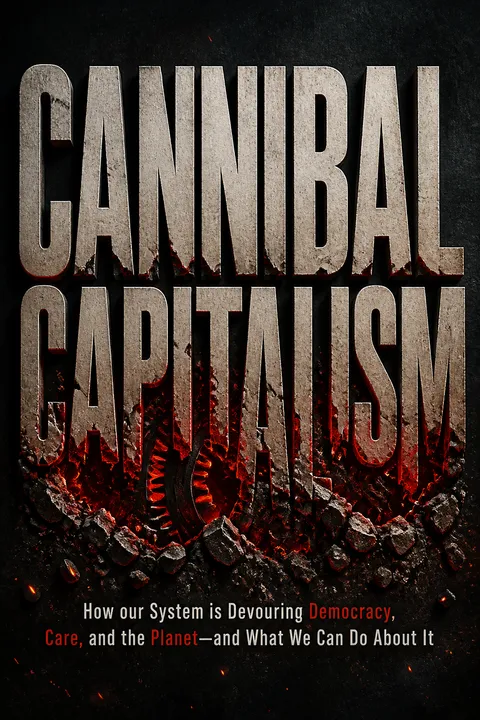
In this book, accordingly, "capitalism" refers not to a type of economy but to a type of society: one that authorizes an officially designated economy to pile up monetized value for investors and owners, while devouring the non-economized wealth of everyone else.
Redefining the system. Traditional views of capitalism focus narrowly on market exchange, private property, and wage labor. However, this economic foreground is entirely dependent on a vast, uncompensated background of non-economic supports. These "hidden abodes" include social reproduction, ecological processes, public power, and expropriated wealth.
The cannibalistic dynamic. Because capital is driven by the singular, blind imperative of self-expansion, it treats these background conditions as free, infinite resources. It consumes them without any obligation to replenish or repair what it damages. This parasitic relationship is inherently self-destabilizing, causing the system to routinely devour its own foundations.
- Social reproduction (unpaid carework that produces the workforce)
- Nonhuman nature (raw materials and waste sinks)
- Public goods (legal frameworks, infrastructure, and state power)
- Expropriated wealth (assets seized from subjugated peoples)
A general crisis. When these multiple forms of cannibalization converge, they produce a crisis that is far larger than a mere economic downturn. We are currently experiencing a general crisis of the entire societal order, where ecological, social, political, and economic calamities reinforce and exacerbate one another.
2. Capitalism is structurally racist, relying on the ongoing expropriation of racialized populations.
The subjection of those whom capital expropriates is a hidden condition of possibility for the freedom of those whom it exploits.
Exploitation versus expropriation. To understand the structural nature of capitalist racism, we must distinguish between two distinct mechanisms of accumulation: exploitation and expropriation. While exploitation involves purchasing labor power through a free contract and paying for its reproduction, expropriation is the outright confiscation of labor, land, and resources without compensation.
The color line. Capitalist societies systematically divide the global population along a racialized status hierarchy to make exploitation profitable. Those on the protected side of the line are treated as citizens suitable for "mere" exploitation, while those on the other side are marked as inherently violable subjects destined for brute expropriation.
- Chattel slaves and colonized subjects in early mercantile capitalism
- Debt peons and sharecroppers in liberal-colonial regimes
- Segregated, underpaid workers in state-managed capitalism
- Subprime borrowers and mass-incarcerated populations in financialized capitalism
Ongoing structural necessity. Far from being a relic of capitalism's "primitive" past, expropriation is an ongoing, structural necessity that lowers production costs for capitalists. By continuously looting the assets of racialized "others," capital offsets the costs of reproducing the "free" workforce, proving that capitalism is inherently and structurally racist.
3. The system cannibalizes social reproduction, creating a chronic crisis of care.
Without this work of social reproduction, as I shall call it, there could be no production or profit or capital; no economy or culture or state.
The care deficit. Social reproduction encompasses the essential work of birthing, raising, and caring for human beings, as well as maintaining communities and social bonds. Although this affective labor is the indispensable foundation of the waged economy, capitalism systematically separates it from production, devalues it, and treats it as a free resource.
The gendered split. This structural division is deeply gendered, historically associating unpaid reproductive labor with women and paid productive labor with men. By relegating carework to a private, unmonetized domestic sphere, capitalism creates a durable foundation for modern women's subordination, as power in a capitalist society is mediated primarily through money.
- Housewifization in the liberal-colonial era
- The family wage model under state-managed Fordism
- The two-earner household norm under neoliberalism
- Global care chains exploiting migrant women of color
Neoliberal care guzzling. Today, financialized capitalism has intensified this contradiction by demanding both the retrenchment of public social services and the massive recruitment of women into low-wage, precarious work. By forcing households to supply more hours of paid labor while stripping away public support, the system has created an acute, global crisis of care.
4. Capitalism's metabolic rift treats nature as an infinite tap and sink, driving ecological collapse.
Systemically primed to free ride on a nature that cannot really self-replenish without limit, capitalism’s economy is always on the verge of destabilizing its own ecological conditions of possibility.
The metabolic rift. Capitalism establishes a sharp ontological division between a "natural" realm, viewed as a costless supply of raw materials and a free waste sink, and an "economic" realm of human-made value. This division introduces a profound metabolic rift, separating human social systems from the natural, biophysical cycles that sustain life on Earth.
Fossil-fueled accumulation. The history of capitalist development is a sequence of socioecological regimes, each utilizing different energy sources to accelerate accumulation. From coal-fired steam to oil-fueled automobiles, capital has systematically externalized its ecological reproduction costs, passing the environmental bill to marginalized populations and future generations.
- Somatic energy (animal and human muscle) in mercantile capitalism
- King Coal and steam power in liberal-colonial capitalism
- Refined oil and the internal combustion engine in state-managed capitalism
- Financialized nature (carbon trading and biotech enclosures) in neoliberalism
An epochal crisis. Today, we face an epochal ecological crisis because the cumulative volume of greenhouse gases has breached the planet's capacity for self-restoration. Because the system vests control over the earth's resources in a class driven solely by profit, we cannot solve global warming without dismantling the structural logic of capital.
5. The separation of economy and polity systematically hollows out public power and butchers democracy.
By virtue of its inherent structure, then, capitalism is fundamentally anti-democratic.
The economy-polity split. Capitalism is unique in splitting economic power from political power, assigning them to separate, distinct spheres. While the public power of the state is tasked with maintaining order and enforcing contracts, the private power to organize production and allocate social surplus is entirely devolved to capital.
Hollowing out the state. This institutional separation creates a structural contradiction: capital relies on public goods and state capacities to function, yet its drive for profit incentivizes it to evade taxes, weaken regulations, and escape political control. Under neoliberalism, global finance capital has successfully disciplined states, hollowing out democratic governance from within.
- Privatization of public goods and infrastructure
- The rise of "politically independent" central banks and transnational institutions
- Corporate capture of state regulatory agencies
- The constitutionalization of free trade treaties that override domestic laws
The threat of de-democratization. The result is a profound crisis of democratic legitimacy, as elected governments are rendered increasingly powerless to address the needs of their citizens. By removing the most vital decisions—such as how we use our collective surplus and relate to nature—from the political agenda, capitalism systematically butchers democracy.
6. Social struggles in capitalist societies are often "boundary struggles" over institutional divisions.
Far from simply being given, capitalism’s institutional divisions often become foci of conflict as actors mobilize to challenge or defend the established boundaries separating economy from polity, production from reproduction, human from nonhuman nature, and exploitation from expropriation.
Beyond class struggle. Traditional Marxist theory privileges class struggles at the point of production, focusing on the conflict between labor and capital. However, an expanded view of capitalism reveals that some of the most vital conflicts in capitalist history are "boundary struggles" fought at the system's institutional joints.
Mapping the battlegrounds. These boundary struggles occur where the profit-driven economy butts up against its non-economic background conditions. Rather than fighting over wages alone, social actors mobilize to defend the integrity of the lifeworld, nature, and public power from the encroaching logic of commodification.
- Conflicts over care, education, and social reproduction
- Environmental struggles over land, water, and energy extraction
- Political struggles over state sovereignty, capital controls, and public goods
- Anti-racist and anti-imperialist struggles against ongoing expropriation
Normative pluralism. In these struggles, actors draw on the distinctive, non-economic normativities of the background spheres—such as ideals of care, ecological stewardship, and public autonomy. These struggles are not external to capitalism; they are internal reactions to the system's persistent drive to cannibalize its own foundations.
7. The COVID-19 pandemic is a perfect storm where all of capitalism's cannibalistic crises converge.
As I write now, in April 2022, the pandemic is the point where all of cannibal capitalism’s contradictions converge: where cannibalization of nature and carework, of political capacity and peripheralized populations, merge in a lethal binge.
A zoonotic leap. The COVID-19 pandemic is not a random natural disaster, but a direct consequence of capital's predatory relationship with nature. Tropical deforestation and global warming, driven by corporate extractivism, destroyed wild habitats and forced species into novel proximities, facilitating the zoonotic spillover of the virus to humans.
A hollowed-out response. The lethality of the virus was vastly compounded by decades of neoliberal disinvestment in public health infrastructure and state capacity. Having privatized healthcare and subordinated medical research to the patent monopolies of Big Pharma, states were structurally unable to mount an effective, coordinated public response.
- Gutted diagnostic capabilities and depleted stockpiles of protective equipment
- The devolution of healthcare to profit-driven insurers and providers
- The unequal distribution of vaccines and therapeutics to the Global North
- The reliance on underpaid, racialized "essential workers" to keep society running
The ultimate indictment. The pandemic also laid bare the crisis of social reproduction, dumping massive care burdens onto families, particularly women, while exposing the deep racial disparities of the system. COVID-19 serves as the ultimate indictment of cannibal capitalism, demonstrating how the system's structural contradictions directly threaten human survival.
8. Twenty-first-century socialism must expand its vision to reorganize the relations between the economy and its non-economic supports.
Whether we call it socialism or something else, the alternative we seek cannot aim to reorganize the system’s economy alone.
An expanded socialism. Because capitalism is an entire societal order and not just an economy, a credible socialist alternative must be equally comprehensive. Social socializing the ownership of the means of production is necessary, but insufficient; we must also fundamentally reorganize the relations between the economy and its non-economic background conditions.
Redrawing the boundaries. A 21st-century socialism must dismantle the rigid, gendered, and racialized divisions that subordinate social reproduction, nature, and public power to the imperatives of capital accumulation. It must establish a "pay as you go" system that ensures the continuous replenishment and repair of all the resources it consumes.
- Elevating carework and social reproduction to society's highest priorities
- Restoring a sustainable, non-extractive metabolic relationship with nonhuman nature
- Democratizing the allocation of social surplus and the definition of basic needs
- Eliminating markets at the top (surplus allocation) and the bottom (basic needs)
Democratizing the future. Ultimately, socialism means reclaiming our collective freedom to decide together how we want to live, work, and relate to the planet. By expanding the scope of democratic self-rule to encompass the entire social totality, we can finally lay the cannibal to rest and build a habitable, just world.








































