

Key Takeaways
Overreacting isn't a character flaw; it's an unlearned skill you can master
Emotion dysregulation is teachable, not permanent. Van Dijk defines emotion dysregulation as reacting to things others wouldn't, reacting more intensely than a situation warrants, and taking longer to return to baseline. Consider Mary, who repeatedly lands good jobs, then torches them by losing her temper with superiors, or Tim, whose failed dates leave him unable to get out of bed for days.
The roots are biology plus environment. Some people are simply born more emotionally sensitive. Add an invalidating childhood environment, one where a parent snaps "stop crying or I'll give you something to cry about," and children learn their feelings are wrong, so they suppress them until emotions become foreign and frightening. The reassuring part: most people absorb emotion-regulation skills naturally while growing up, but those who missed that education can consciously learn it at any age.
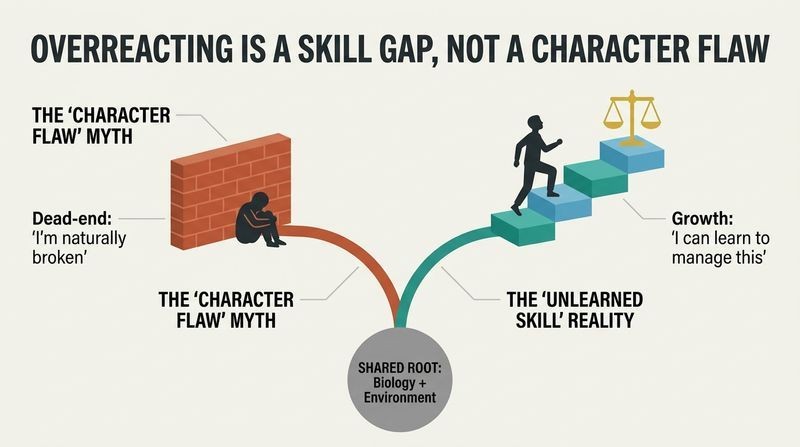
What's striking is the reframe from moral failing to skill deficit. This mirrors a broader shift in clinical psychology away from pathologizing patients toward teaching competencies. The invalidating-environment concept resonates with attachment research: children whose distress is repeatedly dismissed struggle to develop what psychologists call affect regulation. One nuance worth adding is that invalidation exists on a spectrum, and well-meaning parents who simply lacked emotional vocabulary can produce similar effects without abuse. The claim that skills can be learned at any age finds support in neuroplasticity research, though the effort required tends to scale with how entrenched the patterns are.
Living in the past or future manufactures pain the present never asked for
Mindfulness means attention without judgment. Van Dijk borrows Kabat-Zinn's definition: purposely paying attention to the present moment without labeling it good or bad. The mind is a "judging machine," she notes, appraising everything it meets. Take Sydney, injured in a car crash at seventeen, who at twenty-eight replays what she could have done differently (fueling regret) while simultaneously picturing herself bedridden and alone at fifty (fueling dread). She carries the pain of past, present, and future at once.
Present-moment focus shrinks the emotional load. By anchoring attention to now, whether through mindful breathing, mental noting (narrating experience factually), or simply walking the dog with full attention, you stop generating imported suffering. Mindfulness also activates the left prefrontal cortex, linked to optimism, and improves concentration, memory, and immune function.
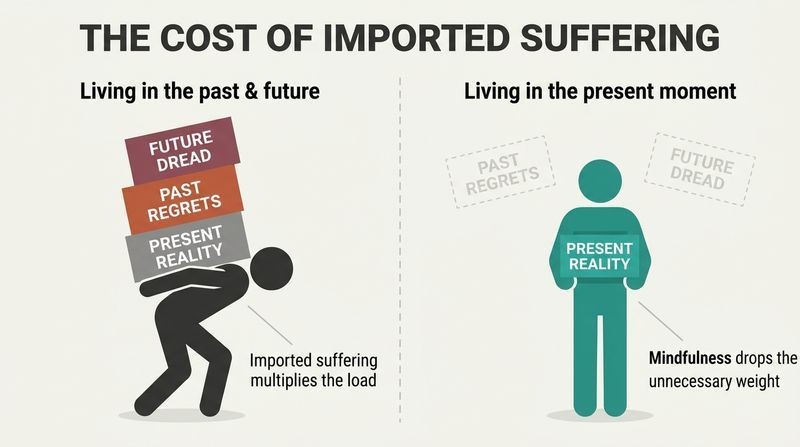
The distinction between present pain and imported pain is clinically powerful and echoes Stoic philosophy: Seneca argued we suffer more in imagination than reality. The Sydney example illustrates what cognitive scientists call mental time travel, a uniquely human capacity that doubles as a curse. Worth noting: mindfulness is not dissociation or positive thinking. Van Dijk honestly warns things may feel worse before better, because you start feeling what you long avoided. This candor separates evidence-based mindfulness from wellness-industry versions. The prefrontal activation claim traces to Davidson's research, though effect sizes vary and mindfulness is no panacea for severe trauma without professional support.
You think three ways; steer toward your wise self
Three modes govern every decision. Drawing on Linehan's DBT, Van Dijk describes emotion mind (feelings drive behavior), reasonable mind (cold logic, discounted feelings), and wise mind, the integration of both plus intuition about long-term interest. Max, purely emotional, punched a wall during an argument and got evicted. Aline, purely reasonable, took a job by tallying salary and commute while ignoring her deep attachment to her home and friends, and regretted it.
Wise self is accessible to everyone. It's the little voice warning "you'll regret this." Techniques to reach it include mentally noting emotions (watching the tornado from a safe distance rather than getting swept up), talking to yourself as you'd talk to a hurting friend, and focusing on just this one moment. Crucially, wise self still feels emotion but isn't controlled by it.
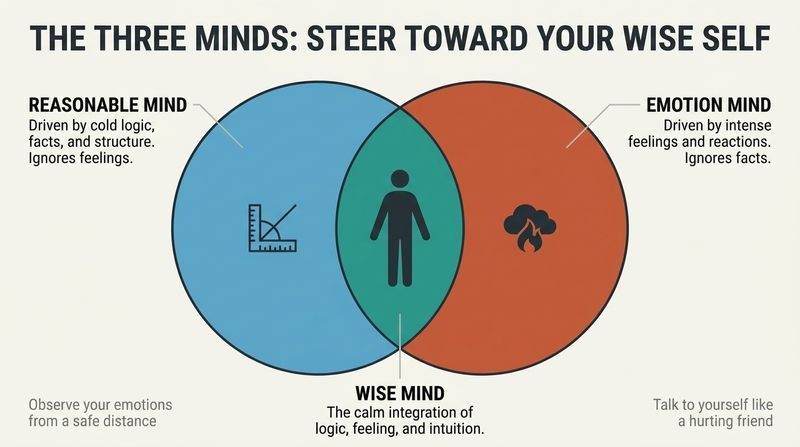
The tripartite model resembles dual-process theories in cognitive science (Kahneman's System 1 and System 2), but wise mind adds a third integrative layer that neither pure intuition nor pure deliberation captures. This is a genuine contribution: it refuses the false binary that emotion and reason are enemies. Neuroscientist Antonio Damasio's work on patients with damaged emotional centers, who became paralyzed by trivial decisions, confirms that good judgment requires feeling. One practical caution: distinguishing wise mind from emotion mind can be slippery, since both carry feeling. Van Dijk's tell (calm versus being swept up) is useful but requires the very self-awareness beginners lack.
Your feelings are always valid; only your behavior gets judged
Emotions are full-system responses. An emotion isn't just a feeling but a package of physiological changes, thoughts, action urges, and the feeling itself. They serve real functions: motivation (anger prompts you to change unfairness), information (fear moves you before conscious thought), and communication (facial expressions signal your state to others). Van Dijk urges naming emotions using six categories: anger, fear, sadness, shame or guilt, love, and happiness. People who can name feelings manage them better.
Thoughts and feelings are not facts. We respond to our interpretation of events, not events themselves. Oliver saw clothes on the floor, assumed his partner did it to spite him, and burned them, before realizing he'd acted on an unquestioned automatic thought. Bella was convinced her boss found her incompetent, yet earned glowing reviews. The feeling was real; the belief was false.
The insistence that all feelings are valid while behavior remains accountable resolves a common confusion in emotional-regulation advice. It sidesteps toxic positivity (feelings are bad, suppress them) and reckless authenticity (I felt it, so acting on it was justified). Aaron Beck's automatic thoughts concept, cited here, underpins modern cognitive therapy and has decades of empirical backing. The six-category naming exercise aligns with affect labeling research by Matthew Lieberman, showing that putting feelings into words measurably dampens amygdala activity. One expansion: emotional granularity research by Lisa Feldman Barrett suggests that people with richer emotional vocabularies regulate better, reinforcing why moving past vague "bad" or "upset" matters.
Judging your own emotions doubles the pain through secondary emotions
Two layers of emotion stack up. A primary emotion is your response to an event: you feel angry after an argument. A secondary emotion is how you feel about that feeling. If you learned anger is bad, you now feel guilt or self-directed anger for being angry, piling pain on pain. Diane, mid-panic-attack, told herself "this is stupid, I should control this by now," which spiked her anxiety further.
Self-validation stops the pileup. Van Dijk offers three ascending levels:
1. Acknowledging: "I feel anxious." Full stop, no judgment.
2. Allowing: "It's okay that I feel anxious."
3. Understanding: "It makes sense I feel anxious, given what happened."
She likens emotions to quicksand: struggling pulls you under, while lying back and accepting keeps you afloat. Validation won't erase the feeling, but it prevents you from manufacturing extra ones.
The primary/secondary distinction is one of DBT's most clinically useful insights and explains why some people spiral while others recover. The mechanism has physiological grounding: self-criticism activates threat systems, while self-validation engages soothing systems, a dynamic Paul Gilbert formalized in Compassion-Focused Therapy. The quicksand metaphor is apt but incomplete, since acceptance alone rarely resolves trauma. Van Dijk is careful to note that validation precedes, not replaces, problem-solving. A cross-cultural caveat: the messages about which emotions are acceptable (men's anger permitted, women's anger not) are socially constructed and vary widely, meaning self-validation is partly an act of resistance against inherited cultural scripts.
Swap labels like 'idiot' for facts and feelings you actually mean
Judgments add fuel to the emotional fire. A judgment is a shorthand label (jerk, stupid, awful) that emerges from painful emotion and then intensifies it. Research on venting shows expressing anger increases rather than discharges it. Judgments also convey no useful information: calling a coworker's work "bad" tells her nothing, while "these notes could be neater" does.
Nonjudgmental doesn't mean passive; it means assertive and specific. The goal is neutrality, neither positive nor negative, because even positive labels can flip (a "wonderful" relationship becomes "terrible" after one hurt). The technique: state the facts plus your emotion. Instead of "you're a jerk," say "you said you'd make dinner, I came home hungry, and I feel angry and disappointed." Self-judgments count as verbal self-abuse; you'd never call a friend worthless, so extend the same courtesy inward.
The counterintuitive claim that venting worsens anger contradicts folk wisdom about catharsis but is well-supported. Brad Bushman's experiments found that hitting a punching bag to vent left people angrier and more aggressive, not calmer. The catharsis hypothesis, inherited from Freud and Lorenz, has largely collapsed under empirical scrutiny. Van Dijk's reframe of judgments as information-poor communication connects neatly to Marshall Rosenberg's Nonviolent Communication, which similarly urges observations plus feelings plus needs over evaluations. One subtle point: her advice to avoid even positive judgments is philosophically bold and may strike readers as joyless, but the logic (labels are unstable and set up future disappointment) holds under scrutiny.
Do what actually works, not what feels satisfying in the moment
Effectiveness means playing to your goal, not your ego. Van Dijk's shorthand is the phrase about cutting off your nose to spite your face: acting on momentary emotion against your long-term interest. Mackenzie, given an ultimatum by his girlfriend to address his anger, exploded and lost her permanently, proving her point. Suzannah rushed back to work after burnout to avoid disappointing her boss, then got suspended for throwing things.
Three obstacles block effectiveness:
1. Not knowing what you actually want in the situation.
2. Responding to how things "should" be rather than reality (arguing the speed limit with a cop who only cares what it is).
3. Fixating on short-term relief over long-term gain.
The tool is opposite-to-emotion action: identify the emotion, identify its urge, then deliberately act against that urge (take a timeout instead of lashing out).
Effectiveness reframes emotional maturity as strategic rather than moral, a pragmatic stance that lowers defensiveness. The "should" trap maps onto Albert Ellis's musturbation concept in Rational Emotive Behavior Therapy, where rigid demands about how reality ought to be generate needless distress. Opposite-to-emotion action has strong empirical support, particularly for depression and anxiety, where behavioral activation (acting against withdrawal urges) rivals medication in some trials. A worthwhile tension: the skill risks sliding into suppression if misapplied. Van Dijk guards against this by insisting the emotion still gets acknowledged and that effective action must align with one's values, not merely secure a win at others' expense.
You can't stop the waves, but you can learn to surf a crisis
Survive without self-sabotage. A crisis is any situation triggering overwhelming emotion. When you can't fix it, the goal shifts to getting through without adding damage. Tamara, blindsided by her husband's request for separation, coped by oversleeping, clubbing, drinking, and casual sex, all of which deepened her self-loathing. Drake, laid off after twelve years, instead distracted himself from drinking urges by seeing movies and meeting friends for coffee.
Two DBT tools carry you through:
1. Distraction: temporarily redirect attention (a hobby, a walk, helping someone) rather than trying to suppress thoughts, which backfires.
2. Self-soothing through the five senses: a warm bath (touch), soothing music (sound), a favorite meal (taste), scented candles (smell), photographs (sight).
Build the list before crisis strikes, since emotion mind can't brainstorm mid-storm. Distraction is short-term only; chronic use becomes avoidance.
The honesty here is bracing: these tools don't fix anything, they just prevent you from making a bad situation catastrophic. That modesty is a strength, distinguishing DBT from self-help promising transformation. The warning that thought suppression backfires references Daniel Wegner's famous white-bear experiments, where trying not to think of something guarantees thinking of it. The five-senses self-soothing framework has intuitive appeal and aligns with polyvagal-informed approaches that use sensory input to downregulate the nervous system. One important boundary Van Dijk honors: distraction and avoidance differ only in duration and intent, and the same behavior that rescues you in a crisis can imprison you if it becomes a default escape.
Pain is unavoidable; suffering is the extra you add by fighting reality
Acceptance dissolves suffering, not pain. Van Dijk's central distinction: pain from loss, illness, or betrayal is inevitable, but suffering is the surplus we generate by refusing to accept it, insisting "this shouldn't be happening." Olivia, denied insurance coverage for pain treatment, felt legitimate disappointment, then multiplied it into outrage and hopelessness by railing against the unfairness. Kornfield's parable captures it: a meditator, annoyed his mind sang along with a bubbling stream, moved the rocks to change the tune, when the real fix was changing his relationship to the sound.
Acceptance is not approval, forgiveness, or surrender. It simply means acknowledging what is real. Nigel could accept his abuse happened without forgiving his abuser. And you must accept reality (not the future, not judgments) before you can change it, as Tammie realized after two years waiting for a partner who'd never want the family she craved.
This is the book's philosophical core, and it echoes both Buddhist teaching and Stoic dichotomy of control. The pain-versus-suffering equation appears across contemplative traditions and now anchors Acceptance and Commitment Therapy, where psychological flexibility depends on dropping the struggle against unwanted experience. The crucial guardrails, that acceptance is neither resignation nor forgiveness, preempt the most common misreadings. Radical acceptance can be misused to counsel passivity in the face of genuine injustice, so Van Dijk's insistence that acceptance enables rather than replaces action matters ethically. The Tammie example is instructive: accepting her partner's stated preferences didn't mean staying, it meant finally seeing clearly enough to choose.
Ditch the word 'motivation'; act first and feeling follows
Waiting to feel like it is a trap. Van Dijk would delete "motivation" from the language. We do unpleasant chores like dishes without wanting to, yet withhold pleasant activities until desire arrives, and it often doesn't. Anton bought a boat to lift his mood, then let it sit unused all season because he couldn't be bothered, forfeiting the very thing that might have helped. The fix: do it whether or not you feel like it, since enjoyment usually arrives only after you start.
Engineer positive emotion deliberately. Notice small pleasures (birdsong, morning sun), plan events to look forward to, and build mastery, doing things for a sense of accomplishment regardless of fun, even something as basic as showering during a low spell. She also invokes Yoda: do or do not, there is no try, since "I'll try" is often a pre-excuse for not doing.
The attack on motivation as a prerequisite is behavioral activation in plain clothes, and it's among the most robustly supported interventions for depression. Peter Lewinsohn's research established that reduced positive reinforcement both causes and deepens low mood, so scheduling pleasant and mastery activities directly reverses the spiral. The insight that action precedes motivation, not the other way around, contradicts intuition but matches how habit and momentum actually work. The mastery concept deserves emphasis: self-efficacy, Albert Bandura's term for believing in one's capability, grows through small accomplishments, which is why showering can genuinely matter. The Yoda framing is memorable, though "try" can also signal honest uncertainty rather than avoidance.
Maintain relationships like a car, not just when the engine dies
Assertiveness is the healthiest of four communication styles. Van Dijk names passive (stuffing your needs, breeding resentment), aggressive (dominating through threats and yelling), passive-aggressive (sarcasm, silent treatment, slammed doors), and assertive (expressing thoughts and feelings clearly and respectfully while listening for the other's needs). Assertiveness is hardest because it requires operating from wise self.
Nurture connection continuously. Relationships need routine upkeep, calling, remembering birthdays, asking about a friend's ailing parent, plus prompt repair when problems arise, rather than letting resentment accumulate until you explode or quit. Andria felt her decades-long friendship fading as she became the only one making effort. The assertiveness toolkit: listen mindfully, stay nonjudgmental, validate the other person, and act according to your values (it's fine to say no without a reason, or tell a small white lie to spare feelings). Even perfect assertiveness guarantees no outcome, only self-respect.
The four-styles taxonomy is standard in assertiveness training, but Van Dijk's integration with DBT skills (mindful listening, validation, values) elevates it beyond a communication checklist into an emotional practice. The car-maintenance metaphor captures something relationship researchers confirm: John Gottman's work shows that stable couples make frequent small "bids" for connection and repair conflicts early, while distressed couples let grievances compound. The candid acknowledgment that assertiveness may feel like aggression to those accustomed to passivity is psychologically astute; the discomfort is a recalibration, not evidence of wrongdoing. One tension worth flagging: the endorsement of small white lies sits uneasily beside the book's emphasis on honesty and self-respect, a pragmatic concession most readers will recognize from real life.
Analysis
Calming the Emotional Storm is a lay adaptation of Marsha Linehan's Dialectical Behavior Therapy, originally built for borderline personality disorder, repackaged for anyone whose emotions run hotter, longer, and more unpredictably than they'd like. Van Dijk's achievement is translation: she strips DBT's clinical scaffolding into ten digestible skills organized as a progression, from awareness (mindfulness, the three minds) through understanding (emotions, judgments, validation) to action (effectiveness, crisis survival, acceptance, positive-emotion building, relationships).
The book's intellectual spine is the marriage of two traditions that once seemed opposed: cognitive-behavioral change (thoughts, feelings, and behaviors are interlinked levers) and Eastern acceptance (mindfulness, radical acceptance). This dialectic, the tension between accepting yourself as you are and working to change, is what "dialectical" names, though Van Dijk underplays the term itself. The genius of DBT is refusing to choose between acceptance and change, insisting both operate simultaneously.
What distinguishes this from generic self-help is its clinical pedigree and its honesty about limits. Van Dijk repeatedly states these skills won't erase pain, won't work overnight, and may worsen things before improving them. She flags when readers need a professional. This restraint is credible where wellness culture overpromises.
The evidence base is real: DBT has among the strongest empirical support of any psychotherapy, particularly for self-harm, suicidality, and emotion dysregulation. The mechanisms she invokes (affect labeling, behavioral activation, exposure through acceptance, thought-suppression rebound) each have independent research backing beyond DBT.
The limitations are structural. A book cannot replicate DBT's full apparatus of group training, individual therapy, and phone coaching. Self-directed skill acquisition demands the very self-regulation the reader lacks, a bootstrapping problem. And the framework assumes insight translates to behavior, when severe trauma often requires more than skills practice. Still, as an accessible on-ramp to genuinely effective techniques, the book delivers disproportionate value for its modest length.
Review Summary
Calming the Emotional Storm receives mostly positive reviews for its accessible introduction to DBT skills and mindfulness techniques. Readers appreciate its concise format and practical exercises for managing emotions. Many find it helpful for emotional regulation and self-awareness. Some criticize its simplicity and repetitiveness, while others value its clarity. The book is recommended for those new to DBT or seeking emotional management strategies. Several reviewers note its potential benefits for both clients and clinicians, though some suggest more in-depth resources for comprehensive DBT understanding.
People Also Read







FAQ
What's "Calming the Emotional Storm" about?
- Overview: "Calming the Emotional Storm" by Sheri Van Dijk is a guide to managing intense emotions using Dialectical Behavior Therapy (DBT) skills. It aims to help readers balance their lives by understanding and regulating their emotions.
- Target Audience: The book is designed for individuals struggling with emotion dysregulation, including those with borderline personality disorder, mood disorders, or anyone experiencing intense emotions.
- Approach: It breaks down complex psychotherapeutic processes into accessible exercises and case studies, making it practical for both individuals and clinicians.
- Goal: The ultimate aim is to teach readers how to acknowledge, experience, and bear their emotional landscape, leading to a healthier and more balanced life.
Why should I read "Calming the Emotional Storm"?
- Comprehensive Guide: The book offers a thorough exploration of DBT skills, making it a valuable resource for anyone looking to manage their emotions more effectively.
- Practical Exercises: It includes exercises that help stabilize emotional reactions and explore ways to make positive changes, providing actionable steps for readers.
- Expert Endorsements: Mental health professionals praise the book for its simplicity, effectiveness, and ability to inspire hope without minimizing the hard work required for change.
- Personal Growth: Reading this book can lead to improved self-esteem, better relationships, and a more balanced life, even in moments of crisis or stress.
What are the key takeaways of "Calming the Emotional Storm"?
- Emotion Dysregulation: Understanding that emotion dysregulation involves reacting intensely to situations and taking longer to recover, and that it can be managed with the right skills.
- DBT Skills: The book focuses on four sets of DBT skills: mindfulness, distress tolerance, emotion regulation, and interpersonal effectiveness, all aimed at improving emotional management.
- Mindfulness and Acceptance: Emphasizes the importance of living in the present moment with awareness and acceptance, which helps in reducing emotional pain and increasing self-awareness.
- Practical Application: Encourages readers to apply DBT skills as a way of living, not just as a therapy, to make positive changes and live a calmer, more effective life.
How does Sheri Van Dijk define emotion dysregulation in the book?
- Definition: Emotion dysregulation is described as reacting emotionally to things that most people wouldn’t typically react to, with reactions more intense than warranted and taking longer to recover.
- Symptoms: People with emotion dysregulation often have difficulty tolerating emotions and may struggle to identify, understand, and express how they feel.
- Consequences: It can lead to unhealthy behaviors like substance abuse, disordered eating, and relationship issues, often exacerbating emotional problems.
- Causes: The book suggests a combination of genetic predisposition and environmental factors, such as growing up in an emotionally invalidating environment, contribute to emotion dysregulation.
What are the DBT skills taught in "Calming the Emotional Storm"?
- Core Mindfulness Skills: These help focus on living in the present moment, increasing awareness of thoughts, emotions, and behaviors, and reducing emotional pain.
- Distress Tolerance Skills: These skills aid in coping with crisis situations in healthy ways, avoiding long-term negative consequences.
- Emotion Regulation Skills: They assist in managing emotions more effectively, reacting less intensely, and tolerating emotions when they can't be changed.
- Interpersonal Effectiveness Skills: These skills help maintain or improve relationships by teaching assertiveness and balancing give-and-take in interactions.
How does the book suggest using mindfulness to manage emotions?
- Present Moment Focus: Mindfulness involves paying attention to the present moment without judgment, which helps in reducing emotional pain by preventing dwelling on the past or future.
- Calming Effect: Practicing mindfulness can have a relaxing effect, helping to lower overall emotional levels and making emotions more manageable.
- Increased Awareness: It enhances self-awareness, allowing individuals to choose how to respond to situations rather than reacting automatically.
- Positive Emotions: Mindfulness increases the experience of positive emotions by helping individuals fully engage in enjoyable activities.
What is the role of acceptance in "Calming the Emotional Storm"?
- Reality Acceptance: The book emphasizes accepting reality as it is, rather than fighting it, to reduce suffering and emotional pain.
- Not Approval: Acceptance does not mean approving of a situation but acknowledging it to reduce the emotional burden.
- Steps to Acceptance: It involves choosing to work on acceptance, noticing when fighting reality occurs, and consciously reaching for acceptance.
- Impact: Acceptance helps in reducing the intensity of emotions, making them more manageable and preventing additional suffering.
How does "Calming the Emotional Storm" address the impact of judgments?
- Judgments Increase Pain: The book explains that judgments, especially negative ones, can increase emotional pain by adding fuel to the emotional fire.
- Nonjudgmental Approach: It encourages replacing judgments with factual, nonjudgmental statements to reduce unnecessary emotional pain.
- Self-Judgments: Self-judgments are seen as a form of verbal abuse that can lower self-esteem and increase painful emotions.
- Communication: Being nonjudgmental improves communication and relationships by reducing blame and increasing understanding.
What are some practical exercises from "Calming the Emotional Storm"?
- Mindfulness Practice: Exercises like focusing on the breath or body to increase present-moment awareness and reduce emotional intensity.
- Opposite to Emotion Action: Identifying an emotion and its urge, then acting opposite to that urge to reduce emotional intensity.
- Validation Exercises: Practicing self-validation by acknowledging, allowing, and understanding emotions to reduce emotional pain.
- Reality Acceptance: Exercises to practice accepting reality, such as acknowledging nonaccepting thoughts and consciously reaching for acceptance.
What are the best quotes from "Calming the Emotional Storm" and what do they mean?
- "Pain is a natural part of life." This quote emphasizes the inevitability of pain and the importance of learning to manage it rather than trying to avoid it.
- "You can’t stop the waves, but you can learn to surf." It highlights the idea that while we can't prevent life's challenges, we can learn skills to navigate them effectively.
- "Being nonjudgmental isn’t about turning a positive into a negative; it’s about being neutral." This quote underscores the importance of neutrality in reducing emotional pain and improving communication.
- "Acceptance is acknowledging reality as it truly is and making decisions based on that reality." It stresses the power of acceptance in reducing suffering and enabling positive change.
How does "Calming the Emotional Storm" suggest improving relationships?
- Need for People: The book emphasizes the importance of having positive, healthy relationships for emotional well-being.
- Communication Styles: It identifies four communication styles—passive, aggressive, passive-aggressive, and assertive—and advocates for assertive communication.
- Balancing Needs: Encourages balancing personal needs with those of others to maintain healthy relationships and prevent resentment.
- Mindful Communication: Suggests practicing mindfulness in interactions to improve relationships by being present and engaged.
What is the significance of building mastery in "Calming the Emotional Storm"?
- Sense of Accomplishment: Building mastery involves engaging in activities that provide a sense of accomplishment and fulfillment, boosting self-esteem.
- Challenging Yourself: It encourages challenging oneself with activities that may not be enjoyable but lead to personal growth and positive emotions.
- Regular Practice: Regularly building mastery helps in maintaining a positive emotional state and reducing the impact of negative emotions.
- Personalized Activities: The book suggests identifying activities that personally build mastery, as they vary for each individual.
About the Author
Other books by Sheri Van Dijk

Download PDF
Download EPUB
.epub digital book format is ideal for reading ebooks on phones, tablets, and e-readers.








































