
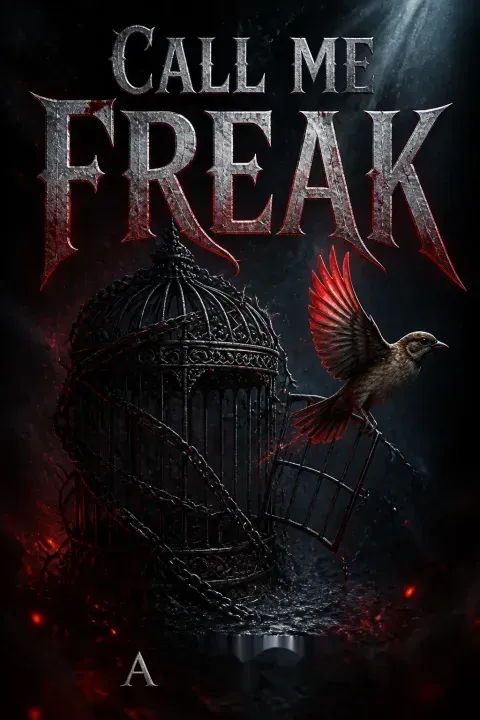


Plot Summary
Prologue
Dmitry1 recalls the summers between age seventeen and twenty-one when he would climb through Natalia2's bedroom window at night. While she slept wearing an eye mask, he would whisper, touch her, and take her without her seeing his face. He tracked her contraceptive pills, stole her used tampons as keepsakes, and believed she welcomed him.
The ritual ended when he had to leave, and on that last night, he left a mold of his own anatomy as a parting gift, ensuring she would never forget her mysterious nocturnal lover. He called her his Little Sparrow.2 The blood no longer deterred him; in fact, it aroused him. She never resisted, which he took as consent. Their summers of secrecy became his escape from a brutal homelife.
The prologue establishes Dmitry's pathology by conflating possession with love and framing violation as a mutual game. The eye mask functions as a consent-loop hole in his mind, allowing him to interpret her silence as complicity. The meticulous tracking of her cycle and the collection of intimate refuse reveal a ritualistic need for control that predates their adult relationship. By presenting himself as a gentle invader who brings pleasure, Dmitry sets the stage for the novel's central moral ambiguity: is this a twisted love story or a predator's delusion? The 'Little Sparrow' nickname immediately casts Natalia as something delicate to be caged and cherished, foreshadowing the obsessions that will drive the narrative.
Playing Sane
Dmitry Rushlakov1 has spent seven years in and out of Russian mental asylums. At Highspring Hall, he learns to charm the psychologist, hide his medication, and feign compliance. His only solace is a tiny sparrow that he names Nat2 after his obsession. One day, his rage surfaces when the bird refuses food; he smashes it against the wall, then remorsefully nurses it back to health in a cardboard box.
He defends it from a bullying patient, Alexi,9 and eventually releases it. After a successful board hearing, he is freed. He visits his mother5 in a nursing home, hoping for answers, but she only mumbles. He self-harms, cutting his cheeks and burning himself, then resolves to find Natalia.2
The asylum segment reveals Dmitry's capacity for performance, a survival skill honed by a lifetime of abuse. His relationship with the sparrow mirrors his dynamic with Natalia: he nurtures, destroys, and then seeks redemption through control. The bird serves as a test run for his obsession, a fragile creature he can protect and claim. His inability to extract closure from his mother reinforces his need to possess Natalia as a substitute source of identity and validation, setting the stage for his stalker's journey.
The Fake Taxi
He has been watching Natalia2 for weeks, mirroring her phone to track every move. One evening, he hijacks the taxi she ordered, killing the driver and stashing the corpse. He drives her to the strip club Sasha's, then later tracks her to an apartment where a man named Marcus is attempting to rape her.
Dmitry1 breaks in, stabs Marcus to death, and takes photos of Natalia2 holding the knife to ensure her silence. He forces her to his grandfather3's farm, where he feeds the body through a meat grinder to the pigs. When one of her ex's henchmen appears, Dmitry1 kills him too and drops him in a well. Back at his Moscow flat, he chains her to the bed and reveals he was her masked summertime lover.
The hijacking and murder mark Dmitry's irreversible step from stalker to abductor. He frames himself as a savior when he kills Marcus, yet immediately shackles Natalia. This paradoxical protector/violator dynamic underscores his warped psyche: he believes he is rescuing her from a world of predators only to keep her as his own. The photos he takes are not just blackmail but a symbolic contract, binding her to him through shared guilt. The farm's meat grinder naturalizes his violence, turning human disposal into a routine chore.
The Tree House Secret
Over the following days, he keeps her restrained but shows a possessive tenderness. They drink vodka, and the conversation turns to their scars. Natalia2 admits that her stepfather,6 a man they both refer to only as The Man,6 sexually abused her for years. Dmitry1 reveals that the same predator forced them together in a tree house when they were eleven, orchestrating their first sexual encounter.
The revelation that they were each other's first and that they share a monstrous past forges a dark intimacy. They reenact elements of the abuse with belts and choking, she calls him 'freak' as his mother5 once did, and they transform remembered pain into a consensual, if twisted, catharsis.
The revelation of their shared abuse reframes their relationship from a simple kidnapper-captive dynamic into a complex trauma bond. Instead of recoiling from the horror, they use it as raw material for a dark catharsis, reenacting the past but with a reclaimed sense of agency. The word 'freak,' once a weapon of his mother, becomes a term of endearment between them, illustrating how language can be reappropriated. This section poses an uncomfortable question: can victims heal by revisiting their wounds with a trusted partner, or are they simply perpetuating the cycle of abuse under a new veneer?
Bloody House Call
Weeks later, Nurse Cassidy8 from Highspring Hall arrives for a routine home check. She finds Natalia2 chained and immediately threatens to report him. Dmitry1 overpowers her, then forces Natalia2 to hold the knife as he stabs the nurse to death. To erase the evidence, he bleaches Natalia2's dark hair blonde and dresses her in the dead woman's uniform.
They travel to the next patient on the nurse's visitation list: Alexi,9 the same inmate who once tormented Dmitry1 at the asylum. Dmitry1 kills him, stages the scene as a murder-suicide with the nurse's body, douses the apartment with lighter fluid, and sets it ablaze. They flee back to his flat, their bond now sealed by shared blood.
The nurse's murder obliterates any pretense of Natalia's innocence, making her an active participant. By chemically altering her appearance and forcing her into the uniform, Dmitry not only covers their tracks but symbolically strips her of her old identity. The staging of Alexi's suicide borrows from news reports of a previous asylum scandal, showing Dmitry's cunning and his ability to exploit institutional vulnerabilities. This chilling episode demonstrates how murder has become a practical extension of their relationship, a problem-solving tool rather than an aberration.
Snowbound Execution
Christmas Day arrives, and they visit grandpa3's farm. After dinner, Dmitry1 and Natalia2 retreat to the lakehouse, where he tells her about his father's attempt to murder him and then hang himself. Using Natalia2's phone, he lures her abusive ex-boyfriend Nikolai,7 a powerful gangster, to the isolated cabin. When Nikolai7 arrives, he refuses to enter, slaps Natalia,2 and Dmitry1 attacks with a claw hammer.
Stabbed in the side, Dmitry1 retrieves a shotgun from an outdoor cache. They chase Nikolai7 into the snowy woods; Natalia2 deceives him into exposing his position, and Dmitry1 fires both barrels, killing him. Later, they find a dead woman in Nikolai7's trunk, stage her body on a bench, and push his car into the frozen lake.
The hunt for Nikolai is the first external conflict they face together as a team. Natalia's initiative in luring and deceiving him shows her growing agency within their dynamic, not merely as victim but as partner. The disposal of the unknown dead woman, placed gently on a bench to be discovered, reveals a sliver of Natalia's remaining empathy amid the carnage. This section crystallizes their transformation from isolated individuals into a symbiotic unit capable of coordinating violence and managing its aftermath with chilling efficiency.
The Box in the Closet
Back at the farmhouse, Dmitry1 confronts the woman he called mother.5 She mutters 'freak' one last time, and in rage he smothers her5 with his hand. Grandpa3 walks in, calms him with whiskey, then reveals a devastating truth: Sylvia5 was not his biological mother. His real mother, Anna, died in childbirth, and Sylvia5 only pretended to be his mother.
The man he believed was his father, Ruslan, tried to kill him because he discovered Dmitry1 was not his son. Grandpa3 then gives him a lead-lined box containing the skull of The Man, explaining that he tortured and killed the pedophile years ago as part of a secret cult. He promises a book with more answers, including the identity of Dmitry1's real father.
The climactic revelation reframes Dmitry's entire life story. The abuse he suffered was not from a birth mother but from an aunt who resented him, and the father who tried to murder him was not his own. This inversion strips away the primal rejection he has carried, replacing it with a more complex legacy of lies and substitutions. The skull serves as a concrete artifact of revenge, proving that the monster who shaped his childhood was ultimately destroyed by a grandfather's vigilante justice. Yet the withheld secret of his true father leaves his psychological journey unresolved, suggesting that self-knowledge remains an elusive, perhaps dangerous, pursuit.
Analysis
Call Me Freak operates within the dark romance genre as a psychological exploration of how trauma can warp love into a mutual psychosis. Dmitry1 and Natalia2 are not simply predator and prey; they are two survivors of childhood sexual abuse who have internalized violence and control as the primary language of intimacy. The novel resists easy moral judgment by framing their relationship through Dmitry1's unreliable first-person narration, where stalking, abduction, and even murder are reinterpreted as acts of devotion and protection. The use of the childhood nickname 'Little Sparrow2 'encapsulates this distortion: a term of endearment that also connotes fragility and capture.
The story’s core tension lies in the concept of consent that has been fractured by early abuse. Dmitry1's summer visits, conducted under an eye mask and without explicit refusal, are presented both as a violation and, from Natalia2's perspective, as a form of secret liberty from her oppressive home life. The novel suggests that in a world where boundaries were forcibly removed, the victims may later reconstruct intimacy on their own terms, even if those terms appear monstrous to outsiders. This complicates the reader’s sympathy: are we witnessing a genuine, albeit depraved, love story, or the rationalizations of two broken minds?
The recurring motif of birds, particularly the sparrow Dmitry1 injures and heals, functions as a metaphor for his treatment of Natalia.2 He breaks what he loves in order to then become its savior, a cycle he replicates with the woman he claims to cherish. The novel also critiques institutional failures: the mental asylum system that can be easily gamed, the family that conceals abuse, and the criminal underworld that exploits vulnerable women. The climactic revelation about Dmitry1's parentage reframes his entire identity from a source of inherent evil to a product of lies and displacement, yet it does not absolve his actions. Instead, it suggests that the search for self-knowledge is a never-ending process, and that some traumas can only be addressed by destroying the narrative that sustained them. The story ultimately asks whether two people who have been dehumanized can find humanity in the darkness they share, or whether they simply create a new version of the hell they escaped.
Review Summary
Call Me Freak is a dark, psychological thriller with romance elements. Readers praise the book's unhinged protagonist, Dmitry, and his obsessive relationship with Natalia. The story explores trauma, mental illness, and toxic love. Many found it addictive and well-written, especially appreciating Joe Arden's audiobook narration. However, some criticized the writing style and lack of clarity in certain plot points. The book's graphic content and disturbing themes are frequently mentioned, with strong recommendations to heed trigger warnings before reading.
People Also Read









Characters
Dmitry Rushlakov
Obsessive Stalker and SurvivorA 28-year-old Russian with bipolar disorder and a history of extreme childhood abuse. The woman who raised him5 detested him while adoring his brother4. He developed an obsessive love for his neighbor Natalia2, sneaking into her room at night during summers. He spent years in mental asylums for violent outbursts but learned to manipulate the system. He is intelligent, brooding, and capable of shocking violence, yet he shows tenderness toward those he considers his. His psyche is a battlefield between a desire for love and a compulsion to control and possess. His tattoos map his trauma. He finds in Natalia2 a mirror of his own brokenness.
Natalia Petrova
Trauma-Bonded BelovedA 28-year-old Moscow woman with a haunting beauty. She was sexually abused by her stepfather6 from childhood and later became entangled with a gangster7 who forced her into sex work. She appears fragile but possesses a steely resilience and a hidden darkness. She has known Dmitry1 since childhood, and despite his stalking, she experienced their nighttime encounters as a romantic escape. Her growing complicity in his crimes reveals a willingness to embrace violence as a form of liberation. She transitions from captive to willing partner, her attraction rooted in shared trauma and a sense of being understood.
Grandpa
Wise Farmer with SecretsDmitry1's maternal grandfather, a farmer with a kind heart but a ruthless past. He was the only loving figure in Dmitry1's childhood, teaching him slaughterhouse skills and providing a refuge. Later revealed to have been a member of a vigilante cult that killed child abusers. He holds the keys to the family's darkest secrets.
Pawel Rushlakov
The Favored BrotherDmitry1's older brother, blonde and blue-eyed. He received the mother5's affection that Dmitry1 was denied. He is unaware of the full extent of Dmitry1's abuse and tries to maintain family connections. He represents normalcy and the life Dmitry1 could never have, a source of both jealousy and a remnant of sibling love.
Sylvia Rushlakova
Abusive Mother FigureThe woman who raised Dmitry1, a narcissistic, alcoholic, drug-addicted abuser who physically and emotionally tortured him while showering Pawel4 with affection. Her dementia in old age leaves her a hollow shell, denying Dmitry1 closure. She calls him 'freak' and blames him for her husband's suicide. Her cruelty is central to Dmitry1's fractured psyche.
The Man
Pedophile StepfatherNatalia2's stepfather, a pervert with a silver tooth who abused both Natalia2 and Dmitry1, using a tree house as his trap. He conditioned them into sexual acts, leaving lifelong scars. He disappeared years ago, but his presence haunts their memories and ultimately becomes a symbol of vengeance.
Nikolai
Gangster Ex-BoyfriendNatalia2's former boyfriend, a brutal criminal who controlled her life, forced her into stripping, and possibly sold her to associates. He represents the outside threat that Dmitry1 must eliminate to claim Natalia2 fully. His violent pursuit escalates the conflict.
Nurse Cassidy
Power-Tripping Asylum NurseA nurse from Highspring Hall who conducts home visits. She is sanctimonious and enjoys wielding authority over patients. Her intrusion into Dmitry1's apartment turns her from an institutional nuisance into a fatal liability.
Alexi Kirkavich
Bullying Fellow InmateA former patient at Highspring who once stole Dmitry1's injured sparrow and mocked him. Later, he becomes the unwitting patsy in a staged murder-suicide, his past cruelty repaid with his life.
Plot Devices
The Eye Mask
Enabler of Anonymous RitualThe blue eye mask Natalia2 wore during her summer encounters, allowing Dmitry1 to remain faceless and creating a fantasy of consent. It symbolizes the blurred boundary between violation and intimacy, and is later used by Dmitry1 to rekindle their dynamic.
The Little Sparrow Box
Obsessive ShrineA collection of Natalia2's discarded personal items, including scrunched notes, tampons, and other mementoes, kept by Dmitry1 in a box labelled 'Little Sparrow2'. It represents his pathological need to possess every aspect of her, a physical archive of his fixation that he adds to throughout his stalking.
The Meat Grinder
Body Disposal ToolAn industrial grinder at grandpa3's farm, originally for processing animals, which Dmitry1 uses to destroy human remains by turning them into pig feed. It reflects his pragmatic approach to murder and his connection to the farm's brutal life cycle.
The Skull of The Man
Trophy of VengeanceKept in a lead-lined box by Grandpa3, the skull with a silver tooth is the remains of the pedophile6 who tormented Dmitry1 and Natalia2. It is given to Dmitry1 as a symbol of retribution, proving that the abuse did not go unpunished.
The Ropes' Book
Secret History ManuscriptA memoir Grandpa3 is writing about his involvement in the vigilante cult The Ropes, which targeted child abusers. Sealed with family secrets including Dmitry1's true parentage, it serves as the narrative's ongoing mystery and a hook for the sequel.
Download PDF
Download EPUB
.epub digital book format is ideal for reading ebooks on phones, tablets, and e-readers.








































