Key Takeaways
1. Treat yourself as a one-person business to navigate career disruption
Our approach, however, asks you to consider yourself a one-person business.
A new career paradigm. In a rapidly changing global economy driven by technological disruption and shifting corporate structures, traditional career planning is obsolete. To survive and thrive, you must view yourself not merely as an employee, but as a self-contained enterprise. This mindset shift empowers you to take full control of your professional destiny rather than leaving it to the whims of external market forces.
Adapting to market shifts. Just as major corporations must constantly evaluate and reinvent their business models to remain competitive, individuals must do the same. Environmental factors like recessions, automation, and globalization are beyond your control, but your response to them is entirely within your power.
- Blockbuster failed to adapt to Netflix's digital delivery model.
- Recruiting firms shifted from full-time callers to remote, part-time web researchers.
- You must proactively adjust how you operate to fit these changing environments.
The personal business model. Defining your personal business model allows you to systematically map out how you engage your unique strengths and talents to grow both personally and professionally. By understanding how your skills fit into the broader organizational machine, you become an invaluable asset to any employer. This structured approach turns the messy, emotional process of career transition into a logical, manageable design project.
2. Map your career using the nine building blocks of the Personal Business Model Canvas
In a personal business model, the Key Resource is you: your interests, skills and abilities, personality, and the assets you own or control.
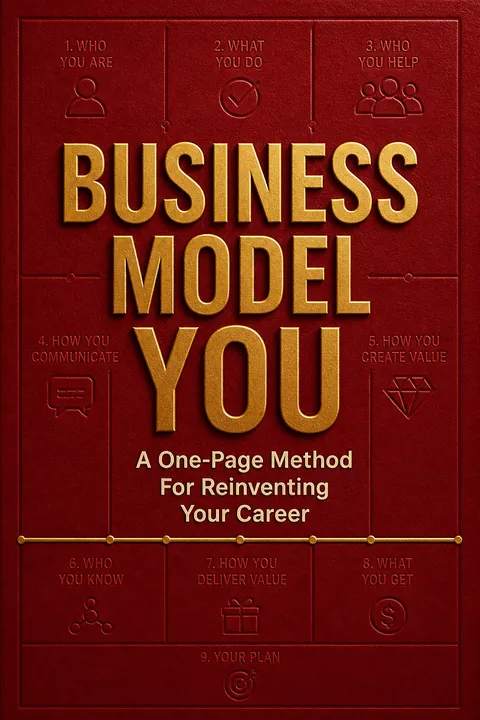
The visual blueprint. The Personal Business Model Canvas is a powerful, one-page tool that translates complex organizational concepts into a personal framework. It uses nine structured building blocks to paint a clear, holistic picture of how your career functions. This visual layout allows you to see how different aspects of your work life interact and depend on one another.
The nine personal blocks. The canvas adapts corporate terminology to reflect your individual reality, focusing on both tangible and intangible elements. It forces you to look at your career through a balanced lens of what you give versus what you get.
- Key Resources & Activities: Who you are, what you have, and what you physically or mentally do.
- Customers & Value Provided: Who you help and the specific benefits you deliver to them.
- Channels & Relationships: How they find you, how you deliver, and how you interact with them.
- Partners, Costs, & Revenues: Who helps you, what you give (stress, time, money), and what you get (salary, satisfaction).
Soft costs and benefits. Unlike corporate models that focus strictly on financial metrics, a personal business model must account for unquantifiable human factors. Soft costs like stress, long commutes, and ethical conflicts are weighed directly against soft benefits like recognition, learning opportunities, and personal satisfaction. This comprehensive view ensures that your career design supports your overall well-being, not just your bank account.
3. Define your value by focusing on "how you help" rather than "what you do"
Never let clients equate Key Activities with Value Provided.
The value-centric shift. One of the most common career mistakes is defining your professional identity by your daily tasks rather than the ultimate benefits you deliver. Customers and employers do not buy your activities; they buy the solutions to their problems. Shifting your focus from "what you do" (activities) to "how you help" (value) instantly elevates your professional worth and marketability.
Solving the customer's job. To define your value, you must identify the core "job-to-be-done" that your customer is hiring you to perform. For example, a translator's activity is translating words, but their true value is helping a law firm win a multi-million-dollar lawsuit.
- Jiffy Lube's value is not changing oil, but providing a mess-free, hassle-free, reliable vehicle.
- Chris Burns realized her value was helping professors get published, not just copyediting.
- When you own the high-level job-to-be-done, your perceived value and compensation soar.
Communicating your worth. Once you clearly distinguish your activities from your value, you can design channels that effectively communicate this worth to decision-makers. You must define how you help in order to sell how you help, which is the only way to get paid for helping. This clarity prevents you from being treated as a replaceable commodity and positions you as an indispensable strategic partner.
4. Align your career with your core interests, personality tendencies, and life balance
Vocational interests are an expression of personality.
Discovering your true self. True career satisfaction is impossible without deep self-knowledge, yet many people operate on career autopilot, conforming to external expectations. To build a sustainable model, you must look inward to identify your core interests, innate abilities, and personality traits. Tools like the Wheel of Life and the Lifeline Discovery help you map out past highs and lows to uncover what truly energizes you.
Holland's personality tendencies. Psychologist John Holland demonstrated that career happiness depends on a harmonious match between your personality and your work environment. He classified people and workplaces into six distinct tendencies:
- Realistic & Investigative: Working with tools/outdoors, or researching and analyzing phenomena.
- Artistic & Social: Creating unstructured art/products, or helping, teaching, and curing people.
- Enterprising & Conventional: Leading and influencing for economic gain, or organizing data in structured settings.
The cost of mismatch. When there is a misalignment between who you are (Key Resources) and what you do (Key Activities), you pay a heavy price in "soft costs." Sean Backus, a programmer with strong social tendencies, found himself miserable until he transitioned into technical training. Aligning your daily activities with your dominant personality type reduces friction, eliminates burnout, and naturally boosts your productivity.
5. Craft a clear career purpose statement to guide your professional choices
If you don't realign your work with your purpose, you're just going to relocate that problem to another desk.
The guiding North Star. Purpose acts as a meta-layer that guides the design of your personal business model from above. Without a clear sense of purpose, any career change you make is likely to result in the same old dissatisfaction at a different desk. Defining your purpose gives you a decision-making compass, allowing you to evaluate opportunities based on long-term alignment rather than short-term convenience.
Drafting your purpose. You can craft a powerful, authentic purpose statement by synthesizing three core elements: the activities you enjoy, the people you want to serve, and how you want to help them.
- Activities: The specific actions that keep you absorbed and make time fly.
- People: The specific customer groups or communities you feel drawn to support.
- Helping: The primary verbs that describe the positive impact you want to make.
Purpose over skills. Focusing on your purpose rather than your current skill set opens up unexpected professional pathways. Adrian Haines, a historian, realized his purpose was "rescuing history from dusty walls," which allowed him to transition from print publishing to digital library curation. When purpose trumps skills, you stop viewing yourself as a rigid job title and start seeing yourself as a versatile agent of value.
6. Shift your mental models to unlock creative career possibilities
Your entire life, including the reality you are experiencing, is a set of stories that you have told yourself and continue to tell yourself.
Challenging internal narratives. We do not experience reality directly; instead, we experience our perspective of reality, which is shaped by our internal mental models. Many of the career limitations we face—such as feeling stuck, underappreciated, or unqualified—are self-imposed stories we tell ourselves. Recognizing that these "realities" are merely interpretations is the first step toward liberating yourself from career stagnation.
Thinking outside the box. To solve seemingly impossible career dilemmas, you must actively challenge your unspoken assumptions and enlarge your frame of reference. Just like the classic nine-dot puzzle, career breakthroughs require you to step outside the boundaries you have unconsciously drawn around yourself.
- Identify a frustrating work situation and write down your current "story" about it.
- Construct a plausible, positive alternative reality that explains the same facts.
- Live as if the new, empowering story is true and actively look for supporting evidence.
The power of perspective. Shifting your perspective allows you to turn perceived weaknesses into powerful career assets. Al Gore transitioned from a frustrated politician into a global environmental media superstar by changing his channels and target audience. By consciously rewriting your professional narrative, you unlock creative business models that were previously invisible within your old frame of mind.
7. Diagnose and modify your canvas to resolve career pain points
The Canvas's strength lies in providing a structured way to experiment with different personal business models.
Systematic career diagnosis. When your career feels painful or stagnant, you can use your Personal Business Model Canvas as a diagnostic tool to pinpoint the exact source of trouble. By systematically reviewing each of the nine building blocks, you can identify where your model is failing. This structured approach removes the emotional overwhelm of career dissatisfaction and replaces it with actionable design problems.
Interconnected building blocks. A change in one building block inevitably triggers a ripple effect across the entire canvas, requiring you to adjust other blocks in response. For example, if you decide to increase your revenue, you must trace how that change impacts your activities and resources.
- Adding a Customer: Requires adding marketing or selling to your Key Activities.
- Acquiring New Skills: Changes your Key Resources and enables new Value Provided.
- Partnering with Others: Can reduce your Costs and free up your time for high-value tasks.
Prototyping multiple models. Rather than committing to a single career plan, use the canvas to prototype and experiment with multiple potential models. This prototyping power gives you the agility to quickly adapt when your external environment changes, such as a sudden layoff or a change in management. By treating your career as a series of flexible hypotheses, you maintain control and confidence in the face of unexpected disruption.
8. Calculate your true business value to understand what employers are paying for
An employee's worth is measured by the Value he or she ultimately provides to Customers.
The economics of employment. To successfully negotiate salaries or fees, you must understand the financial logic that governs how organizations make hiring decisions. Employers do not pay you out of charity; they pay you out of their gross margin, which is funded entirely by customers. To justify your salary, you must generate enough value to cover your fully loaded cost and contribute to the organization's earnings.
The fully loaded cost. An employee's true cost to a company is significantly higher than their base salary due to taxes, benefits, and administrative overhead. As a rule of thumb, an employer must generate two to three times your salary in additional sales to break even on your employment.
- A $4,000 monthly salary actually costs a company around $5,000 in cash.
- At a 40% gross margin, the company must generate $12,500 in monthly sales to cover you.
- Your value must directly or indirectly drive these necessary sales.
Proving your business value. When you position yourself as a one-person business, you must be prepared to explain how your activities will bring measurable economic benefits to the organization. Whether you help increase revenue or reduce costs, your value must outweigh your fully loaded cost. Understanding this financial equation gives you immense leverage during salary negotiations and helps you target organizations where your impact is highest.
9. Test your personal business model in the market through customer discovery
The best way to test is the way savvy entrepreneurs test new product or service business models: by talking to prospective Customers.
Validating your hypotheses. A personal business model designed entirely on paper is merely a set of untested assumptions that must be validated in the real world. To avoid wasting time and energy pursuing a career path that doesn't exist, you must test your model directly with prospective customers. This market-testing process protects you from the devastating failure of launching a service or career that nobody actually wants or is willing to pay for.
Getting out of the building. Customer discovery requires you to leave your comfort zone and conduct informational interviews with industry professionals and decision-makers. The goal of these meetings is not to sell yourself, but to listen, learn, and validate your building block assumptions.
- Warm Referrals: Reach out through friends, colleagues, and acquaintances to secure meetings.
- The Secret Question: Ask "What else should I know about...?" to uncover deep industry insights.
- Identify Pain Points: Discover the real, economic challenges the organization is facing.
Selling to decision-makers. Once you have validated your assumptions and refined your model, you can confidently propose your value to a decision-maker. Presenting a concise, one-page proposal that directly addresses their specific job-to-be-done makes it easy for them to say yes. If they decline, use their feedback as valuable data to refine your model and try again, remembering that persistence is the key to winning opportunities.
10. Pivot and adapt your model continuously as a lifelong practice
Your personal business model is certain to evolve again, if not in response to changing times, at least in response to the more experienced you revealed by passing years.
The power of the pivot. A pivot is a structured course correction designed to test a new hypothesis about your personal business model based on real-world feedback. When your market testing reveals that customers do not value your proposed offering, you must be willing to modify your building blocks rather than giving up. Pivoting is not a sign of failure; it is an essential, scientific step in the process of successful career reinvention.
Adapting to life stages. Your personal business model is not a static document, but a living, breathing map that must evolve as you grow and change. What satisfies you at age 25—such as high income and rapid advancement—may no longer align with your priorities at age 50, when legacy and flexibility become paramount.
- Cyd Cannizzaro pivoted from customer service to a municipal recycling coordinator.
- Dennis Shieh pivoted from a retail computer store to a business-to-business scale calibration firm.
- Makis Malioris adapted his model to manage international locations, overcoming his fear of flying.
A repeatable success pattern. Embracing the personal business model methodology provides you with a repeatable, lifelong framework for navigating career transitions. By continuously monitoring your canvas, diagnosing pain points, and testing new hypotheses, you remain permanently employable and personally fulfilled. You stop being a passive passenger in your career and become the active, strategic pilot of your professional destiny.
Review Summary
Download PDF
Download EPUB
.epub digital book format is ideal for reading ebooks on phones, tablets, and e-readers.








































