

Key Takeaways
Read Western history facing east, through the eyes of its victims
The conquest told from the conquered side. Dee Brown reconstructs thirty years (1860-1890) of American expansion using the words of Native leaders themselves, drawn from treaty council transcripts, translated speeches, and interviews recorded by stenographers and reporters. The great myths of the West (cowboys, cavalry, homesteaders, gold rushes) all bloomed during the exact decades when tribal civilizations were destroyed.
The Indian was cast as villain in a story he did not write. Because few Natives could publish in English, the dominant narrative erased their reason and eloquence. Brown flips the camera. Readers meet leaders speaking with what he calls gentle reasonableness, revealing a people who saw America as a paradise and could not fathom why newcomers wanted to destroy it.
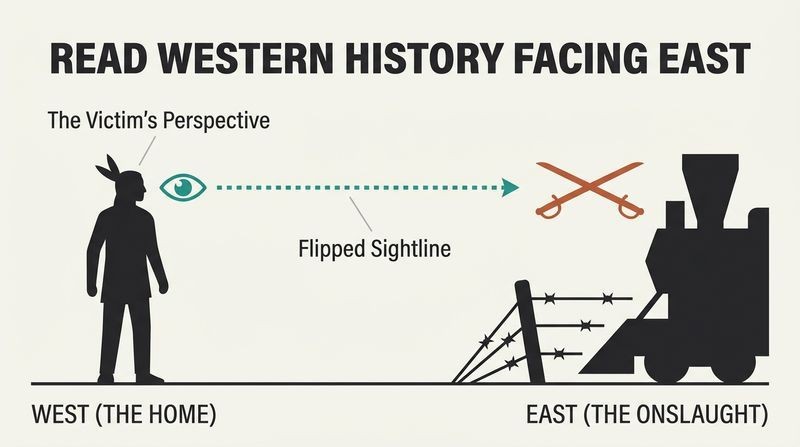
Brown's method anticipates what historians now call subaltern history: recovering the perspective of those written out of official records. Published in 1970 amid Vietnam and civil rights, the book landed like an indictment. Its framing device (turn around, look east) is deceptively simple but epistemologically radical. A caution worth noting: council transcripts pass through interpreters of uneven skill, and Brown acknowledges some speeches were polished or mistranslated. The words are not pristine primary sources. Yet the cumulative weight of hundreds of testimonies overwhelms any single distortion, and the pattern they reveal (promise, encroachment, betrayal) proves consistent across every tribe and decade.
Treaties functioned as delaying tactics, not agreements meant to be kept
The pattern repeated for every tribe. A treaty granted land forever, then gold, timber, railroads, or settlers appeared, and Washington redrew the line. The Navajos signed peace, then soldiers burned their hogans over a stray-livestock dispute. The Cheyennes and Arapahos were told at Fort Wise they kept hunting rights, but the written text stripped them. What chiefs believed they signed and what Congress ratified were, in Brown's phrase, like two horses whose colors did not match.
Numbers made resistance mathematically hopeless. By 1860 roughly 300,000 Natives faced over 30 million settlers. The 1868 treaty required three-fourths of adult males to sign away land; commissioners simply ignored this, collecting signatures from boys or declaring non-signers hostile.
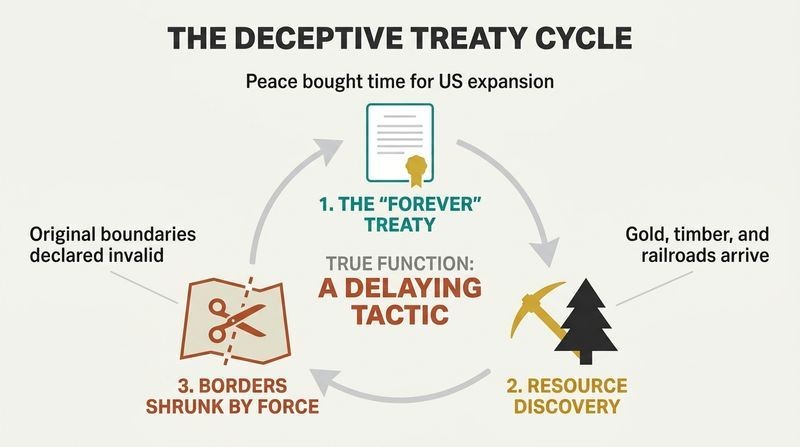
The treaty as instrument of dispossession is not hyperbole but documented procedure. Legal scholars note the United States ratified nearly 400 treaties with tribes and violated substantial portions of nearly all. The mechanism Brown exposes is bureaucratic rather than merely cruel: language barriers, mistranslation, and the gap between negotiated terms and ratified text created plausible deniability. This connects to modern contract theory around information asymmetry and unconscionability. What makes it damning is repetition. A single broken promise is an accident; the same structure deployed against Navajo, Sioux, Cheyenne, Ponca, Nez Perce, and Ute over three decades reveals policy, not error.
Massacres of surrendered, flag-flying camps were rebranded as battles
Sand Creek, 1864. Black Kettle flew both an American flag and a white surrender flag over his camp, trusting a colonel's written pledge of safety. Colonel Chivington's Colorado volunteers attacked at dawn, killing 105 women and children and 28 men, then mutilated the corpses. Chivington had publicly urged killing infants, reasoning that nits make lice.
The pattern recurred. At the Washita in 1868, Custer struck Black Kettle's peaceful village again, this time killing the old peace chief. At Wounded Knee in 1890, the Seventh Cavalry killed roughly 300 disarmed Sioux. Officials called these victories over savage butchers. Brown documents that the mutilations attributed to Indians were frequently first committed by soldiers, then imitated in revenge.
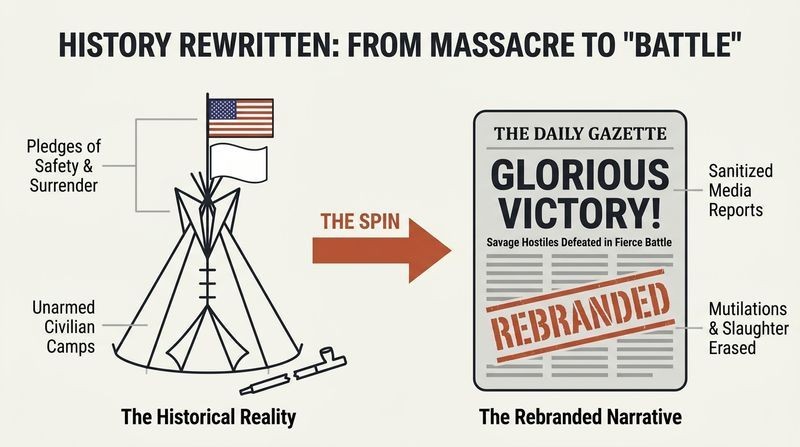
The linguistic sleight of hand (massacre becomes battle, victims become hostiles) is itself a weapon, and Brown's juxtaposition of official reports against eyewitness testimony exposes it. This resonates with Orwell on how political language conceals atrocity. Notably, some contemporaries dissented: Captain Silas Soule refused to let his men fire at Sand Creek and later testified, then was murdered on a Denver street. That internal dissent matters. It shows these acts were recognized as crimes even by their own era's standards, not merely judged harshly by hindsight. The bravery of the peace chiefs, who kept trusting written pledges, becomes almost unbearable to read.
Destroying food, horses, and buffalo beat warriors no army could catch
Scorched earth won where cavalry failed. Kit Carson could rarely find Navajos in Canyon de Chelly, so he burned their cornfields and cut down their prized peach orchards, over 5,000 trees. Starvation, not combat, forced the surrender that launched the Long Walk of 1864, a 300-mile forced march to Bosque Redondo where hundreds died.
Killing the buffalo was killing the Plains tribes. Of 3.7 million buffalo destroyed between 1872 and 1874, Indians killed only 150,000; white hide-hunters did the rest. When Texans asked General Sheridan to curb the slaughter, he reportedly urged hunters to kill until the herds vanished, because it was the surest path to peace. Repeatedly the Army slaughtered captured pony herds, dismounting and disarming a mounted people.
This is total war on subsistence, a doctrine later formalized against civilian economies. The buffalo campaign functioned as ecological warfare: eliminate the resource base and the population collapses without a shot. Modern scholarship confirms the commercial hide trade, enabled by new tanning techniques and railroads, drove the near-extinction, and that military leaders understood its strategic value. The peach orchards detail is telling. The Navajos could forgive Carson for fighting them but never for the trees, because the orchards represented generations of patient cultivation. Destroying accumulated capital, not just current supply, is what breaks a people's capacity to recover.
Peace chiefs were destroyed precisely because they chose peace
Cooperation offered no protection. Black Kettle courted the whites, flew their flag, ransomed captives, and was killed anyway, twice pursued into peaceful camps. Spotted Tail counseled compromise and was assassinated. The gentle Poncas had never warred against the United States, yet were exiled to Indian Territory where a quarter died within a year.
The dynamic radicalized the young. After Sand Creek, survivors abandoned Black Kettle's peace faction for war leaders like Roman Nose and the Dog Soldiers. Brown notes Chivington in a few hours of madness destroyed the power of every Cheyenne chief who had held out for peace. Trusting the government was not merely naive; it was frequently fatal, and it discredited moderation within the tribes.
There is a grim game-theoretic logic here. When cooperation is punished as reliably as resistance, rational actors stop cooperating, and moderates lose standing to hardliners. This mirrors dynamics in conflict studies where spoiler violence and betrayal of peace factions escalate wars. Brown does not romanticize the warriors over the diplomats; he shows both were crushed. The tragedy is structural. The peace chiefs' repeated, almost naive trust (Black Kettle mounting the flag he was told would protect him) reads as heartbreaking rather than foolish, because within their moral universe a solemn pledge was binding. They were destroyed by assuming the other side shared that ethic.
An Indian was legally ruled a person only in 1879
Standing Bear v. Crook. When the Poncas were forced to Indian Territory, Chief Standing Bear's son died begging to be buried in his homeland. Standing Bear led a small band north to keep the promise and was arrested. His lawyers argued he was a person entitled to habeas corpus; the government argued Indians were not persons within the meaning of the law.
Judge Dundy's ruling. In 1879 the court held that an Indian is a person, that the right to leave one's tribe and live under law is natural and inalienable, and that Standing Bear could not be confined against his will. Standing Bear's courtroom speech, comparing himself to a man fleeing a prairie fire with his children, moved the room to a standing ovation.
That American courts had to formally decide whether Indigenous people counted as legal persons in 1879 is a jarring measure of the era's moral architecture. The case is a landmark in civil rights jurisprudence yet remains obscure. Brown resurrects it deliberately, showing the reservation system's guardians immediately grasped its threat: if Indians could simply walk away as citizens, the entire military-political-reservation complex collapsed. When Big Snake tried the same, he was shot. The ruling's promise went largely unenforced. This anticipates a recurring pattern in American rights history, where a legal victory establishes principle decades before power actually yields to it.
Red Cloud won his war, then lost everything at the treaty table
The only Indian to win a war against the United States. From 1866 to 1868 Red Cloud's Oglala Sioux blockaded the Bozeman Trail, annihilated Captain Fetterman's 81 men, and forced the Army to abandon its Powder River forts. He burned them himself. The 1868 treaty gave the Sioux the Black Hills forever.
Victory dissolved in paperwork and gold. Once Custer's 1874 expedition reported Black Hills gold from the grass roots down, miners flooded the sacred Paha Sapa along the Thieves' Road. A commission offered six million dollars; Sitting Bull picked up a pinch of dust and said he would not sell that much. So Congress simply took the hills in 1876 after the Little Bighorn, declaring the Sioux had broken the treaty by defending themselves.
Red Cloud's arc is the book's sharpest lesson about the limits of battlefield success against an industrial state. Military victory bought time, not permanence, because the adversary could regenerate armies and rewrite law faster than any tribe could resist. The Black Hills seizure remains legally contested: in 1980 the Supreme Court found the taking unlawful and awarded compensation, which the Sioux have refused to accept, now grown to over a billion dollars, insisting the land itself return. That living refusal validates Brown's thesis. For the Sioux, Paha Sapa was never a real-estate transaction, a category the commissioners could not comprehend.
The Little Bighorn was a Native triumph that guaranteed Native defeat
Custer's annihilation, June 1876. Drawn by the Sun Dance vision in which Sitting Bull saw soldiers falling into camp upside down, thousands of Sioux and Cheyenne gathered on the Greasy Grass. When Custer attacked, Gall turned Reno's flank while Crazy Horse struck from the rear. The Long Hair and his entire immediate command died. Most warriors never even saw Custer or knew who killed him.
Winning the battle doomed the war. Eastern whites, enraged, demanded total punishment. Within weeks the Army seized the reservations, took the Black Hills by statute, and disarmed and dismounted the agency Sioux. Crazy Horse surrendered in 1877 and was bayoneted months later; Sitting Bull fled to Canada, where cold and hunger slowly forced his return.
The Little Bighorn is the great American irony: the most complete Indigenous military victory triggered the most decisive collapse. This illustrates a structural asymmetry in wars between states and stateless peoples. A state can absorb a catastrophic loss and mobilize public fury into overwhelming force; a mobile confederation of tribes, dependent on buffalo and seasonal gathering, cannot sustain a standing army or replace losses. Brown's account, assembled from Sioux and Cheyenne eyewitnesses, also punctures the heroic Custer myth by showing the chaos and the near-anonymity of his death. Victory in a single engagement means little when the enemy controls the terms of the next decade.
Chief Joseph's brilliant 1,300-mile retreat ended forty miles from freedom
The Nez Perce, friends since Lewis and Clark. For seventy years the tribe boasted no Nez Perce had killed a white man. When ordered off Oregon's Wallowa Valley in 1877, Joseph's people fled toward Canada rather than fight, outmaneuvering pursuing armies across Idaho and Montana in one of history's most admired fighting retreats.
Caught in the Bear Paw Mountains. After 1,300 miles, blocked by Bear Coat Miles just short of the border, Joseph surrendered with the words that from where the sun now stands he would fight no more forever. He was promised return to his homeland. Instead the Army shipped the survivors to Indian Territory, where they sickened and died. Joseph died in exile in Washington in 1904; the agency physician recorded the cause as a broken heart.
Joseph became a national celebrity, praised even by his enemies, which reveals something uncomfortable about how the dominant culture processes conquest: it romanticizes the noble defeated once they are safely no longer a threat. His surrender speech, filtered through Lieutenant Wood's translation, became the most quoted of all Indian orations, arguably because its dignity flattered white sensibilities. Yet Brown insists on the sequel the legend omits: broken promises, malarial exile, mass death. The retreat's tactical genius (Joseph repeatedly evaded and mauled larger forces) matters less to Brown than the betrayal that followed surrender, the same pattern that swallowed every tribe in the book.
The Ghost Dance was Christian and nonviolent, yet triggered Wounded Knee
A gospel of resurrection, not war. The Paiute prophet Wovoka taught that if Indians danced and lived righteously, hurting no one, a new earth would come, the dead would return, the buffalo would flood back, and whites would vanish peacefully. Its ethics (do no harm, do not fight, do right always) were, Brown notes, indistinguishable from any Christian church.
Fear turned dance into slaughter. Alarmed agents called for troops. Sitting Bull was killed during a botched arrest in December 1890. Two weeks later at Wounded Knee Creek, the Seventh Cavalry, disarming Big Foot's band, opened fire. Hotchkiss guns raked the camp. Roughly 300 Sioux died, over half women and children. The wounded were carried to a church whose Christmas banner read Peace on Earth, Good Will to Men.
The Ghost Dance's suppression exposes how the powerful misread the desperation of the powerless as menace. A movement preaching nonviolence and patient waiting was interpreted through the lens of official anxiety as insurrection, precisely because the dominant side could not imagine the dance as anything but a prelude to attack. This is a recurring failure in the psychology of security states: ambiguous behavior by a feared group is read at worst-case. The Christmas banner over the dying is Brown's final, devastating irony. Black Elk's lament, that a people's dream died in that bloody mud, closes the frontier and the book on the same note.
Analysis
Bury My Heart at Wounded Knee is a work of documentary reassembly rather than argument: Brown lets the accumulated testimony of the conquered build a case no single polemic could. Published in 1970, it arrived when a generation questioning Vietnam and celebrating civil rights was primed to reexamine the national founding myth, and it became a permanent fixture of how Americans understand the West. Its structure, roughly chronological and tribe-by-tribe (Navajo, Santee Sioux, Cheyenne, Apache, Modoc, Kiowa, Comanche, Teton Sioux, Nez Perce, Ponca, Ute), produces a devastating cumulative effect: the reader watches the same machinery grind through people after people, each with different terrain and temperament, each ending the same way.
The book's power and its limits both flow from its method. By centering Indigenous voices and framing settlers as intruders, Brown corrected a genuinely lopsided historiography. But the technique flattens Native peoples somewhat, tending toward a unified tragic protagonist and underplaying intertribal warfare, the mercenary scouts (Pawnee, Crow, Apache) who fought for the Army, and the genuine diversity of Native political strategy. Brown includes these facts honestly (the Pawnee killing Yellow Woman, Apaches turning in Apache heads for bounty) yet the elegiac frame can obscure that Native history did not end at Wounded Knee, a point his own 2000 preface corrects by noting thriving, contentious modern tribal nations.
What endures is the demonstration that policy, not accident, drove dispossession: the treaty as delay, the massacre relabeled battle, the buffalo exterminated as strategy, the peace chief destroyed for choosing peace. Modern scholarship on settler colonialism, ecological warfare, and the 1980 Black Hills ruling all vindicate Brown's core claims. The prose occasionally sentimentalizes, and the reliance on interpreter-mediated speeches invites caution about verbatim accuracy. But as moral history, the book's central instruction remains unanswerable: to understand the American West, stop looking west, and turn to face east, toward the people already there.
Review Summary
Readers widely regard Bury My Heart at Wounded Knee as essential, heartbreaking reading that exposes the systematic genocide of Native Americans through broken treaties, massacres, and forced displacement. Many describe it as emotionally overwhelming, requiring breaks between chapters. Reviewers praise Brown's use of primary sources and storytelling skill, while noting its Indian-centric perspective as a necessary corrective to dominant historical narratives. Common criticisms include loose historical sourcing and insufficient exploration of Native cultures beyond warfare. Most agree it should be required reading for all Americans.
People Also Read



Download PDF
Download EPUB
.epub digital book format is ideal for reading ebooks on phones, tablets, and e-readers.








































