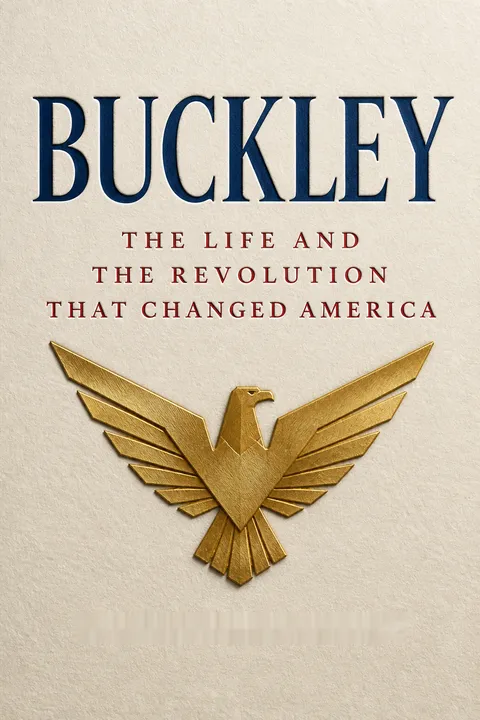

Key Takeaways
1. Formative Years: A Crucible of Contradictions
Everything he learned, and all he became, began at home.
Early influences. William F. Buckley Jr.'s worldview was profoundly shaped by his affluent, devoutly Catholic family, particularly his father, William F. Buckley Sr. A self-made oil speculator and lawyer, the elder Buckley instilled in his ten children a fierce anti-communism, a deep distrust of government intervention, and a strong sense of Catholic identity, often tinged with anti-Semitic and Anglophobic sentiments. These early lessons, absorbed in the family's grand estates in Connecticut and South Carolina, formed the bedrock of young Bill's intellectual and political development.
A unique upbringing. Bill's childhood was marked by privilege and intellectual stimulation, including extensive European travel and homeschooling that emphasized languages, history, and music. Despite a frail body and initial academic struggles, he displayed precocious verbal skills and a passionate intensity. His father's "unearthly self-confidence" and "gift for imperturbability" in the face of financial ruin and political defeat deeply influenced Bill, teaching him to stand firm on his convictions regardless of opposition.
Early rebellions. The Buckley household was a lively arena for debate, where Bill honed his argumentative prowess, often acting as his father's "echo chamber." This environment also fostered a rebellious streak, leading to pranks against local Protestant churches and, notably, a cross-burning incident near a Jewish resort, which Bill later dismissed as a "Halloween prank" but reflected the family's ingrained prejudices. These early acts foreshadowed his later role as a provocative conservative iconoclast.
2. Yale: Launching a Conservative Crusade
I believe that the duel between Christianity and atheism is the most important in the world. I further believe that the struggle between individualism and collectivism is the same struggle reproduced on another level.
A new battleground. Buckley arrived at Yale in 1946, a veteran of World War II, determined to make his mark. He quickly excelled in academics and became a star debater, forming a formidable partnership with L. Brent Bozell Jr. Yale, however, became the primary target of his intellectual activism, as he perceived it to have abandoned its founding principles of Christian faith and free-market individualism in favor of a "collectivist atmosphere."
The birth of a book. His experiences at Yale culminated in his first book, God and Man at Yale (GAMAY), a scathing critique of the university's perceived liberal and secular indoctrination. Buckley argued that Yale, funded by "Christian individualists," was instead producing "atheistic socialists." He meticulously documented instances of professors promoting views contrary to the university's stated values, accusing them of using "academic freedom" as a shield for their ideological biases.
A call to action. GAMAY was more than a critique; it was a manifesto. Buckley urged alumni and donors to leverage their financial power to demand accountability from the university, advocating for the appointment of professors who would uphold conservative principles. The book, though controversial and widely denounced by liberals, became an instant bestseller and established Buckley as a leading voice of the nascent conservative movement, demonstrating his talent for turning intellectual arguments into public spectacles.
3. The McCarthy Years: A Fierce Defense of a Flawed Hero
McCarthyism was a movement around which men of good will and stern morality can close ranks.
Unwavering loyalty. Buckley's unwavering defense of Senator Joseph McCarthy, detailed in McCarthy and His Enemies (co-authored with L. Brent Bozell Jr.), became a defining moment in his early career. Despite McCarthy's increasingly erratic behavior, unsubstantiated claims, and eventual censure, Buckley saw him as a courageous warrior against communism, a figure who dared to challenge the liberal establishment's complacency regarding internal subversion.
A strategic defense. The book argued that McCarthy's methods, though sometimes "clumsy" or "sensationalist," were justified by the existential threat of communism. Buckley and Bozell reframed McCarthy's actions as a necessary "social pressure movement" to expose hidden enemies and rally public opinion. They contended that McCarthy's opponents, particularly liberal intellectuals and the press, were more culpable for undermining national unity and distracting from the true danger.
Personal cost. Buckley's loyalty to McCarthy came at a cost. The book was widely condemned, and his reputation became inextricably linked with McCarthy's. However, for Buckley, McCarthy represented a vital force in the ideological war, a "vigilante" who spoke to the "non-University crowd" and forced a national reckoning with the communist threat, even if his personal conduct was deeply flawed.
4. Founding National Review: Building a Counter-Establishment
It stands athwart history, yelling Stop, at a time when no one else is inclined to do so, or to have much patience with those who so urge it.
A new platform. Disillusioned with existing conservative publications, Buckley, inspired by Willi Schlamm, embarked on his most ambitious project: founding National Review. Launched in 1955, NR was envisioned as a sophisticated, intellectually rigorous weekly journal that would challenge the "monolithic liberal control of public opinion" and unite disparate conservative factions.
A bold mission. NR's mission statement, penned by Buckley, declared its radical conservative stance, opposing:
- "Coexistence with communism"
- "Fabian operators" controlling both political parties
- "Big Brother government" and labor union "monopolies"
- "World government, the United Nations, internationalism"
Early struggles and triumphs. The magazine faced immense financial challenges and internal ideological battles, particularly between Schlamm's apocalyptic anti-communism and James Burnham's more pragmatic geopolitical analysis. Despite these hurdles, Buckley's charisma, fundraising prowess, and ability to attract talented writers like Whittaker Chambers, Frank Meyer, and Russell Kirk, allowed NR to survive and gradually establish itself as the intellectual vanguard of the conservative movement.
5. Navigating Race: From Segregationist Apologist to Nuanced Critic
The South believes that segregation is the answer to a complex situation not fully understandable except to those who live with it.
Defending the "Southern way of life." Buckley's early stance on race was deeply controversial, reflecting his Southern upbringing and his father's views. He defended segregation as a legitimate "folkway" and "custom," arguing that the white community had a right to "prevail, politically and culturally" in areas where it did not numerically dominate. This position was articulated in National Review editorials and in his 1959 book, Up from Liberalism, where he suggested that universal suffrage should be curtailed for "lesser whites as well as Blacks."
The Camden News. The Buckley family's ownership of The Camden News, a weekly newspaper in South Carolina that promoted "massive resistance" to desegregation and published Citizens' Council statements, further cemented his image as a segregationist apologist. This involvement, kept largely secret from his New York circle, highlighted the deep contradictions within his public persona and private actions.
Evolving views. Over time, Buckley's views on race began to moderate, influenced by his experiences on Firing Line and an Urban League tour of Black ghettos. He engaged with Black separatists like Muhammad Ali and Roy Innis, and eventually conceded that "federal intervention was necessary" to dismantle Jim Crow. This shift, though gradual and incomplete, marked a significant evolution from his earlier, more rigid positions, demonstrating his capacity for intellectual growth even on deeply ingrained issues.
6. The Goldwater Revolution: Forging a New Republican Right
Let’s grow up, conservatives. Let’s, if we want to take this party back—and I think we can someday—let’s get to work.
A new conservative champion. The 1964 presidential campaign of Barry Goldwater marked a pivotal moment for the conservative movement, and Buckley played a crucial role in its orchestration. Despite Goldwater's eventual landslide defeat, his nomination represented a triumph for the conservative insurgency within the Republican Party, fulfilling Buckley's long-held ambition to shift the GOP rightward.
The "Conscience" and the "Draft." Buckley and his allies, particularly L. Brent Bozell Jr. (author of The Conscience of a Conservative) and Clifton White (mastermind of the Draft Goldwater movement), meticulously built a grassroots campaign. They leveraged Goldwater's plain-spoken appeal to "forgotten Americans" and his anti-establishment rhetoric to capture delegates in state conventions, particularly in the South and West.
A strategic defeat. Though Goldwater lost the general election decisively, his campaign laid the groundwork for future conservative victories. Buckley, initially skeptical of Goldwater's intellectual depth, recognized his magnetic appeal and the strategic importance of his candidacy. The campaign energized a new generation of activists, Young Americans for Freedom (YAF), who would become the foot soldiers of the conservative revolution, proving that a "counterrevolution" was indeed possible.
7. Nixon's Era: A Complex Dance with Power
Is he one of us? Or, is there nothing left of—us? Or—a third possibility—does the bond of anti-Communism simply not mean anything anymore?
An uneasy alliance. Buckley's relationship with Richard Nixon was complex, marked by both strategic alliance and deep ideological tension. Despite initial reservations and Nixon's past criticisms, Buckley ultimately supported Nixon's presidential bids, viewing him as the most "viable candidate" to advance conservative goals, particularly in the fight against communism. This alliance positioned Buckley closer to presidential power than any conservative journalist before him.
The China shock. Nixon's unexpected opening to China in 1971 deeply unsettled Buckley and many conservatives. Buckley, who had long championed Taiwan and a militant anti-communist stance, viewed Nixon's "démarche" as a betrayal of core principles. He publicly expressed his dismay, even staging a "Pentagon Papers hoax" in National Review to highlight what he saw as the administration's duplicity and the media's complicity.
Watergate's shadow. The Watergate scandal further strained Buckley's loyalty. His close friend and former CIA handler, E. Howard Hunt, was implicated, drawing Buckley into a web of legal and ethical dilemmas. While publicly downplaying the "caper," Buckley privately grappled with the extent of Nixon's crimes and the erosion of public trust. His eventual call for Nixon's resignation, though late, marked a significant break, demonstrating his commitment to institutional integrity over partisan loyalty.
8. The Buckley Persona: Master of Media and Controversy
He is more fun to listen to than most professional comedians.
The Firing Line phenomenon. Buckley's television program, Firing Line, launched in 1966, became his most enduring and influential platform. It showcased his unique persona: erudite, witty, and relentlessly articulate, engaging prominent liberals in civil yet combative debates. Firing Line transformed Buckley into a national celebrity, making conservative ideas accessible and even entertaining to a broad audience.
The Vidal debates. His televised clashes with Gore Vidal during the 1968 political conventions were legendary, characterized by intellectual sparring, personal insults, and thinly veiled homophobic insinuations. Though controversial, these debates captivated millions, elevating Buckley's profile and demonstrating his mastery of the new medium, even as they exposed his own prejudices.
A unique style. Buckley's distinctive speaking style—a blend of languid drawl, ornate vocabulary, and rapid-fire wit—became his trademark. He cultivated an image as a "performing ideologue," capable of turning any political discussion into a captivating spectacle. This theatricality, combined with his genuine intellectual curiosity and ability to charm adversaries, allowed him to transcend the traditional boundaries of journalism and become a cultural icon.
9. Personal Passions: Sailing, Writing, and Unconventional Friendships
The challenge lies in setting the sails as quickly as you know how, in trimming them as well as you know how; in handling the helm as well as you can; in getting as good a fix as you can; in devising the soundest and subtlest strategy given your own horizons; in keeping your temper, and your disposition; and above all things, in keeping your perspective, and bearing in mind, always, the essential beauty of the experience.
The allure of the sea. Beyond politics, Buckley found profound joy and intellectual challenge in sailing. His passion for blue-water voyages, meticulously documented in memoirs like Airborne, became a metaphor for his approach to life: a blend of rigorous discipline, calculated risk, and an appreciation for beauty. These adventures, often shared with a rotating crew of friends and family, provided a vital escape from the pressures of his public life.
A new literary career. In the mid-1970s, Buckley embarked on a successful career as a spy novelist, creating the character Blackford Oakes, an idealized CIA operative. These novels, set in the early Cold War, offered a patriotic counter-narrative to the disillusioned spy fiction of the era, reflecting Buckley's unwavering belief in the righteousness of the anti-communist cause. His prolific output and commercial success demonstrated his versatility as a writer.
The Edgar Smith case. Buckley's most unconventional friendship was with Edgar Smith, a death-row inmate he tirelessly championed for over a decade. Convinced of Smith's innocence, Buckley used his platforms to advocate for his release, even providing financial and legal support. This deeply personal crusade, though ultimately revealing Smith's guilt, underscored Buckley's complex character: his fierce loyalty, his capacity for infatuation, and his willingness to challenge conventional wisdom, even when it led him into morally ambiguous territory.
10. Reagan and Beyond: The Triumph of a Movement
It would be going too far to say Buckley put him there, but it would be fair to say that Ronald Reagan rode to victory on a political philosophy that Bill Buckley’s been offering up for more than two decades.
The Reagan Revolution. Buckley's long-held vision of a conservative ascendancy culminated in the election of Ronald Reagan in 1980. Reagan, whom Buckley had initially dismissed as "not plausible," emerged as the movement's most effective champion, embodying the fusion of anti-communism, anti-statism, and traditional values that Buckley had tirelessly promoted for decades.
A strategic partnership. Buckley played a crucial, albeit often behind-the-scenes, role in Reagan's rise. He provided intellectual legitimacy, helped shape policy, and served as a trusted confidant. Their relationship, though not without its tensions (such as the Panama Canal debate), symbolized the successful integration of conservative intellectualism into mainstream Republican politics.
Cold War victory. The collapse of the Soviet Union in 1991, under Reagan's successor George H.W. Bush, was the ultimate vindication of Buckley's lifelong anti-communist crusade. He celebrated this triumph, reflecting on the "bright hour" history had delivered and the improbable success of a movement that had once been dismissed as a fringe phenomenon.
11. A Lasting Legacy: The Enduring Architect of Modern Conservatism
For almost half a century, millions of Americans could confidently say who had been the country’s greatest conservative: William F. Buckley, Jr.
An institutional force. By the end of his life, Buckley had transformed from a "radical conservative" into an institution. National Review became a respected, if still provocative, voice in American political discourse. His syndicated column reached millions, and Firing Line remained a benchmark for intelligent debate. He had successfully built a "counter-establishment" that profoundly reshaped the Republican Party and American political thought.
A complex figure. Buckley's legacy is marked by contradictions: a champion of freedom who defended segregation, an intellectual who embraced populism, a man of deep faith who flirted with hedonism. He was a master of language, wit, and charm, capable of both fierce polemic and disarming geniality. His ability to hold these tensions in balance, and to adapt his message to changing times, ensured his enduring influence.
An enduring absence. Buckley's death in 2008 left a void in American conservatism. He had cleared a "large place for himself" that no one since has been able to fill. His impact stemmed not just from his ideas, but from his unique persona—his "imagination and generosity, the kindness and warmth"—which allowed him to connect with diverse audiences and shape the intellectual and political landscape for generations.
Review Summary
People Also Read

Download PDF
Download EPUB
.epub digital book format is ideal for reading ebooks on phones, tablets, and e-readers.








































