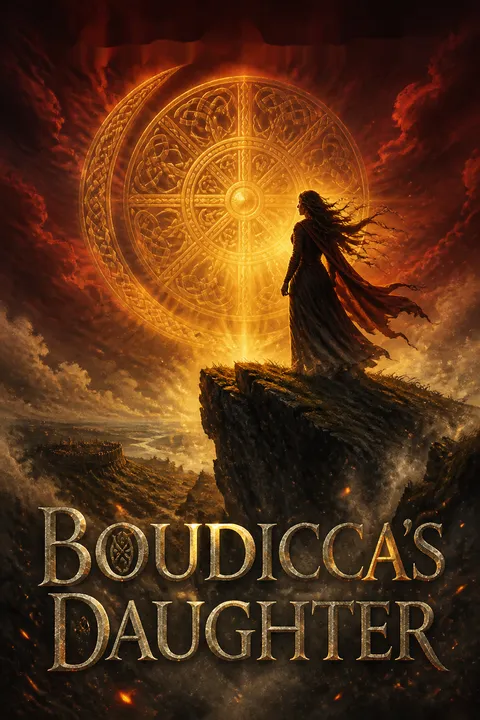

Plot Summary
Daughters of War and Peace
Solina and Bellenia, daughters of Queen Catia (Boudicca), grow up in a Britain under Roman occupation, their lives defined by the tension between their parents: Catia, fierce and warlike, and Prasutagus, a king who seeks peace through uneasy alliance with Rome. The sisters are trained as warriors in secret, their mother's fire and their father's wisdom shaping them differently—Solina, introspective and burdened by expectation, and Bellenia, bold and beloved. Their sibling rivalry is sharpened by their parents' favoritism and the looming threat of Roman violence. The girls' coming of age is marked by rituals, feasts, and the ever-present shadow of war, as they struggle to find their place in a world where peace is fragile and rebellion simmers beneath the surface.
The Feast of Darkness
During the sacred Feast of Darkness, the veil between worlds thins, and Solina is chosen to lead the ceremony, seeking guidance from the gods. The night is heavy with expectation—her father hopes for a vision of peace, her mother for a sign of war. Solina's vision is only darkness, disappointing those who look to her for hope. The feast is both celebration and warning, as tensions between the Iceni and Rome are voiced openly. Catia's pride in her daughters is mingled with pain, and the family's unity is tested by the conflicting desires for vengeance and survival. The night ends with private grief and public performance, foreshadowing the tragedies to come.
Prophecy and Betrayal
Solina's struggle to access the divine is mirrored by her father's confession: his prophecies may be as much political calculation as true vision. The revelation shakes Solina's faith in her family's destiny and the gods' will. Meanwhile, Roman aggression intensifies, and the Iceni's fragile peace is shattered by raids and extortion. Prasutagus's attempts to mediate are met with suspicion and resentment, especially from Catia, who sees his compromises as betrayal. The family's internal fractures deepen as the threat from Rome grows, and Solina is forced to question the very foundations of her identity and future.
The King's Last Stand
A Roman raid on the Iceni's salt marshes brings violence to the king's doorstep. Prasutagus, weakened by age and illness, rides out to confront the invaders, only to die in the aftermath—his heart failing under the weight of leadership and compromise. His death leaves the kingdom vulnerable, and his will, splitting power between his daughters and Rome, pleases no one. Catia's grief is laced with anger, and the sisters are thrust into the roles of heirs before they are ready. The family's unity dissolves as the reality of Roman power becomes undeniable, and the seeds of rebellion are sown in loss and humiliation.
Aftermath and Division
With Prasutagus gone, the Iceni are divided. Catia seeks to rally the tribes for war, while Solina and Bellenia struggle to assert their authority amid suspicion and misogyny. The Romans reject the king's will, and violence erupts as soldiers descend on the family home, bringing rape and public flogging. The sisters' bond is tested by trauma, shame, and their mother's relentless drive for vengeance. The survivors flee north, seeking refuge and allies, but the wounds—physical and emotional—run deep. The family's suffering becomes the rallying cry for a rebellion that will consume them all.
The Roman Reckoning
The attack on Catia and her daughters becomes the catalyst for open revolt. Catia, now Boudicca, channels her grief and rage into a campaign of vengeance, using her daughters' dishonor to unite the tribes. Solina and Bellenia are forced to perform their pain for the cause, their private trauma made public. The rebellion swells as the Iceni and their allies march south, sacking Roman settlements and gathering an army. The sisters' relationship is strained by the demands of leadership and the scars of violence, as they are swept up in a war that promises either liberation or annihilation.
Ruin and Survival
The rebellion's early victories are marked by bloodshed and destruction. Cities burn, Roman settlers are slaughtered, and the Iceni's vengeance is absolute. Yet the violence takes its toll on the rebels as well—Bellenia is haunted by trauma, and Solina hardens herself to survive. The line between justice and atrocity blurs, and the sisters are forced to confront the darkness within themselves and their cause. As the war escalates, the hope of freedom is tainted by the knowledge that victory may demand the sacrifice of everything they once held dear.
The Spark of Rebellion
Boudicca's charisma and fury transform her into a living legend, but also a monster in the eyes of Rome. The rebellion's momentum grows as more tribes join, drawn by the promise of vengeance and the spectacle of Boudicca's leadership. Solina and Bellenia are both weapon and symbol, their suffering used to inspire others. The campaign becomes a crucible, forging new identities and alliances, but also deepening old wounds. The sisters' paths begin to diverge, as Bellenia's spirit falters and Solina's resolve is steeled by necessity and rage.
Blood and Vengeance
The rebellion reaches its zenith in ritual and violence. Solina and Bellenia are forced to kill one of their attackers in a public ceremony, reclaiming their honor through blood. The act is both catharsis and curse, binding them to the cycle of vengeance that defines their people's fate. The war becomes increasingly personal, as the sisters' choices are shaped by grief, guilt, and the need for retribution. The cost of survival is measured in lives lost and innocence destroyed, and the line between victim and perpetrator grows ever thinner.
The Fall of Cities
The Iceni's army sweeps through Roman Britain, burning Camulodunum, London, and Verulamium. The victories are pyrrhic—each city's fall brings more death, more horror, and more enemies. The sisters are both celebrated and broken by the violence, and Boudicca's transformation into a figure of myth is complete. Yet the rebellion's success sows the seeds of its own destruction, as Roman legions regroup and the rebels' unity begins to fracture. The cost of vengeance becomes unbearable, and the survivors are left to reckon with what they have become.
Ashes and Grief
The rebellion collapses under the weight of Roman retaliation. Bellenia is killed in a tragic accident, her death a final blow to her family's hopes. Solina is captured, her mother dead by her own hand. The survivors are scattered, enslaved, or hunted. The dream of freedom is reduced to ashes, and the legacy of violence haunts those left behind. Solina's captivity is marked by humiliation and despair, as she is paraded as a symbol of Rome's victory and forced to confront the consequences of her choices.
The Price of Victory
Solina's life as a captive of Suetonius Paulinus is a study in survival and adaptation. She is used as a tool of Roman propaganda, her suffering exploited to pacify the conquered. Yet in the intimacy of captivity, a complex relationship develops between Solina and Paulinus—one of mutual fascination, manipulation, and reluctant affection. The boundaries between enemy and lover blur, as both are forced to confront the humanity of the other. Solina's struggle for agency becomes a battle of wits and wills, as she seeks to reclaim some measure of power in a world that has stripped her of everything.
Captive Among Enemies
Brought to Rome as a trophy, Solina is thrust into the heart of the empire, where she must navigate the treacherous politics of the Imperial court. She is both exotic curiosity and dangerous reminder of rebellion, her every move watched and judged. As she adapts to her new life, Solina forms alliances with other captives and slaves, finding moments of solidarity and resistance. Her relationship with Paulinus deepens, complicated by guilt, desire, and the impossibility of forgiveness. The past is never far behind, and the struggle to define herself outside of victimhood becomes her greatest challenge.
The Enemy's Embrace
Solina and Paulinus marry, forging a fragile peace between conqueror and conquered. Their union is marked by love, but also by the scars of war and betrayal. As Solina becomes a mother, she is haunted by the ghosts of her family and the knowledge that her child will inherit both her legacy and her trauma. The couple's attempts to build a life together are continually tested by the demands of Roman society, the expectations of friends and enemies, and the unresolved pain of the past. Forgiveness proves elusive, and the cost of survival is measured in compromises and silences.
Shadows of the Past
The wounds of war linger, shaping every aspect of Solina's and Paulinus's lives. Their marriage is a constant negotiation between love and resentment, honesty and self-protection. The birth of their son brings both joy and renewed grief, as Solina is forced to confront what she has lost and what she cannot forgive. The couple's struggle to find meaning and connection is mirrored by the chaos of Rome, as civil war and political intrigue threaten their fragile peace. The past is never truly buried, and the search for redemption becomes a lifelong journey.
The Cost of Forgiveness
As Rome descends into further violence and instability, Solina and Paulinus are forced to confront the limits of forgiveness and the price of survival. The city's civil wars echo the destruction of the Iceni, and the couple's personal history is reflected in the larger tragedies around them. Solina's refusal to forgive Paulinus is both a wound and a form of strength, allowing her to claim her own story without erasing the suffering she endured. Their love endures, but it is marked by the knowledge that some wounds never heal, and some debts can never be repaid.
Fate and Freedom
In the aftermath of war and loss, Solina finds meaning in motherhood and memory. The survival of her son, the return of a lost family heirloom, and the knowledge that some of her people escaped destruction offer a measure of hope. Solina's story becomes one of endurance rather than triumph, her legacy shaped by the refusal to forget or forgive, but also by the capacity to love and rebuild. The cycle of violence is not broken, but the possibility of a different future remains. The tale ends where it began: with a daughter remembering her mother, and the hope that the story of Catia—Boudicca—will not be lost.
Analysis
Boudicca's Daughter is a sweeping, psychologically rich reimagining of the Boudiccan revolt, told through the eyes of a survivor who is neither hero nor traitor, but something more complex: a woman forced to navigate the ruins of her world. Elodie Harper's novel interrogates the costs of resistance, the impossibility of forgiveness, and the endurance required to survive trauma and remake identity. By centering the story on Solina—a character who is both victim and agent, both Iceni and Roman—the book challenges simplistic narratives of good and evil, victory and defeat. The use of ritual, prophecy, and public performance highlights the ways in which power is constructed and contested, while the intimate focus on family, grief, and love grounds the epic in the personal. The novel's refusal to offer easy redemption or closure is its greatest strength, insisting that survival is itself a form of resistance, and that the legacy of violence can only be endured, not erased. In a modern context, Boudicca's Daughter speaks to the complexities of inherited trauma, the dangers of mythmaking, and the necessity of claiming one's own story—even when forgiveness is impossible.
Review Summary
Boudicca's Daughter receives an overall rating of 4.2/5, with most readers praising Elodie Harper's lyrical prose, immersive historical detail, and emotionally complex characters. Solina, the fictional eldest daughter of Boudicca, is widely celebrated as a compelling protagonist. Reviewers highlight the vivid contrasts between Celtic Britain and Ancient Rome, and appreciate the morally grey relationships. Common criticisms include inconsistent pacing, a rushed beginning, and some finding the central romance between Solina and her Roman captor controversial or poorly handled.
People Also Read

Characters
Solina
Solina is the eldest daughter of Catia (Boudicca) and Prasutagus, shaped by the conflicting legacies of her parents: her mother's ferocity and her father's pragmatism. Trained as a warrior and a Druid, Solina is introspective, intelligent, and burdened by expectation. Her journey is one of trauma and endurance—surviving rape, war, and the destruction of her people, she is forced to navigate a world that continually strips her of agency. Her relationship with her sister Bellenia is both a source of strength and pain, and her eventual marriage to Paulinus is marked by love, resentment, and the impossibility of forgiveness. Solina's psychological arc is defined by her struggle to claim her own story, refusing to be reduced to victim or traitor, and her legacy is one of survival, memory, and the hope of renewal.
Catia (Boudicca)
Catia, later known as Boudicca, is a woman of immense charisma, rage, and contradiction. Her love for her daughters is inseparable from her ambition and her need for vengeance against Rome. Catia's marriage to Prasutagus is both a political alliance and a source of deep personal conflict, as she resents his compromises and mourns the loss of her own power. Her transformation into Boudicca is driven by grief and humiliation, and her leadership is both inspiring and monstrous. Catia's psychological complexity lies in her inability to separate love from violence, and her legacy is both the destruction of her people and the enduring myth of resistance.
Bellenia
Bellenia is Solina's younger sister, favored by their mother for her beauty and fire. She is bold, passionate, and eager to prove herself, but the trauma of rape and the horrors of war shatter her spirit. Bellenia's relationship with Solina is marked by rivalry and deep affection, and her inability to recover from violence becomes a symbol of the rebellion's cost. Her tragic death is a turning point for Solina, representing the loss of innocence and the impossibility of returning to the past. Bellenia's psychological arc is one of hope destroyed by brutality, and her memory haunts those who survive.
Prasutagus
Prasutagus is the king of the Iceni, a Druid and a man torn between the demands of survival and the ideals of freedom. His decision to ally with Rome is both a political calculation and a personal compromise, earning him the resentment of his wife and many of his people. Prasutagus's love for Solina is both a source of pride and a burden, as he projects his hopes onto her. His death marks the end of an era and the beginning of the rebellion, and his legacy is one of failed prophecy and the limits of power. Psychologically, he is defined by doubt, guilt, and the knowledge that leadership often means choosing the lesser evil.
Suetonius Paulinus
Paulinus is the Roman general who defeats Boudicca's rebellion and later becomes Solina's captor, lover, and husband. He is disciplined, intelligent, and ambitious, but also capable of brutality and self-deception. His relationship with Solina is marked by fascination, guilt, and a desperate need for redemption. Paulinus's psychological journey is one of reckoning with the consequences of his actions—his love for Solina is both a source of hope and a reminder of his crimes. He is haunted by the knowledge that survival often demands unforgivable choices, and his struggle to earn forgiveness is both noble and doomed.
Riomanda
Riomanda is Catia's sister-in-law and Solina's aunt, a warrior and a source of stability amid chaos. She is pragmatic, nurturing, and fiercely protective of her family. Riomanda's survival and the escape of some Iceni into the woods represent the possibility of endurance and the preservation of memory. Her relationship with Solina is one of mutual respect and affection, and her presence is a reminder that not all resistance is violent. Psychologically, she embodies resilience and the quiet power of love.
Vassura
Vassura is Prasutagus's sister, a woman marked by loss and the burden of memory. Her son's death and her role as caretaker for Solina and Bellenia after the attack highlight the generational trauma of war. Vassura's psychoanalytic role is that of the mourner, the one who weaves the stories of the past into the fabric of the present. Her strength lies in endurance and the ability to find meaning in suffering.
Diseta
Diseta is Catia's cousin, an older warrior who refuses to submit to Rome. Her outspoken defiance and eventual execution by Solina's hand symbolize the tragic cost of rebellion and the impossibility of compromise. Diseta's psychological arc is one of pride, rage, and the refusal to be broken, even in death. Her relationship with Solina is both a challenge and a gift, forcing the younger woman to confront the limits of loyalty and the meaning of honor.
Polla
Polla is the widow of the poet Lucan, a Roman woman whose friendship with Solina bridges the gap between conqueror and conquered. She is intellectual, empathetic, and haunted by loss. Polla's role is that of confidante and chronicler, helping Solina to process her trauma and find meaning in survival. Her psychological journey is one of grief transformed into creativity, and her presence offers a model of endurance and hope.
Tigellinus
Tigellinus is the prefect of the Praetorian Guard, a man whose power lies in cunning and the ability to exploit others' weaknesses. He is both enemy and facilitator for Solina and Paulinus, embodying the dangers of the Roman court. Tigellinus's psychological profile is that of the opportunist, driven by self-interest and the thrill of control. His downfall is a reminder that in a world ruled by violence and intrigue, no one is truly safe.
Plot Devices
Duality of Victim and Survivor
The novel's central device is the tension between victimhood and survival, embodied in Solina's journey from princess to captive to wife and mother. The narrative continually interrogates the meaning of honor, the possibility of forgiveness, and the cost of endurance. The use of ritual, prophecy, and public performance blurs the line between personal and collective suffering, forcing characters to navigate the expectations of family, tribe, and empire. The shifting perspectives—between Iceni and Roman, conqueror and conquered—highlight the instability of power and the complexity of human motivation.
Ritual and Prophecy
Rituals and prophecies structure the narrative, providing both a sense of inevitability and a tool for political manipulation. Prasutagus's ambiguous visions, Solina's failed prophecies, and the invocation of fate by both Britons and Romans serve to justify choices and absolve guilt. The tension between true vision and calculated deceit is a recurring motif, reflecting the uncertainty of history and the unreliability of memory.
Public and Private Performance
Characters are continually forced to perform their pain, loyalty, or love for the benefit of others—whether in ritual, battle, or the court of Rome. The gap between public persona and private self is a source of both power and vulnerability. Solina's captivity and marriage are as much about negotiation and performance as about genuine feeling, and the novel uses this device to explore the limits of agency in a world defined by violence and spectacle.
Cycles of Violence and Forgiveness
The narrative is structured around cycles—of vengeance, trauma, and attempted reconciliation. The sins of the past are visited upon the present, and the struggle to break free from inherited patterns is central to the characters' development. The refusal or impossibility of forgiveness becomes both a wound and a form of strength, allowing for survival without erasure of suffering.
Interweaving of Historical and Personal
The novel uses the grand sweep of history—the rebellion, the fall of cities, the chaos of Rome—to mirror and amplify the personal struggles of its characters. The interplay between public catastrophe and private grief creates a sense of inevitability and tragedy, while also allowing for moments of hope and renewal. The use of letters, rituals, and heirlooms as plot devices reinforces the importance of memory and the persistence of the past.
Download PDF
Download EPUB
.epub digital book format is ideal for reading ebooks on phones, tablets, and e-readers.








































