
Key Takeaways
1. Birth Order Shapes Revolutionary Personality.
What is missing from these and other attempts to explain radical thought is a simple but startling observation about human behavior: most individual differences in personality, including those that underlie the propensity to rebel, arise within the family.
Family's profound influence. The core argument is that a person's propensity to rebel or conform is largely shaped by their position within the family. This "propensity to rebel" is a fundamental aspect of personality, influencing how individuals react to new ideas and societal norms. It's a powerful, often overlooked, factor in understanding human behavior.
Siblings are different. Research consistently shows that siblings raised in the same family are almost as different in personality as unrelated individuals. This surprising finding suggests that the "shared family environment" is not as uniform as once thought; instead, each child experiences a unique micro-environment within the family unit.
Birth order as a proxy. Birth order serves as a powerful proxy for a complex set of influences, including differences in age, size, power, and privilege within the family system. These disparities create distinct "family niches" that children adapt to, leading to predictable personality traits and behavioral strategies that persist throughout life.
2. Sibling Differences Stem from Evolutionary Competition for Parental Investment.
In their efforts to gain a competitive edge, siblings use physical advantages in size and strength.
Darwinian roots. Evolutionary theory offers a compelling explanation for why birth order affects personality: siblings are in constant, often unconscious, competition for scarce parental resources, especially affection and attention. This competition drives the development of adaptive strategies to maximize individual gain.
Kin selection's role. William Hamilton's theory of kin selection, which posits that organisms act to ensure the survival of their genes (even in relatives), extends to explain conflicts over parental investment. Since siblings share, on average, only half their genes, their interests in resource allocation are not perfectly aligned, leading to inherent rivalries.
Parent-offspring conflict. This sibling competition manifests as parent-offspring conflict, where offspring desire more resources than parents are optimally willing to give, especially when other offspring are present or anticipated. This dynamic forces children to develop distinct strategies to secure their share, influencing their personality development from an early age.
3. Firstborns Defend the Status Quo, Laterborns Challenge It.
As underdogs within the family system, younger siblings are inclined to question the status quo and in some cases to develop a "revolutionary personality."
Firstborns identify with authority. Firstborns, arriving first, naturally align with parental authority and seek to maintain their privileged status. They tend to be:
- Assertive, socially dominant, ambitious
- Conscientious, conventional, and defensive
- Jealous of their status
Laterborns question the status quo. Younger siblings, as "underdogs," are compelled to challenge existing hierarchies. They are more likely to be:
- Open to experience, imaginative, flexible, creative, independent, and liberal
- Iconoclasts, bold explorers, and heretics
- Empathetic towards other underdogs
Historical consistency. These birth-order trends are not just psychological observations but are traceable throughout recorded history. From scientific revolutions to political upheavals, firstborns often champion conservative ideas, while laterborns are disproportionately found among those who initiate and support radical change.
4. Family Niches Drive Sibling Divergence and Personality.
Siblings are different because they exemplify Darwin's "principle of divergence."
Minimizing competition. Just as species diversify to exploit different ecological niches, siblings unconsciously carve out unique "family niches" to minimize direct competition for parental resources. By developing distinct interests, talents, and behaviors, they reduce friction and increase their chances of receiving parental investment.
Adaptive radiation. This process, termed "adaptive radiation" in evolutionary biology, explains how individuals within a family become increasingly differentiated. For example, if an older sibling excels academically, a younger sibling might pursue athletic or artistic talents, or develop a more sociable personality.
Openness as a strategy. Laterborns, in particular, benefit from cultivating "openness to experience." This psychological trait allows them to explore novel interests and unconventional paths, increasing the likelihood of discovering an unoccupied niche where they can excel and gain parental favor.
5. Developmental Glitches Can Alter Typical Birth Order Effects.
When children encounter adversity, they do their best to make things better.
Disrupted patterns. While birth order provides a strong general framework, specific "developmental glitches" can significantly alter typical personality outcomes. These glitches include:
- Pronounced parent-offspring conflict
- Early parental loss
- Specific temperamental traits like shyness
Firstborn radicalization. For firstborns, who typically conform, high levels of parental conflict can disrupt their usual identification with authority, making them behave more like laterborns and embrace radical ideas. Isaac Newton and Johannes Kepler, both firstborns with troubled childhoods, exemplify this.
Shyness's complex role. Shyness, a highly heritable trait, interacts with birth order in nuanced ways. Shy firstborns may be more open to new ideas than their extraverted counterparts, while shy laterborns might lack the confidence to be outspoken revolutionaries, leading to "reluctant revolutionaries" like Copernicus and Mendel.
6. Social Attitudes Reflect Deep-Seated Sibling Differences.
Most individual differences in social attitudes are within the family.
Parental influence, sibling divergence. Children often inherit their parents' political and religious attitudes, but siblings within the same family frequently diverge in their social views. Laterborns tend to be more politically liberal than firstborns, who lean towards conservatism.
Generational compounding. These sibling differences in worldview can compound across generations through "assortative mating," where individuals tend to choose spouses with similar social attitudes. This process perpetuates ideological disparities, leading to families with long traditions of either radicalism or conservatism.
Beyond class. Contrary to Marxist theories, social class explains very little about individual differences in social radicalism. Instead, the primary drivers are within-family dynamics, making sibling differences a far more potent predictor of political and religious leanings than socioeconomic status.
7. Historical Revolutions Are Fueled by Sibling Strife, Not Just Class Conflict.
The French Revolution is the story of Cain and Abel writ large.
Intra-family polarization. Major historical upheavals, like the Protestant Reformation and the French Revolution, often polarize family members, turning relatives against each other. This "fratricidal" conflict is a direct manifestation of deep-seated sibling differences, rather than broad class struggles.
Reformation's divisions. During the Protestant Reformation, laterborns were overwhelmingly more likely to embrace the new faith, even suffering martyrdom for it, while firstborns largely defended Catholicism. This split extended to ruling families, where laterborn princes often adopted Protestantism, influencing the religious map of Europe.
French Revolution's Terror. The Reign of Terror during the French Revolution, often attributed to class struggle, was fundamentally a clash between firstborn and laterborn deputies. Firstborn Montagnards, like Robespierre, favored ruthless, tough-minded tactics, while laterborn Girondins often advocated for more moderate, tender-minded approaches, leading to their demise.
8. The Nature of Innovation Dictates Birth Order's Influence.
The more socially radical the innovation, the more it was supported by laterborns and opposed by firstborns.
Context is key. The impact of birth order on an individual's response to new ideas is not universal but is highly dependent on the historical, social, and intellectual context of the innovation. Different types of revolutions elicit different responses from firstborns and laterborns.
Ideological vs. technical.
- Radical Ideological Revolutions (e.g., Darwinism, Copernican theory): Strongly championed by laterborns, fiercely opposed by firstborns. These challenge fundamental beliefs.
- Conservative Theories (e.g., eugenics, vitalism): Favored by firstborns, who see them as reinforcing existing social or religious hierarchies.
- Technical Revolutions (e.g., DNA structure, Lavoisier's chemistry): Often led or quickly adopted by firstborns, as they represent clever puzzle-solving within established paradigms.
Life cycle of theories. Birth-order differences are most pronounced in the early stages of controversial debates, when empirical evidence is still accumulating. As evidence solidifies, subjective biases diminish, and both firstborns and laterborns tend to converge on acceptance, though laterborns typically lead the charge by decades.
9. Darwin's Genius Exemplifies Laterborn Revolutionary Traits.
With such moderate abilities as I possess, it is truly surprising that I should have influenced to a considerable extent the belief of scientific men on some important points.
Beyond intelligence. Charles Darwin, a laterborn, embodied the "revolutionary personality" not through sheer intellectual brilliance alone, but through a unique blend of laterborn traits:
- Openness to experience: His extensive travels and diverse interests across geology, zoology, and botany.
- Dogged persistence: His unwavering determination to pursue his ideas despite personal anxieties and societal opposition.
- Questioning authority: His willingness to challenge deeply entrenched creationist dogma.
Humble creativity. Darwin's scientific method, which he called "dogged," involved meticulous observation, patient reflection, and a willingness to perform "fool's experiments" that others dismissed. This approach allowed him to elevate the seemingly insignificant (like earthworms) into profound insights, ultimately replacing divine genius with the "heretical genius of trial and error."
A multifaceted mind. Darwin's genius was "divergent," characterized by a fortuitous mixture of diversified interests and personality attributes. He was not just a brilliant thinker but a quintessential laterborn rebel, whose strategies for navigating his family life translated into a revolutionary approach to understanding the natural world.
Review Summary
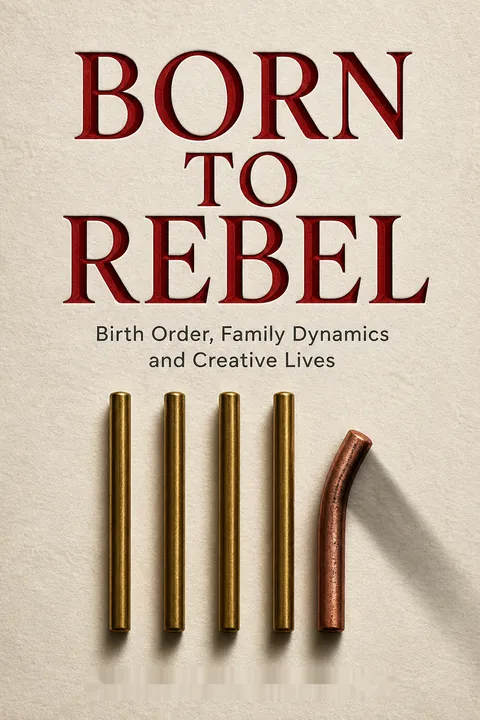
Born to Rebel explores how birth order influences personality and historical events. Reviewers find it thought-provoking yet controversial. Sulloway argues laterborns embrace revolutionary ideas while firstborns favor tradition and authority. Many praise the extensive research spanning scientific and political revolutions, though critics question data interpretation and methodology. Some firstborns felt defensive reading it. The book draws on evolutionary psychology and Darwinian theory to explain sibling rivalry and family dynamics. While reviewers appreciate the fascinating premise connecting Darwin to history, several note the repetitive writing and questionable causation claims. Overall, ratings reflect intrigue tempered by skepticism about predictive validity.
People Also Read



Download PDF
Download EPUB
.epub digital book format is ideal for reading ebooks on phones, tablets, and e-readers.








































