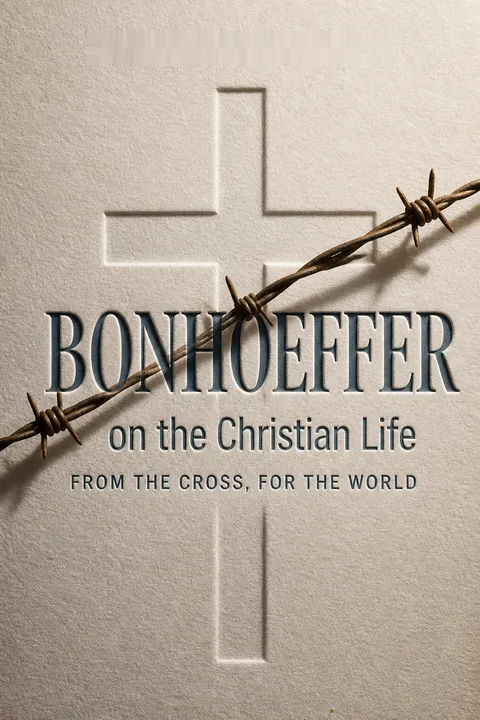

Key Takeaways
1. Costly Discipleship: Life from the Cross
To understand Bonhoeffer, we must first and foremost understand living by faith.
Brash faith. Dietrich Bonhoeffer's decision to return to Nazi Germany in 1939, despite having a safe haven in America, stemmed from a profound, "brash faith" and an unwavering dependence on God. He believed he belonged with his brothers in Germany during its deepest hour of need, not as a hero, but as a humble recipient of God's mercy. This choice exemplified his core conviction that "God's strength is made perfect in our weakness," a Pauline idea that deeply captivated him.
Theology of the cross. Bonhoeffer, like Martin Luther before him, championed a "theology of the cross" against any "theology of glory" that emphasized human strength or achievement. He saw the cross as the ultimate display of God's weakness, where Christ "was crucified in weakness," confounding all human wisdom and power. This perspective directly challenged the Nazi ideology of the "Übermensch" (Superman) and its disdain for weakness, highlighting that true hope and redemption reside outside of human capability, in God's alien righteousness.
Christo-ecclesiological-ethics. Bonhoeffer's understanding of Christ and the cross formed the bedrock of his entire theology and ethics, a concept termed "Christo-ecclesiological-ethics." This means that life is lived in Christ, in community, and in love. The cross is not merely a historical event but the starting point for Christian spirituality, where God's grace meets us precisely in our weakness, leading to a life of costly discipleship that embraces suffering as a path to joy and dependence on God.
2. Community in Christ: The Church's True Nature
Christianity means community through Jesus Christ and in Jesus Christ.
Church as community. From his earliest writings, Bonhoeffer consistently emphasized the church as a community forged "in and through Jesus Christ," a theme he explored from his dissertation Sanctorum Communio to his novel Sunday. He critiqued a "pathetic representative" church that had lost its way, advocating for a genuine community rooted in Christ, the Holy Spirit, faith, and love. This vision stood in stark contrast to both abstract notions of community and the culturally accommodated German church of his day.
Finkenwalde's model. His experience at the underground seminary in Finkenwalde provided a living laboratory for his ideas on Christian community, detailed in Life Together. Here, students learned to pray, study, work, and live together, fostering a realism that acknowledged the imperfections of human fellowship. Bonhoeffer dismissed "wish dreams" of utopian harmony, insisting that true community thrives through:
- Forgiveness: Recognizing shared sinfulness and extending grace.
- Gratitude: Cultivating thankfulness for God's gifts and each other.
Ministries of service. Bonhoeffer outlined seven essential ministries for the church, prioritizing humble service over outward display. He placed "platform" ministries like proclaiming and authority after foundational acts of care, emphasizing that genuine proclamation flows from authentic living. His list included:
- Holding one's tongue
- Meekness
- Listening
- Helpfulness
- Bearing (one another's burdens)
This ordering underscored that the church's credibility and effectiveness in proclaiming God's Word are deeply intertwined with its members' active, selfless service to one another.
3. The Authority of God's Word: Foundation for Life
We are not the judges of God’s Word in the Bible; instead, the Bible is given to us so that through it we may submit ourselves to Christ’s judgment.
God's direct revelation. Bonhoeffer firmly believed that the Holy Scriptures of the Old and New Testaments are the "sole source and norm for the doctrine of the church," constituting a "fully valid witness" to God's historical and perceptible revelation in Christ. This conviction, a "conversion" for him, positioned him as a theological conservative, rejecting liberal interpretations that reduced the Bible to mere human reflections or "myth." He saw the Bible as God's authoritative Word, demanding submission, not critical judgment.
Bethel Confession's clarity. His involvement in the Bethel Confession of 1933 highlighted his commitment to a high view of Scripture, explicitly rejecting doctrines that "tear apart the unity of the Holy Scriptures" or treat them merely as historical documents. For Bonhoeffer, the Bible's unity is found in "Jesus Christ, the Crucified and Risen One," who speaks throughout its pages. This stance was crucial in resisting the Nazi-influenced church's attempts to reinterpret Scripture to support its ideology.
Reading with obedience. Bonhoeffer's practice of reading the Bible was deeply intentional and transformative, encompassing five key approaches:
- Directly: Engaging with it as God's personal word, placing oneself within its sacred history.
- Prayerfully and Meditatively: Allowing the text to take deep root, not for "spiritual experiments" but for genuine listening.
- Collectively: Proclaiming and speaking God's Word to one another, bound by its truth.
- Submissively: Accepting its authority over one's life, rather than imposing one's own preferences.
- Obediently: Translating its commands into action, recognizing that true understanding comes through submission.
He famously stated, "I know that without this I could not live properly any longer," underscoring Scripture's indispensable role in the Christian life.
4. Prayer as the Heart of Christian Life
Prayer is the heart of Christian life.
Necessity, not luxury. Bonhoeffer consistently emphasized prayer as an absolute necessity, not a luxury, for both individual Christians and the church. He saw it as "the heart of Christian life," a lifeline that sustained him even amidst the horrors of Tegel Prison, where he found himself "back quite simply to prayer and the Bible" during air raids. He fiercely defended the teaching of prayer in seminary, calling the neglect of it "blasphemous ignorance" regarding how true preaching and teaching come about.
God-centered orientation. For Bonhoeffer, prayer is fundamentally about "the orientation of one's life to God," shifting focus from self-centered "I petitions" to God-centered "You petitions" as exemplified in the Lord's Prayer. He taught that prayer begins with God's name, kingdom, and will, before moving to personal needs like daily bread and forgiveness. This God-first approach ensures that prayer aligns human desires with divine priorities, rooted in Christ as the foundation and enabler of all prayer.
Intercession and overcoming. Bonhoeffer stressed the vital role of intercessory prayer within the Christian community, declaring that "a Christian fellowship lives and exists by intercession of its members for one another, or it collapses." He recognized the struggle of praying for those who cause trouble, but insisted that such prayer transforms perspective, allowing one to see others "under the cross of Jesus as a poor sinner in need of grace." This active, outward-focused prayer, coupled with personal meditation on Scripture, was Bonhoeffer's means of "overcoming in prayer" even profound depths of despair.
5. Theology as Confession: Lived Belief
A young theological student should know that to pursue theology is to serve the true church of Christ, which is unwavering in confessing its Lord, and should live with this responsibility.
Beyond pietism and rationalism. Bonhoeffer navigated the dangerous divide between pietism, which reduced Christianity to emotional experience and personal striving, and rationalism, which stripped theology of its spiritual vitality. He sought a "middle way," insisting that theology is not merely abstract knowledge but a lived confession that shapes one's entire existence. He believed that "orthopraxy" (right practice) flows directly from "orthodoxy" (right belief), and that a robust Christian life requires both.
Confession for the church. For Bonhoeffer, theology's primary purpose is to serve the church, not the academy. He lamented the "no theology here" he observed at Union Seminary and the "pathetic" sermons resulting from a diminished commitment to doctrinal truth. At Finkenwalde, he immersed his students in the Lutheran confessions, recognizing that these historical statements of faith were crucial for:
- Clarity: Defining true doctrine against heresy.
- Fidelity: Keeping the church anchored to God's Word.
- Growth: Guiding believers in their understanding and worship of God.
He saw the absence of a concept of heresy in the German church as a sign of its theological decay and inability to stand against falsehood.
Theology for life. Bonhoeffer's theology was always intensely practical, leading to reverence, adoration, and joy. He connected deep theological reflection, such as on the "Image of Christ" in The Cost of Discipleship, directly to daily living. He argued that humanity, fallen from God's image, finds its true purpose and life only in Christ, the perfect image-bearer. Discipleship, therefore, means "bearing his image, walking as he walked, serving as he served, loving as he loved, forgiving as he forgave," transforming theological concepts into a lived reality where one loses their life in Christ to truly find it.
6. Worldly Discipleship: Engaging God's Reality
There are not two realities, but only one reality, and that is God’s reality revealed in Christ in the reality of the world.
In the world, not of it. Bonhoeffer challenged the common extremes of Christian engagement with culture: monastic withdrawal ("not of the world") and cultural accommodation ("in the world"). He advocated for a "worldly discipleship," or "Christotelic discipleship," meaning a life lived through, toward, and in Christ within the concrete realities of the world. This approach rejected the notion of escaping earthly tasks, insisting that Christians must "drink the earthly cup to the dregs" with Christ.
"Religionless Christianity" explained. His controversial phrase "religionless Christianity" was not a rejection of faith, but a critique of human-centered "religion" that sought to reach God through self-justification or confined Christ to Sunday mornings. Instead, Bonhoeffer called for a "Christ-full Christianity" where the lordship of Jesus permeates all aspects of life, moving beyond pious formality into the whole world. He believed that true faith, rooted in God's grace reaching down to humanity, was the only antidote to the secularization of Christianity.
The one Christ-reality. Bonhoeffer posited "Christuswirklichkeit"—the one realm of the Christ-reality—to overcome the false dichotomy between the spiritual and natural realms. He argued that there are not two separate realities, but one unified reality in God, revealed in Christ within the world. This perspective informed his understanding of the "four mandates" through which God structures human life:
- Work: Co-creative human deeds destined for Christ's glory.
- Marriage: A "yes to God's earth," strengthening resolve and love.
- Government: Preserving the world for Christ's reality through justice.
- Church: Witnessing to Christ's salvation and the unity of all mandates in Him.
For Bonhoeffer, genuine Christian existence is found only by fully engaging this singular Christ-reality, taking "the next necessary step" in obedience rather than attempting to transform the world through triumphalist means.
7. Freedom Through Service and Sacrifice
Only through discipline may a man learn to be free.
Paradox of freedom. Bonhoeffer embraced Luther's paradox that "a Christian is a perfectly free lord of all, subject to none" and "a perfectly dutiful servant of all, subject to all." He understood that true freedom is not found in unbridled license, but in disciplined obedience to Christ, leading to selfless service and sacrifice. This counterintuitive path, outlined in his poem "Stations on the Road to Freedom," reveals that freedom is ultimately realized through commitment and surrender.
Stations on the road. His poem, written from prison, maps the journey to freedom through four stages:
- Discipline: Governing one's soul and senses, steadfastly seeking God's aim.
- Action: Daring to do what is right, valiantly grasping occasions, trusting God's commandment.
- Suffering: Committing one's cause to stronger hands, finding contentment in helplessness, and encountering Christ.
- Death: The "greatest of fests," casting aside chains to behold freedom revealed in the Lord.
This progression reflects Bonhoeffer's own maturing understanding of discipleship, where suffering is embraced not as an end, but as a means to grace and a deeper reliance on God.
Contentment in affliction. Bonhoeffer taught that joy and contentment can be found even in suffering, because "God's love has been poured into our hearts through the Holy Spirit." He saw affliction as producing endurance, character, and hope, rather than despair. To "bear as Christ bore the cross" means finding Christ underneath the burden, recognizing that God is "nearer to suffering than to happiness." This perspective allowed him to face his own imprisonment and eventual martyrdom with gratitude and cheerfulness, trusting in God's faithfulness and the ultimate triumph of Christ's resurrection.
8. Love as the Extraordinary Command
What is unique to Christianity is the cross, which allows Christians to step beyond the world in order to receive victory over the world.
The "Extraordinary" love. Bonhoeffer identified Christ's command to "love your enemies" (Matthew 5:44) as "the Extraordinary," the defining characteristic that sets genuine discipleship apart from cheap imitations. This radical love, exemplified by Christ's death on the cross for sinners, transcends natural human strength and is only made possible by living "from the cross." It is a love that "cannot remain hidden" but must be visibly lived out, magnifying the Father in heaven.
Grace as love's foundation. While the Sermon on the Mount presents challenging ethical demands, Bonhoeffer insisted that these are not a path to legalism but are rooted in grace. "Only the Christian conception of grace makes man before God free and gives so the only possible basis for ethical life." This grace, received through faith in Christ's justification and sanctification, empowers believers to obey the singular command to love God and neighbor, transforming self-denial into a liberation that enables clear perception of reality, neighbor, and the world.
Christ as love supreme. For Bonhoeffer, love is not an abstract concept or a mere method; it is "always Jesus Christ himself." His personal life, particularly his love letters to Maria von Wedemeyer from prison, reflected this "life-affirming theology," expressing hope, thankfulness, and trust amidst profound hardship. He saw their marriage as a "yes to God's earth," a commitment to live fully in the world for Christ. Ultimately, Bonhoeffer's "Christotelic discipleship" culminates in a life of faith, love, and hope, rooted in the incarnate, crucified, and risen Christ, who empowers believers to live extraordinarily in a world desperately in need of His love.
Review Summary
Reviews of Bonhoeffer on the Christian Life are generally positive, averaging 4.21 out of 5. Many readers praise Nichols' balance between biography and theology, calling it an accessible and inspiring introduction to Bonhoeffer's thought. The book is commended for its practical insights on discipleship, community, and the Christian life. However, some critics argue Nichols presents an overly evangelical interpretation of Bonhoeffer, glossing over theological complexities and his connections to Barth. Several reviewers note the writing can feel superficial or simplistic, though most recommend it as a worthy entry point.
People Also Read










Download PDF
Download EPUB
.epub digital book format is ideal for reading ebooks on phones, tablets, and e-readers.








































