


Plot Summary
Prologue
An ancient seer called Fate draws smoke from her pipe and reads the words of predestination — but for the first time, the prophecy arrives scrambled and incomplete. Fragmented verses speak of a lost one chained to death's soldiers, a healing light that will mend four, and tides of war yet to come.
The incompleteness is unprecedented and terrifying: it can only mean another Spartan possesses the rare ability to read predestination. A once-in-a-millennium event has occurred again. Someone else can see what Fate sees. The pipe slips from her parted lips as rain soaks her toga, and the implications settle like a stone in dark water. Everything she thought she knew about the future has changed.
Leaving Paradise for Hell
Alexis1 — whose birth name is Hercules — has spent months hiding on Crete with her adoptive parents, Hades6 and Persephone.7 She is partially blind in one eye and deaf in one ear from childhood abuse, secrets she guards absolutely. Her blood is literal poison. Her mind is fracturing from the voices of people she has killed.
Yet Persephone's7 island sanctuary cannot hold a woman bent on revenge against the Spartan civilization that brutalized her. Hades6 coaches her: no one fears the sane. With a venomous snake named Nyx10 coiled around her neck and a misshapen beast protector called Fluffy Jr.15 stumbling at her heels, she leaps into Siberian darkness to join the Assembly of Death — the Chthonic assassin cult her estranged husbands belong to.
Hunted Through Siberian Forest
Six Chthonic assassins wait in freezing woods. Alexis1 has not seen her husbands since fleeing their wedding three months ago. Kharon2 — the infamous Hunter, skeleton tattoos covering one arm, two spectral hellhounds at his feet — mouths a silent greeting.
Augustus3 — eldest Chthonic heir, a scar slashing his face, blood leaking from his eyes — stares with ravenous intensity. The initiation begins: Alexis1 and Drex,13 an Olympian volunteer, must outrun their pursuers through twenty-five miles of forest. A Gorgon member shoots Alexis1 in the calf.
Kharon2 retaliates by putting three bullets through the shooter's skull. Alexis1 leaps in panic to Montana, accidentally dragging Kharon2 along. He kneels to bandage her wound. She insists what they share is only physical. He lunges and kisses her instead.
A Prisoner Freed at Midnight
Everyone relocates to Augustus's3 villa on Lake Como. Alexis1 chooses Patro4 and Achilles5 — the Crimson Duo, her former mentors — as mission partners over her husbands, devastating both men. That first night, she follows screams to a dungeon and discovers a pink-haired woman named Ceres imprisoned and bleeding from Augustus's3 interrogation.
Accused of conspiring with a traitor, Ceres swears innocence and suffers memory loss. Alexis1 frees her. Helen,9 Augustus's3 teenage sister, helps maintain the deception.
When the men discover what happened, Patro4 uses his lie-detection power and confirms Ceres did not assist the traitor. The men grudgingly accept it. None of them suspects that the woman sheltering behind Alexis1 is not the real Ceres at all — she is someone far more dangerous,8 concealed beneath a pink wig.
Abandoned With Monsters
On their first Titan mission in Rome, Patro4 reveals an ulterior motive: he and Achilles5 want to help Alexis1 break her marriage bond by nearly killing her husbands with her poisonous blood, freeing her to potentially marry them instead. Before Alexis1 can process this betrayal of motive, two mutated winged Titans crash from the sky.
One rams Patro4 into a wall, snapping his neck sideways. Achilles5 makes an agonizing choice: he lifts Patro's4 broken body and leaps to a hospital, abandoning Alexis1 with two monsters she cannot defeat. She does not flee. Standing between the Titans and a group of elderly Romans at their chess tables, she spreads her arms wide and opens fire.
Kharon's Ear in the Rain
A Titan rips Alexis1 into the sky. She leaps from midair back to the ground — a feat that should be impossible — and fights with daggers, Nyx's10 venom, and Fluffy Jr.'s15 suddenly monstrous strength. A talon severs her left ear. She collapses in blood-soaked grass as Romans pray around her. Augustus3 arrives from South America dragging three chained Titans behind him.
Kharon2 kneels beside Alexis1 in the pouring rain, lifts a knife past his own cheek, holds her gaze, and slices. With a needle and thread from his cargo pants, he stitches his ear onto the wound on her skull. Augustus3 carries all of them through Roman streets. Hundreds of humans line the cobblestones, chanting a name that will follow her forever: Angelus Romae.
Pain Shared, Pain Hidden
Back at the villa, Alexis1 confesses a devastating truth: her left ear was already deaf from childhood injury. Kharon2 sacrificed his ear for the one side that could never hear. But she buries an even deeper secret.
When Kharon2 accidentally elbows her, both husbands feel the blow through the marriage bond — they can sense her pain. Horrified, they assume the connection runs one direction only. Alexis1 lies and tells them she feels nothing of theirs. In truth, every one of Kharon's2 limping steps, every migraine splitting Augustus's3 skull, echoes through her body.
She hides it because being coddled and removed from the fight is worse than reflected suffering. Meanwhile, their animal protectors defect — the hellhounds, Poco the raccoon,14 even Fluffy Jr.15 — choosing Alexis1 over the men.
Devils on Their Knees
Augustus3 and Kharon2 bind Patro4 and Achilles5 to chairs, confront Alexis1 with the vial of blood Patro4 stole, and instead of demanding an explanation, pour her poisonous blood into two glasses and drink. If she wants a divorce, they tell her, she should take it now. Alexis's1 power erupts. Both men collapse, foam streaming from their lips, and begin crawling across the dining room floor toward her.
She feels their agony ripping through her own chest. She could sever the bond forever. Instead she stops. Her hands ignite with bright white light — a power she does not understand — and the poisoning ceases. She tells them she wants to give this a chance. Later, Kharon2 kisses her feet and whispers one word: angel.
Twelve Labors, One Bed
Zeus11 announces the Spartan Gladiator Competition will start months early, using Medusa's8 escape as pretext to imprison all Chthonics at the Dolomites Coliseum. During the opening ceremony, an enforcer rips Alexis's1 toga open before the crowd; Kharon2 snaps his neck.
Then Zeus11 rolls the dice for her labors. Sparks leap from his fingertips onto the ivory cubes. The result: twelve labors and three rounds — the statistical near-impossibility that Alexis1 recognizes instantly. Locked in underground cells, she shares a single bed with Augustus3 and Kharon.2
The forced proximity dissolves the last barriers between them. Night after night, sandwiched between her husbands, Alexis1 grips the custom graphing calculator Augustus3 once commissioned for her and whispers confessions into its recording function.
Lightning at Zeus's Fingertips
The gladiator days blur with escalating horror. Chthonic leaders showcase terrifying power — Artemis with arrows, Ares with bare-handed torture, Hades6 with madness-inducing fog, Aphrodite hacking Cyclopes with a golden axe.
Then Agatha, a creature who eats men, cannibalizes her opponents but refuses to fight her partner Hermos. Hades's6 fog fills the stadium in support. Zeus11 raises his golden scepter. Lightning strikes — he redirects the bolt into the arena sand, missing Agatha by inches.
Hermos chokes her unconscious to save her life, and Zeus11 brands her five times with searing Vulcan metal. During subsequent interrogations, the Olympians beat Chthonic competitors for information about Medusa.8 Patro's4 Achilles tendon is severed. They are not just competing — they are being systematically brutalized.
The Dragon Unmuzzled
Achilles5 has worn a leather muzzle his entire adult life, sworn by oath never to remove it. Now Zeus11 commands it off. Patro4 unlocks the straps with trembling hands, then limps away on his ruined tendon. Beneath the muzzle, an X of scar tissue slashes across Achilles's5 lips — someone once tried to sew his mouth shut.
He cuts his own heel to match Patro's4 wound, then points the bloody knife at Zeus.11 When four Minotaurs charge, Achilles5 opens his jaw. Greek fire — flames that burn water — streams from his throat. The arena ignites. Rain catches fire. Sand turns to glass beneath his feet. Cowardly Olympians flee in clouds of smoke. The Chthonic section remains seated, unmoved, cheering in the inferno.
Kharon Burns, Alexis Screams
Zeus11 sends three class-seven Typhons — serpentine beasts with flesh-dissolving saliva — against Kharon.2 He kills all three with arrows and his hellhounds but takes a direct hit of acid across his chest, skin boiling to bone. He saunters out of the arena smirking, then collapses.
In the stands, Alexis1 doubles over at the same instant, clutching her unmarked chest, gasping in identical agony. Augustus3 watches them both fold and understands: she lied. The pain bond runs both directions.
Every wound Kharon2 has taken, every migraine Augustus3 has suffered, has been quietly tearing through their wife. Zeus11 drags Kharon2 into an underground crypt for interrogation, beating him for Medusa's8 location. Patro4 is forced to verify his answers under threat of Achilles's5 imprisonment.
Augustus Commands Death Itself
Augustus's3 power has evolved since the marriage bond settled into place. His chronic headaches vanished, replaced by something terrifying: he can push his thoughts directly into other minds and command obedience with his voice. Six Minotaurs charge onto the sand.
Augustus3 speaks two words. Their eyeballs explode from their skulls. Their brains pour from their ears. The fight ends in seconds — a display of power so absolute it silences the entire stadium. He did it for one reason: if the battle had dragged on, his injuries would have coursed through Alexis's1 body.
By revealing his full, terrible might to all of Sparta and painting a target on himself, he spares her minutes of reflected agony. Poco the raccoon14 screeches victoriously from his shoulder in a tiny silver chest plate.
The Twelve Labors of Hercules
Alexis1 enters the arena alone — her husbands were drugged overnight. Eight lions attack instead of the expected four. She kills them with her spear, Nyx's10 venom, and Fluffy Jr.'s15 ferocity. When her bleeding palms tingle unbearably, her blood hardens into a glowing crimson rod — the Rod of Asclepius, the ancient symbol of Spartan healing.
Fluffy Jr.'s15 mysterious spinal hump splits open to reveal shimmering blue wings: he is a Pegasus hybrid. They take flight to battle two returning winged Titans in the sky. Nyx10 is gravely slashed, but the glowing staff heals her. For the final round, Zeus11 sends Alexis's1 own cuffed husbands as opponents. They refuse to fight. Augustus3 grabs her wrist and drives the rod into his own heart.
Zeus Falls to a Calculator
Zeus11 interrogates Alexis1 in a crypt of skulls. She accuses him of engineering her attempted murder as a baby — sending a man named Vyco to kill her, then framing Medusa8 for the attack. Zeus11 confirms everything, laughing at how trivial her knowledge seems. He does not realize the graphing calculator in her pocket has been recording.
After Nyx10 kills the guards, Alexis1 leaps to the symposium and plugs the device into speakers a siren friend secretly arranged. Zeus's11 crackling laughter fills the crowded room as his own voice admits he tried to murder a child and imprisoned an innocent woman. The Chthonic and Olympian leaders turn on him in unison. Zeus11 flees. Fate stands on a chair and declares the prophecy fulfilled.
Medusa Unwigged, Vengeance Claimed
Patro4 rips the pink wig from the woman everyone knew as Ceres, revealing Medusa8 — Kharon's2 Gorgon sister — and her three pale snakes. A flashback unveils the truth: months earlier, Alexis1 accidentally leapt into the Underworld, found Medusa8 being violated by guards, killed them with Nyx,10 and smuggled her to Crete with Hades's6 help.
She poisoned the real Ceres, who was guilty, and substituted Medusa8 in disguise. Now the reformed federation pardons Medusa8 and assigns Patro4 and Achilles5 as her reluctant bodyguards at university — where Alexis1 also enrolls.
In the villa's dungeon, Alexis1 confronts the foster father her husbands kidnapped. She stabs him with the Rod of Asclepius and walks away without looking back. That night, she makes love to her husbands for the first time.
Epilogue
The full prophecy that Fate could only partially read is at last revealed: the lost one will change Sparta, chained to death's soldiers. Her healing light will mend the injured four — Drex,13 the wounded Roman woman Lucia, Kharon,2 and the serpent Nyx.10 Medusa,8 the chained one, will reveal corruption while guarded by Crimson men whose love will shift the tides of war.
And the monstrous one — Fluffy Jr.15 — will mend and restore, because the lost one hears his beastly roar. Every fragment that was garbled now reads clean, every scrambled name now legible. The prophecy was never incomplete. It was simply waiting for the right woman to live it into being.
Analysis
Bonds of Hercules operates as a sustained interrogation of what it means to be powerful in a system designed to punish power. Alexis's1 blood is simultaneously her deadliest weapon and the reason she was nearly murdered as an infant — the Rod of Asclepius literalizes the paradox by forming a staff that both poisons and heals. This duality extends to every character: Augustus's3 mental compulsion makes him a leader and a monster; Kharon's2 obsession is both a trauma response and the purest love he can offer; Achilles's5 fire is both his identity and his prison.
The novel's most psychologically precise insight is its treatment of bodily autonomy as the central political currency of Sparta. The marriage bond is imposed without consent but becomes genuine through suffering. The muzzle silences Achilles's5 most authentic self. Branding permanently marks the body as a ledger of defeat. Zeus's scepter threatens the ultimate violation — erasure of consciousness. Alexis's1 arc is not about gaining power but about choosing which violations she will accept, refuse, or redirect. Her decision to keep the marriage bond — after being given every opportunity to sever it — is not submission but sovereignty exercised through staying.
The book also deconstructs protectiveness as a form of control. Augustus3 and Kharon2 believe protecting Alexis1 means shielding her from combat, yet she consistently saves herself — and them. The turning point arrives when Augustus3 impales himself on her weapon rather than fight her, inverting the traditional hero's sacrifice: the man doesn't save the woman from the dragon; he offers himself to her blade so she can walk out standing. The novel argues that love between traumatized people cannot be gentle — it must be willing to bleed publicly, to cut off its own ear in the rain, to drink poison and crawl. Tenderness is not softness; it is the hardest thing monsters can learn.
Review Summary
Reviews are mixed for Bonds of Hercules, with readers split between enthusiastic praise and disappointment. Fans love Alexis's sarcasm, the slow-burn romance with Kharon and Augustus, and the Greek mythology elements. However, many feel betrayed by Patroclus and Achilles not becoming love interests as expected, instead being set up with Medusa for a future book. Common criticisms include two-dimensional characters, rushed plot development, lack of proper character arcs, anticlimactic spice scenes, and feeling the romance was advertised as reverse harem but didn't deliver all four men.
Characters
Alexis
Poisonous heiress seeking revengeBorn Hercules, heiress to the House of Hades6, raised in abject poverty in a Montana trailer park after a failed assassination attempt. Partially blind in one eye and deaf in one ear from childhood abuse—secrets she guards with pathological precision. Her blood is poisonous on contact, and she carries a latent healing power she cannot yet control. A mathematical prodigy who solves equations for comfort and carries a graphing calculator like a talisman. Beneath her stammering, self-deprecating exterior lives a woman forged by starvation and brutality into someone harder than she lets anyone see. She is married against her will to two Chthonic men she is learning to love, and bonded to a venomous snake10 and a misshapen beast15 she would die for.
Kharon
Obsessive Hunter, devoted husbandHeir to the House of Artemis, secretly disowned by his mother after a catastrophic gladiator loss at eighteen—eleven Minotaurs left him crawling through sand with a mangled knee. His father Erebus is an ancient creature who wears a bone mask. Kharon is obsessive, feral, and incapable of leaving Alexis1 unmonitored—he watches her sleep every night. He paints his nails black, plays piano beautifully, and communicates through two spectral hellhounds. His love language is diamonds, roses, weapons, and self-mutilation on his wife's behalf. Beneath the predatory exterior hides a man who has never been loved without conditions, who bonds with dangerous creatures because they are the only beings that do not recoil from him.
Augustus
Eldest heir, controlled monsterThe eldest Chthonic heir, son of Ares and Aphrodite. He wears a scar slashed across his face by his father's poisoned blade—a House of Ares tradition. His Chthonic power invades and breaks minds, and debilitating migraines have plagued him since childhood. To the world he projects calm authority, the diplomat. In private he fights to contain the hereditary madness of the House of War. He bonded with a raccoon named Poco14 instead of a fearsome beast, and grows his hair long because Poco14 wept when it burned off. Augustus tucks blankets under toes, praises in a voice like dark silk, and quietly compiles mental hit lists of everyone who wrongs the people he loves. Control is his religion; Alexis1 is his undoing.
Patro
Tortured liar, Achilles's heartSon of Aphrodite and a human father—a half-blood in a civilization that despises weakness. Raised in luxury until his mother claimed him, then tortured by Gorgon trainers who sought to break him. His Chthonic power detects lies through touch, and LIAR is tattooed across his knuckles. He scrubs himself raw when memories surface, compulsively grooming as though cleanliness can erase the past. Achilles5 is the only person he trusts completely, and his terror of losing him drives increasingly desperate schemes. Cruel when cornered, tender when unguarded, he devotes himself to people with a fervor that borders on fanaticism. His antagonism toward Alexis1 is partly jealousy, partly genuine concern twisted into something corrosive.
Achilles
Muzzled dragon, silent protectorSon of the House of Ares, bound by oath to wear a leather muzzle that constrains the Greek fire he breathes. Someone once tried to sew his mouth shut, leaving X-shaped scars across his lips. He communicates through sign language and expresses himself only through violence or tenderness. Patro4 is his entire world, and everyone else—including Alexis1—ranks a distant second. His possessiveness runs as deep as his silence.
Hades
Fearsome father, reluctant allyLeader of the House of Hades and Alexis's1 adoptive father. His fog-based power drives people to screaming madness. Beneath the terrifying exterior, he is a devoted parent who teaches his daughter to weaponize her instability and coaches her mantra: no one fears the sane. When Alexis1 freed Medusa8 from the Underworld, he chose to wage war for her without hesitation.
Persephone
Fierce mother, island sovereignAlexis's1 adoptive mother, born of the Olympian Demeter and a dark creature named Iasion. She claimed the island of Crete with her power—she can feel every living thing that walks upon it. Exiled by her own mother and the federation for her hybrid nature, she found sanctuary with Hades6. Gentle and ferocious in equal measure, she detects deception through the land itself.
Medusa
Framed Gorgon, hidden prophetKharon's2 sister, a Gorgon born with three snakes and the rare power of Fate. Incarcerated as a child and kept in age stasis at twenty-one, she was framed by Zeus11 for an attack she never committed and violated by guards. Disguised as the muse Ceres with a pink wig, she hides at the villa researching ancient texts, desperate to piece together her shattered memories and prove her innocence.
Helen
Sparkly teenage co-conspiratorAugustus's3 teenage sister, daughter of Aphrodite. A fearless girl who sleeps with bedazzled pink guns under her pillow and an Erebus poster on her wall. She befriends Charlie12, assists in concealing Medusa8, and delivers uncomfortable truths with devastating composure. Beneath her glittering exterior, she is a survivor who understands precisely how dangerous their world is.
Nyx
Venomous snake, sardonic guardianAlexis's1 echidna protector—a class-seven beast whose bite kills Spartans and comas adults. Invisible at will, she wraps around Alexis1 like a scarf and delivers relentless commentary on everything. She was enslaved by the man Zeus11 sent to murder Alexis1 as a baby, but bonded with the child instead. Her venom and loyalty are Alexis's1 most reliable weapons, and her bluntness the closest thing to honest counsel Alexis1 receives.
Zeus
Lightning-wielding tyrant, exposedLeader of the Spartan federation, wielding lightning through a golden eagle scepter. He orchestrated a Titan attack to cover an assassination attempt on baby Alexis1, then framed Medusa8 for the crime. Beneath his benevolent public persona, he is calculating, paranoid, and convinced that Chthonic power—especially the heir of Hades6—threatens his supremacy over all of Sparta.
Charlie
Alexis's loyal adopted brotherA lanky teen with yellow eyes, raised alongside Alexis1 in Montana's destitution. He communicates primarily through sign language and writing, gradually finding warmth and belonging at the villa, where he bonds with Helen9 and even learns to sign with Achilles5.
Drex
Olympian exile, cheerful survivorAn Olympian volunteer who joins the Chthonic Assembly of Death after being exiled. Loyal to Alexis1, spectacularly bad at combat—he runs from Chimeras for thirty minutes without landing a single blow—and the unlikely heart of the group.
Poco
Augustus's raccoon soulmateAugustus's3 unranked raccoon protector. He tangles hair into knots, plays finger-gun games with Kharon2, suffers from anxious biting syndrome, and wears tiny battle armor during the gladiator competition. Augustus3 grew his hair out because Poco cried when it burned off.
Fluffy Jr.
Beast protector, secret PegasusAlexis's1 beast protector—a dog-Pegasus hybrid who eats sticks, chokes on them, and eventually sprouts shimmering blue wings during her climactic arena battle. Not the brightest creature, but ferociously loyal when it counts.
Plot Devices
The Rod of Asclepius
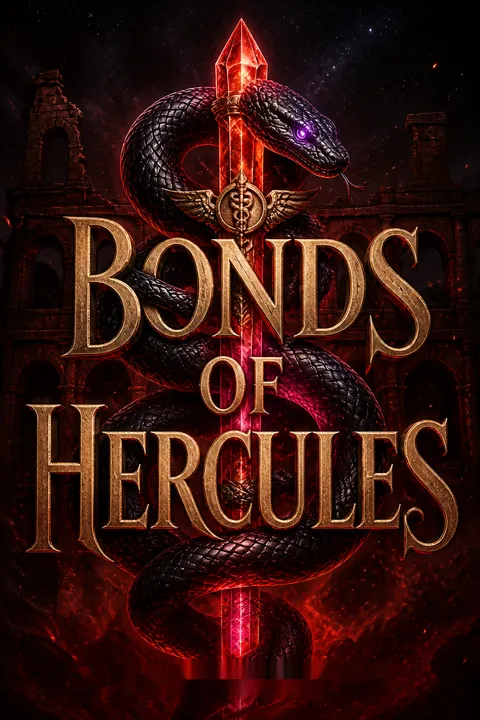
Alexis's blood-forged healing weaponThe ancient symbol of Spartan healing—a staff with a snake and wings—manifests physically through Alexis's1 blood. When her tingling fingers contact her spilled blood, it solidifies into a glowing crimson rod with a sharp point and a rounded end. The rod poisons on contact and heals through its light, reflecting her dual heritage: Chthonic death from Hades6, Olympian life from Persephone's7 Demeter lineage, and creature power from her grandfather Iasion. It first appears when she is near death in the arena, and its shape matches a symbol the disguised Medusa8 showed her from an ancient text—a symbol that vanished from the page. The Rod embodies the book's central tension between destruction and restoration within a single bloodline.
The Marriage Bond
Pain-sharing soul connectionThe Spartan marriage bond between Alexis1, Augustus3, and Kharon2 strengthens all their powers but also transmits physical pain between them. Augustus's3 headaches worsen and blood drips from his eyes; Kharon's2 hellhounds become visible. The bond was forged against Alexis's1 will, making it a symbol of her captivity—yet it also becomes the mechanism for their deepest intimacy. The pain-sharing creates devastating tactical consequences during the gladiator competition: any wound one suffers, all three feel. Alexis1 hides that the connection is bidirectional, bearing their agony silently. The bond can theoretically be severed if Alexis1 brings her husbands to the brink of death, but she chooses to preserve it—transforming a chain into a tether she holds willingly.
The Graphing Calculator
Recording device that topples ZeusA custom-made bulletproof graphing calculator that Augustus3 commissions as a courting gift, recognizing that Alexis1 is a mathematical prodigy who finds peace in equations. It features a built-in recorder and a cable port for connecting to external devices. Alexis1 uses it as a diary throughout the gladiator competition, recording confessions and observations. In the climactic interrogation, the calculator captures Zeus11 admitting to orchestrating her attempted murder and framing Medusa8. Plugged into speakers arranged by a siren ally, the recording broadcasts his confession to all of Sparta. The device functions as a Trojan horse: what appears to be a romantic gesture from her husbands becomes the weapon that dismantles Spartan political power.
Achilles's Muzzle
Oath-bound restraint on destructionA leather muzzle made from fire-lizard skin that Achilles5 wears permanently, bound by an unbreakable Spartan oath never to remove it himself. It contains his ability to breathe Greek fire—flames that burn even water. The muzzle allows enough give to eat and smoke, but not enough to unleash his power. It represents the federation's neutering of Chthonic strength: the most dangerous weapon in Sparta, forcibly silenced. When Zeus11 orders it removed during the gladiator competition, the resulting inferno—an entire coliseum ablaze—demonstrates exactly why the Olympians feared him. The scars across his lips beneath it reveal that someone once tried a more permanent solution to his voice.
Zeus's Lightning Scepter
Storm-dependent weapon of controlA golden scepter topped with an eagle that allows Zeus11 to channel and redirect lightning. It is the only offensive Olympian power and the primary reason the Chthonics lost the Great War—a single strike can put any non-ancient Spartan into a permanent coma. Its limitation is weather dependency: Zeus11 can only wield it outdoors on stormy days, creating a recurring source of dread whenever clouds gather over the Dolomites Coliseum. He uses it to threaten rebellious Chthonics during the competition and nearly strikes Agatha dead. The scepter symbolizes the asymmetry of Spartan power—one man's storm holds an entire civilization hostage.
Villains of Lore Series
About the Author
Other books by Jasmine Mas


Download PDF
Download EPUB
.epub digital book format is ideal for reading ebooks on phones, tablets, and e-readers.








































