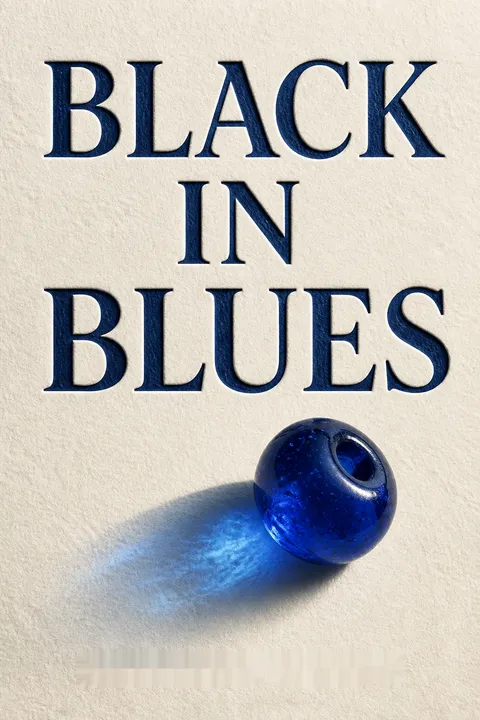

Key Takeaways
1. Blue as the Enduring Sensibility of Black Life
This blue-black living and doing is a bittersweet virtue, mastery in heartbreak, and raw laughter from the underside.
A profound connection. The color blue, far beyond its literal hue, serves as a deep, intuitive sensibility for Black people, embodying a complex emotional and spiritual landscape. It represents a unique way of experiencing the world, marked by both profound suffering and unwavering resilience. This "blue-black living" is a testament to finding beauty and meaning even amidst relentless injustice.
Resilience and possibility. From the North Star guiding the enslaved to freedom to the celestial blue promising heaven, Black people have consistently looked to blue expanses as symbols of hope and possibility. Even in the face of treacherous landscapes, like the deep ocean waters of the Middle Passage, blue has been imagined as a path to freedom or a return to the past, before the brutal trade in flesh. This reliance on a "blues-soaked sensibility" has been crucial for sustaining identity and becoming oneself through successive waves of reckoning.
A shared testimony. The ability to sing and live fully, without fear of an "ugly mouth or crumpled face," despite the scourge of injustice, is a core aspect of this blue sensibility. It's a collective testimony offered by "blues people" who created a sound for the world's favorite color. This shared experience, rooted in suffering yet blossoming in full-throated expression, defines a unique cultural virtue.
2. The Paradox of Blue in the Making of Blackness
Wanting blue was well inside human cultures by the time imperial conquest organized the world, and that desire was carried through its unfolding.
A coveted commodity. The global desire for blue, particularly indigo dye, became a central driver of imperial conquest and the transatlantic slave trade. While indigo had spiritual significance and was prized in African, Asian, and European cultures for centuries, its cultivation in the Americas became inextricably linked to forced, unfree labor. This transformation turned a symbol of beauty into a tool of global imbalance, where a block of indigo could be traded for a human life.
Humanity in trade. Despite being reduced to chattel, enslaved Africans often retained blue beads as their sole possessions during the harrowing Middle Passage. These delicate, fragile items served as powerful reminders of their humanity, even as they were stripped naked and branded. This paradox highlights how blue, a color valued by European traders, became a poignant symbol of self-worth and spiritual connection for those whose bodies were commodified.
The birth of "Black." The systematic enslavement of dark-skinned people in the service of empire led to the creation of "Black" as a racial category—a "hard-earned love" rather than a chosen identity. This process, driven by the desire for accumulation and goods, transformed diverse African peoples into a unified group defined by their perceived disposability yet indispensable labor. The color blue, in its beauty and its role in this trade, became an unwitting witness to this profound historical shift.
3. Spiritual Blue: Resistance and Resilience in Folkways
To be unrecorded and have their rituals thieved did not prevent Black people from creating new selves with old roots.
Sacred markers. In the American South, blue became a sacred color in Black folk practices, serving as a bulwark against dehumanization. Enslaved people marked graves with periwinkle flowers, and later, cobalt blue bottles adorned crepe myrtle trees, while porches were painted "haint blue." These practices, rooted in Kongo traditions, were believed to deflect evil, attract good spirits, and welcome ancestral power, transforming mundane spaces into portals of spiritual protection.
Improvisational faith. Denied formal recognition and civil society, Black people improvised new spiritual traditions, blending diverse African theologies with elements of Christianity.
- Hush harbors: Secret sites for religious ceremonies under midnight skies.
- Mojo hands (nkisi, gris-gris, juju): Amulets containing bone, feather, dust, stone, and often blue-inked Islamic scriptures, carried for spiritual protection.
These practices demonstrated a profound resourcefulness, sustaining belief in their souls and intellect despite utter domination.
A living tradition. Hoodoo, an umbrella term for these spiritual-medical-ethical-social practices, is a knowledge system born of disruption and cosmopolitanism. It teaches that the natural world can yield to human desire through rituals, incantations, and recipes, often incorporating blue elements like blue candles, blue water, and bluestone (later laundry bluing). This insurgent theology offered a sense of control and ethical relation in a world defined by natal indebtedness and systemic injustice.
4. The Blue Note: A Sound of Enduring Black Ingenuity
Held but never possessed. A BLUE NOTE.
A unique inflection. The musical "blue note"—a slurred, bent, or "worried" sound—is the most African of interventions into Western music, a distinctive inflection that transcends formal notation. It's a flexible relation to the scale, a shimmer or vibration that conveys deep emotion and meaning, making the hairs on the back of one's neck stand up. This sound is intrinsically tied to the Black musical tradition, where the body itself acts as both instrument and conduit.
Beyond notation. Black music, from gospel wails to electric guitar riffs, often defies conventional Western notation, which struggles to capture its full complexity. The rhythmic stomp-stomp-clap, the sway of a stride piano player, the precise timing and cadence of breath in a vocalist like Aretha Franklin—these are cultivated works of sonic art that demonstrate a mastery of music inside and through the body. The blue note is a testament to this embodied, improvisational genius.
Endurance and expression. The blue note emerged from the lives of enslaved people whose bodies were regimented and commodified, yet whose minds, feelings, and art remained their own. It became a sound released to attest to their unpossessed inner world—a testament to endurance, survival, anguish, and love. As James Baldwin noted, the blues, as a metaphor for anguish, creates a "kind of joy" through its "toughness that manages to make this experience articulate."
5. The Color Line's Blue Hues: Stratification and Identity
The rule of hypodescent in the United States treated Blackness as a stain, a drop of it, like the bad apple, ruining the body.
Arbitrary distinctions. The concept of "blue-eyed Negroes" and "blue gums" highlights the arbitrary yet brutal nature of racial classification in the Americas. W. E. B. Du Bois's lament over his blue-eyed son's death due to the color line, or the legal cases denying freedom based on a "preponderance of testimony that the petitioner belongs to the negro race," underscore how race was a technology of production, not just perception. This system created a stratified yet eclectic Black community, from "blue-black" to "near white."
Fear and power. The folklore surrounding "blue gums"—believed to be poisonous—revealed a deep-seated fear among White people of Black retaliation and a lingering admiration for a perceived mystical power. This belief, whether superstition or a reflection of actual human bite dangers, underscored the unsettling proximity of Black people to power and their capacity to disturb the established order, even with their own bodies.
Internal complexities. Within Black communities, the color line fostered both connection and painful divisions. Terms like "blue veins" for light-skinned elites, as depicted in Charles Chesnutt's work, illustrate internal hierarchies and the desire for proximity to Whiteness. Yet, Chesnutt also cautioned against abandoning the "blue-gummed" and "blue-black," reminding readers that all Black people were bound by a shared history and culture, regardless of complexion.
6. Blueprints of Freedom: Education and Political Action
Everything . . . contributed to his enlightenment and prepared him for that freedom for which he thirsted.
The power of literacy. The "blue-back speller," a literal description of Noah Webster's reading guide, became a treasured artifact for freedpeople's aspiration for education. For figures like Booker T. Washington and Frederick Douglass, this book was a key to unlocking a world once forbidden, a dangerous activity under slavery. Post-emancipation, literacy became a fundamental tool for staying free, an anchor against the cruelties of Jim Crow and the snatching away of promised rights.
Building institutions. The founding of institutions like Tuskegee Institute, born from political negotiation and built from the ground up by Black hands, exemplified the collective drive for formal education. Despite the accommodationist politics of leaders like Washington, these schools became vital "Black oases," producing scientists, artists, and teachers, and serving as blueprints for self-determination in a hostile environment.
Symbolic uniforms. The blue uniform, from Union Army soldiers fighting for their own emancipation to the overalls worn by SNCC activists returning to the plantation South, became a powerful symbol of Black people's persistent pursuit of freedom and citizenship. This "overall movement" represented a rejection of societal values and a commitment to everyday virtue, even as the "boys in blue" (police) often stood in notorious tension with Black America, embodying the state's enforcement arm against freedom fighters.
7. Global Blues: Interconnected Struggles and Shared Aspirations
The Southland and Motherland were bound not only by history but by struggles.
A global tapestry. Black liberation was never solely a domestic American matter; it was a deeply interconnected global struggle. From the Haitian Revolution's red and blue flag to African independence movements, Black people across continents shared symbols, strategies, and a common "blues-soaked" sensibility. Figures like Martin Luther King Jr. drawing courage from Ghana's independence, or Malcolm X's evolving internationalist philosophy, highlight this arterial connection.
Shared defiance. The Montgomery bus boycott, the Newport Jazz Festival's electrifying performance by Paul Gonsalves, and the Little Rock Nine's courageous desegregation efforts were all part of a larger "movement" that resonated globally. Simultaneously, African nations like Ghana and Tanzania gained independence, inspiring activists in the US South who saw parallels between colonial arrangements and economic exploitation at home.
The cost of freedom. Despite the hopeful dawn of Black citizenship in the mid-twentieth century, the path was fraught with dashed hopes and devastating losses. The assassination of Patrice Lumumba in the Congo, the murder of Medgar Evers in Mississippi, and Malcolm X's assassination underscored that empires and world powers would not easily relinquish control. Yet, creative connections and common purpose persisted, binding Black people together across national boundaries in a shared fight for self-determination.
8. The Ambivalence of Blue: Beauty, Betrayal, and the Cost of Progress
The spiraling reduction of who we are to a vice, a fad, a yearning, and then a pestilence is exhausting.
Beauty and objectification. The allure of blue in art, fashion, and popular culture often masked deeper contradictions, reflecting both the beauty of Black expression and the painful realities of objectification. From Baudelaire's exoticization of Jeanne Duval's "blue-black" hair to "nigger head boucle" fabric, Blackness was simultaneously desired and denigrated, creating an "eerie matrix of wanting" that fueled racism.
Commodification and compromise. The blues, jazz, and other Black art forms, while profound expressions of anguish and joy, were also subject to commodification. Musicians like Burn Down feared their music would be "traded without his hand or thought in it at all." This tension between authentic expression and market demands, coupled with internal colorism and the pressures of mainstream success (as seen with Whitney Houston), often led to a "hard truth" underneath the glamorous surface.
The shadow of progress. The post-Civil Rights era brought new challenges, where the "blue code of silence" among police and the rise of figures like Frank Lucas (whose "blue magic" heroin brought both wealth and destruction) revealed the enduring complexities of systemic injustice. The "buoyant hope" of earlier movements gave way to a "hard way to go," where the promise of Black citizenship was often betrayed, and the struggle for self-determination continued amidst new forms of exploitation and internal divisions.
9. Art as a Blue Portal: Transforming History and Honoring Ancestors
We haunt the past to refuse to let it lie comfortably as it was.
Reimagining history. Contemporary Black artists use blue as a powerful medium to revisit and reimagine history, transforming collective trauma into acts of remembrance and healing. Sonya Clark's "Finding Freedom" exhibition, using cyan-dyed muslin and seeds to map the North Star, allows viewers to "time-travel" and connect with the journey of fugitive slaves. This artistic engagement actively "haunts the past," refusing to let it remain a comfortable, static narrative.
Living altars. Artists like Adebunmi Gbadebo return to ancestral lands, such as the True Blue plantation, to depict historic scenes with indigo ink on rice paper. These works, filled with the vital presence of Black people and the "gaping wounds" of history, serve as living altars. The intention to purchase and transform parts of these lands for descendants exemplifies how art can be a practical conjuration, turning sites of suffering into spaces of healing and empowerment.
A continuous transformation. From Vanessa German's "blue walks" and "blue mother" installations to Ashon Crawley's "Homegoing" shrine honoring Black church musicians lost to AIDS, art becomes a "blue portal" for caretaking and transformation. These artistic expressions, rooted in the "blues-soaked grace" of Black life, demonstrate that the imperative to create and rearrange our relationship to the past is as constant as the blueness of the sky, ensuring that something hardy is continually planted for future generations.
Review Summary
Black in Blues by Imani Perry explores the deep connections between the color blue and Black history and culture. Readers praise Perry's poetic writing, extensive research, and ability to weave together diverse topics. The book covers areas such as indigo dye, blues music, and spiritual symbolism. Many reviewers found it enlightening and emotionally impactful, though some noted its dense information and non-linear structure. Overall, it's highly regarded for its unique perspective on Black experiences and cultural contributions, with several readers predicting award nominations.
People Also Read




Download PDF
Download EPUB
.epub digital book format is ideal for reading ebooks on phones, tablets, and e-readers.








































