


Key Takeaways
Shrink an eight-year record to seven months through sheer belief
The mission that experts called impossible. Nims Purja set out to climb all fourteen of the world's 8,000-metre peaks (the so-called Death Zone mountains) in seven months. The previous record, held by Korean climber Kim Chang-ho, stood at seven years, ten months, and six days. Red Bull compared his goal to swimming to the moon.
He finished in six months and six days. A Nepalese former Gurkha and Special Boat Service operator with barely seven years of climbing experience, Nims called the project 'Project Possible' partly as a two-fingered salute to the doubters. He treated it like a military operation: phased planning, weather analysis across five seasons, and a hand-picked team of Nepalese climbers. The point was not just the record but proving what a determined mind could achieve.
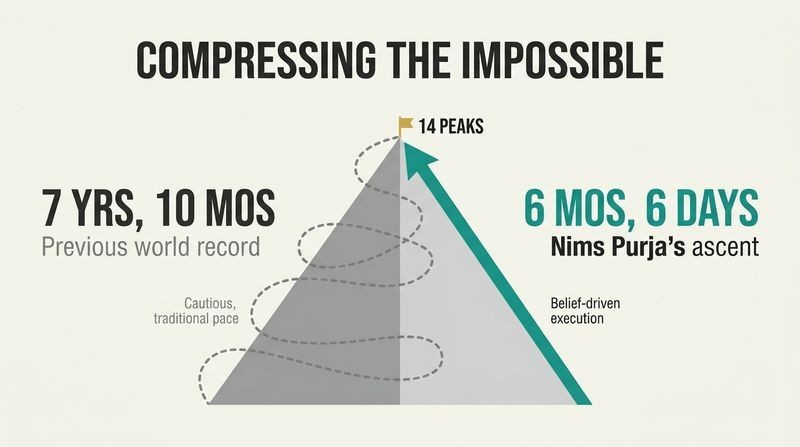
What's striking is how Nims reframes an outrageous physical feat as primarily a psychological one. Sports science supports this: elite performance ceilings are often set by perceived limits rather than physiological ones, a phenomenon Roger Bannister demonstrated with the four-minute mile. Yet the story invites scrutiny. His success rested heavily on supplemental oxygen, helicopter transfers between Nepalese base camps, and an extraordinary team of Sherpas. The achievement is real, but it was collective and technology-assisted, not a solo triumph of will. Purja himself credits this network, which makes his framing more honest than the lone-hero narrative the title might suggest.
Treat your goal as a god you surrender to completely
Hope is God, Nims-style. Though raised Hindu and open to all faiths, Nims made his ambitions his object of worship. Becoming a Gurkha was his first god. Passing Special Forces Selection became the next. Raising money for Project Possible became another. Each time, he gave the goal total devotion rather than mere hope for satisfaction or bragging rights.
Belief as fuel, not fantasy. As a child he beat tuberculosis and asthma by refusing to be defined by them, calling himself a 'human antibiotic.' He argues that wishing and praying without commitment gets you nowhere. Instead you must make the goal your entire cause and pour everything into it. Before Selection he memorized British jokes to fit in, biked seventy miles, swam thousands of metres, and did midnight load carries, all because the SBS had become his church.
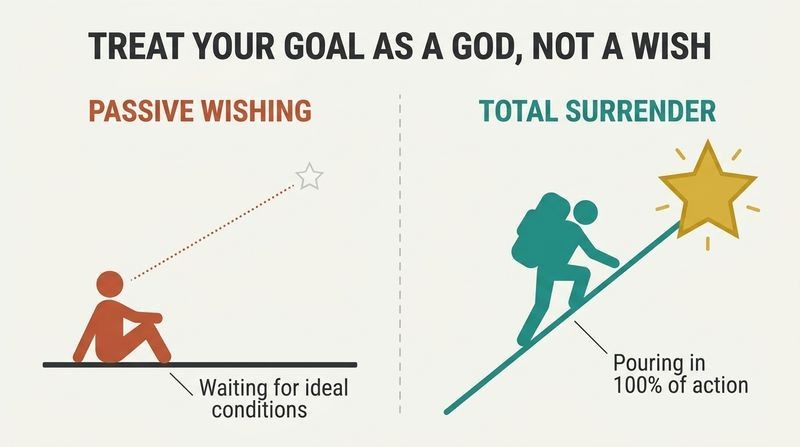
The 'hope is God' framing resembles what psychologists call approach-oriented goal commitment, where an identity-level attachment to an outcome sustains effort through adversity. It echoes Viktor Frankl's insight that a strong enough 'why' lets a person bear almost any 'how.' The risk, which Nims embodies, is that total devotion to a single aim can crowd out everything else, including financial security and family presence during his mother's illness. Monomania produces records but exacts hidden costs. The lesson works best when readers distinguish between borrowing his intensity for a defined sprint and adopting it as a permanent operating system.
On big mountains, the smallest overlooked details kill you
Little things count most. Nims frames survival at extreme altitude as a series of micro-decisions. He learned to breathe through pursed lips, drawing air through a buff and exhaling downward so his goggles never fogged, which also warmed the air entering his lungs and spared his fingers from removing gloves. A forgotten water bottle cap during SBS Selection earned him a rock in his pack. A single distracted moment cost him control.
Two near-fatal lapses prove it. On Nanga Parbat he unclipped from a rope as a courtesy to let another climber pass, then slid headfirst down a slushy face, saved only by grabbing the fixed line. He compared the slip to texting at 90 miles per hour. On Gasherbrum I, momentary panic on an unroped descent shattered his confidence. Sloppiness, not the mountain, was the real enemy.
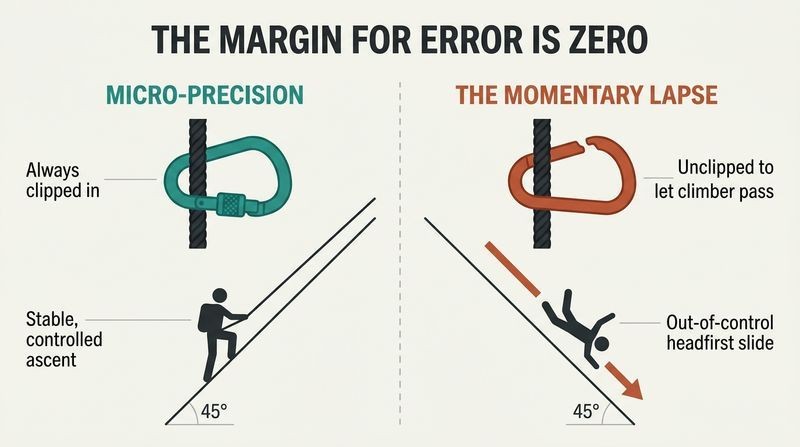
This is essentially high-consequence checklist thinking, the same discipline Atul Gawande documents in surgery and aviation, where catastrophic failures trace back to trivially preventable omissions. Environments with no margin for error punish the mundane. What Nims adds is the emotional dimension: fatigue erodes attention to detail precisely when the stakes peak, creating a vicious loop. The takeaway generalizes well beyond mountaineering. Contracts, medical dosing, and financial audits all fail at the level of small, boring particulars. The counterpoint worth noting is that obsessive detail-focus can itself induce paralysis, so the skill is knowing which small things are load-bearing.
Give everything to today because tomorrow may never arrive
Focus on the next 24 hours only. During six months of SBS Selection over the Brecon Beacons, Nims refused to be overwhelmed by the punishing schedule ahead. Each morning he told himself to give 100 percent and survive that single day, worrying about tomorrow when it came. Holding energy in reserve was pointless if failure today meant no tomorrow.
The same logic scaled the Himalayas. While climbing K2 he refused to think about Broad Peak, knowing divided focus could get him killed. Fatigue was constant: he estimated nine hours of sleep across five gruelling days on Dhaulagiri before charging up Kanchenjunga in a single push. He drew on Muhammad Ali and Usain Bolt, champions who never entertained defeat, telling himself at every base camp that the summit was his to take.
This present-focus discipline mirrors the core of both military resilience training and modern therapies like ACT (Acceptance and Commitment Therapy), which teach that anxiety lives in imagined futures. Breaking an overwhelming task into a single unit of time is also the engine behind marathon runners' mile-by-mile mantras and addiction recovery's 'one day at a time.' The neuroscience is sound: chronic future-catastrophizing floods the system with cortisol and degrades performance. The tension in Nims's version is that his day-at-a-time intensity coexists with meticulous multi-month planning, suggesting the real skill is compartmentalization: plan long, execute short, and never let the two bleed together mid-task.
Convert stolen oxygen and betrayal into positive momentum, or die
Reframe disaster instantly. When someone stole the oxygen cylinders Nims had cached across Everest, Lhotse, and Makalu in 2017, fury threatened to derail him. He deliberately told himself the air had gone to save a dying climber, a story he suspected was false but which stopped him wasting precious energy on rage. Emotional collapse at altitude invites the brain-swelling condition HACE (high altitude cerebral edema) and death.
Positivity as a survival mechanic. He treated negativity as literally lethal, not merely unhelpful. On K2, where roughly 95 percent of that season's climbers had given up and gone home, he rebuilt broken morale at base camp before leading the line-fixing to the summit. His logic: you can rest in a jungle or a desert and still survive, but on a mountain, to stop is to freeze and die.
Cognitive reappraisal, the technical name for deliberately reinterpreting a stressor, is one of the most robustly validated emotion-regulation strategies in psychology, consistently outperforming suppression. Nims intuitively practices it under the most extreme conditions imaginable. His willingness to construct a comforting fiction is interesting: he distinguishes this self-protective reframe from the dishonest excuse-making he condemns elsewhere. The distinction is subtle but real. One preserves function toward a goal; the other erodes it. The physiological stakes he cites are not hyperbole, since panic accelerates oxygen consumption and metabolic decline, meaning a bad mood at 8,000 metres genuinely can be fatal.
Never lie to yourself, even when nobody would ever know
Integrity when no one is watching. After his 2017 world-record climb of Everest, Lhotse, and Makalu, Nims's pilot friend Nishal offered to fly him directly to Camp 2 on Makalu, saving days and letting him claim a first. Nishal argued that no one would ever know. Nims refused, climbing the mountain from bottom to top, insisting he would know, and that was enough.
Small lies compound into failure. Nims applies this to everyday commitments. If he pledges 300 push-ups, he does all 300. If he promises an hour's run, he runs the full hour. He argues that a single cheat, a sneaky cigarette when quitting or a shortcut on a climb, breaks a promise to yourself and makes the next failure easier. He also refused to climb without oxygen just to silence a boastful rival, honoring a rule he had set himself.
This is the psychology of self-signaling, where private actions build or erode a self-concept that later governs behavior. Behavioral economists have shown that people who cheat 'just a little' rapidly recalibrate their sense of acceptable conduct, the slippery slope Dan Ariely documented in his dishonesty research. Nims's absolutism functions as a precommitment device: by allowing zero exceptions, he removes the exhausting daily negotiation over whether this instance counts. The approach is demanding and arguably rigid, but its efficiency is real. Where it gets complicated is his acknowledged use of comforting falsehoods about lost oxygen, revealing that even his integrity has strategic boundaries.
Leaders slow down for the team instead of sprinting ahead
Leadership is not about your pace. After summiting Annapurna and rescuing a stranded climber, Nims arrived at Dhaulagiri to find his team physically wrecked and demoralized. Though he felt strong, he pulled everyone off the mountain for a week of rest, drinking, and dancing in Pokhara rather than pushing his own agenda. The gesture proved the mission was not only about him, and the team broke their backs for the cause afterward.
Match the runner, don't lose them. Nims describes deliberately climbing only slightly faster than his teammates, like a marathon pacer who drags others to a speed they never thought possible, rather than vanishing into the distance and demoralizing them. He contrasts this with the G200E Everest expedition, where politics put slow, exhausted leaders in the lead party ahead of stronger climbers, a decision he found both selfish and dangerous.
Nims's pacing model aligns with what leadership researchers call situational leadership, adjusting your style to the followers' capacity rather than your own preference. The marathon-pacer metaphor is especially apt: studies of pacemakers show that a runner slightly ahead pulls performance upward, while one far ahead induces demoralization and disengagement. His critique of the G200E hierarchy also surfaces a real organizational pathology, where rank and politics override competence in high-risk roles, a failure mode aviation and medicine have spent decades engineering out. The Pokhara rest stop illustrates that morale and recovery are strategic resources, not indulgences, a lesson high-achievers chronically underrate.
A person's true character surfaces only when survival is at stake
Calm base camps hide everyone's real self. Nims argues you cannot judge a soldier by barracks bravado or a climber by sunny base-camp selfies. Character emerges when bullets fly or storms hit. On Kanchenjunga he watched this play out tragically: after summiting, he and his team spent hours trying to rescue stranded Indian climbers Biplab and Kuntal, radioing base camp over a hundred times.
Fifty rested climbers stayed in their tents. Roughly fifty people who had summited that day slept below while Nims's exhausted team, who had climbed in a single push on almost no sleep, gave away their own oxygen and dragged casualties down. Biplab died on the line; Kuntal was ultimately abandoned by a rescue party that came within reach. The Chilean Rodrigo, warned repeatedly, pushed on with summit fever and died, his headlamp glowing at the peak until the battery died.
The bystander effect, first studied after the 1964 Kitty Genovese case, explains part of what Nims witnessed: diffusion of responsibility among many capable people paradoxically reduces individual action. Altitude compounds it, since self-preservation instincts sharpen when oxygen is scarce. Yet Nims's fury points to something the research underweights, namely that a few individuals reliably override the effect through prior conditioning and identity. His military 'leave no one behind' ethos functioned as a pre-installed override. The darker implication is sobering: the mountaineering community's celebrated heroes were, in his account, the ones hiding in tents, exposing a gap between reputation and conduct that social media only widens.
Master fear by transforming it into focused energy, never denial
Gurkhas feel fear; they just manage it. Nims punctures the myth that elite soldiers are fearless. Fear is human nature, he says, and the skill is converting its paralyzing effects into motivational fuel. He tells himself, 'I'm scared because this means something.' In combat he made his life secondary to the mission, silencing thoughts of injury or death by focusing on the reputation he represented.
Approach every mountain neutral, then attack at 100 percent. After the trauma of Kanchenjunga, he adopted a deliberately neutral mindset before climbs: neither fearful, which causes overthinking, nor overconfident, which breeds corner-cutting and laziness. He also used a pain-transfer trick learned in war: when his heavy pack hurt his back, he ran harder so knee pain would eclipse it. On K2 he climbed through explosive diarrhea and altitude-induced toothache by generating a larger, controllable pain to drown the first.
Nims's fear-to-fuel conversion maps onto research on anxiety reappraisal, where reframing arousal as excitement rather than threat measurably improves performance under pressure. His neutral pre-climb stance echoes the Stoic middle path and the athletic concept of the optimal arousal zone described by the Yerkes-Dodson law, where too little and too much activation both degrade output. The pain-transfer technique is more idiosyncratic and edges toward dangerous, since masking bodily signals can hide genuine injury or organ failure. Endurance athletes use similar dissociation strategies, but sports physiologists warn they can override protective limits. His method works because his baseline body awareness is exceptional, a caveat most readers lack.
Fight bureaucracy with humility and relentless persistence, not entitlement
Shishapangma was locked shut. The final peak sat in Tibet, closed all season by the Chinese Mountaineering Association, which flatly rejected Nims's permit request. Rather than sulk after thirteen mountains in the bag, he refused to hold grudges against the authorities who had said no. He worked every angle: contacting Nepalese ministers, securing a meeting with former Prime Minister Madhav Kumar Nepal, and reconnecting humbly through the well-connected climber Mingma Sherpa.
Humility opened the door. He pitched the mission as belonging to the human race rather than any nation, and accepted a condition that Mingma Sherpa accompany him to base camp, swallowing his suspicion that others wanted to share his limelight. The permit came through. He then talked down an obstructive liaison officer by citing his record: nineteen successful 8,000-metre expeditions, thirteen in 2019 alone, with zero deaths under his leadership.
The Shishapangma saga reveals a skill absent from most adventure narratives: political and diplomatic patience. Nims's refusal to weaponize resentment reflects a practical understanding of reciprocity and face in East Asian relationship-building, where public confrontation destroys the very access one needs. His framing of the mission as belonging to humanity rather than to Britain or Nepal was strategically shrewd, sidestepping the frostier UK-China channel for the warmer Nepal-China one. There is an instructive contrast here with his mountain persona: on rock he attacks at full aggression, but in offices he bends people through humility and evidence. Knowing which register a situation demands is itself a mark of maturity.
Champion the invisible Sherpas who make every summit possible
The uncredited engine of mountaineering. Nims built Project Possible partly to drag Nepalese climbers into the spotlight. Sherpas fix the ropes, carry 30 to 40 kilos while paying clients travel light, and place the ladders across the Khumbu Icefall's crevasses as specialized 'Ice Doctors.' Without them most ascents would fail, yet climbing magazines glorified the clients and rarely named the guides doing the hardest work for low pay.
He built the Special Forces of altitude. His team, including Mingma David, Gesman Tamang, and Geljen Sherpa, operated like an elite unit of thinkers, not sheep. Gesman, initially the least qualified, offered to climb the treacherous Dutch Rib alone with supplies when seasoned guides ignored Nims's radio calls, proving the team's ethos. After the mission, these climbers became sought-after guides, and Nims named his new route over Shishapangma the Project Possible Route in tribute.
Nims's advocacy addresses a genuine and well-documented inequity. Sherpas historically bore the highest fatality rates in Himalayan climbing while receiving a fraction of the recognition and revenue, a dynamic sociologists have compared to other forms of invisible frontline labor. The 2014 Everest disaster that killed sixteen Sherpas, including his mentor Dorje Khatri, catalyzed a labor reckoning in Nepal. By positioning his team as an elite brand rather than anonymous support, Nims changes the market value of their skill, a more durable intervention than charity. The lesson extends to any field where credit flows to the visible client rather than the specialists who actually deliver the result.
Underestimating any challenge, however easy it looks, invites catastrophe
Aconcagua humbled him. In 2015 Nims tackled Aconcagua (6,961 metres) in the Andes, a peak with a reputation so gentle that photos show children and elderly couples reaching the top. Trusting the hype, he did not even pack a summit suit. Then snow fell, avalanche risk spiked, and altitude sickness nearly made him pass out just 300 metres from the peak. He barely made it, borrowing better boots and a jacket from other climbers.
The lesson recurred at 8,000 metres. Despite promising himself to treat every mountain as potentially his last, he briefly underestimated Gasherbrum I during Project Possible and it kicked him in the arse, triggering the confidence collapse that dogged him afterward. His resolution: do full due diligence on every expedition, be confident but show respect, because a mountain everyone calls easy can still kill you.
This is the planning-fallacy and complacency trap that behavioral scientists find pervasive precisely in tasks judged 'routine.' Accident data across aviation, driving, and mountaineering consistently show that familiarity and low perceived difficulty correlate with elevated error rates, because vigilance drops. Nims's Aconcagua story is a clean case study in how reputation and social proof (all those photos of casual climbers) manufacture false confidence. The corrective he lands on, calibrated respect rather than either fear or arrogance, matches the disposition high-reliability organizations cultivate: chronic unease about complacency. The broader application is that the tasks most likely to blindside you are the ones you have stopped taking seriously.
Analysis
Beyond Possible is a memoir disguised as a leadership manual, or perhaps the reverse. Structurally it braids three narratives: a poor Nepalese boy's ascent through the Gurkhas and the SBS, the seven-month record-shattering climb of all fourteen 8,000-metre peaks, and a distilled set of lessons appended at the end. The difficulty in summarizing it is that Purja's principles are almost banal in isolation (believe in yourself, work hard, never quit) yet acquire authority only through the extremity of the evidence. The genre's usual inspirational filler is here backed by verifiable world records and near-death specifics.
The book's most original contribution is not the psychology of self-belief, which is well-trodden, but its reframing of Himalayan mountaineering as a labor-justice and national-pride project. Purja's insistence on naming and elevating Sherpas, and his construction of an elite Nepalese climbing team as a branded unit, is a genuine intervention in a sport long narrated by Western clients. His critique of summit-fever selfishness, dramatized by the Kanchenjunga deaths where fifty rested climbers ignored his rescue calls, is a sharp ethical indictment that transcends adventure writing.
The book's blind spots deserve attention. Purja uses supplemental oxygen and helicopters, choices purists contest, and his relentless drive coexists uneasily with his mother dying in a Kathmandu hospital while he climbed. He acknowledges but never fully reckons with these costs. His absolutist ethics (never lie, always give 100 percent) sit awkwardly beside his admitted self-deceptions about stolen oxygen, revealing that his integrity is pragmatic rather than pure.
What endures is the demonstration that perceived limits are frequently social constructs. Kim Chang-ho's eight-year benchmark looked immovable until a relative novice compressed it by 92 percent. That single fact reframes ambition itself. Purja's real message is less about mountains than about the audacity to reject consensus about what is achievable, tempered by the discipline to earn the right to try.
Review Summary
Beyond Possible received mixed reviews. Many praised Purja's incredible mountaineering achievements but criticized the book's writing style. Readers found it self-centered, repetitive, and lacking depth in mountain descriptions. Some appreciated the inspirational aspects and behind-the-scenes details of the expeditions. Others felt the ego-centric tone and military references were off-putting. The book was seen as a supplement to the Netflix documentary, providing additional context to Purja's background and motivations. Overall, readers acknowledged Purja's extraordinary feats while wishing for a more polished narrative.
People Also Read


Glossary
Project Possible
Climb all fourteen 8000ers fastNims Purja's self-named mission to summit all fourteen mountains above 8,000 metres in seven months, shattering the previous record of nearly eight years. Completed in six months and six days in 2019. The name doubled as a rebuke to doubters who called the goal impossible, and the endeavor was later branded Bremont Project Possible after his key sponsor.
Death Zone
Altitude above 8000 metresThe region above roughly 8,000 metres where oxygen is so thin that the human body and brain progressively deteriorate and cannot acclimatize. Prolonged exposure causes altitude sicknesses, organ failure, and death. All fourteen of the peaks Nims climbed have summits in this zone, making rescue and even basic movement extraordinarily dangerous.
Hope Is God
Total devotion to a goalNims's personal philosophy of making an ambition the object of complete devotion rather than a mere wish. Each major goal (becoming a Gurkha, joining the SBS, funding Project Possible) became his 'god,' demanding total commitment. He argues that fantasizing achieves nothing, but surrendering entirely to a goal makes it attainable.
Trailblazing
Leading through deep snowThe exhausting technique of breaking a path through deep snow at the front of a climbing group so others can follow the compacted footholds. Nims describes two methods for shin-deep versus waist-deep powder, and prided himself on trailblazing large percentages of routes, sparing teammates and Sherpas energy on ascents like Dhaulagiri.
HAPE / HACE
Fatal altitude sickness conditionsHAPE (high altitude pulmonary edema) is fluid accumulation in the lungs causing wheezing, blue skin, and a pounding heart. HACE (high altitude cerebral edema) is brain swelling causing confusion, clumsiness, and stumbling. Both are potentially fatal without descent. Nims developed HAPE on his first Everest attempt in 2016.
The Grey Man
Blending in to avoid scrutinyA Special Forces tactic of blending invisibly into surroundings or a group to avoid detection and unwanted scrutiny. During SBS Selection, standing out invited harsh treatment from instructors. Nims found it impossible to be the Grey Man because his skin color made him conspicuous, so his mistakes were spotted instantly.
Nims-style
Fast, self-sufficient, front-led climbingNims's signature approach to high-altitude climbing: moving fast with minimal rest, leading from the front, fixing his own ropes, trailblazing aggressively, and using supplemental oxygen while remaining self-sufficient enough never to burden other expeditions. It prioritized pace and planning over the traditional slow acclimatization favored by most mountaineers.
FAQ
1. What’s Beyond Possible: One Soldier, Fourteen Peaks — My Life In The Death Zone by Nimsdai Purja about?
- Epic mountaineering journey: The book follows Nimsdai Purja’s quest to climb all fourteen 8,000-metre “Death Zone” peaks in just over six months, a feat previously thought impossible.
- Military and adventure blend: It intertwines his background as a Gurkha and Special Boat Service (SBS) soldier with his mountaineering exploits, showing how military discipline and resilience shaped his approach.
- Personal and cultural mission: Purja’s story is also about restoring pride to Nepalese climbers, especially Sherpas, and raising awareness of environmental and political issues in the Himalayas.
- Real-life drama: The narrative includes near-fatal incidents, high-altitude rescues, and the psychological toll of extreme adventure.
2. Why should I read Beyond Possible by Nimsdai Purja?
- Inspiration and mindset: The book delivers a powerful message about self-belief, resilience, and pushing beyond perceived human limits, exemplified by Purja’s motto: “Better to Die Than to Be a Coward.”
- Unique perspective: Readers gain rare insight into the life of a Gurkha and Special Forces operator turned elite mountaineer, blending military precision with extreme adventure.
- Real-life lessons: The story offers authentic accounts of life-or-death situations, leadership under pressure, and the importance of teamwork and integrity.
- Broader relevance: Lessons from the book apply beyond climbing, including business, personal growth, and overcoming adversity.
3. What are the key takeaways and lessons from Beyond Possible by Nimsdai Purja?
- Leadership and teamwork: True leadership is about compromise, building trust, and putting the team’s needs above personal ambition.
- Attention to detail: Small techniques and preparation, such as breathing methods and gear management, can make the difference between success and failure at high altitude.
- Hope and commitment: Purja emphasizes making your goal your “god” and committing fully, taking serious action rather than just fantasizing.
- Truth and integrity: Honesty with oneself and others is crucial for progress, as self-deception undermines trust and achievement.
4. What motivated Nimsdai Purja to undertake Project Possible and write Beyond Possible?
- Personal ambition: Purja wanted to prove that anything is possible with dedication, aiming to break the long-standing record for climbing all fourteen 8,000-metre peaks.
- Cultural pride: He sought to restore the reputation of Nepalese climbers and Sherpas, who had been underappreciated despite their essential roles.
- Raising awareness: The project aimed to highlight the effects of climate change on the Himalayas and inspire others to dream big and push their limits.
- Legacy and recognition: Purja wanted to leave a mark on the mountaineering world and bring global attention to the skills of his team and countrymen.
5. How did Nimsdai Purja’s military background influence his approach in Beyond Possible?
- Mental toughness: Gurkha and SBS training instilled relentless pursuit of excellence, emotional control, and the ability to operate under extreme pressure.
- Leadership and discipline: Military experience taught him to lead from the front, maintain morale, and make quick, high-stakes decisions.
- Physical conditioning: Elite soldier fitness allowed him to move faster and recover quicker at high altitudes, often outperforming more experienced climbers.
- Risk assessment: He applied tactical planning and risk management from combat to mountaineering, treating each mountain as an adversary.
6. What is Project Possible as described in Beyond Possible by Nimsdai Purja?
- Ambitious goal: Project Possible was Purja’s mission to climb all fourteen 8,000-metre Death Zone peaks in under seven months, shattering previous records.
- Phased approach: The project was divided into three phases covering Nepal, Pakistan, and Tibet, with careful planning around weather, permits, and logistics.
- Financial and logistical challenges: Funding required sponsorships, guiding expeditions, and even remortgaging his house, reflecting immense personal and financial risk.
- Team and strategy: Purja assembled a team of elite Sherpas and climbers, emphasizing positivity, skill, and adaptability.
7. What were the biggest challenges and dangers Nimsdai Purja faced during Project Possible?
- Extreme weather and terrain: Brutal conditions included avalanches, whiteouts, hurricane-force winds, and treacherous ice slopes on peaks like K2 and Kanchenjunga.
- Altitude sickness and health: Managing teammates’ altitude sickness, frostbite, and exhaustion was a constant concern, requiring tough decisions for safety.
- Logistical and political hurdles: Securing permits, especially for peaks like Shishapangma, involved complex diplomacy and bureaucratic challenges.
- Financial uncertainty: The mission’s completion was often in doubt due to limited funds and the need for creative fundraising.
8. How does Beyond Possible portray the role and recognition of Sherpas in high-altitude mountaineering?
- Unsung heroes: Sherpas are depicted as the backbone of Himalayan expeditions, performing the most dangerous and physically demanding tasks.
- Underappreciated and underpaid: Despite their critical role, Sherpas often receive little credit or financial reward compared to the climbers they support.
- Team integration: Purja treats Sherpas as elite operators, carefully selecting those who are strong, positive, and team-oriented.
- Advocacy for recognition: The book aims to spotlight Sherpa skills and contributions, challenging stereotypes and promoting fair treatment.
9. What leadership and team dynamics lessons does Nimsdai Purja share in Beyond Possible?
- Respect and trust: Leadership is earned by sharing the hardest work, leading by example, and building credibility with the team.
- Positive mindset: Purja insists on climbing with passion and optimism, choosing team members who share these values and rejecting ego-driven attitudes.
- Adaptability and communication: Clear operational plans, flexibility in tactics, and maintaining team cohesion are essential under life-threatening conditions.
- Compromise and empathy: He took rest breaks for his team even when he felt strong, building trust and loyalty.
10. How did Nimsdai Purja handle rescue situations and emergencies during Project Possible?
- Prioritizing safety: Purja made immediate decisions to get unwell or injured teammates to safety, sometimes sending them down the mountain.
- High-altitude rescues: He and his team performed daring rescues, improvising with limited equipment and oxygen to save stranded climbers.
- Dealing with abandonment: Purja experienced frustration when other climbers failed to assist during emergencies, highlighting ethical challenges in mountaineering.
- Calm leadership: He maintained composure and morale, drawing on military training to manage stress and danger.
11. What environmental and political issues does Beyond Possible by Nimsdai Purja address?
- Climate change impact: The book discusses melting glaciers, reduced snowfall, and earlier thaws in the Himalayas, linking these changes to global warming.
- Waste and pollution: Purja highlights the growing problem of human waste and pollution on mountains like Everest, posing health and environmental hazards.
- Overcrowding and permits: He addresses dangerous congestion on Everest, the debate over permit costs, and the need for qualification systems to manage climber numbers.
- Geopolitical challenges: Access to certain peaks, such as Shishapangma, is complicated by government restrictions and requires diplomatic efforts.
12. What are the best quotes from Beyond Possible by Nimsdai Purja and what do they mean?
- “Better to Die Than to Be a Coward”: This Gurkha motto encapsulates Purja’s fearless approach to both combat and climbing, valuing bravery and pushing limits over safety or fear.
- “Hope is God.” Purja’s philosophy that commitment and faith in one’s goal are essential, but must be paired with serious action to achieve success.
- “The peak is only the halfway point.” A reminder that reaching the summit is just part of the mission; getting down safely is equally critical.
- “By strength and guile, the only one, SBS!” Reflects Purja’s pride in his Special Boat Service background and the blend of physical power and intelligence needed to succeed.
- “You are the champion. You can do this.” A mantra Purja used to maintain self-belief and motivation, emphasizing the power of positive thinking in overcoming extreme challenges.
Download PDF
Download EPUB
.epub digital book format is ideal for reading ebooks on phones, tablets, and e-readers.








































