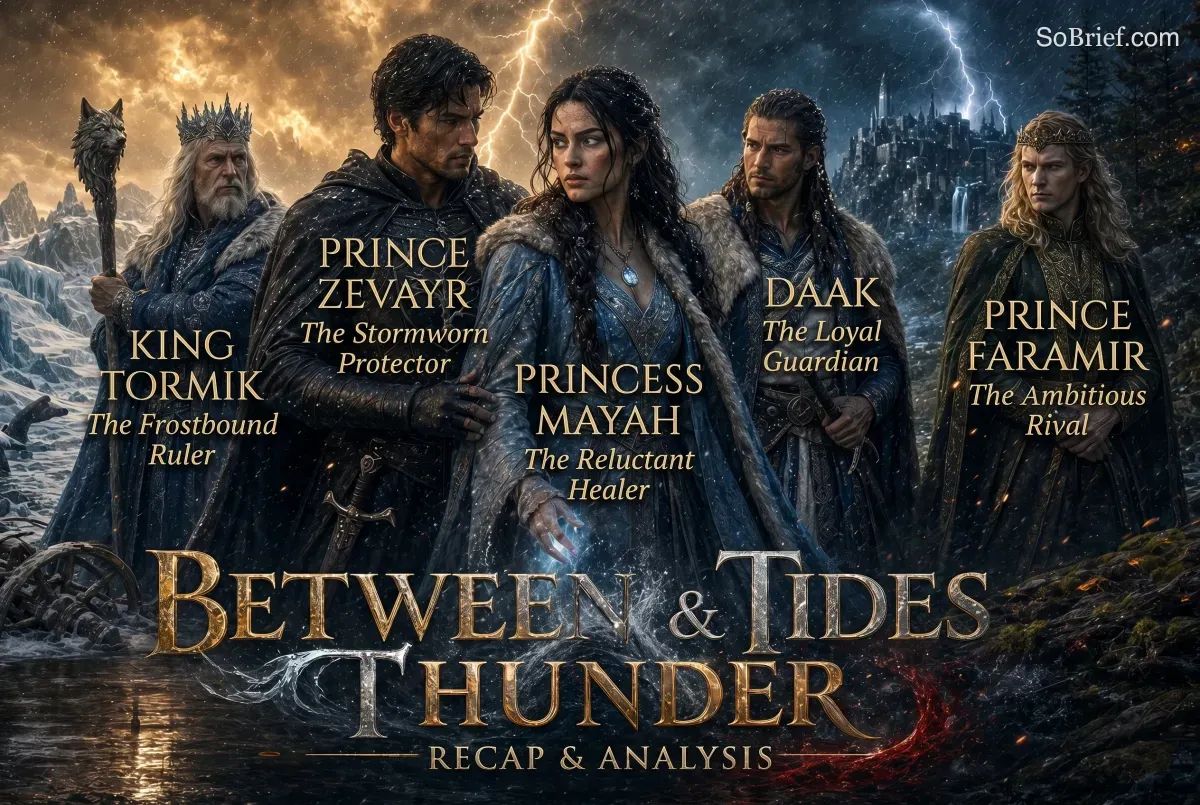


Plot Summary
Prologue
A six-year-old girl crouches in a closet during a shrieking thunderstorm, clutching a carved wooden reindeer her father gave her, obeying her mother's command to stay hidden no matter what she hears. The rain hammers like it wants inside. Then boots climb the stairs, too heavy to be her mother, and strangers crash through her room.
The door flies open, and she screams and screams. This is Mayah's1 oldest wound, the night that planted a lifelong terror of storms and severed her from the mother she barely remembers, the buried memory that the whole story slowly, devastatingly excavates.
Betrothed to the Enemy
Mayah,1 twenty-five, princess and healer of frozen Tundrayn, spends her days mending warriors maimed in a decades-long war with Arbinj, quietly raging at how nonwielding commons are thrown to the front lines to die. Her cold father, King Tormik,4 has bartered her marriage to Faramir,6 crown prince of Arbinj, in exchange for peace and food stores.
She finds private comfort in Daak,3 the guard captain who loves her, but duty wins. On the betrothal day the promised groom never appears. Instead the feared Dark Commander, Prince Zevayr,2 strides in as proxy, lifts his helmet to reveal a maddeningly handsome face, makes her prove her healing on his sliced palm, and rings her finger. Then he announces he will deliver her to Arbinj within the hour.
The opening weaponizes the marriage-as-treaty trope to expose how women become currency between warring patriarchs. Mayah's healing is both gift and cage: it makes her valuable and therefore tradeable. The substitution of the dreaded Commander for the absent prince introduces the central irony, that the monster of propaganda will prove more humane than the system selling her. Her storm phobia, seeded in the prologue, marks trauma carried in the body, foreshadowing how intimately her private wound will collide with a man who literally commands thunder.
The Forced March
Barely an hour out, Zev2 moves them into a battered prisoner carriage as a precaution, infuriating Mayah.1 The wisdom shows when the procession is bombed and overrun, seemingly by the Rebellion.7 Zev fights with blade and lightning while Mayah, paralyzed by her storm terror, faints, and the attackers shield rather than harm her.
She wakes bound over his shoulder; he interrogates her, suspecting she knew, until she headbutts him and he pins her, dragging out her shameful confession that thunder unmakes her. Every soldier under his command is dead. Unable to safely re-enter Tundrayn or send her alone, Zev decides they will cross two kingdoms on foot for over a month, so she can still wed his brother and prevent fresh war.
Forced proximity strips away rank and reputation, reducing princess and commander to two cold, hungry people dependent on each other. The carriage attack also plants the Rebellion as a third force whose true shape is hidden. Mayah's involuntary collapse humiliates her warrior self-image yet humanizes her to Zev, who expected a scheming royal. The mutual suspicion here establishes trust as the novel's scarcest resource, the thing that must be painstakingly built and will later be catastrophically broken.
Grief Thaws the Ice
On the trek, hostility softens into something dangerous. Zev2 surrenders his fur-lined gloves, lets Mayah1 heal his wounds for an uneasy truce, and gathers her against his chest each freezing night so she will not die in the snow. They trade their dead: he lost his only friend, the earthwielder Lev, frozen alive by a waterwielder; she lost the twins Sura8 and Tumaas,9 nonwielder best friends sent to perish at the border.
When they find a widow's cottage and her young son is mauled by a bear, Mayah heals the nonwielder boy without hesitation while Zev quietly summons rain for their dying garden. The infamous killer calls Lev's parents nonwielders, not commons, and Mayah glimpses the grieving man beneath the storm.
This is the emotional engine of enemies-to-lovers: discovering the enemy mourns identically. Their shared contempt for how both kingdoms discard nonwielders reframes the war as a class atrocity rather than a tribal one. The cottage scene externalizes their hidden tenderness, letting each witness the other's compassion safely. The nickname Zev, once Lev's, becomes a relic transferred, suggesting Mayah is filling a hollow left by loss, intimacy born from parallel wounds rather than mere attraction.
Borrowed Power, Burning Need
In rebel-held woods a concealed sharpshooter targets Zev;2 Mayah1 screams a warning and takes the iron-tipped arrow in her side. Enraged, Zev kills the attackers by drawing scattered lightning straight from the air, a power he can only reach in fury.
The iron poisons her blood and suppresses her healing until the wound festers. Desperate, he offers power sharing, warning that channeled power doubles as an aphrodisiac. She mends herself, then burns with manufactured desire and throws herself at him.
Refusing to exploit her, he binds and gently gags her to protect her from her own need, then weathers her mortification with unexpected kindness the next morning. The episode dissolves the last of her hatred and tangles her feelings into something she cannot name.
The aphrodisiac mechanic literalizes consent anxiety: Zev's restraint while she begs becomes the clearest proof of his character, inverting the Dark Commander myth entirely. Mayah taking the arrow marks the moment self-preservation yields to protectiveness, her body choosing him before her mind admits it. The scene also smuggles in the rule that will later save lives, establishing power sharing's stakes long before its climactic payoff, a careful seeding of magic-system consequence inside a moment of vulnerability.
The Confession of Murder
Days from the Arbinji base, Zev2 forces out the truth he has dreaded. After Lev died in agony, he hunted the Tundrayni battalion responsible and annihilated it with lightning, and that battalion held Sura8 and Tumaas.9 Mayah1 crumples, the man she has begun to trust suddenly recast as the monster who incinerated the twins she still grieves.
She wants to summon hatred and cannot; his remorse mirrors her own loss too precisely. She tells him she despises what the war has made of them all, and that this is exactly why she must still marry into Arbinj and end it. They sleep on opposite sides of the blanket, the confession a wound that neither her glowing hands nor passing time can close.
Placing this revelation before the wedding tests whether love can survive moral horror, refusing the easy fantasy of a clean love interest. Mayah's inability to hate him exposes how grief seeks understanding over vengeance, how comprehension corrodes righteous anger. The scene reframes atrocity as the product of unbearable pain rather than innate evil, an uncomfortable thesis the book will keep pressing: that nearly everyone here has killed, and that the war manufactures monsters from the heartbroken on both sides.
The Bridegroom Switched
They reach the army base, then ride into a capital that spits hatred at its Tundrayni bride. In the throne room King Varad5 calmly announces the deal has changed: Faramir6 will wed a Volcan princess, and Mayah1 must instead marry the second son, Zevayr.2 Refusal means a dungeon, death, or renewed war, and Varad plainly wants her to refuse. She does not.
Choosing survival and the peace she crossed a continent for, she agrees, and Zev kneels to accept her. He pulls Faramir's ring from her finger, vowing to replace it, and kisses her at last, hungrily. To spare her the invasive purity test, he lies before the court that he already inspected her himself, an act both humiliating and fiercely protective.
Varad's manipulation reveals power's preferred weapon: the illusion of choice. By engineering a marriage he expects her to reject, he tries to manufacture his own pretext for cruelty. Mayah's acceptance converts coercion into agency, reclaiming the decision as hers. The switch also rescues the romance from tragedy, letting the man she actually loves become her husband, while the purity-test lie crystallizes Zev's pattern of shielding her through transgression, protection delivered in the language of scandal.
Bride, Blade, and Healer
At the garden wedding Zev2 anchors Mayah1 through her terror while summoning a small ceremonial storm. During the reception a dagger meant for her instead strikes a passing servant.
She kneels in her bloodied gown and heals the dying nonwielder before the entire court, branding herself the Healing Princess and unnerving Varad,5 who now suspects Rebellion7 sympathies. Confined afterward to opulent chambers like a caged bird, Mayah rebels by working the palace infirmary, slowly winning over the prickly medic Sauzon.13
Zev courts her with rooftop picnics and a teardrop ring matched to her dead mother's pendant. Their marriage warms into genuine tenderness, even as her letters to a stonily silent father go unanswered and escalating Rebellion attacks keep dragging Zev away.
The public healing is a political christening: Mayah's compassion becomes a populist asset that simultaneously endangers her among the powerful. The gilded-cage motif interrogates how even loving protection can curdle into imprisonment, and her insistence on the infirmary asserts vocation as identity, healing as the self she refuses to surrender. The matching ring fuses romance with maternal memory, while the unanswered letters quietly foreshadow that the father she defends is not the man she imagines him to be.
The Hidden Waterwielder
With Zev2 gone to the border, the secret Mayah1 has hidden from everyone breaks open: she is a covert waterwielder, trained in shadow by Daak3 and shaped by her father into a living weapon. She locates a hidden tunnel beneath the palace, follows the water's pull, and finds Daak waiting in the dark. Her entire arrival has been a coup.
The plan is to poison the assembled royals and nobles at the coming Equinox Festival with toxinnia dissolved in strong wine, then seize both thrones to build a fairer realm. But her heart has migrated. She resolves to spare Zev with an antidote, and when Daak kisses her it feels like a betrayal of someone else. She is plotting murder while loving one of her targets.
The reveal recontextualizes the entire romance, transforming Mayah from pawn into double agent and weaponizing the reader's sympathy against itself. Her conflicted kiss with Daak dramatizes love as something the body adjudicates before the mind, her revulsion a verdict already rendered. The tunnel, water-guided, literalizes how her suppressed power and suppressed self run beneath everything, hidden infrastructure beneath a polished surface. The coup also reframes her earlier idealism, showing conviction and deception can share the same root.
Caught in the Tunnels
Varad5 privately confesses he wanted Zev,2 not the unstable Faramir,6 to be king, and insists his son loves her. Then Zev returns early and finds Mayah1 in the tunnels with Daak.3 Believing he has uncovered both an affair and her treason, he kills Daak with his lightning-from-air power. Shattered, Mayah turns her hidden waterwielding against him; he answers by conjuring a storm underground, and her phobia plunges her into darkness.
She wakes shackled inside a prisoner carriage, the same kind that began their journey. Zev, betrayed and glacial, reveals he knows about the poison and has had the toxinnia flushed from the tunnels. He addresses her only as wife, the word now a blade, and tells her he has not yet decided whether she lives.
This is the structural pivot from romance to ruin, the betrayal that the whole back half must metabolize. Zev's murder of Daak is grief and possession indistinguishable, the Dark Commander resurfacing through heartbreak. The carriage's return as cage closes a cruel loop: their bond began with him transporting her and now ends the same way, intimacy collapsing back into captivity. Mayah's collapse mid-attack ties her trauma to her undoing, the phobia weaponized against her at the worst possible moment.
The Self-Inflicted Wound
Zev2 hauls her to a camp of his soldiers, among them Sulon,11 the brute he once forced to bow to her. When Zev steps away, Sulon beats Mayah1 and attempts to rape her; Zev returns and kills all six men with one surge of harvested lightning. Bound and frantic, Mayah slits her own wrist and feigns being unable to heal, gambling that he will power-share to save her.
He does. Flooded with his strength, she turns the water against him and nearly drowns him, then flees as the aphrodisiac ignites in her veins. Stumbling through the woods, she collides with Sorka,10 Daak's father3 and a Tundrayni general, whose warriors ambush and seize the weakened Dark Commander in iron chains.
Even at the nadir of his rage, Zev's annihilation of Sulon affirms a line he will not cross, separating possessive fury from the systemic predation Mayah faces. Her self-wounding gambit shows how trauma sharpens into ruthless agency, manipulating his lingering care as both weapon and proof of it. The reversal of captor and captive, engineered through the very power-sharing that once saved her, demonstrates the magic system as moral mirror, every gift convertible into betrayal depending on the heart wielding it.
The Father's True Face
In the Tundrayni camp Zev2 hangs chained and beaten, yet Mayah1 secretly heals him each night, unable to bear his suffering. Her father4 arrives, intending to ransom the Commander and lure Varad5 and Faramir6 to slaughter. Then Mayah watches Tormik call lightning down from a cloudless sky. The truth detonates: her father is a stormwielder, descended from her Arbinji-blooded grandmother.
He, not Arbinj, murdered her mother for fleeing with her, and he tortured her with summoned storms for twenty years to scour the weakness from her. Sickened and furious, Mayah picks the locks on Zev's iron with ribbons of ice, and together they drown and electrocute the entire camp. Tormik escapes with a handful of warriors into the trees.
The keystone reveal collapses Mayah's entire moral architecture: the enemy she was raised to destroy is innocent of her defining wound, and the father she sought to please is its author. Her phobia is recast as engineered abuse, trauma deliberately inflicted and disguised as discipline. Freeing the husband she betrayed, then massacring her own people beside him, marks her irreversible severance from inherited loyalty, a self forged in the wreckage of every lie that built her. Vengeance and complicity become indistinguishable.
The Mother Presumed Dead
Fleeing on horseback, Zev2 keeps Mayah1 captive yet swears that if she truly tries to leave, he will let her go. Rebels surround them, led by a woman who proves to be Tairna,7 the nonwielder who raised Zev and was long believed murdered by Varad.5 She fled to build the Rebellion and once knew Mayah's mother.
More staggering still, Sura8 and Tumaas9 are alive, survivors of the very battalion Zev destroyed. Tairna lays out her design: with a Volcan alliance, strike both kingdoms simultaneously and install Mayah and Zev as monarchs beneath oversight councils. Mayah weeps through reunions with her resurrected friends while Zev confronts the mother who left him alone with a cruel king and a crueler brother.
Resurrection here functions as grace and as reckoning: the dead returning forces every character to renegotiate guilt, especially Zev, whose worst atrocity is partly undone yet never erased. Tairna embodies maternal abandonment reframed as survival, complicating the binary of devotion and betrayal. The Rebellion's vision of councils and shared rule offers the book's political thesis, that justice requires structural checks, not merely better kings. Sura's living forgiveness becomes the moral pressure that will let Mayah forgive herself.
Two Kings Fall
At the Rebellion camp, beneath storms and a hard-won dance, Mayah1 confesses she loves Zev,2 and Sura8 persuades Tairna7 to strike off his suppressing iron cuffs. Then Arbinji and Tundrayni forces attack together, Faramir's6 earthwielding toppling buildings. Fighting back to back, Mayah and Zev carve through soldiers. Faramir gloats that he poisoned Varad with her own toxinnia before Zev beheads him.
Tormik4 appears and turns Mayah's ice spear midair into Zev's chest. In an eruption of grief, Mayah discovers she can wield blood, freezing her father's veins until his heart stops, finally avenging her mother. Zev lies dying and she is drained empty, until she eats the bruised apple he saved for her and heals the gaping wound in his chest.
The dual patricide-by-proxy resolves the war's poisoned bloodlines: both tyrant fathers fall, one by his own son's blade, one by his daughter's impossible new power. Blood-wielding, taboo and supposedly impossible, externalizes how love and rage can unlock what duty never could. The saved apple is the book's quietest devastation, proof that even at his most wounded Zev was provisioning her survival. Mayah killing Tormik is not catharsis so much as severance, the final cord cut between her and the man who manufactured her.
The Truthwielder's Secret
Declared queen of both kingdoms, Mayah1 faces Zev2 packing to leave for Volca, convinced he can never trust her after Daak.3 In fury she tells him she hates him, and he goes rigid, demanding she say it again. Then he reveals his own buried gift: he is a truthwielder, and her lies prick his skin like a blade dragged down his spine.
Across their entire journey she never once lied about wanting him, missing him, loving his scowl, and the antidote really was for him. Only now, claiming hatred, does the falsehood wound him, which is the proof he needed. He admits he fell in love while dragging her to marry his brother. They reconcile and at last consummate their marriage.
The truthwielder twist retroactively certifies every tender word, resolving the betrayal arc through magic-as-epistemology: in a story drowning in lies, one man can feel the difference, and her love passes the only test that matters. The inversion is elegant, hatred spoken becomes love proven, the lie that finally hurts revealing the truths that never did. Their union completes the dismantling of the Dark Commander myth, intimacy reframed as radical honesty between two people the world taught to weaponize deception.
Epilogue
Three months later, Mayah1 and Zev2 rule Arbinj as the Healing Queen and her reformed Commander-King, opening trade routes and a wielder exchange. Journeying at last to Tundrayn, Mayah teases Zev by insisting they ride the old prisoner carriage, transforming the vehicle of their bitter beginning into a place of play and shackle-free seduction.
At the ice palace, General Sorka,10 the pregnant healer Vy,12 and her resurrected friends Sura8 and Tumaas9 wait to receive them. Two enlarged thrones stand carved upon the dais. Despite her father's death and the blood spilled at the camp, Tundrayn welcomes its Healing Queen home. The exile who left in chains returns crowned, with the man she once feared now beside her as king.
Analysis
Between Tides and Thunder dresses a familiar arranged-marriage romantasy in a sharper political question: who decides which lives are disposable, and what lies must be told to keep that order intact. The recurring contempt for nonwielders, the commons sent to die at the front, functions as a clear allegory for caste and class, and the Rebellion's7 demand for oversight councils rather than merely kinder rulers gives the book an unusually structural notion of justice. Mayah's1 healing gift literalizes care as both vocation and political currency, while Zev's2 storms make masculine rage into something that can be either weaponized or tamed by tenderness.
The novel's deepest preoccupation is epistemological: how do you know what is true when everyone, including your father, has lied to you? Mayah is raised on a fabricated history, her trauma reframed as discipline, her enemy manufactured for her. The twin late reveals, that she can wield blood through love-fueled rage and that Zev can physically feel her lies, resolve the betrayal plot through magic-as-truth-test. In a story saturated with deception, the fantasy of a partner who can verify your sincerity becomes the ultimate intimacy, and the lie of hatred that finally wounds him is the proof that every loving word was real.
Psychologically, the book is most compelling on trauma and forgiveness. Sura's8 living absolution permits Mayah to forgive herself; Tairna's7 abandonment reframes maternal failure as survival; even the tyrant fathers are granted flickers of distorted love. The saved apple, the matching teardrop ring, the recurring prisoner carriage, these motifs track how objects of captivity and grief can be reclaimed as tokens of devotion. The takeaway is bracing rather than tidy: enemies are usually invented by the powerful, love demands radical honesty, and the self can be rebuilt from the wreckage of inherited lies.
Review Summary
Between Tides & Thunder receives an overall rating of 4.22/5, with most readers praising its compelling enemies-to-lovers romance, sharp banter, and shocking plot twists. The standout characters—fierce healer Mayah and broody storm-wielder Zev—earned widespread adoration. Many celebrated its rare achievement as a satisfying standalone romantasy. Common criticisms include uneven pacing, underdeveloped world-building, rushed plot resolutions, and overuse of the endearment "baby." The second half particularly impressed readers, delivering emotional chaos and revelations, though some felt twists were excessive or contrived.
Characters
Mayah
Healer princess, secret weaponPrincess and gifted healer of icebound Tundrayn, secretly a trained waterwielder. Mayah is defined by a fierce, stubborn compassion, especially toward the nonwielders both kingdoms treat as disposable, a conviction rooted in her dead nonwielder mother and lost friends. Beneath her royal poise runs a debilitating terror of thunderstorms and a lifelong hunger for a distant father's4 approval she can never quite earn. She is quick-tongued, defiant, and physically brave, yet haunted by grief she cannot heal in herself. Torn between duty and desire, vengeance and mercy, she carries a coiled rage and an instinct to soothe pain in equal measure. Her arc tests whether a person built from lies can choose her own truth.
Zevayr (Zev)
Feared Dark CommanderSecond son of Arbinj, its most powerful stormwielder, and the realm's most dreaded soldier, the Dark Commander blamed for thousands of deaths. Beneath the brutal reputation, Zev is wry, fiercely protective, and quietly principled, refusing to dehumanize nonwielders the way his court does. He is profoundly lonely, scarred by his father's5 cruelty, the loss of his best friend, and an absent mother7, and he dreams of escaping the realm entirely. He guards his heart with sarcasm and control, terrified of betrayal yet desperate to be known. Tender when trusted and terrifying when wronged, he loves with an intensity that tips toward possession. His journey hinges on whether grief and rage can give way to faith in another person.
Daak
Devoted guard captainCaptain of Tundrayn's royal guard, a powerful waterwielder, and the man who secretly trained Mayah1 in combat and wielding. Daak is warm, teasing, and steadfastly devoted to her, her comfort through grief and storms. Bound by rank and her betrothal, he loves her with patient restraint, and his loyalty entangles him in dangerous loyalties beyond their relationship.
King Tormik
Mayah's cold fatherKing of Tundrayn, Mayah's1 distant and exacting father, who rules a starving land of ice and scarcity. He prizes wielders, despises commons, and views his daughter as an instrument of statecraft. Capable of rare, awkward flickers of tenderness, he more often wields disappointment as a weapon, and harbors secrets that have shaped Mayah's entire fearful existence.
King Varad
Ruthless Arbinji kingKing of Arbinj, father to Zevayr2 and Faramir6, a calculating ruler with decades of war and bad blood behind him. Varad treats marriages and alliances as leverage, manipulating people toward outcomes he can exploit. Cold and imperious, he nonetheless reveals unexpected, complicated feeling toward his sons, blurring the line between tyrant and father.
Faramir
Cruel crown princeCrown prince of Arbinj, a powerful earthwielder and Zev's2 half-brother. Faramir is malicious, mercurial, and consumed by jealousy of his stronger sibling, convinced Zev covets the throne. His taunts mask genuine instability and a hunger for power that makes him dangerously unpredictable to everyone, family included.
Tairna
The woman who raised ZevThe nonwielder woman who raised Zevayr2 with the warmth his father never offered, tending his wounds and teaching him to dance. She shaped his conscience and his rare empathy for commons before vanishing from his life under murky circumstances. Maternal, shrewd, and burdened by hard choices, she knew more of Mayah's mother1 than anyone suspects.
Sura
Cherished childhood friendOne of the nonwielder twins Mayah1 grew up beside, radiant, rule-breaking, and irrepressibly bright, with a lopsided grin and a habit of scheming Mayah toward her brother. Sura's fierce love and unbreakable spirit make her Mayah's truest mirror and the conscience that helps her face what she has done.
Tumaas
Gentle giant twinSura's8 twin and Mayah's1 childhood friend, a hulking, warm-hearted nonwielder perpetually exasperated by his sister's antics. Steady, protective, and tender, he embodies the loyal devotion that the war's contempt for commons tried and failed to extinguish.
Sorka
Kind Tundrayni generalGeneral of the Tundrayni army and Daak's father3, distinguished by the same deep-blue eyes. Sorka is principled and unusually compassionate for his rank, often advocating mercy in a court that allows none. His quiet decency and grief make him a rare honorable figure amid scheming kings.
Sulon
Brutish second-in-commandA powerful Arbinji waterwielder and Zev's2 second in command, arrogant and predatory. He nurses a hatred of Mayah1 after being publicly humiliated, and his cruelty marks him as the kind of soldier the war breeds and rewards.
Vykiss (Vy)
Quiet rebel healerA young healer in the Tundrayni and Rebellion camps, gentle and observant, herself a survivor of nonconsensual power sharing. Her empathy and hard-won understanding make her a discreet, unexpected ally to Mayah1.
Sauzon
Prickly palace medicThe bespectacled head medic of the Arbinji palace infirmary, who treats nonwielders and wielders alike using poultices and research rather than magic. Initially hostile to Mayah's1 intrusion, he grows into a respectful colleague and friend.
Plot Devices
Storms and the phobia
Trauma made literalThunderstorms terrorize Mayah1, dropping her into helpless panic that returns her to the night of her childhood trauma. The phobia recurs at every crisis, the betrothal, the ambush, the wedding, captivity, leaving her vulnerable precisely when she most needs control. It binds her to Zev2, a stormwielder who learns to anchor her through each episode, turning her greatest fear into a site of intimacy. Crucially, the storms also encode a hidden truth about her past: their origin is not what she believes. The device operates as embodied PTSD, a wound the narrative slowly traces back to its real source, so that conquering her terror and uncovering her history become the same act of liberation.
Power sharing
Forbidden intimacy mechanicOne wielder can channel power into another, temporarily strengthening the recipient while weakening the giver. The act is forbidden partly because it functions as a potent aphrodisiac, making nonconsensual sharing a tool of violation. The book introduces it when Zev2 uses it to save Mayah1 from an iron-poisoned wound, where it produces overwhelming desire she must endure. Later it becomes a weapon when Mayah manipulates Zev into sharing so she can attack him, and finally a lifeline again in the climax. It externalizes the novel's preoccupation with consent, trust, and the way the same gift can heal, seduce, or betray depending entirely on the intent behind it.
Iron suppression
Magic nullifier and cageIron, in arrowheads, collars, and shackles, suppresses a wielder's abilities and severs them from their power. The device controls who holds power in any given scene and repeatedly inverts captor and captive. Iron collars bind suppressed servants in Tundrayn, an iron-coated arrow nearly kills Mayah1 by blocking her healing, and iron cuffs later restrain both Mayah and Zev2 at different points. The choice to remove or apply iron becomes a measure of trust between characters, most movingly when Zev's cuffs are struck off at an ally's urging. It grounds the magic system in tangible stakes and turns liberation into a literal unlocking.
The poison plot
Hidden coup engineMayah's1 true purpose in Arbinj is a coup: poison the assembled royals and nobles at the Equinox Festival using toxinnia hidden in strong wine, then seize both thrones to build a fairer realm for nonwielders. The scheme, plotted with Daak3 through secret palace tunnels, secretly drives the entire first half, recasting Mayah's idealism and her marriage as cover. Her growing love for one of her intended victims, and her decision to secure an antidote for him, becomes the moral fault line of the book. The poison resurfaces with lethal irony in the climax, repurposed by an enemy, proving that weapons set in motion rarely stay in their maker's hands.
Secondary wielding abilities
Revelation engineIn a world where most people wield one element, a rare few possess hidden secondary gifts, and concealed abilities power nearly every major twist. Mayah1 secretly wields water alongside healing; other suppressed talents, blood, truth, and storm, surface at pivotal moments to overturn what characters believed about each other and themselves. These revelations restructure loyalties, expose lies decades old, and ultimately become the means by which love is finally proven and a tyrant finally falls. The motif argues that identity is layered and often deliberately buried, that the realm's cruelty toward certain wielders forces secrecy, and that the truths people hide are precisely the ones that decide everything.
Download PDF
Download EPUB
.epub digital book format is ideal for reading ebooks on phones, tablets, and e-readers.








































