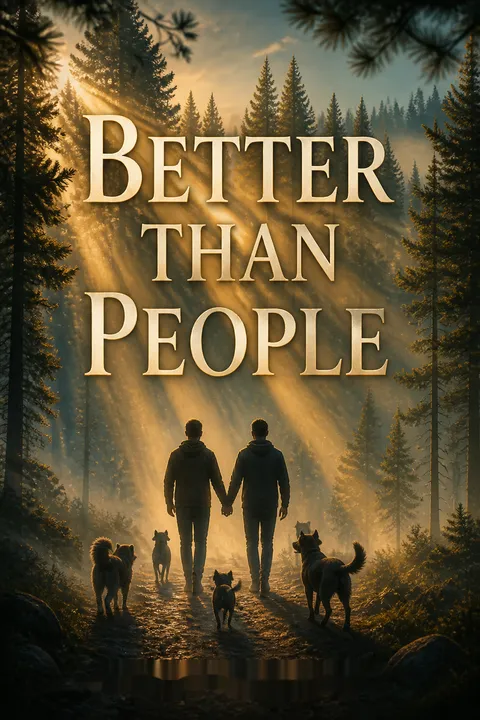

Plot Summary
Broken Bones, Broken Trust
Jack Matheson, a reclusive children's book illustrator in rural Wyoming, finds his world literally and figuratively shattered after a fall leaves him with a broken leg. Isolated in his cabin, his only solace is his menagerie of rescue dogs and cats. But the injury means he can't care for them as he used to, and the loss of his creative drive after a betrayal by his former collaborator, Davis, leaves him adrift. Jack's brother, Charlie, tries to help, but Jack's pride and anger keep him at arm's length. The pain of physical helplessness mirrors the emotional wounds Jack carries, setting the stage for a story about healing, trust, and the unexpected ways connection can begin.
The Pack and the Panic
Simon Burke, a gentle, anxious graphic designer, has always found animals easier than people. When he moves in with his grandmother, giving up his dream of adopting a dog due to her allergies, he turns to the PetShare app. Jack's desperate request for a dog walker brings Simon to his door. Their first meeting is a tangle of nerves, leashes, and animal chaos, but Simon's quiet competence with the pack and his deep empathy for their quirks immediately set him apart. Both men are awkward, but the animals become a bridge, allowing them to interact in ways words can't. Simon's anxiety is palpable, but so is his longing for connection.
Silent Connections
Simon's social anxiety makes conversation nearly impossible, but with Jack, he finds a rare understanding. Their early interactions are marked by silence, texting, and the comfort of routine. Jack, frustrated by his own helplessness, is surprised by how much he looks forward to Simon's visits. The animals thrive under Simon's care, and Jack begins to see Simon's quiet strength. As they navigate the logistics of dog-walking and daily life, a tentative friendship forms, rooted in mutual respect and the unspoken language of kindness.
Cookies, Confessions, and Cats
Simon's grandmother bakes cookies for Jack, and the simple gift opens a door to vulnerability. Over shared snickerdoodles, Jack reveals the story of his creative betrayal—how Davis stole his idea and left him unable to draw. Simon, in turn, shares the lifelong burden of his anxiety and the pain of being misunderstood. Their confessions are halting but honest, and the animals—especially the cats—provide comic relief and comfort. The act of sharing food and stories becomes a turning point, deepening their bond and hinting at the possibility of more.
Drawing Out the Past
Jack shows Simon his studio and the books he illustrated, exposing the raw wound left by Davis's betrayal. Simon is awed by Jack's talent and gently encourages him to draw again, but Jack's fear of failure and loss is overwhelming. Meanwhile, Simon's own history of bullying and isolation resurfaces, making him question whether he can ever truly belong. Their mutual admiration is tinged with sadness, but also with hope—each sees in the other a reflection of their own struggles and a possibility for healing.
Storms and First Kisses
When a sudden storm catches Simon and the pack outside, Jack welcomes him in, offering warmth and dry clothes. The physical closeness breaks down barriers, and as they watch British baking shows and share laughter, the tension between them shifts. A massage for Simon's twitching hand becomes an excuse for touch, and the storm outside mirrors the emotional turbulence within. In a moment of courage, Simon initiates their first kiss—awkward, sweet, and transformative. It's a revelation for both, marking the start of something new.
Learning to Want
The aftermath of their kiss leaves Simon exhilarated but anxious. He worries about expectations, about not being ready for sex, about being a disappointment. Jack reassures him with patience and humor, making it clear that there's no rush. Their days become a dance of longing and restraint, each learning to express desire in their own way. Simon's inexperience is met with Jack's tenderness, and together they begin to explore the boundaries of intimacy, discovering that wanting is as much about trust as it is about touch.
The Language of Touch
As their relationship deepens, Simon and Jack find that touch often says what words cannot. From casual brushes to heated encounters, their bodies become fluent in a language neither has spoken before. Simon's anxiety still flares, especially in new situations, but Jack's steady presence grounds him. They learn to navigate consent, pleasure, and vulnerability, building a foundation of safety and mutual respect. The animals, ever-present, are both witnesses and participants in this unfolding intimacy.
Family Dinners and Fears
Jack's brother Charlie and Simon's grandmother Jean become part of their world, bringing both comfort and new challenges. A dinner at Charlie's house triggers Simon's panic, forcing him to confront the limits of his social endurance. Charlie, gruff but kind, offers unexpected understanding, while Jack grapples with guilt over pushing Simon too far. The experience exposes the fragility of their connection but also the depth of their commitment to making it work, even when it's hard.
Falling Apart, Coming Together
As Jack's leg heals and he regains his independence, Simon fears he'll no longer be needed. Old insecurities resurface, leading to a painful confrontation where both men question whether they can give each other what they need. Simon's belief that he's just a distraction for Jack collides with Jack's fear of losing the only person who's made him feel whole in months. The resulting distance is agonizing, but it forces both to reckon with what they truly want—and what they're willing to risk for love.
Drawing Again
In the aftermath of their fight, Jack finds himself drawing again—first trees, then Simon, then the life they're building together. The act of creation becomes an act of healing, a way to process pain and reclaim joy. Simon, too, begins to see himself differently, recognizing his own strength and the value he brings to Jack's life. Their reunion is tentative but heartfelt, marked by honest conversation and the realization that love means accepting each other's limitations—and choosing each other anyway.
Love in the Everyday
With Jack's leg healed and Simon more comfortable in his skin, they settle into a new rhythm. Grocery shopping, baking with Jean, and walking the pack become rituals of intimacy. They navigate the challenges of Simon's anxiety and Jack's lingering fears, but their commitment deepens. Small acts—pinning a paper boutonniere, sharing a meal, holding hands in public—become declarations of love. The ordinary becomes extraordinary in the light of their connection.
The Fight for Belonging
Simon and Jack face the realities of being together outside the safety of the cabin. A dinner with Jack's friends, a public date, and the approach of Christmas all test their ability to support each other. Simon's courage grows, bolstered by Jack's unwavering presence, while Jack learns to listen and adapt. Their love is no longer just a refuge but a force that allows them to engage with the world on their own terms.
Healing, Hurting, Hoping
Not every day is easy. Simon's anxiety still leads to panic attacks, and Jack's old wounds sometimes reopen. But each setback is met with compassion and a renewed commitment to understanding. They learn that healing is not linear, that love doesn't erase pain but makes it bearable. Together, they create new traditions, support each other through hard days, and celebrate the victories—no matter how small.
The Risk of Real
As Christmas approaches, both men grapple with the fear of losing what they've found. Simon worries he'll never be enough; Jack fears he'll never be able to give Simon the life he deserves. A crisis brings their insecurities to the surface, but also clarifies what matters most. They realize that love is a choice made daily, a risk worth taking even when the outcome is uncertain.
Breaking, Mending, Choosing
A misunderstanding drives them apart, each convinced the other would be better off without them. In the solitude that follows, both confront their deepest fears and desires. Encouraged by their families, they find the courage to reach out, apologize, and try again. Their reunion is marked by honesty, forgiveness, and a renewed sense of purpose. They choose each other, not in spite of their flaws, but because of them.
Christmas, Home, and Hope
The holidays become a time of healing and celebration. Simon and Jack decorate a tree, invite Charlie and Jean for dinner, and exchange gifts that reflect their journey. A new puppy joins the pack, symbolizing the growth of their chosen family. The cabin, once a place of isolation, becomes a true home—warm, chaotic, and filled with love. Together, they look to the future with hope.
The Pack Grows
With the addition of the puppy and Simon's decision to move in, their family expands. The animals adjust, rituals are established, and the rhythms of daily life become a source of joy. Jack's art flourishes, inspired by Simon and the pack, while Simon finds peace in belonging. Their love, once tentative, is now a foundation—resilient, adaptable, and ever-growing.
Our Bed, Our Life
In the quiet of winter, Simon and Jack reflect on how far they've come. Their bed, once a place of loneliness, is now a sanctuary. They hold each other, whisper promises, and dream of the life they'll build—one filled with animals, art, laughter, and the kind of love that makes even the hardest days worth living. The story ends not with a grand gesture, but with the simple, profound act of choosing each other, every day.
Analysis
"Better Than People" is a tender, deeply empathetic exploration of love, vulnerability, and the courage it takes to build a life together when the world—and your own mind—makes connection hard. Roan Parrish crafts a romance that is as much about healing as it is about desire, centering characters whose struggles with anxiety, trust, and self-worth are rendered with nuance and compassion. The novel challenges the myth that love is easy or that it "fixes" brokenness; instead, it shows that real intimacy is forged in the willingness to be seen, to risk rejection, and to keep choosing each other even when it's hard. The animals are not just cute sidekicks but essential to the emotional landscape, modeling unconditional love and providing a bridge between two men who might otherwise remain isolated. In a world that often prizes extroversion and ease, "Better Than People" is a celebration of quiet bravery, of finding home in another person, and of the messy, beautiful work of building a family—one walk, one cookie, one touch at a time. The story's lesson is clear: love doesn't demand perfection; it asks only that we show up, again and again, with open hearts.
Review Summary
Better Than People receives mixed but mostly positive reviews (3.95/5), praised for its sensitive portrayal of severe social anxiety and heartwarming romance between two animal lovers. Readers appreciate the low-angst, feel-good story featuring Jack, a grumpy illustrator, and Simon, who struggles with debilitating anxiety. The pets and slow-burn relationship earn consistent praise, as does the steamy romance and emotional depth. Critics note pacing issues, Jack's treatment of his brother Charlie, and intimate scenes feeling disconnected. Some found the premise too similar to Parrish's other work. The audiobook narration received strong praise.
People Also Read

Characters
Jack Matheson
Jack is a children's book illustrator whose life is upended by a broken leg and a creative betrayal. Grumpy, fiercely independent, and deeply loyal to his animals, Jack hides a tender heart beneath layers of sarcasm and self-protection. His relationship with his brother Charlie is marked by both gratitude and resentment, shaped by shared loss. Jack's journey is one of learning to accept help, trust again, and rediscover his passion for art. Through Simon, he finds not only love but also the courage to be vulnerable, to forgive, and to hope for more than survival.
Simon Burke
Simon is a graphic designer whose severe social anxiety has shaped every aspect of his life. Sensitive, introspective, and quietly brave, he finds comfort in animals and routine. Living with his grandmother after his grandfather's death, Simon sacrifices his own dreams for family. His journey is one of self-acceptance—learning that his worth is not defined by his ability to perform or conform. With Jack, Simon discovers a love that honors his boundaries and celebrates his strengths. He learns to advocate for himself, to risk connection, and to believe he is worthy of happiness.
Charlie Matheson
Charlie is Jack's older brother, a hardware store owner who took on the role of caretaker after their parents' death. Stoic, practical, and quietly loving, Charlie struggles to express his own needs, often subsuming them for Jack's sake. His relationship with Jack is complicated by guilt, pride, and a deep-seated fear of abandonment. Charlie's arc is one of learning to let go, to trust others, and to accept that caring for someone doesn't mean controlling them. His kindness toward Simon reveals a capacity for empathy that runs deeper than words.
Jean Burke
Jean is Simon's grandmother and closest confidante. Warm, witty, and fiercely protective, she provides the unconditional love Simon has always needed. Her own grief after her husband's death is palpable, but she channels it into nurturing Simon and encouraging his independence. Jean's presence is a reminder that family can be chosen, that healing is possible at any age, and that love is best expressed through small, everyday acts of care.
Davis Snyder
Davis is Jack's former collaborator, whose theft of Jack's story idea shatters Jack's trust and creative confidence. Though he never appears directly, Davis's actions cast a long shadow over Jack's life, representing the pain of betrayal and the difficulty of moving on. Jack's eventual ability to draw again—and to imagine new stories—signals his triumph over this wound.
Bernard, Puddles, Dandelion, Rat, Pirate, Pickles, Mayonnaise, Louis, Box
Each animal in Jack's household has a distinct personality, from Bernard's gentle strength to Puddles' skittish loyalty, Dandelion's cheer, Rat's feistiness, and Pirate's independence. The cats—Pickles, Mayonnaise, Louis—and later, the puppy Box, add layers of chaos and comfort. The animals serve as emotional barometers, comic relief, and catalysts for connection, embodying the unconditional love both Jack and Simon crave.
Vanessa Carlson
Vanessa is Jack's longtime friend, sharp-tongued and loyal. She represents the world outside Jack's isolation, pushing him to reconnect and reminding him of the value of friendship. Her acceptance of Simon and her willingness to adapt signal the importance of chosen family.
Rachel
Rachel, Vanessa's partner, is a teacher whose warmth and humor help ease Simon into social situations. She models acceptance and patience, reinforcing the theme that love and friendship are built on understanding and flexibility.
The Town of Garnet Run
The small Wyoming town is both a place of isolation and a canvas for new beginnings. Its rhythms, seasons, and community shape the characters' journeys, offering both obstacles and opportunities for growth.
Plot Devices
Dual Perspectives and Alternating Narration
The novel alternates between Jack and Simon's points of view, allowing readers to inhabit both men's inner worlds. This structure highlights the misunderstandings, fears, and desires that drive the story, creating empathy and tension. By giving equal weight to both perspectives, the narrative underscores that love is a partnership—requiring effort, compromise, and mutual understanding.
Animals as Emotional Catalysts
The animals are more than background—they are active participants in the story. Their needs force Jack and Simon to interact, their quirks mirror the men's own vulnerabilities, and their unconditional affection models the kind of love both protagonists seek. The animals' presence softens moments of tension, provides comic relief, and offers comfort when words fail.
Art as Healing and Expression
Jack's inability to draw after Davis's betrayal is both a symptom and a symbol of his emotional paralysis. As he heals—through Simon's support, through touch, through risk—his art returns, first tentatively, then with renewed passion. Simon's own graphic design work becomes a point of pride and connection. Art is both a means of communication and a measure of healing.
Foreshadowing and Recurring Motifs
The story is rich with motifs—broken bones, storms, cookies, animal chaos, and the recurring image of walking the pack. These elements foreshadow emotional turning points and reinforce themes of vulnerability, resilience, and the search for home. The changing seasons mirror the characters' internal transformations, and the motif of "better than people" is interrogated and ultimately redefined.
Miscommunication and Resolution
Many of the story's crises stem from misunderstandings—Simon's belief that he's a burden, Jack's fear of being abandoned, both men's struggle to articulate their needs. The narrative structure allows readers to see both sides, building tension and empathy. Resolution comes not from grand gestures, but from honest conversation, apology, and the willingness to try again.
Garnet Run Series
Download PDF
Download EPUB
.epub digital book format is ideal for reading ebooks on phones, tablets, and e-readers.








































