

Key Takeaways
Every thought and feeling collapses into one of two states: contraction or expansion
The book's master lens. Song argues that beneath every self-help technique lies a single hidden variable: your internal state. Contraction is the closed, defensive body: tight chest, shallow breath, tunnel vision, black-and-white thinking, fight-flight-freeze. Expansion is the open body: relaxed, curious, abundant, solution-seeing. From contraction you have access to a hammer; from expansion, a Swiss army knife.
Why it matters. Song, a Yale and Harvard Business School graduate and former Forbes 30 Under 30 venture capitalist, claims your access to creativity, flow, synchronicity, and what she calls supernatural abilities is determined entirely by how much time you spend expanded. Her first code to bending reality is a single diagnostic question you ask all day: am I contracted or expanded right now? You need no device to answer. The body gives instant feedback.
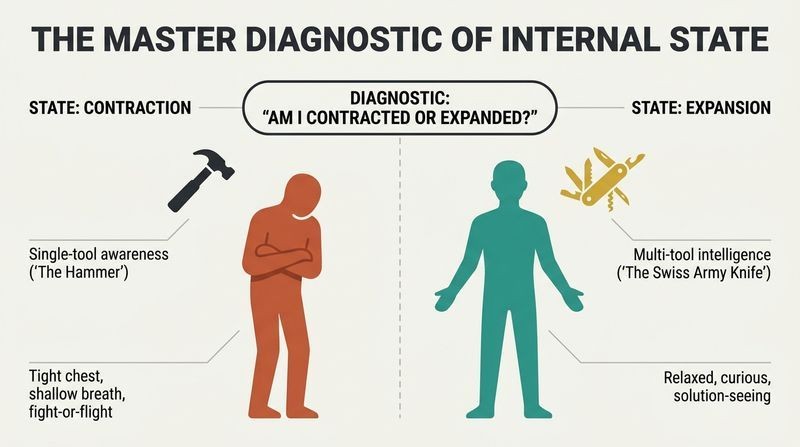
The framework echoes polyvagal theory, where Stephen Porges maps a ventral vagal state of safety and connection against sympathetic threat states, and it rhymes with Barbara Fredrickson's broaden-and-build research showing positive affect literally widens attention and cognitive range. Song's contribution is radical simplification: one binary to rule them all. That elegance is also the risk. Collapsing fear, focus, grief, and ambition into two buckets can flatten useful distinctions, and framing wealthy CEOs' flow states as supernatural invites skepticism. Still, as a practical self-monitoring tool, a felt-sense yes-or-no beats abstract mood labels most people cannot access in real time.
Society runs on your feeling not-enough, and it profits from your contraction
The system is rigged. Song names the ambient conditioning we all breathe 94.7, the radio station of humanity. From before age seven we learn love is conditional on being a certain way, so we contract to fit in. Then advertising sells the fix: you would feel beautiful, loved, successful if only you bought this. Happy, fulfilled people make terrible consumers, so an entire economy quietly depends on low self-esteem.
No summit cures it. Song's most striking evidence is her clientele: billionaires, founders, and Ivy League peers who reached every goal and felt nothing. The high of achievement lasts days, then the mind asks what's next. Their private conclusion is always the same: there must be something wrong with me. There isn't. The climb itself was the trap.
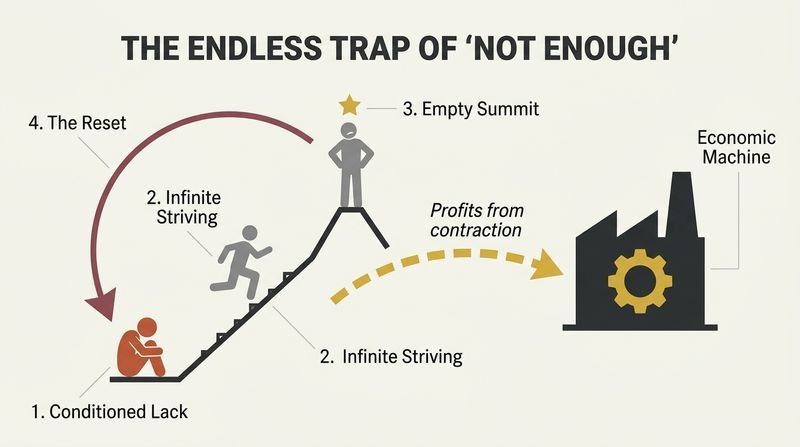
This lands squarely in the hedonic treadmill literature: Brickman and Campbell showed decades ago that we adapt to gains and return to baseline, and lottery winners report happiness near controls. Tim Kasser's research on materialism links extrinsic goals to lower well-being, supporting Song's claim that outsourced worth corrodes. Where a critic pushes back: not all striving is contraction, and some ambition is genuinely generative. Song risks pathologizing normal drive. Her sharper point survives the objection though, that using achievement to answer am I enough guarantees the answer never sticks, because the question was never about achievement.
Fear, guilt, shame, and anger are fossil fuels: powerful, poisonous, unsustainable
Toxic motivation burns you down. Song extends her energy metaphor: running on fear or shame is like burning fossil fuels. It moves you short-term but pollutes you and everyone near you, and it inevitably ends in burnout. She distinguishes the four dirty fuels:
1. Fear narrows options into binary thinking and becomes self-fulfilling.
2. Guilt makes you live by should until you cannot name what you want.
3. Shame says I am bad rather than I did something bad.
4. Anger often masks softer feelings like fear or hurt you were taught not to show.
The tell. When you catch yourself thinking must make this happen, you are contracted. Investors praised founders with a chip on their shoulder; Song heard a warning that the person had made their company a matter of ego life or death.
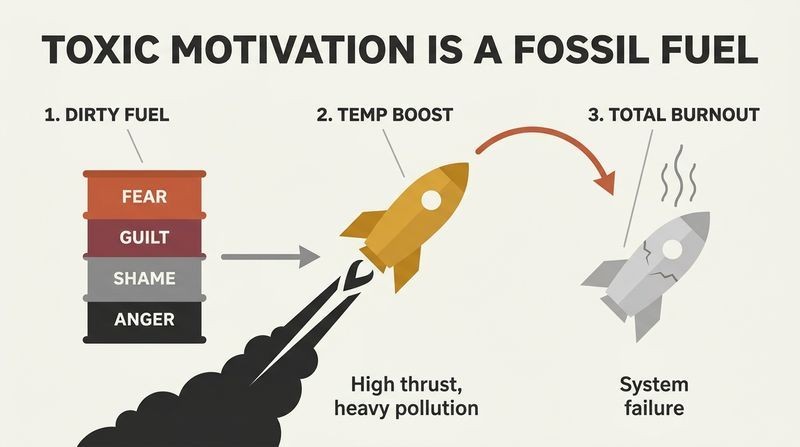
The guilt-versus-shame distinction Song borrows from Brene Brown is empirically robust: June Tangney's work links shame-proneness to depression, aggression, and withdrawal, while guilt-proneness predicts reparative behavior. Song's reframe of anger as a secondary emotion also aligns with emotion-focused therapy, which treats reactive anger as a shield over primary vulnerability. The fossil-fuel analogy is memorable and honest about a real cost: chronic threat activation dysregulates cortisol and, as she notes citing Lustig, worsens nearly every chronic disease. The nuance worth adding is that fear and anger are sometimes accurate, adaptive signals. The goal is metabolizing them, not judging them as always poison.
You cannot selectively numb emotions; feel the worst one fully to release it
Into the eye of the storm. Song's third and central code is: feel whatever arises. Emotions are energy-in-motion, e-motion. Repress them and they metastasize into stuck patterns: repressed anger becomes rage, grief becomes depression, fear becomes panic. Crucially, numbing is not selective. Wall off sadness and you also wall off joy, which is why her high-achieving clients arrive numb, living in their heads, unable to name what's missing.
The gazelle lesson. A gazelle chased all day shakes violently once safe, discharging the adrenaline, then grazes calmly. Humans instead stuff each threat down. Song's counterintuitive claim: the slower you move through an emotion, the faster it releases. Jing Gao felt through years of hiding behind an anglicized name, reclaimed Jing, and her company Fly by Jing grew 1,000 percent that year.
The physiology here is sound. Peter Levine's Somatic Experiencing, which Song cites, is built on exactly this animal-discharge observation, and Bessel van der Kolk's The Body Keeps the Score documents how unprocessed trauma lodges in the body and hijacks the nervous system. James Pennebaker's expressive-writing studies show emotional disclosure improves immune markers. The claim that emotions clear in seconds to minutes is optimistic; complex trauma often does not, which is why Song sensibly recommends professional support. The deeper wisdom, that avoidance is the engine of suffering, is the shared root of acceptance-based therapies, mindfulness, and Jung's line that what you resist persists.
Say a part of me feels, never I am: separate the emotion from your identity
You contain multitudes. A small grammatical shift changes everything. I am sad fuses you to the feeling; a part of me feels sad creates space to hold it. Song notes we usually carry contradictory parts at once: a part scared and a part excited, a part guilty and a part that knows it did its best. The more expanded you are, the more of these simultaneous parts you can hold without collapsing into one.
Acceptance dissolves contraction. The move is not to fix or banish the difficult part but to welcome it, the way a loving parent attends to a child who has been escalating for attention. Once a part feels acknowledged, it quiets. Integrating every part, the ones you celebrate and the ones you hide, is the path out of the internal war contraction keeps you fighting.
This is essentially Internal Family Systems therapy, Richard Schwartz's model of the psyche as a system of parts led by a calm Self, which research increasingly validates for trauma and depression. The linguistic distancing Song prescribes also has hard evidence: Ethan Kross's studies on self-talk show that third-person and non-identified framing reduces amygdala reactivity and improves emotion regulation under stress. Naming affect, as Matthew Lieberman's affect-labeling research demonstrates, literally dampens limbic arousal. Song packages rigorous clinical technique in plain language. The one caution: welcoming every part is not the same as acting on every part, a distinction the driver's-seat metaphor preserves but that eager readers can miss.
Feel emotions in your body, not in your head; the mind lies, the body does not
Story is not sensation. Song's clients want to analyze why they feel bad. She stops them and asks what they feel right now, and where in the body. Answers come as sensation: tightness in the chest, a sinking stomach, heat, a buzzing head. The instruction is to go to the worst spot, turn it up to 100 percent, breathe into it, and stay until it shifts, without judging, fixing, or interpreting.
Why the mind fails. Intellectual insight gives a dopamine hit of figuring it out but rarely changes anything, because the contraction lives in the body where the subconscious resides. Song cites research on split-brain patients severed from emotional processing: far from becoming perfect rational deciders, they cannot decide at all, unable to sense whether a day is convenient. Emotion is not the enemy of good judgment; it is its precondition.
The split-brain reference points to Antonio Damasio's somatic marker hypothesis, drawn from patients like Elliot whose emotional flattening after prefrontal damage destroyed their decision-making despite intact IQ. This is one of neuroscience's genuinely paradigm-shifting findings, and Song deploys it well against our cultural worship of pure logic. The body-first approach also matches interoception research: people with higher interoceptive accuracy regulate emotions better. A fair challenge is that pure sensation-tracking without any narrative meaning can leave some people flooded rather than freed, which is why trauma clinicians pace and titrate. Song acknowledges this, recommending professionals for trauma, which keeps the advice responsible.
Fuel expansion with purpose, values, your zone of genius, and love
The clean, renewable fuels. Against the fossil fuels, Song offers four sustainable sources drawn from what she noticed every coaching school teaches:
1. Purpose: a why big enough that you stay unattached to its form. One client committed to human harmony with nature, expressed through a company, a nonprofit, and scuba diving alike.
2. Values: your inner compass, so decisions become which choice honors courage rather than which is right or wrong.
3. Zone of genius: the work that feels like play, your personal 10, where you enter flow. Delegate everything that isn't a 10, even things you're good at.
4. Love: the highest expansion state, the opposite pole from fear.
The payoff. HelixNano's six-person team, fueled this way, built a COVID vaccine in three months and spotted a design flaw a year before larger rivals.
Each fuel maps onto validated science. Purpose links to Victor Strecher's and blue-zone research connecting ikigai to longevity. Values-based decision making is the backbone of Acceptance and Commitment Therapy, where committed action toward chosen values outperforms symptom-chasing. Zone of genius is Csikszentmihalyi's flow, which requires a skill-challenge match, and Gay Hendricks coined the term in The Big Leap. The advice to delegate even your competencies is unusually bold and echoes Marcus Buckingham's strengths work. The vulnerability: not everyone can economically outsource their non-10s, and privilege shapes who gets to live in their zone of genius. Song works with billionaires, so the sample skews.
Manifestation fails from contraction because your subconscious body vetoes your goals
Mindset alone is the tip of the iceberg. Song's tenth unlearning: you cannot manifest from contraction. Affirming I am abundant while your body holds shame just trips your own bullshit detector, her term for the nervous system's felt resonance. You must feel and release the contraction first, then hold the vision from an expanded body, engaging all five senses as if it already happened.
The Honey story. Client George Ruan, CEO of Honey, spent three weeks each morning walking to work visualizing, with full sensory detail and from expansion, a meeting with PayPal's engineers going brilliantly. Weeks later PayPal made an unsolicited offer and ultimately acquired Honey for 4 billion dollars, an outcome Ruan had not been seeking. Song frames the placebo effect and prayer the same way: belief plus a relaxed, trusting body is what does the work.
Here the book is at its most contested and its causal claims outrun the evidence. Visualization does improve performance, but the research favors process visualization (rehearsing the steps) over outcome visualization; Lien Pham and Shelley Taylor found fantasizing about outcomes can actually reduce effort and success, and Gabriele Oettingen's decades of work show pure positive fantasy saps motivation unless paired with obstacle-focused mental contrasting. The Honey anecdote is a single vivid case vulnerable to survivorship bias. That said, Song's mechanism, that embodied belief reduces threat physiology and thereby widens perception and boldness, is more defensible than magical thinking, and her placebo framing has genuine grounding in expectation research.
Control is the vulnerable state; trust is the invulnerable one
The inversion. Most of us treat control as safety and trust as risky exposure. Song flips it. Gripping to control people and outcomes shrinks you into a tiny box of what's acceptable and leaves you fragile to anything not going your way. Trust, by contrast, makes you antifragile, more agile, creative, and resilient, because you can meet whatever arises.
Bandwidth for uncertainty. Your nervous system's capacity to sit in the unknown determines how much reality you can perceive. A wound-up system panics at ambiguity, grabs for false certainty, and oversimplifies. A relaxed, expanded system stays in the discomfort of not knowing long enough for new information and solutions to appear. This is Song's picture of entrepreneurship: repeatedly leaping into midair between the familiar and the not-yet-visible, where only a calm nervous system survives the crossing.
The reframe is philosophically sharp and matches Nassim Taleb's antifragility, systems that gain from disorder, which Song explicitly invokes. It also aligns with tolerance-of-uncertainty research in clinical psychology, where intolerance of uncertainty is a transdiagnostic driver of anxiety and its reduction predicts recovery. Negative capability, Keats's phrase for staying in doubt without irritable reaching after fact, is the same idea from poetry. The steelman is strong: premature closure is a documented cognitive failure mode in medicine and intelligence analysis. The limit is that trust and control are not pure opposites; skilled agency blends both, and some domains genuinely reward vigilant control over surrender.
Copying successful people's playbooks caps you at their local maximum
Borrow the why, not the what. Bookstores overflow with the habits of Jobs and Bezos, but Song warns that imitating someone's routine puts you into contraction, because the moment you try to be anyone but you, you contract. Pattern recognition optimizes for the local maximum, the tallest hill you can currently see, not the global maximum of your full potential.
The better question. If someone drinks green juice daily, don't copy the juice; discover their why (health), check whether you share it, then find your own health solution. Visionaries you admire earned that status by marching to their own drum, so the transferable lesson is the drum-marching, not the specific march. Song's aim with clients is never to improve a business by template but to help them write their own playbook and sit in uncertainty long enough for original answers to arrive.
The local-versus-global maximum metaphor, lifted from optimization and machine learning, is a genuinely useful mental model for careers: greedy algorithms that always climb the nearest slope get stuck, and escaping requires stepping downhill first. Song's point rhymes with Peter Thiel's argument that copying winners produces incremental sameness while true value comes from doing something new, and with Cal Newport's caution against blindly following passion scripts. The critical nuance: novices actually benefit from copying, since deliberate practice often starts with imitation before divergence. The advice suits Song's advanced clientele more than beginners. Still, the deeper claim, that authenticity is a competitive advantage and not a luxury, is well made.
Analysis
Bending Reality is a self-development book disguised as a metaphysics manual, and its real value is more grounded than its packaging. Victoria Song, a former venture capitalist, takes the sprawling landscape of coaching, somatic therapy, and spirituality and compresses it into one binary: contraction versus expansion. Her genuine intellectual move is horizontal synthesis. Rather than championing one modality, she claims every tool that works does so by the same mechanism, releasing a tightened nervous system so a person can act from openness rather than threat. That is a defensible and even elegant unifying theory, and it converges with independent findings in polyvagal theory, somatic trauma work, affect-labeling neuroscience, and flow research.
The book is strongest as embodied emotional practice. Its insistence that you cannot selectively numb, that feeling is the exit, and that the body holds what the mind forgets is well supported and unusually actionable for a mainstream audience. The grammar of parts, the sensation-over-story instruction, and the trust-over-control inversion are portable and wise.
The book is weakest where it conflates state management with metaphysics. Terms like supernatural abilities, zero-point field, and warping spacetime, plus single-case manifestation anecdotes like the Honey acquisition, invite the very bullshit-detector response Song describes. The manifestation claims contradict Oettingen's robust findings that positive fantasy without obstacle-contrasting undermines effort. The evidence base is also skewed: her clients are billionaires and founders, so the freedom to delegate everything but your zone of genius reads as advice from an economically frictionless world.
Read charitably, the supernatural language is marketing wrapped around cognitive-behavioral and somatic substance. Strip the mysticism and a solid thesis remains: chronic threat physiology narrows perception, creativity, and relationships, and learning to feel and discharge emotion restores range. That claim is testable, humane, and largely correct.
Review Summary
Readers overwhelmingly praise "Bending Reality" as a life-changing book that offers practical, accessible tools for personal growth. Many highlight its ability to bridge spiritual concepts with analytical thinking, making it appealing to skeptics. The book's focus on recognizing and shifting between states of contraction and expansion resonates strongly with readers, who report significant positive changes in their lives after applying the principles. Some note it synthesizes various self-help modalities into a cohesive, actionable framework.
People Also Read





Glossary
Contraction
Closed, defensive nervous-system stateSong's term for the body's constricted state: tight chest, shallow breath, tunnel vision, fight-flight-freeze, black-and-white thinking, scarcity, and judgment. In contraction you see only problems and threats, act reactively, and lose access to creativity and connection. She treats it as the default state most people live in due to conditioning and unfelt emotions, and as the block to what she calls bending reality.
Expansion
Open, relaxed, creative stateSong's term for the body's open state: relaxed chest, slower breathing, grounded posture, curiosity, trust, abundance, and access to solutions and flow. She claims expansion is your natural state and the source of creativity, synchronicity, and manifestation. It is achieved not by chasing positivity but by fully feeling and releasing contraction from the nervous system.
94.7
The radio station of humanitySong's metaphor for the ambient cultural conditioning everyone absorbs from family, school, media, and advertising, which trains people to fit in, seek external validation, and feel not-enough. Living on 94.7 means unconsciously running on contraction and conformity. Breaking free requires releasing that programming and following your own authentic expansion.
Fossil fuels of contraction
Toxic short-term motivatorsSong's label for fear, guilt, shame, and anger as sources of motivation. Like fossil fuels, they can power action briefly but are unsustainable, poison you and your environment, and lead to burnout. She contrasts them with renewable fuels of expansion: purpose, values, zone of genius, and love.
Zone of genius
Work that feels like playThe activity that feels effortless, energizing, and joyful for you specifically, your personal 10, where you enter flow and lose track of time. Song advises spending maximum time here and delegating everything that isn't a 10, even tasks you're competent at, because working outside your zone of genius pulls you into contraction.
Codes to Bending Reality
Five practices for expansionSong's five core instructions: recognize whether you are contracted or expanded, choose your thoughts carefully, feel whatever arises, stay in expansion while reaching for more, and feel your vision coming true from expansion. Together they aim to release contraction and stabilize expansion, the state she says is required to access peak creativity and manifestation.
Upper limit
Your ceiling on expansionThe maximum amount of pleasure, love, success, or expansion your nervous system currently tolerates before it snaps back to contraction. Song, drawing on Gay Hendricks, says you raise your upper limit only by acknowledging and releasing the contractions underneath it, allowing you to hold more good feeling without self-sabotage.
Bullshit detector
Body's felt-resonance testSong's name for the nervous system's instant somatic response to a belief or statement. If a thought like I can do this expands the body, it resonates and can work; if it triggers resistance, doubt, or numbness, the belief isn't yet true for you and points to contraction that needs to be felt and released first.
Spiritual bypassing
Using spirituality to avoid feelingA term from psychotherapist John Welwood, cited by Song, for using spiritual ideas or practices to sidestep unresolved emotional wounds and developmental tasks. Example: I'm broke but I'll just manifest money and trust the universe. Song warns it is resisting contraction disguised as expansion, and that real work requires feeling the contraction, not spiritually skipping it.
Rewilding
Undoing self-domesticationSong's personal term for reclaiming the parts of yourself you were conditioned to tame: numbed senses, ignored intuition, edited expression, suppressed pleasure, and clipped dreams. It is the ongoing process of releasing contraction to live fully, wildly, and authentically rather than conforming to others' expectations.
FAQ
What's "Bending Reality: How to Make the Impossible Probable" about?
- Overview of the Book: "Bending Reality" by Victoria Song explores how individuals can achieve improbable outcomes by shifting their state of consciousness from contraction to expansion.
- Core Concept: The book introduces a unifying theory of two states—contraction and expansion—and provides a framework for transitioning between them to unlock potential and achieve personal and professional goals.
- Target Audience: It is aimed at leaders, entrepreneurs, and anyone looking to make a positive impact on the world by accessing their full potential and bending reality to their will.
Why should I read "Bending Reality"?
- Empowerment: The book offers strategies to empower readers to reach their personal peak without burning out, become better leaders, and find fulfillment.
- Practical Techniques: It provides practical tools and exercises to help readers shift their mindset and access a state of expansion, which is essential for achieving improbable outcomes.
- Universal Application: The concepts are applicable to a wide range of individuals, from tech founders to artists, making it a versatile guide for personal and professional growth.
What are the key takeaways of "Bending Reality"?
- Contraction vs. Expansion: Understanding the difference between contraction (a state of fear and limitation) and expansion (a state of openness and possibility) is crucial.
- Emotional Processing: The book emphasizes the importance of processing emotions to release contraction and access expansion.
- Manifestation and Reality Bending: By aligning thoughts, emotions, and actions, readers can manifest their visions and bend reality to achieve their goals.
How does Victoria Song define "bending reality"?
- Lens on Reality: Song explains that everyone has a subjective lens on reality, which can be expanded to access new possibilities.
- Consciousness Shift: Bending reality involves shifting from a contracted state to an expanded state of consciousness, allowing for greater creativity and problem-solving.
- Practical Application: The book provides step-by-step guidance on how to achieve this shift and apply it to real-world challenges.
What is the "contraction and expansion" model in "Bending Reality"?
- Contraction Defined: Contraction is a state characterized by fear, limitation, and a narrow focus on problems.
- Expansion Defined: Expansion is a state of openness, creativity, and a focus on solutions and possibilities.
- Transitioning States: The book offers tools and exercises to help readers identify when they are in contraction and how to shift into expansion.
What are some practical exercises from "Bending Reality"?
- Daily Gratitude: Practicing gratitude daily to shift focus from scarcity to abundance.
- Visualization Techniques: Using visualization to imagine and feel the emotions of achieving one's goals.
- Emotional Processing: Techniques for fully feeling and releasing emotions to dissolve contraction and access expansion.
How does "Bending Reality" address emotional intelligence?
- Emotions as Energy: The book describes emotions as energy-in-motion that need to be felt and processed to avoid becoming stuck and causing contraction.
- Emotional Awareness: Developing emotional intelligence is key to recognizing and shifting from contraction to expansion.
- Empathy and Connection: By understanding and processing one's own emotions, individuals can better empathize and connect with others.
What role does mindset play in "Bending Reality"?
- Mindset and Beliefs: The book emphasizes the importance of questioning and choosing thoughts that lead to expansion rather than contraction.
- Subconscious Programming: It highlights how much of our actions and decisions are driven by subconscious programming and offers ways to reprogram these patterns.
- Limitless Potential: By cultivating a mindset of expansion, individuals can access their full potential and achieve extraordinary results.
What are the "codes to bending reality" mentioned in the book?
- Recognize Your State: Be aware of whether you are in a state of contraction or expansion at any given moment.
- Choose Thoughts Carefully: Select thoughts that promote expansion and align with your goals.
- Feel Whatever Arises: Fully experience and process emotions to release contraction and access expansion.
How does "Bending Reality" suggest handling fear and uncertainty?
- Fear as a Feedback Loop: The book explains that fear creates a feedback loop that limits perception and possibilities.
- Embracing Uncertainty: It encourages readers to improve their relationship with uncertainty and remain open and expansive in the unknown.
- Tools for Overcoming Fear: Practical tools are provided to help readers face and process fear, transforming it into a source of power.
What are some of the best quotes from "Bending Reality" and what do they mean?
- "The greatest rebellion to this system is expansion." This quote emphasizes that true freedom and potential are found in a state of expansion, challenging societal norms of contraction.
- "Your external reality is a direct reflection of your internal state." It highlights the idea that one's inner state of consciousness shapes their external experiences and outcomes.
- "Feel your vision coming true from a place of expansion." This encourages readers to visualize their goals with a sense of openness and possibility, rather than from a place of need or lack.
How can "Bending Reality" help in personal and professional growth?
- Leadership Development: The book provides insights and tools for becoming a more effective and fulfilled leader by accessing expansion.
- Personal Fulfillment: It offers strategies for achieving personal goals and finding deeper fulfillment by aligning with one's true self.
- Holistic Growth: By addressing both mindset and emotional intelligence, the book supports holistic growth in all areas of life.
Download PDF
Download EPUB
.epub digital book format is ideal for reading ebooks on phones, tablets, and e-readers.








































