

Key Takeaways
Media changed Macron's age at meeting from 14 to 17 to dodge scrutiny
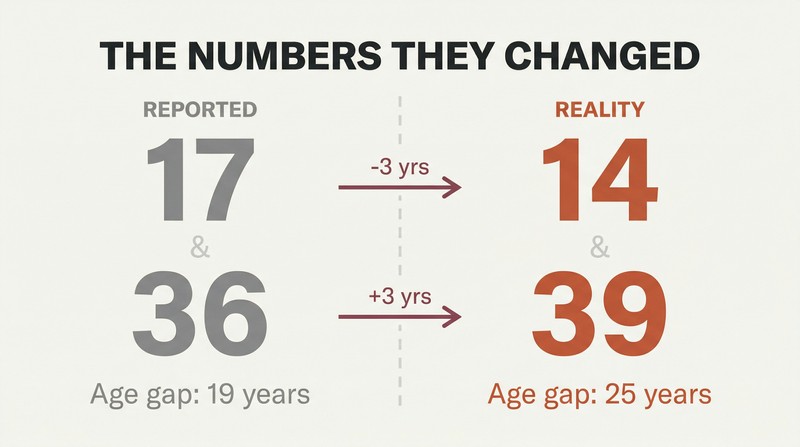
A deliberate numerical lie. From 2012 onward, French media repeated that "Brigitte" was "almost twenty years" older than Emmanuel Macron and that they met when "she was 36, he was 17." In reality, nearly twenty-five years separate them. When they met at the Lycée La Providence theater workshop in Amiens, Emmanuel Macron was 14 (born December 21, 1977) and Brigitte Auzière was 39 (born April 13, 1953).
Investigative journalist Éric Stemmelen first exposed this systematic distortion: an age-appropriate love story at 17/36 becomes a potential criminal matter at 14/39. During the presidential campaign, the couple ensured the words "embezzlement of a minor" were never uttered. Macron's own father reportedly enrolled him at the Lycée Henri-IV in Paris specifically to separate the teenager from his teacher.
"Brigitte" runs French politics from an office no one voted for
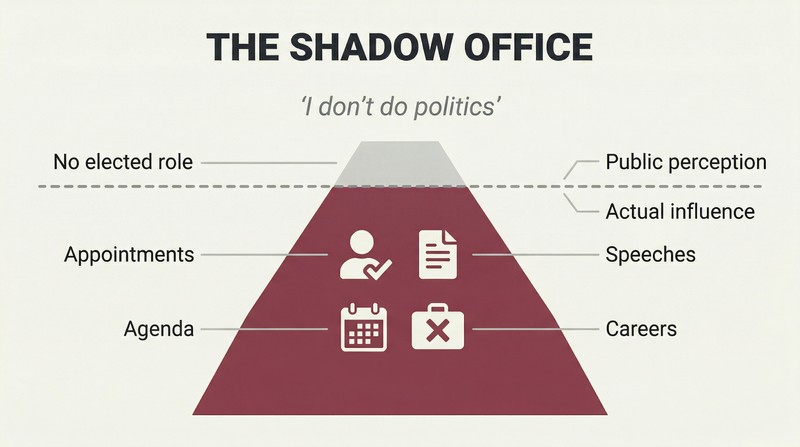
Unelected, unchecked power. Despite repeating "I don't do politics," "Brigitte" conducts ministerial job interviews, controls appointments, rewrites presidential speeches, and manages the agenda. Ministers wait outside her salon at the Élysée for audiences. Her budget grew from €291,826 in 2020 to €315,808 in 2022.
Her fingerprints appear on nearly every major appointment: Jean-Michel Blanquer (Education), Éric Dupond-Moretti (Justice), Gabriel Attal, Sébastien Lecornu, Rachida Dati, and more. Multiple insider accounts describe her as "vice-president in the shadows." One senior aide warned colleagues she could end careers with a word. Emmanuel Macron himself confirmed the symbiosis: "Brigitte is me and I am her." Former president François Hollande offered a haunting formula: "They are their mutual roots."
23 years of "Brigitte's" life are a total photographic void
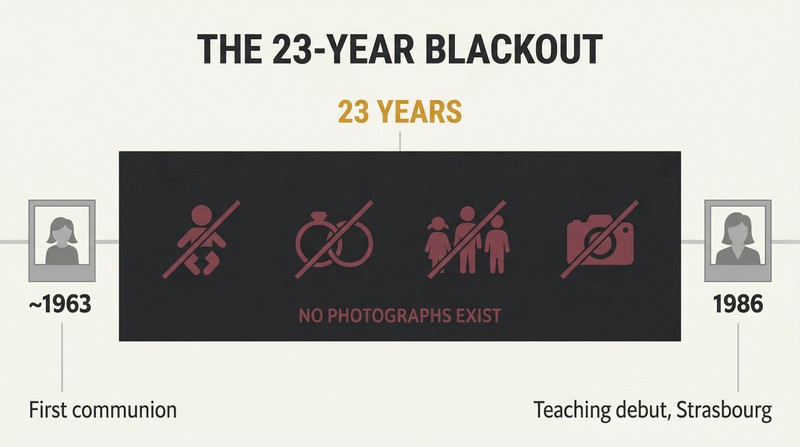
No baby photos, no wedding album. Between her first communion (early 1960s) and her teaching debut in Strasbourg (1986), not a single photograph of "Brigitte" has been published — despite the most intensive media coverage of any French first lady. Documentary filmmaker Virginie Linhart, commissioned by France 3, complained of an unprecedented "lead blanket" of control over her project.
No photos of her as a young mother with her three children. No photos of her first wedding to André Auzière. No photos with her first husband at all. The official biography's photo album begins only at age 40, at La Providence in 1993. When a journalist tried to find old acquaintances in Le Touquet, Brigitte's supposed hometown haunt, she spent two full days canvassing bars, shops, and casinos — finding no one who remembered her.
The Macrons spread the Gallet gay rumor as deliberate misdirection
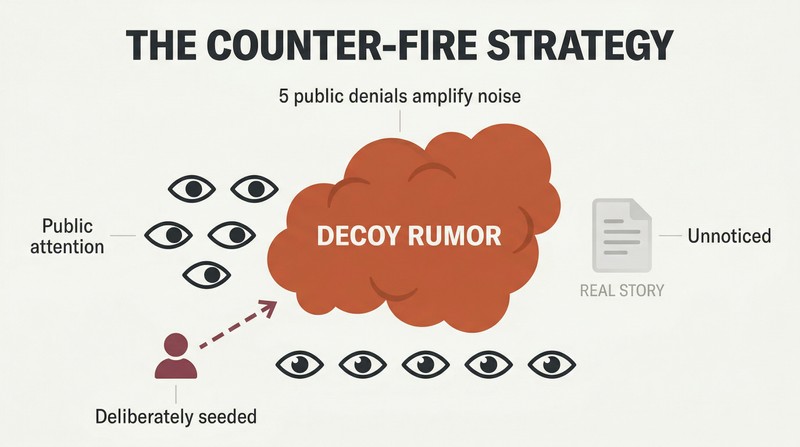
Manufactured smoke. In spring 2016, while the couple's meeting story was being quietly rewritten from 17/36 to 14/39, an explosive rumor detonated: Emmanuel Macron was secretly gay, having an affair with Radio France boss Mathieu Gallet, and "Brigitte" was merely a cover. The rumor spread from elite Parisian dinner tables to national conversation.
The author argues this was not organic gossip but strategic "counter-fire" — a deliberate distraction seeded during dinners the Macrons hosted at taxpayer expense at the Ministry of Economy. At each dinner, Brigitte would performatively protest the gay rumor to guests, which only amplified it. A former campaign member later confirmed: the Gallet story was "knowingly relayed." Macron publicly denied his homosexuality five separate times — each denial functioning as free publicity that drowned out the age rewrite.
Facial recognition says "Brigitte" is not the woman born Brigitte Trogneux
The investigation's centerpiece. Using Face++, the Chinese visual AI system used for China's social credit program, the author compared verified childhood photos of Brigitte Trogneux (communion photo, 1974 wedding) against 60 images of the current "Brigitte." Reference tests on eight women born in 1953 yielded matches between 70% and 80%. The scores for "Brigitte" averaged just 53.8% — firmly in the "low" bracket.
Conversely, childhood class photos of Jean-Michel Trogneux (Brigitte's brother, born 1945) consistently scored higher against today's "Brigitte" than they did against the "little fat man" the Élysée presented as Jean-Michel. Additional evidence includes retouched family photos (a lampshade erased, dental alignment altered), "Brigitte's" refusal to certify in writing that the 1974 wedding photo depicted her, and former classmates who could not recognize her.
A brother erased from every record may hold the key
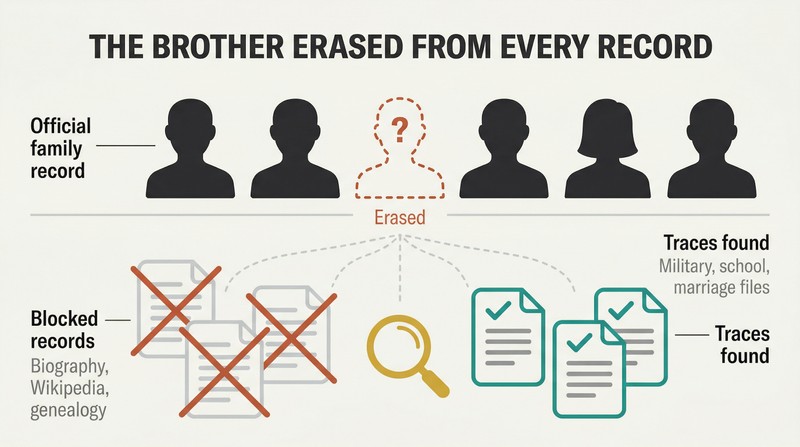
Jean-Michel Trogneux vanished. Despite intensive media coverage of the Trogneux family saga, brother Jean-Michel was never mentioned in any biography of "Brigitte" until journalist Sylvie Bommel incidentally named him in 2019. He appeared on no genealogical database. Wikipedia's "Trogneux Family" page initially listed five children, omitting him entirely.
The author traced Jean-Michel through military census records (Algiers at 18), school files (La Providence, ESTP Paris), field hockey records (Speyer, Germany), business registrations (Picardie Metal), and marriage documents (Véronique Dreux, 1980). Yet every institution resisted providing documentation. His school file at ESTP had an empty photo slot. His military file was classified. The Amiens town hall twice refused to issue his birth certificate to Natacha Rey — until a journalist allied with the Élysée obtained it for "debunking" purposes.
Pedophilia-adjacent figures cluster around the Macron presidency
A recurring pattern. The book documents a network of individuals linked to pedophilia who orbit the presidential couple:
1. Olivier Duhamel — incest on his 13-year-old stepson, revealed 2021; he dined with the Macrons and helped "cast" the prime minister
2. Daniel Cohn-Bendit — published explicit accounts of sexual interactions with children; celebrated Macron's first-round victory at La Rotonde
3. Jean-Marc Borello — SOS Group chief convicted in the Palace drug case; connected to the Tournelles child abuse scandal
4. Pierre Bergé — accused by a former employee of sexual abuse of minors in Morocco; financially supported Macron
5. Jack Lang — signed a 1977 petition defending men who filmed children in "sexual games"; reappointed twice by Macron
The Élysée's favorite artist, sculptor Claude Lévêque, was charged with rape of minors under 15 — his "Black Sun" carpet had adorned the presidential office.
France deployed police, tax audits, and censorship against questioners
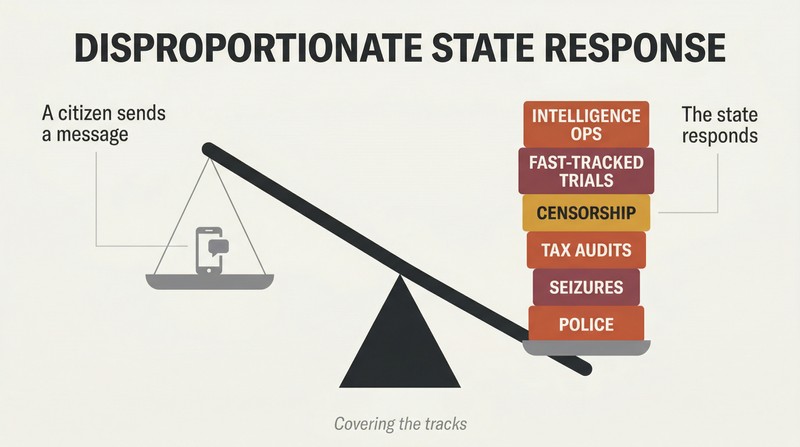
Disproportionate state response. When Natacha Rey, an ordinary citizen, sent WhatsApp messages to a family member of "Brigitte," she was placed in police custody without a summons, interrogated for five hours, and had her phone permanently seized. The author's webmaster was arrested, searched three times, and placed under judicial control. A tax audit was launched on the parent company of the author's newsletter.
The trial calendar was accelerated in an unprecedented manner — moved from March 2025 to June 2024. Twitter France manually removed the #JeanMichelTrogneux hashtag from trending despite massive organic engagement. Social media accounts were suspended. A 76-year-old homeless pensioner received six months in prison for sending a photomontage to her social worker. Meanwhile, the Élysée recruited a former DGSE intelligence operative to coordinate legal actions against critics.
Former classmates could not recognize "Brigitte Macron" as their schoolmate
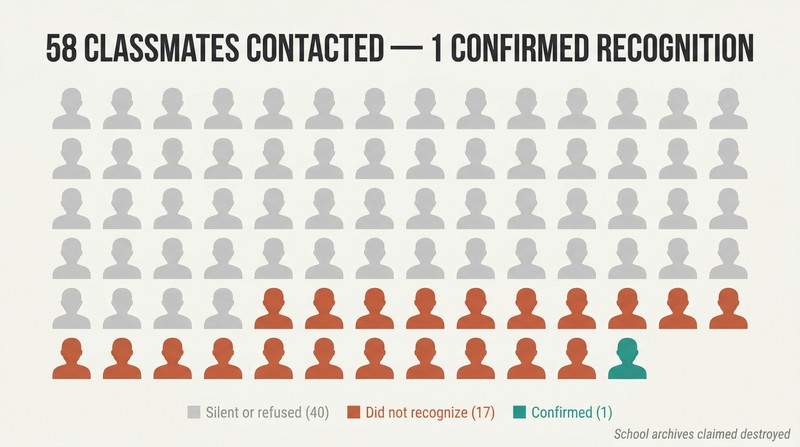
A vanishing identity. The author contacted 58 of Brigitte Trogneux's former classmates from the Sacré-Coeur school in Amiens. Only 18 responded — most refusing to discuss the matter. Their reactions were striking: one who spent two years in primary school with Brigitte Trogneux insisted she'd "never been in class with Brigitte Macron." Another said she "didn't even recognize her" when Macron was elected. A third: "I have no memory of her before." Several noted their sisters told them the First Lady "has the head of the Trogneux" family — but they personally couldn't connect the two.
Only one classmate was emphatic that it was the same person. None were contacted by "Brigitte's" legal team to testify. The school itself claimed it had "gotten rid of" its class photo archives — contradicting the CADA ruling that such documents are public records.
Rothschild built Macron's career as its political instrument
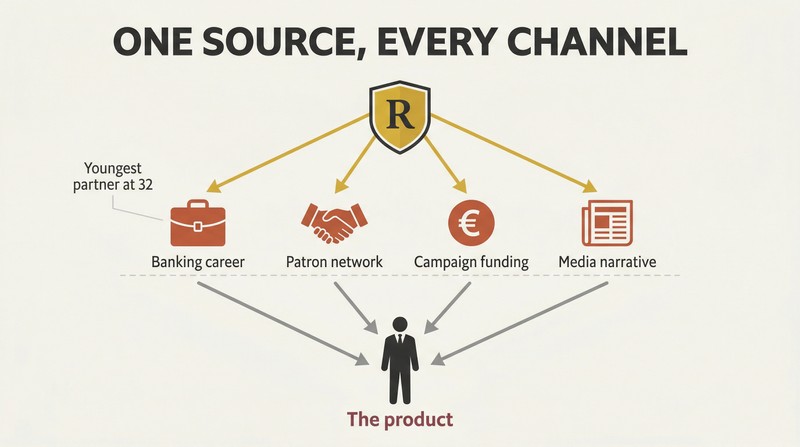
Manufactured from above. David de Rothschild made Macron the youngest managing partner in the bank's history at 32, despite colleagues saying he "never made an equation" and didn't know what EBITDA was. Macron himself acknowledged: "I had a career path that was very unintelligible. No one could understand it anywhere else than Rothschild." He described his banking work to the Wall Street Journal: "We are a kind of prostitute. The job is to seduce."
The Rothschild connection runs deeper than employment. Macron's patron Henry Hermand made his fortune on Rothschild-owned land. His campaign insurance came through a Rothschild subsidiary. The Economist, controlled by the Rothschild and Agnelli families, compared Macron to Charlemagne and called him "saviour of Europe." Internal Rothschild documents listed Macron as born in Paris — not Amiens — until 2012. His forgotten middle name on his Sciences-Po registration form: "Jean-Michel."
Analysis
"Becoming Brigitte" is simultaneously the most audacious piece of investigative journalism and the most elaborate conspiracy theory to emerge from French politics in decades. Poussard's methodology oscillates between rigorous archival work — CADA rulings, military census documents, commercial court filings — and speculative leaps supported primarily by facial recognition percentages from a Chinese AI tool never validated for this purpose.
The book's strongest evidence is negative: the astonishing absence of photographs, the family's wall of silence, the state's wildly disproportionate response to what should be trivially debunkable claims. If the thesis is false, publishing a handful of family photos would end the matter overnight. That this has not happened — that the Élysée recruited a former intelligence officer to manage the crisis instead — is the most damning circumstantial evidence in the entire 90,000-word text.
The weakest links are the positive claims. Facial recognition software applied to 1950s school photos and modern celebrity images introduces enormous methodological uncertainty. The book's conspiracy architecture — connecting Rothschilds, Duhamel, Cohn-Bendit, Epstein, and Algerian intelligence into a unified explanation — risks the classic conspiratorial error of conflating proximity with causation.
What elevates the work above mere conspiracy is the documentary record. Multiple mainstream French journalists (Bommel, Anizon, Stemmelen, Endeweld) independently documented the same anomalies: the age falsification, the missing photographs, the untraceable first husband, the biography rewritten at least twice. Emmanuelle Anizon's book for L'Obs — titled "anatomy of fake news" — quietly corroborates key findings while nominally debunking them, a contradiction Poussard exploits brilliantly.
The broader significance transcends the identity question. Whether or not "Brigitte" is Jean-Michel Trogneux, the book documents a French press corps that uncritically amplified a manufactured narrative, a judiciary weaponized against citizens asking legitimate questions, and an unelected individual wielding state power without legal framework or democratic accountability. The Macron presidency, as Poussard frames it, is less a government than a performance — and the audience has been told not to look behind the curtain.
Review Summary
Becoming Brigitte by Xavier Poussard is a controversial book exploring theories about Brigitte Macron's identity and past. Readers find it well-researched and compelling, albeit sometimes difficult to follow due to translation issues. Many praise the author's thorough investigation and meticulous fact-checking. The book raises questions about media control, political power, and potential cover-ups. Some readers remain skeptical, while others are convinced by the evidence presented. Overall, the book is described as eye-opening, disturbing, and thought-provoking, challenging readers' perceptions of the French presidency.
People Also Read







Glossary
Official legend
Authorized biography of the MacronsThe author's term for the carefully constructed and repeatedly revised narrative of how "Brigitte" and Emmanuel Macron met, fell in love, and rose to power. The "official legend" was rewritten at least twice—first presenting their meeting as teacher/student at ages 36/17, then gradually revealing the actual ages of 39/14—and was sold to the public through coordinated media saturation.
Counter-fire
Deliberate distraction rumor strategyA tactical information operation in which the Macrons allegedly spread false rumors (such as Emmanuel's supposed homosexual affair with Radio France chief Mathieu Gallet) to divert public and media attention from more damaging truths—specifically, the rewriting of their meeting timeline from 17/36 to 14/39. The term is borrowed from firefighting, where a controlled burn stops an advancing wildfire.
The Rey thesis
Natacha Rey's identity substitution claimThe theory advanced by citizen investigator Natacha Rey that Brigitte Macron is not the woman born Brigitte Trogneux on April 13, 1953, but rather her brother Jean-Michel Trogneux (born February 11, 1945), who allegedly underwent gender transition and assumed his sister's civil identity. First presented publicly on December 10, 2021, it triggered massive online engagement and multiple lawsuits.
Misdirection
Magician's attention diversion techniqueA conjurer's technique for directing the audience's eye away from where the trick is actually performed, applied by the author as a metaphor for the Macrons' political and media strategy. Just as magicians use a wand to guide attention, the Macrons use carefully staged photo opportunities, celebrity press coverage, and manufactured controversies to keep public scrutiny away from biographical inconsistencies.
Face++
Chinese facial recognition AI softwareVisual artificial intelligence technology developed by Chinese giant Megvii, presented by the World Economic Forum as the global leader in facial recognition. Used by the author to compare historical photographs of Brigitte Trogneux and Jean-Michel Trogneux against modern images of "Brigitte Macron." Results are expressed as percentage probabilities, with specialists generally considering scores above 70% as positive matches.
Total blackout
Absence of biographical photographs/recordsDocumentary filmmaker Virginie Linhart's phrase describing the complete absence of photographs or records from "Brigitte's" life between her first communion (early 1960s) and her teaching debut (1986)—a gap of roughly 23 years during which no photos of her as a young woman, bride, or mother have ever surfaced despite intensive media interest.
The little fat man
Individual presented as Jean-Michel TrogneuxThe Élysée Palace's counter-argument to the Rey thesis: an overweight man visible at Emmanuel Macron's 2017 inauguration and living at 14 rue des Vergeaux in Amiens, presented as Jean-Michel Trogneux. The author's facial recognition analysis suggests this individual's childhood photos match Jean-Michel Trogneux less strongly than "Brigitte's" photos do. No identity documents with photographs have been publicly presented to confirm his identity.
The Anizon file
Research roadmap for journalist AnizonA curated list of prioritized contacts—former classmates of both Brigitte Trogneux and Jean-Michel Trogneux—that author Xavier Poussard provided to Nouvel Obs journalist Emmanuelle Anizon on June 14, 2023. The document guided Anizon's fieldwork in Amiens, leading to the retrieval of key cross-checking photographs including communion group photos and class photos from La Providence.
FAQ
What is Becoming Brigitte by Xavier Poussard about?
- Investigation into Brigitte Macron’s identity: The book explores the official and unofficial narratives surrounding Brigitte Macron, questioning whether she is truly Brigitte Trogneux or someone else living under that identity.
- Political and media myth-making: It examines how Brigitte’s public image was constructed and used to support Emmanuel Macron’s political rise.
- Controversies and family secrets: The book delves into alleged inconsistencies in Brigitte’s biography, rumors about her gender identity, and the possibility of identity theft within her family.
- Societal and political implications: Poussard discusses the broader consequences of these revelations for French politics, media, and elite networks.
Why should I read Becoming Brigitte by Xavier Poussard?
- Unprecedented investigation: The book offers a deep dive into one of France’s most enigmatic public figures, challenging official narratives with forensic and journalistic rigor.
- Insight into power and image: Readers gain a behind-the-scenes look at how political images are crafted and maintained in modern democracies.
- Controversial and timely: The book addresses ongoing rumors and legal battles, making it highly relevant to current French political discourse.
- Broader reflections: It raises important questions about transparency, media control, and the influence of elite networks in shaping public perception.
What are the key takeaways from Becoming Brigitte by Xavier Poussard?
- Identity theft hypothesis: The book concludes that Brigitte Macron is not the original Brigitte Trogneux, but Jean-Michel Trogneux living under her identity since at least 1986.
- Media and legal control: The Macron family and state apparatus have allegedly used legal actions and media influence to suppress investigation and discussion of Brigitte’s true identity.
- Forensic and archival methods: Poussard combines facial recognition technology, archival research, and testimonies to build his case.
- Implications for democracy: The revelations challenge the transparency and accountability of France’s political and media institutions.
How does Xavier Poussard use facial recognition technology in Becoming Brigitte?
- Application of Face++ software: Poussard uses Face++, a Chinese facial recognition tool, to compare historical and contemporary photos of Brigitte and Jean-Michel Trogneux.
- Establishing benchmarks: The book sets reference values by comparing known individuals’ photos at different ages to interpret similarity scores.
- Findings support identity theft: The software shows low similarity between Brigitte Macron and the official Brigitte Trogneux, but higher similarity with Jean-Michel Trogneux, supporting the identity theft theory.
- Evidence for public scrutiny: These results are presented alongside other forms of evidence to question the official biography.
What is the "Anizon File" and why is it important in Becoming Brigitte?
- Collaboration with journalist: The "Anizon File" refers to Poussard’s partnership with journalist Emmanuelle Anizon to cross-check photos and testimonies.
- Key photographic evidence: Anizon obtained crucial photos, such as first communion and wedding images, which were analyzed using facial recognition.
- Transparency and ethics: Poussard’s open approach with Anizon aimed to ensure ethical standards and counter accusations of forgery.
- Foundation for investigation: The file was instrumental in advancing the investigation and providing credible evidence.
What inconsistencies and controversies does Becoming Brigitte highlight about Brigitte Macron’s biography?
- Missing childhood and youth photos: There is a notable absence of photographs from Brigitte’s early life, schooling, and first marriage.
- Contradictory testimonies: Former classmates and acquaintances often do not recognize the current Brigitte as the person they knew.
- Manipulated or withheld images: Some family photos appear retouched or altered, and institutions have refused to release class photos despite legal obligations.
- Opaque family history: The disappearance of her first husband and silence around her brother Jean-Michel add to the mystery.
How does Becoming Brigitte by Xavier Poussard describe the relationship between Brigitte Macron and Jean-Michel Trogneux?
- Official family roles: Jean-Michel is officially Brigitte’s older brother, but the book suggests he assumed her identity.
- Close but secretive ties: They served as best man and witness at each other’s weddings, indicating a close relationship.
- Disappearance from records: Jean-Michel vanishes from public and family records after a certain point, fueling suspicions.
- Family secrecy: The book posits a family secret and coordinated silence to protect the alleged identity substitution.
What role do media, communicators, and elite networks play in shaping Brigitte Macron’s public image according to Becoming Brigitte?
- Media saturation and myth-making: The book details how communicators and journalists crafted a compelling narrative around Brigitte and Emmanuel Macron.
- Celebrity management: Figures like Michèle Marchand managed Brigitte’s image through staged photos and media relations.
- Elite and business ties: The Macrons’ network includes influential families, financiers, and cultural leaders, reinforcing their power.
- Suppression of dissent: Media and legal mechanisms are used to control the narrative and suppress alternative investigations.
How does Becoming Brigitte address the rumors and legal battles about Brigitte Macron’s gender identity?
- Emergence of rumors: The book discusses how rumors about Brigitte being a transgender man gained traction, especially on social media.
- Legal actions and censorship: Investigators and journalists faced lawsuits, police custody, and social media censorship for pursuing these claims.
- Presidential response: Emmanuel Macron publicly condemned the rumors, calling them his "worst memory" as president.
- Analysis of evidence: The book examines photos, family records, and expert opinions, while noting the strong taboo and censorship in French media.
What is the significance of the Rothschild family and financial networks in Becoming Brigitte?
- Key role in Macron’s rise: The Rothschild banking network is portrayed as instrumental in Emmanuel Macron’s ascent in finance and politics.
- Political and financial backing: The book describes how elite connections facilitated Macron’s rapid career progression.
- Controversial reputation: Poussard cites sources describing investment banking as manipulative, reflecting a cynical view of Macron’s background.
- Broader elite influence: The Rothschilds’ involvement is linked to global finance, intelligence, and controversial projects.
How does Becoming Brigitte by Xavier Poussard describe Emmanuel Macron’s early life and family background?
- Opaque childhood: Emmanuel’s early years are described as a "black hole," with few photos and little testimony from family or classmates.
- Distant parental relationships: He is depicted as having a distant relationship with his parents but a close bond with his grandmother.
- Social isolation: Former classmates recall him as mysterious and socially isolated.
- Influence of literature: His grandmother introduced him to literature and acting, shaping his intellectual development.
What are the broader political and social implications of the revelations in Becoming Brigitte by Xavier Poussard?
- Challenge to official narratives: The book questions the authenticity of the Macron couple’s public image and the transparency of French political life.
- Taboos and censorship: It highlights the strong social and media taboos around discussing Brigitte’s past and the couple’s private life.
- Legal and media control: The use of lawsuits and media influence to suppress investigation is a central theme.
- Reflection on democracy: The book raises questions about power, elite networks, and democratic accountability in France.
Download PDF
Download EPUB
.epub digital book format is ideal for reading ebooks on phones, tablets, and e-readers.








































