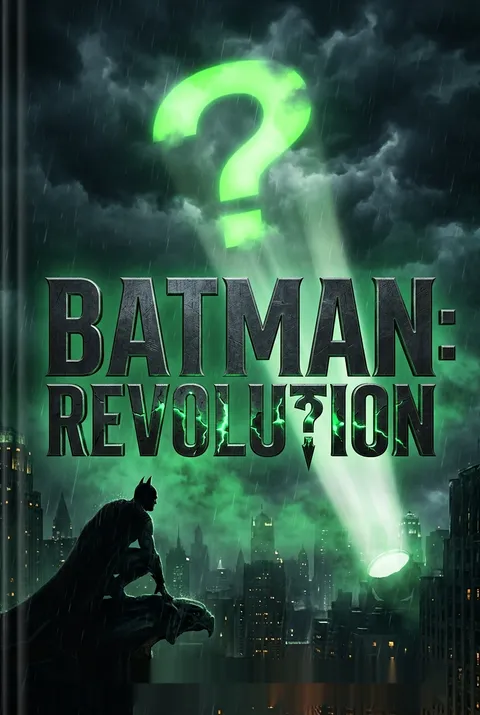

Plot Summary
Shadows and Secrets Awaken
In the predawn chill, young Norman Pinkus, a clever but overlooked boy living secretly in Gotham's grand library, discovers the world's cruelty and promise through newspapers and riddles with his mother. Meanwhile, Bruce Wayne, haunted by his parents' murder, struggles to reconcile his public persona with his private crusade as Batman. The city's wounds are fresh, and the seeds of revolution and vengeance are sown in the hearts of Gotham's forgotten and privileged alike. As the city prepares for a bicentennial celebration, old traumas and new ambitions stir beneath the surface, setting the stage for a collision between the city's past and its uncertain future.
The Archer's Deadly Overture
Batman investigates a string of murders committed by a mysterious archer, whose victims seem random but whose precision is chilling. The city's police are baffled, and Batman's detective skills are tested as he uncovers patterns hidden in the chaos. The Archer's killings are not just crimes—they are performances, each death a note in a macabre symphony. As Batman closes in, he realizes the killer is not only a master marksman but also a tormented artist, seeking recognition in a city that has forgotten him. The hunt becomes personal, and the line between hunter and hunted blurs.
Riddles in the Ruins
Norman, now grown and working at the Gotham Globe, uses his puzzle-making genius to help solve crimes from the shadows, adopting the persona of "The Bookworm." His anonymous tips aid Batman and the police, but his brilliance goes unrecognized. Meanwhile, a vandalized historical display at the library hints at deeper secrets, and a cryptic riddle scrawled in green foreshadows the rise of a new player. As Norman's frustrations mount, his desire for acknowledgment and justice grows, setting him on a path that will transform him—and Gotham—forever.
The Servants of Freedom
A clandestine group, the Aeterna Militia, emerges from Gotham's underbelly, uniting outcasts, radicals, and the disillusioned under the enigmatic Camille. Their ideology is a patchwork of grievances, but their unity is forged in anger against the city's elite. The discovery of a hidden Revolutionary-era temple beneath the library reveals Gotham's history of secret societies and betrayals. The Servants of Freedom, once a brotherhood of the oppressed, become the blueprint for a new uprising. As the past bleeds into the present, the lines between heroism and terrorism blur.
The Bookworm's Secret Clues
Norman's life is a web of secrets and missed opportunities. His mother's illness and his own obscurity drive him to seek validation through his puzzles and anonymous heroics. When his tips lead to the capture of The Archer and the exposure of a corrupt tycoon, Norman tastes the power of influence—but also its dangers. His yearning for recognition collides with his fear of exposure, and the city's growing unrest mirrors his internal turmoil. The Bookworm's clues become lifelines for Gotham, but also the seeds of his transformation into something more.
Aeterna's War on Gotham
The Aeterna Militia escalates its campaign, orchestrating bombings, hostage crises, and daring attacks on Gotham's institutions. Camille's leadership is ruthless, her tactics unpredictable. Batman, Dent, and Gordon struggle to contain the violence as the city teeters on the brink. The militia's actions force unlikely alliances and test the limits of Batman's code. Amid the chaos, Norman's dual life as puzzle-maker and secret informant becomes untenable. The city's descent into anarchy is both a crucible and a calling for those who would shape its destiny.
The Rise of The Riddler
Betrayed by the institutions he served and devastated by personal loss, Norman sheds his old identity and emerges as The Riddler. His hotline becomes a sensation, dispensing answers, riddles, and subversive calls to action. The city is swept up in a frenzy of games, protests, and pranks, all orchestrated by The Riddler's manic genius. His charisma and rage galvanize the disaffected, while his vendetta against Gotham's elite and Batman grows. The Riddler's revolution is part spectacle, part reckoning—a challenge to the city's very soul.
Killer Moth Takes Flight
Cameron Van Cleer, once a visionary engineer ruined by betrayal, resurfaces as Killer Moth—a masked, winged avenger with a personal stake in Gotham's upheaval. His advanced technology and aerial prowess make him a wild card in the city's war. Bound by a mysterious connection to Camille, Killer Moth's motives are tangled in love, regret, and vengeance. His interventions save lives and sow chaos, and his alliance with the Servants of Freedom tips the balance of power. Batman faces a foe who matches him in ingenuity and pain.
The Militia Unites
The Servants of Freedom absorb rival factions, forging a volatile coalition under Norman's rhetorical brilliance and Camille's iron will. Ancient grievances are repurposed for modern revolt, and the city's history is rewritten as a call to arms. Tattoos, slogans, and secret rituals bind the new order, but old rivalries simmer beneath the surface. As plans for a spectacular act of rebellion take shape, the movement's leaders wrestle with ambition, loyalty, and the cost of victory. The revolution's promise is intoxicating—and its dangers are mounting.
The Hostage Gambit
In a stunning coup, the Servants of Freedom hijack a motorcade, capturing the governor, mayor, and other VIPs. The city reels as its power structure is held ransom. Batman, himself briefly a captive, must navigate a labyrinth of caves and betrayals to escape and regroup. The hostages become pawns in a larger game, their fates intertwined with the revolution's success or failure. As the world watches, Gotham becomes a stage for the ultimate confrontation between order and chaos, past and future.
Patriots Park Inferno
The city's bicentennial celebration at Patriots Park is transformed into a powder keg. The Riddler's charisma draws a massive crowd, while hidden militants prepare a massacre to ignite revolution. Batman races against time to unravel the plot, battling Killer Moth in the skies and confronting the darkness within himself. Explosions, betrayals, and desperate heroics converge in a night of terror and revelation. The city's fate hangs in the balance as the revolution threatens to consume all.
The Library's Final Riddle
The Servants' last gambit centers on Gotham's beloved library, rigged with bombs and deadly Smylex powder. Batman and Norman, forced into an uneasy partnership, race to decode clues and disarm the threat. The library's history, secrets, and symbolism become the battleground for Gotham's soul. As flames and chaos spread, the line between villain and hero blurs, and the city's future is decided in the stacks and shadows of its oldest sanctuary.
Fathers, Daughters, and Betrayal
The revelation that Camille is Killer Moth's daughter shatters alliances and exposes wounds that never healed. Betrayals, regrets, and desperate choices culminate in a confrontation that is both personal and apocalyptic. The sins of the fathers—and the ambitions of the children—collide in violence and heartbreak. As the revolution collapses under the weight of its own contradictions, Gotham's survivors are left to reckon with the cost of their dreams.
The Collapse of Revolution
The Servants of Freedom's grand design unravels in catastrophe. Camille and Killer Moth perish in a final, fiery embrace. The Riddler, broken and burned, is left to face the consequences of his genius and his rage. Batman, battered but unbowed, saves the city from destruction—but not from its scars. The revolution's promise is buried beneath rubble and regret, and Gotham must find a new way forward.
The Last Question
In the aftermath, Norman is left physically and emotionally shattered, his identity as The Riddler exposed only to a few. Batman and Gordon reflect on the nature of justice, forgiveness, and the power of questions. The city mourns its dead and celebrates its survival, but the wounds of revolution linger. The search for meaning, connection, and hope continues, as Gotham's heroes and villains alike confront the riddles that remain.
Aftermath and Answers
The city's institutions are reformed, and the victims of past injustices are honored. Bruce Wayne, inspired by the lessons of the past, dedicates the new library to Nathaniel Boyd, a forgotten hero. The survivors find new purpose, and the city's story enters a new chapter. The legacy of the Servants of Freedom endures—not as a warning, but as a challenge to keep questioning, striving, and serving.
The Servant's Legacy
In the quiet after the storm, Gotham's people reflect on the cost and promise of revolution. The lessons of the past—of servants and masters, of questions and answers—echo in the city's heart. Batman, Gordon, and the city's new generation vow to honor the spirit of those who fought for justice, even as they guard against the darkness that always returns. The story ends not with certainty, but with the hope that every riddle has an answer—and every servant can become a hero.
Analysis
Batman: Revolution is a sweeping meditation on the nature of power, recognition, and the cyclical struggle between order and chaos. Through its intricate plot and psychologically rich characters, the novel interrogates the myths of heroism and revolution, exposing the wounds and hopes that drive individuals and societies alike. The story's use of riddles and secret histories is not merely decorative; it is a structural principle, inviting readers to question the narratives they inherit and the roles they play. The collapse of the Servants of Freedom's revolution is both tragedy and necessity—a warning against the seductions of violence and the dangers of unchecked ambition. Yet the novel refuses cynicism: in its aftermath, acts of care, forgiveness, and remembrance offer the possibility of renewal. The dedication of the new library to a forgotten servant, rather than a celebrated master, encapsulates the book's central lesson: true freedom is found not in domination, but in service, humility, and the courage to keep asking questions. In a world of masks and riddles, the search for meaning is itself an act of hope.
Review Summary
Batman: Revolution is largely praised for its rich character development, particularly the sympathetic Riddler origin story of Norman Pinkus, which many readers found emotionally compelling. John Jackson Miller's ability to capture Tim Burton's gothic Gotham atmosphere while bridging the 1989 film and Batman Returns is frequently highlighted. Supporting characters like Selina Kyle and Knox receive positive attention. Common criticisms include the Camille militia storyline feeling derivative of The Dark Knight Rises, occasional pacing issues, and Batman taking a backseat to villains. Overall, most reviewers enthusiastically recommend it despite minor reservations.
Characters
Bruce Wayne / Batman
Bruce Wayne is Gotham's most famous orphan, a billionaire philanthropist whose public persona masks the pain and guilt of his parents' murder. As Batman, he is a force of justice and vengeance, driven by trauma and a sense of responsibility to protect the city that failed him. His relationships—with Alfred, Gordon, and the city's people—are marked by distance and longing. Bruce's journey in this story is one of reckoning: with his own limits, with the consequences of his actions, and with the need to trust others. He is both savior and symbol, but also a man searching for answers to riddles that have no easy solution.
Norman Pinkus / The Riddler / The Bookworm
Norman is a genius puzzle-maker, shaped by a childhood of poverty, secrecy, and a mother's anxious love. His life is a series of missed chances and hidden contributions—solving crimes as "The Bookworm," creating beloved puzzles, and helping others from the shadows. Betrayed by the institutions he served and devastated by personal loss, Norman transforms into The Riddler: a manic, charismatic leader who channels his pain into revolution and chaos. His psychological arc is one of longing for validation, wrestling with shame, and ultimately seeking redemption. Norman's relationships—with his mother, Camille, and Batman—are fraught with admiration, envy, and the desperate hope to matter.
Camille / Elena / Emily Van Cleer
Camille is the enigmatic leader of the Aeterna Militia, a master of disguise and manipulation. Her past is a tapestry of abandonment, trauma, and survival, culminating in the revelation that she is the daughter of Cameron Van Cleer (Killer Moth). Camille's drive for revolution is both political and personal—a quest to avenge her family's suffering and to find meaning in a world that has always betrayed her. Her relationship with Norman is complex: part romance, part rivalry, part mutual exploitation. Camille's arc is one of ambition, betrayal, and ultimately, self-destruction—her ideals consumed by the violence she unleashes.
Cameron Van Cleer / Killer Moth
Once a visionary engineer, Van Cleer's life was destroyed by corporate betrayal and personal tragedy. Reborn as Killer Moth, he becomes a technological terror, his genius twisted by grief and obsession. His interventions in Gotham's chaos are driven by a need to protect Camille, even as he fails to connect with her. Van Cleer's psychological torment is rooted in guilt, regret, and the inability to repair what he has lost. His final acts are both heroic and monstrous, a testament to the destructive power of love and the futility of revenge.
James Gordon
Gordon is Gotham's police commissioner, a man of principle in a city that tests every conviction. His relationship with Batman is built on mutual respect and shared burdens, but also on secrets and regrets. Gordon's failures haunt him—cases unsolved, victims unavenged, and the knowledge that justice is always incomplete. He is both mentor and confessor, offering hope and accountability to Gotham's heroes and citizens. Gordon's arc is one of humility, perseverance, and the quiet heroism of those who serve without glory.
Alfred Pennyworth
Alfred is more than a butler—he is Bruce Wayne's conscience, confidant, and co-conspirator. His wit and wisdom ground the story, offering perspective and compassion amid chaos. Alfred's own history is marked by service, sacrifice, and a deep understanding of human frailty. He is the bridge between past and present, tradition and change. Alfred's role is to remind Bruce—and the reader—that heroism is found in small acts of care, and that every servant can shape history.
Max Shreck
Shreck is the embodiment of Gotham's corrupt elite: charming, ruthless, and obsessed with legacy. His quest for legitimacy leads him to embrace—and exploit—the city's history, even as he is undone by his own hubris. Shreck's relationships are transactional, his loyalty fleeting. He is both victim and perpetrator, a man who cannot escape the consequences of his choices. Shreck's arc is a cautionary tale about the emptiness of power without purpose.
Harvey Dent
Dent is Gotham's district attorney, a man caught between ambition and integrity. His partnership with Batman and Gordon is pragmatic, but his own demons threaten to consume him. Dent's charm and intelligence mask a deep insecurity, and his fate is a mirror for the city's own struggle with duality. He is both hope and warning—a reminder that justice is always at risk of becoming vengeance.
William Matthew Stokowski / The Archer
Stokowski is a cellist whose genius is unrecognized, his bitterness transformed into a campaign of murder. The Archer's crimes are both protest and performance, a desperate plea for acknowledgment. His alliance with the Servants of Freedom is opportunistic, and his end is both fitting and pitiable. Stokowski's arc is a meditation on the dangers of isolation, envy, and the need to be seen.
Alexander Knox
Knox is the city's chronicler, a man who sees through the facades of Gotham's powerful and powerless alike. His wit and skepticism are defenses against disappointment, but his loyalty to Norman and others reveals a capacity for empathy. Knox's journey is one of discovery—of others, and of himself. He is the story's conscience, reminding us that every narrative is shaped by those who tell it.
Plot Devices
Dual Identities and Masks
The story is built on the interplay of secret identities—Batman/Bruce, Norman/The Riddler, Camille/Elena/Emily, Van Cleer/Killer Moth. These masks are both shields and prisons, allowing characters to act beyond their limits but also trapping them in roles they cannot escape. The device is used to explore themes of recognition, shame, and the longing to be known. The revelation of true selves is both catharsis and catastrophe, driving the plot's most emotional moments.
Riddles, Codes, and Steganography
Riddles are not just entertainment—they are the architecture of the plot. Norman's puzzles, the Servants' coded messages, and the clues left for Batman and the police create a web of secrets that must be unraveled to prevent disaster. The use of steganography (hidden messages within texts and maps) ties the present to the past, making history itself a puzzle to be solved. This device reinforces the story's central question: can knowledge save us, or does it only reveal new dangers?
Revolutionary History as Mirror
The discovery of the Servants of Freedom's temple and plot beneath the library is both literal and symbolic. The city's revolutionary roots are reinterpreted by modern radicals, and the failures of the past become the blueprint for new rebellion. The device of historical echo—through statues, letters, and secret societies—serves as both warning and inspiration, blurring the line between progress and repetition.
Foreshadowing and Parallelism
The narrative is rich with foreshadowing: Norman's childhood in the library prefigures his role as The Riddler; Camille's abandonment by her father is mirrored in her own betrayals; Batman's struggle with justice is reflected in Gordon's regrets. Parallel plotlines—hostage crises, bomb threats, masked confrontations—reinforce the story's themes of duality, legacy, and the cost of revolution.
The Power and Danger of Recognition
Characters are shaped by the need to be seen, heard, and valued. Norman's journey from invisible genius to infamous Riddler is propelled by his hunger for acknowledgment—and the pain of its absence. Camille's revolution is both a quest for justice and a cry for her father's love. Batman's heroism is haunted by the knowledge that even the best intentions can go unnoticed or unappreciated. The device of recognition—given, withheld, or misdirected—fuels the story's emotional stakes.
Download PDF
Download EPUB
.epub digital book format is ideal for reading ebooks on phones, tablets, and e-readers.








































