

Key Takeaways
Economics is about scarce resources with alternative uses, not money
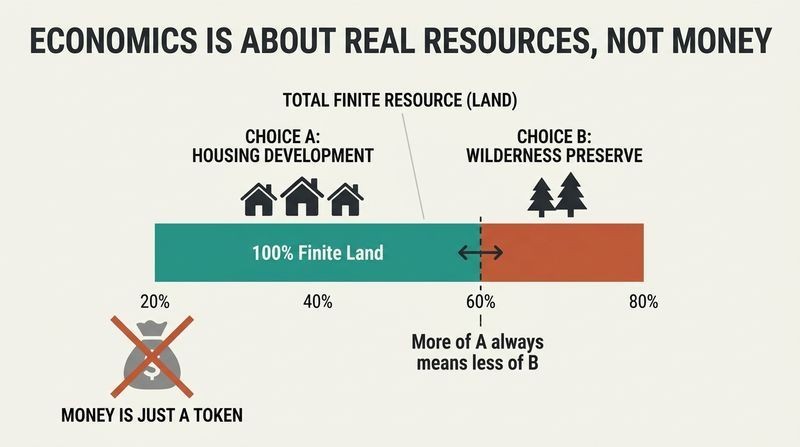
Scarcity forces trade-offs, always. Sowell builds the entire book on one definition borrowed from economist Lionel Robbins: economics studies the use of scarce resources that have alternative uses. Money is just a token. What matters is real stuff: iron ore, labor, land, time. A battlefield medical team with too few doctors faces a purely economic problem even though no cash changes hands, because time spent on one wounded soldier is time denied another.
There are no solutions, only trade-offs. Because everyone's wants exceed what exists, every choice sacrifices something else. When a politician promises more of some good, the honest question is: at the cost of less of what? Japan and Switzerland thrive with few natural resources, while resource-rich nations stay poor. Decisions about resources matter more than the resources themselves.
What's striking is how this deceptively simple definition disarms utopian thinking. By anchoring economics in physical scarcity rather than money, Sowell sidesteps the moralizing that dominates public debate. The framing echoes Thomas Sowell's broader project across his work: consequences over intentions. A useful connection is Herbert Simon's notion of bounded rationality, which similarly stresses that constraints, not unlimited wants, define real decisions. One nuance worth flagging: critics argue that pure scarcity framing can undervalue distributional justice, treating a starving family's trade-off and a billionaire's as analytically identical. Sowell would counter that ignoring scarcity harms the poor most, since good intentions without economic literacy produce disasters.
Prices are messengers of reality, not obstacles invented by greed
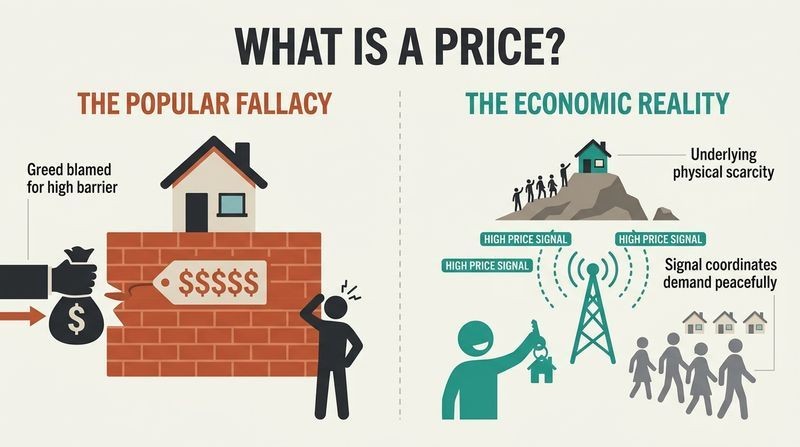
Prices coordinate what no planner can. Sowell's central mechanism is that prices transmit knowledge instantly across millions of strangers. When Margaret Thatcher was asked by Gorbachev how Britain fed its people, the answer was: she did not, prices did. A discovery of iron ore in one country quietly makes steel desks cheaper worldwide, even though 99% of buyers never hear the news.
Beachfront homes are expensive because they are scarce, not because sellers are greedy. High prices do not cause scarcity, they reflect it. Prices ration existing supply and signal producers where to send resources. Soviet planners drowning in 24 million prices proved that no committee can replace this. Losses matter as much as profits: losses tell producers what to stop making, freeing resources for what people actually want.
This is Friedrich Hayek's knowledge problem rendered in plain English. Hayek argued in 1945 that the economic problem is one of dispersed, tacit knowledge no central mind can assemble, and prices act as a distributed signaling network. Sowell's genius is concretizing it with moleskins rotting in Soviet warehouses. Modern behavioral economics complicates the picture: prices can also transmit noise, bubbles, and manipulation, as 2008 showed. But the core insight remains robust. Notably, even Marx and Engels understood price signals better than their followers, a point Sowell relishes. The framing that losses are as vital as profits is underappreciated and worth sitting with.
Price controls create shortages, black markets, and rotting quality
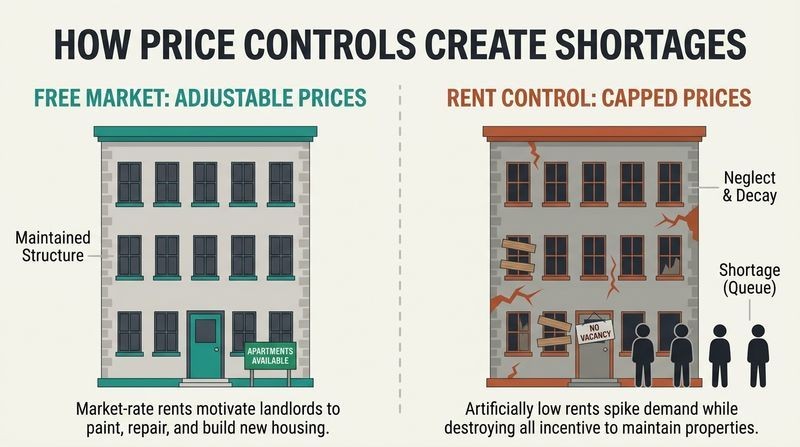
A shortage is a price phenomenon, not a physical scarcity. After World War II, American housing per person was unchanged, yet rent control produced a brutal shortage because artificially low prices made people demand more space. After the 1906 San Francisco earthquake destroyed half the housing overnight, there was no shortage, because prices were free to adjust. Same physical reality, opposite outcomes.
Controls punish the very people they claim to help. Rent control in New York, San Francisco, Cairo, and Melbourne consistently reduces new construction, accelerates decay, and shifts building toward exempt luxury units. A Swedish socialist economist called rent control the most efficient way to destroy a city short of bombing. Price floors work in reverse: agricultural supports create surpluses so large the U.S. government once destroyed millions of hogs amid hunger.
The scarcity-versus-shortage distinction is the chapter's diagnostic gift. Empirical support is unusually strong: surveys find near-unanimity among economists that rent control degrades housing quality and quantity, a rare consensus in a contentious field. What's clever is Sowell's use of a self-identified socialist and a Vietnamese communist official both conceding rent control's destructiveness, preempting the charge of ideological bias. A fair challenge: short-term rent stabilization can protect incumbent tenants from displacement shocks, a real welfare gain the model underweights. The deeper lesson transcends housing: suppressing a symptom (price) without addressing the underlying reality (supply and demand) reliably backfires, a principle applicable to minimum wages, usury caps, and drug prohibition.
Judge policies by incentives they create, not goals they proclaim
Good intentions are not results. Sowell hammers the gap between a policy's stated aim and its actual consequences. Rent control aims at affordable housing but diverts resources toward luxury apartments and office towers that are exempt. Minimum wage laws aim to help low-skilled workers but price the least experienced out of jobs entirely, since the real minimum wage is always zero.
Incentives explain behavior that looks irrational. A Soviet factory manager hoarding mining machinery over a paint-color technicality was not stupid, he was rationally avoiding an eight-year prison sentence. Systemic causation, where outcomes emerge from millions of interactions no one intended, explains more than blaming greed or stupidity. Higher prices in poor neighborhoods reflect higher costs of doing business (theft, insurance, small transactions), not exploitation by cruel merchants.
This is arguably the book's most transferable mental habit, and it aligns with public choice theory, pioneered by James Buchanan and Gordon Tullock, which models politicians and bureaucrats as self-interested actors rather than benevolent guardians. Sowell's insistence on systemic over intentional causation parallels the sociologist Robert Merton's law of unintended consequences. The framework is powerful but can be wielded too cynically: not every regulation backfires, and some (clean air laws, seatbelt mandates) demonstrably improve welfare. The stronger version of Sowell's claim is epistemic humility: always trace second and third-order effects before celebrating a policy's announced purpose. Ask what it rewards and punishes, not what it promises.
Businesses rise and fall because knowledge, not capital, is scarcest
The graveyard of giants proves the point. A&P was once the world's largest retailer with 15,000 stores earning double the national profit rate, then collapsed when suburbanization and refrigerators changed the game and Safeway adapted faster. Montgomery Ward, Eastman Kodak, U.S. Steel, and Pan Am all fell because rivals understood changing conditions sooner.
Markets tap knowledge scattered among millions. A former railroad clerk named James Cash Penney, raised in poverty, forced Sears and Montgomery Ward to imitate him not by persuading them but by beating them in the marketplace. This is capitalism's hidden advantage: you do not have to convince the people at the top of anything. Insight held by an outsider can overwhelm the wealth and authority of established firms, something impossible under kings, commissars, or central planners.
Sowell reframes capitalism as fundamentally a knowledge-processing system, not a money system, which is a profound and under-appreciated move. It resonates with Joseph Schumpeter's creative destruction and with Clayton Christensen's later theory of disruptive innovation, where incumbents fail precisely because they are well-managed for yesterday's conditions. The Penney example illustrates what Hayek called the discovery procedure of competition. A worthwhile tension: this celebrates outcomes but glosses over the human cost of churn, the workers and communities gutted when giants fall. Sowell addresses this elsewhere as necessary for progress, but the emotional weight of that displacement is real and politically potent, which is why protectionism endures.
Profits are a price paid for efficiency, cheaper than inefficiency
Socialism's invisible cost dwarfs capitalism's visible one. Sowell notes that capitalism has a visible cost (profit) that socialism lacks, but socialism has an invisible cost (inefficiency) that capitalism weeds out through losses and bankruptcy. Since goods are more affordable under capitalism, profit must be less costly than inefficiency. The Soviet Union used far more electricity, steel, and labor per unit of output than Japan or Germany.
Great fortunes come from lower prices, not higher ones. Ford, Rockefeller, Carnegie, and the retail chain founders all got rich by cutting costs and charging less to reach mass markets. A supermarket earning a penny per dollar of sales prospers because inventory turns over 25 times a year. The owner is an unmonitored monitor, pressured by self-interest to watch every detail no salaried bureaucrat would.
The framing of profit as the price of efficiency is elegant and counterintuitive, directly rebutting the folk intuition (shared by Nehru, Shaw, and Dewey) that profit is a parasitic surcharge. The empirical clincher, that non-profit and government entities have increasingly outsourced functions to profit-seeking firms rather than the reverse, is a genuinely powerful natural experiment. Principal-agent theory in modern economics formalizes Sowell's unmonitored monitor: residual claimants who keep the leftover after costs have sharper incentives than fixed-salary managers. One caveat worth noting: in industries with weak competition or information asymmetries (healthcare, finance), profits can reflect market power rather than efficiency, a distinction Sowell handles more in his monopoly discussion.
High wages do not mean high labor costs per unit of output
Confusing wage rates with labor costs breeds bad policy. Sowell's sharpest international-trade correction: wage rates are measured per hour, labor costs per unit produced. A prosperous country paying double the wages but producing triple the output has lower labor costs. Average Indian labor productivity in modern sectors was about 15% of American productivity, so paying 20% of American wages would actually cost more per unit.
Rich countries have exported to poor countries for centuries. The Dutch and British dominated world trade while paying some of the highest wages of their eras. Capital, management, transportation, and economies of scale all shape total cost. This dismantles the perennial fear that free trade lets low-wage nations vacuum up all the jobs, a fear that fueled the disastrous Smoot-Hawley tariffs of 1930.
This distinction is one of the most economically literate points in the book and remains chronically misunderstood in political discourse. It connects to the concept of unit labor cost, a standard metric in international competitiveness analysis. Paul Krugman made a parallel argument in the 1990s, warning that treating nations as competing corporations is a dangerous fallacy. Sowell's historical evidence (high-wage Holland and Britain as export leaders) is compelling. The nuance modern trade economists add: while free trade raises aggregate wealth, the gains and losses are distributed unevenly, and the China shock research by Autor and colleagues shows displaced manufacturing workers often did not smoothly find comparable jobs, which sharpens the political backlash Sowell describes.
Known reserves of oil measure discovery cost, not what's underground
We keep not running out of resources. In 1960 a bestseller warned the U.S. had only 13 years of oil left. Thirteen years later, known reserves had grown. Sowell explains that known reserves reflect how much it pays to discover at current prices and interest rates, not the physical quantity in the earth. It never pays to find more than roughly a decade or two of supply, because discovery is expensive.
Present value ties the future to the present. Rising prices automatically trigger conservation and new exploration long before any true exhaustion. Economist Julian Simon famously bet environmentalist Paul Ehrlich that any five resources would fall in real cost over a decade, and won on all five. Canada's oil sands were not even counted as reserves until prices rose enough to make extraction profitable.
The reserves insight is a masterclass in why physical intuition misleads in economics. It reframes resource scarcity as an economic rather than geological question, a view associated with the economist Harold Hotelling and later Julian Simon's cornucopian optimism. The Simon-Ehrlich wager is genuinely instructive, though intellectually honest readers should note it is not decisive: Ehrlich might have won over a different decade or basket, and some resources (fresh aquifers, fisheries, atmospheric carbon capacity) lack functioning price signals and are genuinely depleting. Sowell's mechanism works best for priced, tradeable commodities. The concept of present value doing intergenerational sharing without anyone intending it is quietly one of the book's most beautiful ideas.
Speculation and insurance reduce society's risk, not just shift it
Risk is inescapable, so someone must bear it efficiently. A wheat farmer cannot know harvest-time prices set by growers in Russia and Argentina. A speculator signs a futures contract guaranteeing a price today, letting the farmer farm while the specialist bears the risk. Crucially, this is the opposite of gambling: gambling manufactures new risk, while speculation manages inherent risk and shifts it to whoever can carry it most cheaply.
Insurance pools risk into predictability. An insurer cannot predict when one person dies, but can predict average death rates across millions accurately. Risk is not merely transferred but genuinely reduced, which is why buying a policy benefits both parties. Government programs branded as insurance (flood insurance, FEMA) often do the reverse, subsidizing people to build in hurricane paths and raising society's total risk.
Sowell's clean separation of speculation from gambling is pedagogically valuable and often lost on the public and press, for whom speculator is a slur. This maps onto modern risk-management theory: hedging exists to transfer variance to parties with lower cost of bearing it, whether from deeper capital, diversification, or superior information. The insurance-reduces-risk point rests on the law of large numbers, a foundational actuarial principle. The critique of government pseudo-insurance connects to moral hazard, where subsidized protection distorts behavior. John Stossel's beach house, rebuilt twice at taxpayer expense, is a vivid illustration. A modern extension: the 2008 crisis showed that even private financial engineering can amplify systemic risk when correlations are underestimated, a limit to the reassuring model.
Rising tax rates can shrink revenue as people change behavior
Tax rates and tax revenues are different things. When Maryland taxed millionaires more heavily, the number of millionaire households fell from roughly 8,000 to under 6,000 and projected new revenue turned into a $257 million loss. When the U.S. cut the capital gains rate from 28% to 20% in 1997, revenue rose to nearly double projections as investors shifted money out of tax shelters into productive assets.
People react, so static projections mislead. Alaska's cigarette tax hike sent smokers stockpiling 175 million cigarettes beforehand. Hedge funds fled Britain's 51% tax for Switzerland. Iceland tripled corporate tax revenue by cutting the rate from 45% to 18%. The lesson is not that all cuts raise revenue, but that behavior responds to incentives, so the direction of revenue change cannot be assumed from the direction of the rate change.
This is the Laffer curve without the ideological baggage, and Sowell is careful to say the effect is empirical, not automatic. The honest version, which he provides, is that revenue response depends on where you sit on the curve, the elasticity of the taxed behavior, and mobility of the tax base. Capital gains and high earners are highly responsive because they can time realizations and relocate. The evidence on cuts consistently raising revenue is genuinely contested among public finance economists, and most estimates place the U.S. well below the revenue-maximizing rate for ordinary income. Sowell's stronger, defensible point is the distinction itself: legislators control rates, not revenues, and confusing the two produces persistent forecasting errors and sloppy rhetoric about tax cuts costing X billion dollars.
National debt and trade deficits are misread by scary words
Words like deficit and debtor nation mislead. The U.S. ran a favorable trade balance every year of the Great Depression and became a record debtor nation during the booming 1990s. Sowell insists we think things, not words. When Japan sells more cars to Americans than it buys, it accumulates dollars it then invests back into the U.S. economy, building factories and buying assets, which creates American jobs.
Trade counts goods, ignores services and unmoved assets. The American economy produces more services than goods, so it naturally imports more goods and exports more services like Microsoft software, which the trade balance omits entirely. Foreign investment made the U.S. a debtor for most of its history, the same history in which it had the world's highest living standard. Context and scale relative to GDP matter far more than the emotional label.
Sowell's demystification of trade accounting is timely in any protectionist era. The key technical truth, that the current account and capital account must balance, means a trade deficit is mathematically mirrored by a capital surplus, an insight from open-economy macroeconomics. Foreign eagerness to hold dollar assets reflects confidence, not weakness. That said, mainstream economists are more divided than Sowell suggests: persistent large deficits can signal low domestic savings, and debt sustainability depends on whether borrowing funds productive investment or consumption. His bank-deposit analogy (a bank going deeper into debt as customers deposit more) is genuinely clarifying. The overarching lesson, distrust emotionally loaded economic vocabulary, is a durable defense against demagoguery from both left and right.
Third World poverty stems from missing institutions, not missing wealth
Poor countries often sit on unmobilized wealth. Sowell argues that dependable property rights and financial institutions, not foreign aid, unlock prosperity. In Peru, real estate held without legal title was estimated at more than a dozen times all foreign investment ever made there. This dead capital cannot be borrowed against or built upon. Egypt had an estimated 4.7 million illegally built homes outside the legal system.
Corruption and bureaucracy strangle growth. Starting a business took 155 days in Congo versus under 10 in Singapore. Entrepreneurial minorities (Chinese in Southeast Asia, Lebanese in West Africa, Indians in East Africa) created whole industries, then were expelled or persecuted out of zero-sum resentment, leaving the countries poorer. Rich nations mostly invest in other rich nations, drawn by reliable law, not by the cheap labor exploitation theory would predict.
This synthesizes Hernando de Soto's dead-capital thesis, which Sowell explicitly draws on, with his own recurring theme of entrepreneurial middleman minorities. The property-rights argument aligns with the institutional economics of Douglass North and later Acemoglu and Robinson, whose Why Nations Fail argues inclusive institutions, not geography or culture, explain the wealth gap. The observation that capital flees to rich countries rather than exploiting poor ones is a strong empirical rebuttal to Leninist imperialism theory. A fair nuance: institutions themselves have deep historical and cultural roots, so prescribing property rights is easier than growing the trust and legal capacity that sustain them. Sowell's zero-sum-thinking critique, the belief that middlemen and foreign investors extract rather than create wealth, remains one of the book's most important and morally consequential correctives.
Analysis
Basic Economics is a thesis-driven primer disguised as an anthology of examples. Its structure is relentless repetition of a single organizing definition (scarce resources with alternative uses) applied across prices, industry, labor, finance, government, and trade. What makes it hard to summarize is not conceptual difficulty but density: Sowell packs hundreds of cross-cultural, cross-century examples into every principle, and the persuasive force lives in that accumulation. Stripping the examples risks reducing the book to platitudes it works hard to earn.
The book's intellectual lineage is the Chicago and Austrian traditions: Hayek's dispersed-knowledge argument, Friedman's price-theoretic clarity, and public choice theory's skepticism of benevolent government. Sowell's distinctive contribution is rhetorical and pedagogical rather than theoretical. He coins almost nothing; instead he reframes standard economics for readers who never took a class, deploying vivid natural experiments (the 1906 earthquake versus rent control, Soviet moleskins, the Simon-Ehrlich wager) that function like Gladwellian set-pieces. His signature move is the incentives-versus-intentions distinction, which doubles as a political weapon against progressive policy.
The work is ideologically committed, and readers should engage it as advocacy grounded in genuine economic consensus rather than neutral exposition. On core price theory, rent control, minimum wage effects on low-skilled workers, and trade gains, Sowell reflects mainstream findings. On contested terrain, distribution, the revenue effects of tax cuts, the adequacy of markets in healthcare and finance, and the human costs of creative destruction, he presents one defensible side as settled. The 2008 financial crisis, which the later editions address, exposes the limits of his market-optimism where information asymmetries and systemic risk dominate.
Its enduring value is training a habit of mind: trace second-order consequences, distrust emotionally loaded words, ask at the cost of less of what. That analytical discipline outlasts any particular policy debate and is precisely what public discourse most lacks.
Review Summary
Basic Economics receives high praise for its clear explanation of economic principles without jargon or graphs. Readers appreciate Sowell's use of real-world examples to illustrate concepts. Many consider it essential reading for understanding free market economics and policy implications. Critics argue it presents an overly biased pro-capitalist view. The book is acclaimed for making complex ideas accessible to general readers, though some find it repetitive. Overall, reviewers recommend it as an informative introduction to economics, particularly from a conservative perspective.
People Also Read




Glossary
Scarce resources which have alternative uses
The core definition of economicsSowell's foundational framing, borrowed from economist Lionel Robbins: economics is the study of how societies allocate resources that are limited and can be used in multiple competing ways. Because wants exceed resources, every use of a resource sacrifices another possible use, making trade-offs, not solutions, the essence of all economic decisions regardless of the political system.
Systemic causation
Outcomes from interactions, not intentionsThe idea that economic results emerge from countless reciprocal interactions among individuals rather than from anyone's deliberate design. Contrasted with intentional causation (blaming greed or stupidity), systemic causation explains phenomena like prices, bankruptcies, and higher costs in poor neighborhoods as products of impersonal market forces. As Engels put it, what emerges is something no one willed.
Shortage versus scarcity
Price phenomenon versus physical quantityA key distinction: scarcity means fewer goods exist relative to wants, while a shortage means people willing to pay the going price cannot find the good. Shortages are caused by prices held artificially low (price controls), not by reduced physical supply. The same physical quantity can produce a severe shortage under price control or none in a free market.
Present value
Future benefits discounted to todayThe current worth of an asset's anticipated future benefits, discounted because delayed money is worth less than immediate money. Present value causes markets to conserve natural resources for future generations automatically and explains why known reserves reflect discovery costs rather than physical quantities. It also explains why politicians, unlike markets, ignore long-run consequences beyond the next election.
Incentives versus goals
Judge by consequences, not intentionsSowell's analytical principle that economic policies should be evaluated by the incentives and constraints they create rather than the desirable goals they proclaim. Rent control aims at affordability but incentivizes luxury construction and housing decay; minimum wage aims to help workers but prices the least skilled out of jobs. Consequences routinely diverge from, and often reverse, intentions.
Wage rates versus labor costs
Hourly pay versus cost per outputA distinction central to trade analysis: wage rates are measured per hour of work, while labor costs are measured per unit of output produced. A high-wage country can have lower labor costs if its workers are more productive. Confusing the two produces the fallacy that high-wage nations cannot compete with low-wage nations in international trade.
Fallacy of composition
What's true for part isn't for wholeThe mistaken assumption that what is true of a part must be true of the whole. Any individual can see better by standing at a stadium, but not everyone can if all stand. Any industry's jobs can be saved by government, but not all jobs across the economy, because the resources come from taxing other productive activities elsewhere.
Unmet needs
Always exist under scarcitySowell's critique of political rhetoric demanding government meet some unmet need. Because resources are scarce and have alternative uses, unmet needs are permanent and infinite; fully meeting one need only worsens others. Calling something a need treats it as categorically more important, obscuring that even essentials like food, water, and oxygen are beneficial only within limited ranges.
FAQ
What's Basic Economics: A Common Sense Guide to the Economy about?
- Accessible Economics Overview: Basic Economics by Thomas Sowell is designed to introduce economic principles to the general public and beginners, covering key concepts like supply and demand, prices, and government policy impacts.
- Real-World Applications: Sowell illustrates how economic principles apply across different economies and historical contexts, showing that the same economic laws govern diverse systems.
- Focus on Consequences: The book emphasizes the importance of understanding economics for informed decision-making, particularly in politics, where ignoring economic principles can lead to negative outcomes.
Why should I read Basic Economics?
- Clear and Informative: Sowell presents complex economic ideas in a straightforward manner, making them accessible to readers without an economics background.
- Practical Examples: The book is filled with real-life examples that illustrate economic principles, helping readers understand how these concepts affect everyday life and public policy.
- Empowerment Through Knowledge: Understanding economics enables readers to better navigate political discussions and make informed choices as voters.
What are the key takeaways of Basic Economics?
- Scarcity and Choice: Resources are scarce, necessitating choices and trade-offs. Economics is defined as "the study of the use of scarce resources which have alternative uses."
- Role of Prices: Prices act as signals in the market, guiding consumers and producers in their decisions and helping allocate resources efficiently.
- Consequences Over Intentions: The consequences of economic policies matter more than the intentions behind them, as misguided policies can lead to shortages or surpluses.
What are the best quotes from Basic Economics and what do they mean?
- "Nothing is easier than to have good intentions but, without an understanding of how an economy works, good intentions can lead to disastrous consequences.": Highlights the importance of economic literacy in policymaking.
- "Economics is not just about dealing with the existing output of goods and services as consumers. It is also, and more fundamentally, about producing that output from scarce resources in the first place.": Emphasizes the dual focus of economics on production and consumption.
- "The role of prices is to provide incentives to affect behavior in the use of resources and their resulting products.": Encapsulates the function of prices in a market economy.
How does Basic Economics define scarcity?
- Fundamental Economic Concept: Scarcity is the condition where individual wants exceed available resources, underpinning all economic activity and decision-making.
- Implications for Choices: Limited resources necessitate choices about allocation, leading to trade-offs where gaining more of one good means giving up another.
- Universal Reality: Scarcity affects all economies, making it essential to understand for grasping the necessity of economic systems and competition.
What is the role of prices in economics according to Basic Economics?
- Incentives for Behavior: Prices influence consumer and producer behavior, encouraging balance in the market by signaling when to buy less or supply more.
- Coordination of Knowledge: Prices help coordinate actions in an economy without central planning, conveying information about supply and demand.
- Reflection of Scarcity: Prices reflect resource scarcity, rising when demand exceeds supply, signaling consumers to reduce consumption or seek alternatives.
What are the consequences of price controls as discussed in Basic Economics?
- Shortages and Surpluses: Price controls can lead to shortages when set too low, causing demand to exceed supply, or surpluses when set too high.
- Quality Deterioration: Often result in a decline in quality, as producers cut corners to maintain profitability under suppressed prices.
- Black Markets: Legal prices that don't reflect market realities can lead to black markets, where goods are traded at market prices.
How does Basic Economics explain the role of profits and losses?
- Incentives for Efficiency: Profits reward efficient resource allocation and meeting consumer demands, while losses signal inefficiencies.
- Market Signals: Profits and losses provide critical information about business success or failure, guiding decisions on production and innovation.
- Economic Health Indicator: Overall profit levels indicate economic health, with high profits suggesting effective resource use and widespread losses signaling distress.
What is the significance of competition in Basic Economics?
- Driving Innovation: Competition encourages businesses to innovate, leading to better quality and lower prices for consumers.
- Resource Allocation: Helps allocate resources to their most valued uses, with inefficient firms adapting or failing.
- Consumer Benefits: Provides consumers with more choices and better prices, ensuring businesses remain responsive to needs and preferences.
How does Basic Economics address the relationship between government and the economy?
- Government Intervention Risks: Warns that interventions often lead to unintended consequences, disrupting market signals and causing inefficiencies.
- Role of Regulation: While necessary for order and consumer protection, excessive regulation can stifle competition and innovation.
- Understanding Market Dynamics: Emphasizes understanding market functions independently of government control for efficient resource allocation.
What is the concept of "comparative advantage" in Basic Economics?
- Definition of Comparative Advantage: The ability to produce a good at a lower opportunity cost than others, explaining the benefits of trade.
- Example of Specialization: Countries specialize in products they produce most efficiently, trading to benefit from each other's strengths.
- Implications for Trade: Even if one country is more efficient in all goods, trade can still be mutually beneficial, supporting free trade arguments.
How does Basic Economics explain the relationship between supply and demand?
- Fundamental Economic Principle: Supply and demand determine prices and resource allocation, essential for analyzing market behavior.
- Shifts in Supply and Demand: Various factors can shift curves, affecting prices and quantities, such as changes in preferences or production costs.
- Market Equilibrium: Markets tend to reach equilibrium where supply equals demand, dynamically changing with economic factors.
About the Author
Other books by Thomas Sowellm


Download PDF
Download EPUB
.epub digital book format is ideal for reading ebooks on phones, tablets, and e-readers.








































