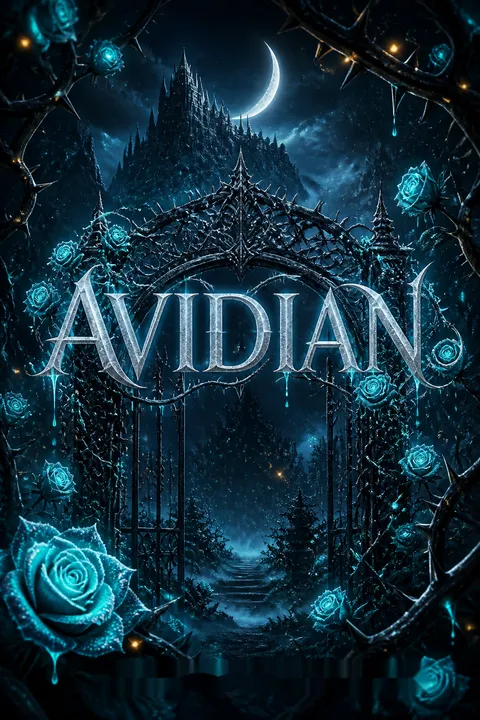

Plot Summary
Night-Blooming Secrets
Katja, a young woman with the rare ability to see and communicate with the dead, finds solace in a forbidden garden under the moonlight. Her life is not her own—she is property, trafficked and owned by the ruthless Volkov family in a fractured, dystopian America. A chance encounter with Malachi, a mysterious stranger, sparks a connection that is both dangerous and intoxicating. Their flirtation is laced with secrets, and Katja's yearning for escape is palpable. The garden, lush and alive against the backdrop of a dying world, becomes a symbol of hope and the possibility of something more than survival.
Prisoner of the Volkovs
Katja returns to the Volkov estate, a fortress perched on a cliff, both home and prison. The Western District is ruled by Marco Volkov, whose power is absolute and whose cruelty is legendary. Katja's existence is defined by fear, obedience, and the ever-present threat of violence. She is haunted by the screams of other Avids—people with supernatural gifts like hers—who are trafficked and exploited. Her only comfort is Mischka, the ghost of her childhood dog, a constant companion in a world where trust is a luxury. Memories of her lost family and first love, Cade, linger, shaping her resilience and her refusal to break.
Ghosts and Guilt
Katja is summoned by Marco for a new case—a murder in the Eastern District, ruled by his estranged twin, Viktor. On the journey, she reflects on her past: the trauma of being sold, the pain of losing her family, and the twisted bond she shares with Marco, who both saved and imprisoned her. The world is broken, divided into districts ruled by powerful families, and Avids are hunted for their abilities. Katja's power to speak with the dead is both her value and her curse, making her indispensable and forever in danger.
Blood on Snow
In Viktor's icy mansion, Katja is confronted with a gruesome double murder—Damien, Viktor's son, and Carmen, a servant. The room is a scene of carnage, and Katja must use her gift to communicate with the victims' spirits. The process is harrowing, leaving her physically and emotionally drained. She is drawn into a web of secrets, betrayals, and family politics, where every ally could be an enemy. The dead are restless, and their memories are fragmented, forcing Katja to piece together the truth from pain and regret.
The Demon's Bargain
Malachi, revealed as Marco's son, becomes Katja's reluctant guardian and unexpected confidant. Their chemistry is undeniable, but trust is elusive. Malachi confesses his own rebellion against his family's legacy—he is working with a secret group, Solace, to dismantle the trafficking of Avids from within. He offers Katja a deal: help him, and he will free her and others like her. The stakes are life and death, and Katja must decide whether to risk everything for a chance at freedom and love.
Unquiet Dead
Katja's investigation into the murders is complicated by the interference of Viktor, Marco, and their dangerous sons. The dead refuse to rest, and Katja's attempts to communicate with them grow more perilous. Damien's spirit is vengeful and cryptic, taunting her with riddles and threats. Carmen's ghost is fractured by trauma and betrayal. The line between the living and the dead blurs, and Katja is forced to confront her own guilt, grief, and the possibility that the answers she seeks may destroy her.
Wolves in the Family
The Volkov family's power is built on fear, violence, and the exploitation of Avids. Katja navigates a world where loyalty is bought with blood and betrayal is inevitable. Orin, Marco's sadistic son, torments her, while Malachi's motives remain uncertain. A lavish party becomes a stage for manipulation, seduction, and espionage. Katja uses her wits and her body to gather information, risking everything to uncover the truth behind the murders and the fate of the Avids held captive in Viktor's house.
Dinner with Monsters
At Viktor's party, Katja is forced to play the role of Orin's date, enduring humiliation and danger as she eavesdrops on the powerful men who buy and sell Avids. She discovers a planned auction of two captive Avids and, with Malachi's help, orchestrates a daring rescue. The night spirals into violence and chaos, culminating in a murder that Malachi commits to protect Katja. Their alibi is fragile, and the consequences of their actions ripple through the Volkov family and beyond.
The Syndicate's Veil
Malachi takes Katja to his true home in the Midwest District, where she meets his aunt Irina and is introduced to the Syndicate—a secret organization fighting to overthrow the ruling families and restore democracy. The Depths, an underground sanctuary, is a haven for Avids and a laboratory for scientific breakthroughs. Katja learns that her gift is part of a larger tapestry of power, resistance, and hope. She is offered a place in Solace, but the cost of trust and loyalty is higher than ever.
Carnival of Lies
Malachi gives Katja a taste of freedom at a winter carnival, where they share moments of laughter, intimacy, and vulnerability. Their relationship deepens, but the shadow of Marco and the Volkov legacy hangs over them. The world outside is still hostile, and the fight for survival is never far away. The carnival is a brief respite, a reminder of what is at stake and what could be lost.
Wolves Prowl at Midnight
Clues from the dead and from Carmen's journal lead Katja and Malachi to a remote cabin, searching for the truth behind the murders and the Volkovs' darkest secrets. They are hunted by monstrous, genetically altered wolves—creatures born of Marco's experiments. The fight for survival is brutal, and Katja is wounded, forcing her to rely on Malachi and the experimental Avidian serum to heal. The cabin becomes a crucible for their love and their resolve to end the Volkovs' reign.
The Truth in Shadows
In the aftermath of the attack, Katja and Malachi confront the truth about Carmen's murder and the role of Solace. Carmen's journal reveals that her boyfriend, a Solace operative, killed her and Damien to protect the organization. Katja is forced to question everything—her trust in Malachi, the morality of the rebellion, and her own complicity. The lines between hero and villain blur, and the price of justice becomes painfully clear.
The Depths Below
In the Syndicate's underground labs, Katja witnesses the creation of Avidian—a distilled essence of Avid powers that can be used by anyone. The potential for liberation and abuse is immense. Katja's own abilities are amplified, allowing her to see the dead more clearly but at great personal risk. The Syndicate's vision of a new world is seductive, but the dangers of unchecked power and internal betrayal threaten to unravel everything.
Avidian's Price
Katja's use of Avidian brings her closer to the truth but also to the edge of madness. The spirits she summons are more powerful and more dangerous, and the veil between life and death grows thin. The price of using her gift is exhaustion, pain, and the risk of losing herself. The choices she makes—to trust, to fight, to love—carry consequences that cannot be undone.
Betrayal in the Blood
Orin betrays Katja, dragging her back to Marco's estate and exposing her to new dangers. The Volkov family fractures under the weight of secrets and violence. Katja is forced to confront Marco, the man who shaped her life and her suffering. The confrontation is brutal, and the question of who will survive—and at what cost—hangs in the balance.
The Cabin's Secret
In the aftermath of violence, Katja is haunted by visions of Cade, her lost love, and by the revelation that nothing is as it seems. The past and present collide, and the truth about Cade's fate and his connection to the Volkovs is finally revealed. The secrets hidden in the cabin and in Katja's own heart threaten to destroy everything she has fought for.
Hunted by Monsters
Katja's journey becomes a desperate flight from the Volkovs and their monstrous creations. She is hunted by both the living and the dead, forced to rely on her wits, her power, and the fragile alliances she has forged. The line between prey and predator blurs, and Katja must decide what she is willing to become to survive.
The Devil's Work
The final confrontation with Marco is a reckoning years in the making. Katja embraces the darkness within her, becoming the demon he always accused her of being. The act of killing is both liberation and damnation, and the cost of vengeance is written in blood. The cycle of violence is broken, but the scars remain.
The Knife's Edge
In the aftermath, Katja and Malachi are left to pick up the pieces of their shattered world. The fight for freedom is not over, and the wounds of betrayal and loss run deep. Their love is tested by the choices they have made and the ghosts that haunt them. The future is uncertain, but the possibility of healing and hope remains.
Cade's Return
In a final, shocking twist, Cade—Katja's first love, long believed dead—returns, alive and changed. His true identity and his role in the web of secrets and betrayals are revealed, setting the stage for a new conflict. The story ends on the precipice of a new beginning, with Katja caught between the ghosts of her past and the uncertain promise of the future.
Analysis
Avidian is a searing exploration of power, trauma, and the search for freedom in a world built on exploitation. At its core, the novel interrogates what it means to survive when every system is rigged against you, and whether true liberation is possible without confronting the darkness within and without. Through Katja's journey—from captive to rebel, from haunted survivor to agent of change—the story examines the cost of trust, the complexity of love, and the moral ambiguity of resistance. The supernatural elements, particularly Katja's ability to see the dead, serve as both literal plot devices and metaphors for the inescapability of the past and the weight of unresolved grief. The use of Avidian as both a tool of empowerment and a potential weapon of oppression raises questions about the ethics of power and the dangers of becoming what you fight against. The novel's structure—fragmented, nonlinear, and haunted by unreliable narration—mirrors the psychological reality of trauma and the difficulty of discerning truth in a world of shifting loyalties. Ultimately, Avidian is a story about reclaiming agency, forging unlikely alliances, and daring to hope for a future beyond the scars of the past. Its lessons are both timely and timeless: that survival is not enough, that freedom must be fought for, and that the greatest battles are often those we wage within ourselves.
People Also Read




Characters
Katja Sinclair
Katja is the heart of the story—a young woman marked by trauma, loss, and the rare ability to see and speak with the dead. Her power is both her curse and her salvation, making her valuable to the Volkovs and a target for exploitation. Katja's psychological landscape is shaped by grief, guilt, and a fierce will to survive. She is resourceful, guarded, and slow to trust, but beneath her stoic exterior lies a deep well of empathy and longing for connection. Her relationships—with Malachi, Marco, Mischka, and the ghosts of her past—drive her evolution from captive to fighter, from victim to agent of her own destiny.
Malachi Volkov
Malachi is Marco's son, torn between loyalty to his family and his own moral compass. Outwardly charming and privileged, he hides a deep dissatisfaction with the Volkov legacy and a secret role as a leader in Solace, the underground resistance. His relationship with Katja is fraught with tension, desire, and mutual suspicion, but also genuine care and vulnerability. Malachi's journey is one of self-discovery, as he confronts the darkness within his family and himself, ultimately choosing to fight for a better world—even if it means betraying his blood.
Marco Volkov
Marco is the head of the Volkov family and the Western District, ruling through fear, violence, and calculated charm. He is both Katja's captor and, in a twisted way, her protector, having saved her from a worse fate only to imprison her in luxury. Marco's psyche is a labyrinth of grief, control, and self-justification. He sees himself as a savior, but his actions are driven by power and paranoia. His relationship with Katja is complex—part obsession, part paternalism, part ownership—and his downfall is a reckoning for years of cruelty.
Orin Volkov
Orin is Marco's son and the story's most overtly violent antagonist. He delights in tormenting Katja and others, enforcing his father's will with brutality and relish. Orin's psychology is shaped by a need for dominance and a deep-seated insecurity, making him both dangerous and pitiable. He is a constant threat, a reminder of the violence that underpins the Volkovs' power.
Viktor Volkov
Viktor, Marco's twin, rules the Eastern District with an iron fist. He is ruthless, calculating, and driven by a need to outdo his brother. His relationship with Katja is one of suspicion and exploitation—she is a tool to solve his problems, nothing more. Viktor's grief over his son's murder is buried beneath layers of pride and ambition, making him a formidable and unpredictable adversary.
Mischka
Mischka, Katja's childhood dog, is her first and most loyal spirit companion. Mischka represents the last vestige of Katja's lost innocence and the enduring power of love beyond death. Her presence is a source of comfort and grounding, a reminder of the world that was and the hope that remains.
Carmen
Carmen is a servant at Viktor's estate and one of the murder victims whose death sets the story in motion. Her journal and spirit provide crucial clues, revealing a web of manipulation, betrayal, and the cost of survival. Carmen's relationship with her secret boyfriend and her role in the Solace operation highlight the blurred lines between victim and accomplice, agency and exploitation.
Damien Volkov
Damien, Viktor's son, is both victim and antagonist. In life, he was cruel and entitled; in death, he is a taunting, malevolent presence, haunting Katja and obstructing her investigation. Damien's spirit embodies the unresolved guilt, rage, and secrets that fester within the Volkov family, and his interactions with Katja force her to confront the darkness in herself and others.
Irina Volkov
Irina, Marco and Viktor's sister, is a key figure in the Syndicate and the fight for Avid freedom. She is a survivor of her own traumas, having killed her husband to stop his trafficking empire, and now works to atone by building a sanctuary for Avids. Irina's strength, compassion, and strategic mind make her a mentor and ally to Katja, and her presence is a beacon of what is possible beyond the Volkovs' tyranny.
Cade/Brian
Cade is Katja's childhood best friend and first love, believed dead in the accident that killed her family. His shocking return as Brian, the Solace operative responsible for Carmen and Damien's deaths, is the story's final twist. Cade's dual identity embodies the story's central themes of love, loss, betrayal, and the impossibility of escaping the past. His reappearance forces Katja to confront the deepest wounds of her heart and the most dangerous secrets of her world.
Plot Devices
Duality of Captivity and Freedom
The narrative is structured around the tension between captivity and the longing for freedom—physical, emotional, and existential. Katja's journey is marked by cycles of imprisonment and escape, each new alliance or betrayal shifting the boundaries of her cage. The use of the garden, the mansion, the Depths, and the cabin as settings underscores the shifting nature of safety and danger. The story's structure mirrors Katja's psychological state: moments of hope and connection are always shadowed by the threat of violence and loss.
The Veil and the Dead
Katja's ability to see and communicate with the dead is both a literal plot device and a metaphor for trauma, memory, and the inescapability of the past. The veil between life and death is thin, and the dead are restless, their secrets and regrets driving the living to action. The use of projection, Avidian, and spirit communication allows for nonlinear storytelling, fragmented memories, and unreliable narration, heightening suspense and emotional intensity.
Power, Exploitation, and Resistance
The trafficking and exploitation of Avids is the central engine of the plot, driving the actions of the Volkovs, the Syndicate, and Solace. The creation of Avidian—the distilled essence of Avid powers—serves as both a symbol of hope for liberation and a potential tool of oppression. The story interrogates the morality of resistance, the cost of power, and the dangers of becoming what you fight against. The rebellion is as fraught with betrayal and compromise as the regime it seeks to overthrow.
Unreliable Allies and Shifting Loyalties
The narrative is propelled by shifting alliances, hidden motives, and the constant threat of betrayal. Katja's relationships—with Malachi, Marco, Irina, and Cade—are defined by uncertainty and the need to balance vulnerability with self-preservation. Foreshadowing, red herrings, and the use of journals, visions, and ghostly warnings keep the reader and protagonist guessing, blurring the line between friend and foe.
Trauma, Memory, and Identity
Katja's psychological journey is as central as the external plot. Her memories of her family, her guilt over surviving, and her unresolved feelings for Cade shape her actions and her sense of self. The return of Cade as Brian is the ultimate plot twist, forcing a reckoning with the past and the realization that identity is never fixed. The story uses dreams, flashbacks, and spirit encounters to explore the ways trauma lingers and the possibility of healing.
Download PDF
Download EPUB
.epub digital book format is ideal for reading ebooks on phones, tablets, and e-readers.








































