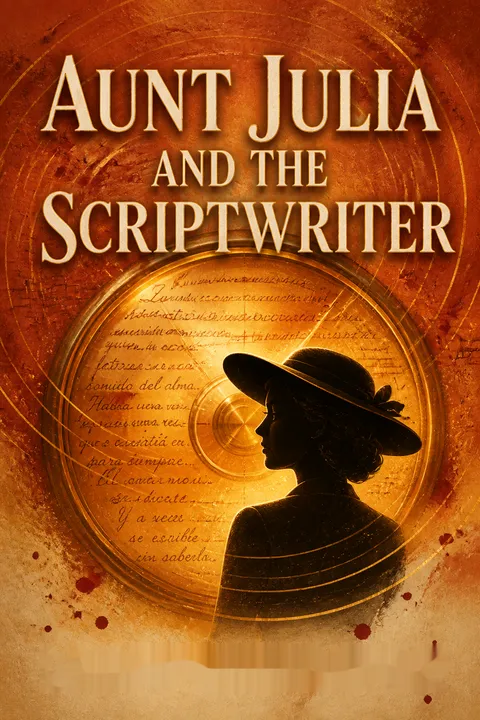

Plot Summary
Lima's Radio and Dreams
Mario, an ambitious law student in Lima, secretly dreams of becoming a writer. He works as news director at Radio Panamericana, a job that allows him to observe the city's vibrant radio culture and its two contrasting stations: the snobbish, modern Panamericana and the earthy, popular Radio Central. Mario's days are filled with editing news, attending university, and fantasizing about literature, while his family expects him to follow a respectable, conventional path. The city's radio world, with its actors, announcers, and imported Cuban soap operas, becomes the backdrop for Mario's coming-of-age, as he navigates between duty and desire, reality and imagination.
The Arrival of Julia
Mario's life is upended by the arrival of Aunt Julia, his uncle's recently divorced, witty, and worldly Bolivian sister-in-law. Julia, twelve years his senior, is seeking a new start in Lima. Their first encounters are marked by teasing and condescension, but Mario is both irritated and intrigued by her. Julia's presence in the family stirs gossip and speculation, and her candid, playful attitude challenges Mario's sense of himself as an adult. Their relationship begins with awkward lunches and movie outings, setting the stage for a connection that will soon defy family expectations and social norms.
Pedro Camacho's World
Radio Central hires Pedro Camacho, a Bolivian playwright and radio scriptwriter of legendary productivity and eccentricity, to write original soap operas. Camacho is a tiny, intense man with a messianic sense of artistic mission and a deep disdain for Argentines. He immerses himself in Lima's districts, classifying them with bizarre acronyms, and insists on total control over his scripts and actors. His arrival electrifies the radio world, as he churns out multiple serials daily, each filled with melodrama, crime, and passion. Camacho's presence becomes a source of fascination and comic relief for Mario, who observes the scriptwriter's rituals, manias, and growing influence.
Soap Operas and Reality
As Camacho's serials become wildly popular, their melodramatic plots—full of betrayals, crimes, and improbable coincidences—begin to mirror and distort the lives of Lima's listeners. Mario's family, especially the women, become addicted to the radio dramas, blurring the line between fiction and reality. Meanwhile, Mario's own life grows more complicated as his secret relationship with Julia deepens. The city's gossip, the family's expectations, and the fantastical world of the soap operas all converge, creating a sense of both possibility and impending crisis. The boundaries between art and life, invention and truth, become increasingly porous.
Forbidden Romance Blooms
Mario and Julia's flirtation evolves into a clandestine romance, marked by secret meetings, movie dates, and stolen kisses. The age difference, family ties, and Julia's status as a divorcée make their relationship taboo. They invent elaborate ruses to see each other, relying on the complicity of friends and the chaos of the city. Their love is both passionate and innocent, filled with humor and longing, but always shadowed by the threat of discovery. As their bond deepens, Mario's writing becomes more personal, and the couple's fate becomes entwined with the melodramatic spirit of Camacho's serials.
The Scriptwriter's Descent
Pedro Camacho's prodigious output begins to take a toll. Exhausted by his relentless schedule and obsession with artistic perfection, he starts to lose control over his stories. Characters migrate between serials, plots become tangled, and logic gives way to chaos. The actors and technicians, once inspired by his discipline, grow alarmed by his lapses and eccentricities. Camacho's mental state deteriorates, and his serials descend into surreal catastrophes—fires, earthquakes, mass deaths—mirroring his own unraveling mind. The radio station's management is torn between commercial success and the growing absurdity of his work, as Camacho's breakdown becomes both a public spectacle and a private tragedy.
Family Scandal Erupts
The inevitable happens: Mario and Julia's romance is discovered by the family. Shock, outrage, and gossip sweep through the clan, and Mario's parents, living abroad, are summoned to intervene. The lovers face intense pressure to separate, with threats of scandal, legal action, and exile. Friends and cousins become reluctant accomplices, helping the couple evade surveillance and plot their next move. The family's reaction is both comic and cruel, exposing the hypocrisies and anxieties of Lima's bourgeois society. Mario and Julia are forced to confront the consequences of their love, as the melodrama of their lives rivals anything on the radio.
The Art of Escape
Determined not to be separated, Mario and Julia hatch a plan to marry in secret. With the help of loyal friends, they navigate a labyrinth of legal obstacles, corrupt officials, and provincial mayors, traveling from Lima to Chincha and beyond in search of someone willing to marry them despite Mario's age and Julia's divorce. Their journey is a comic odyssey through Peru's bureaucracy and geography, filled with setbacks, farcical encounters, and moments of tenderness. The couple's resilience and ingenuity are tested, but their love endures, culminating in a makeshift wedding in a remote village—a triumph of passion over propriety.
Catastrophes on Air
As Mario and Julia struggle for happiness, Pedro Camacho's radio world collapses. His serials become increasingly incoherent, with characters dying en masse, resurrecting inexplicably, and crossing between stories. The city's listeners are bewildered, the actors desperate, and the station's owners frantic. Camacho's breakdown is both comic and tragic, a reflection of the pressures of creativity and the fragility of genius. His final scripts are apocalyptic, filled with disasters that echo the turmoil in Mario's own life. The collapse of Camacho's fictional universe marks the end of an era for Lima's radio and for Mario's youth.
Marriage Against All Odds
Despite family opposition and legal hurdles, Mario and Julia succeed in marrying. Their union is both a scandal and a victory, a defiant assertion of love in the face of convention. The newlyweds face exile, poverty, and uncertainty, but also the exhilaration of freedom and the promise of a shared life. Mario juggles multiple jobs to support them, while Julia becomes his confidante and collaborator. Their marriage is a partnership of equals, forged in adversity and sustained by humor, affection, and mutual respect. The melodrama of their courtship gives way to the quieter, deeper drama of building a life together.
Exile and Return
The family's pressure forces Julia into temporary exile in Chile, leaving Mario alone in Lima to fend for himself. He throws himself into work, taking on a dizzying array of jobs to prove his independence and prepare for Julia's return. Their separation is marked by longing, letters, and the determination to reunite. When Julia finally returns, they move into a modest apartment and begin their life as a married couple. The experience of exile and struggle deepens their bond, teaching them resilience and the value of small victories. Their love, once forbidden, becomes a source of strength and creativity.
The End of Camacho
Pedro Camacho, once the king of Lima's airwaves, is committed to an asylum, his mind shattered by overwork and obsession. The radio station replaces his serials with imported scripts, and the city moves on, but Mario cannot forget the man who embodied both the promise and the peril of artistic ambition. Years later, Mario encounters Camacho, now a broken figure, working as a messenger for a scandal sheet, his genius forgotten by all but a few. The encounter is both poignant and unsettling, a reminder of the costs of creativity and the impermanence of fame. Camacho's fate haunts Mario, shaping his understanding of art, memory, and mortality.
Writing, Memory, and Love
As Mario matures, his experiences with Julia, Camacho, and the world of radio become the raw material for his writing. He grapples with the challenges of memory, the responsibilities of storytelling, and the interplay between fiction and reality. The lessons of love, loss, and ambition inform his work, as he seeks to capture the complexity of life in Lima and beyond. Writing becomes both a refuge and a calling, a way to make sense of the chaos and beauty of the world. Mario's journey from apprentice to artist is marked by self-doubt, perseverance, and the enduring power of imagination.
The Fate of Stories
The novel's final chapters explore the fate of stories—those told on the radio, in families, and in the writer's mind. Camacho's serials, once the heartbeat of Lima, are forgotten, their characters lost to time. Mario's own stories, shaped by memory and invention, become a way to preserve what is fleeting and to honor what is lost. The act of storytelling is both an assertion of meaning and an admission of its limits. The novel ends with a meditation on the persistence of love, the necessity of art, and the bittersweet knowledge that all stories, like all lives, are ultimately unfinished.
The Writer Remembers
Years later, Mario reflects on the tumultuous events of his youth—the forbidden romance, the family scandal, the rise and fall of Pedro Camacho—with a mixture of nostalgia, irony, and gratitude. He has become a successful writer, living abroad but forever marked by the city and people who shaped him. His marriage to Julia has ended, but the lessons of their love endure. The novel closes with Mario's recognition that life, like fiction, is a blend of comedy and tragedy, invention and truth, and that the stories we tell are both a way of remembering and a way of living.
Analysis
Aunt Julia and the Scriptwriteris a dazzling, self-aware exploration of love, art, and the blurred boundaries between fiction and reality. Set in mid-century Lima, the novel uses the parallel stories of Mario's forbidden romance and Pedro Camacho's radio serials to interrogate the nature of storytelling, the pressures of conformity, and the costs of creative ambition. Through satire, metafiction, and a playful yet poignant narrative structure, Vargas Llosa exposes the absurdities of social norms, the fragility of genius, and the resilience of the human spirit. The novel's interwoven plots highlight the ways in which life imitates art and vice versa, suggesting that our identities are shaped as much by the stories we tell as by the realities we inhabit. Ultimately, the book is a celebration of the transformative power of love and imagination, as well as a cautionary tale about the dangers of obsession and the inevitability of change. Its enduring lesson is that life, like fiction, is messy, unpredictable, and unfinished—and that it is through the act of storytelling that we make meaning of our joys, our losses, and our dreams.
Review Summary
Reviews for Aunt Julia and the Scriptwriter are largely positive, averaging 3.96/5. Readers praise its humor, originality, and entertaining dual narrative structure, alternating between a young man's secret romance with his older divorced aunt and the increasingly chaotic radio soap operas of eccentric scriptwriter Pedro Camacho. Many highlight Vargas Llosa's vivid portrayal of 1950s Lima and his ability to blend autobiography with fiction. Some critics find the soap opera chapters tedious or overlong, and a few are disappointed by the ending.
People Also Read

Characters
Mario (Marito) Varguitas
Mario is a young law student in Lima, outwardly conforming to family expectations but inwardly obsessed with literature and storytelling. His job at Radio Panamericana exposes him to the city's vibrant, chaotic media world, fueling his creative ambitions. Mario's psychological journey is marked by a struggle between duty and desire, reality and imagination. His forbidden romance with Aunt Julia becomes both a personal rebellion and a source of artistic inspiration. Over the course of the novel, Mario matures from a self-conscious adolescent into a determined, self-reliant adult, learning to balance love, work, and creativity. His relationships—with Julia, his family, and the enigmatic Pedro Camacho—shape his understanding of art, identity, and the complexities of life.
Aunt Julia
Julia is Mario's uncle's Bolivian sister-in-law, recently divorced and seeking a new beginning in Lima. She is twelve years older than Mario, sophisticated, sharp-tongued, and both playful and pragmatic. Julia's presence disrupts the family's routines and challenges social conventions. Her relationship with Mario evolves from teasing condescension to passionate, clandestine love, marked by humor, tenderness, and resilience. Julia is both a muse and a partner, supporting Mario's ambitions while navigating her own fears and desires. Her psychological complexity—combining strength, vulnerability, and a longing for connection—makes her a compelling figure whose fate is inseparable from Mario's coming-of-age.
Pedro Camacho
Pedro Camacho is a Bolivian playwright and radio scriptwriter, renowned for his prodigious output and eccentric personality. Driven by a messianic sense of artistic mission, he is both inspiring and tyrannical, demanding total control over his work and alienating those around him. Camacho's psychological makeup is marked by perfectionism, paranoia, and a deep-seated fear of mediocrity. As his workload increases, his grip on reality loosens, leading to creative chaos and eventual mental collapse. Camacho embodies both the promise and peril of artistic ambition, serving as a cautionary figure for Mario and a symbol of the thin line between genius and madness.
Javier
Javier is Mario's best friend, a former literature student turned economics trainee, whose wit, intelligence, and skepticism provide a counterpoint to Mario's romanticism. He is a steadfast ally in Mario's schemes, offering practical advice, comic relief, and emotional support. Javier's own struggles—with love, career, and identity—mirror Mario's, and their friendship is a source of stability amid the chaos of family and romance. Javier's psychological insight and willingness to challenge Mario's illusions make him both a sounding board and a reality check, grounding the novel's flights of fancy in everyday experience.
Pascual
Pascual is Mario's colleague at Radio Panamericana, a young man obsessed with disasters and sensational news. His morbid humor and irreverence provide comic relief, while his loyalty and resourcefulness make him an indispensable accomplice in Mario's adventures. Pascual's psychological makeup is shaped by a fascination with the macabre and a desire to escape the monotony of daily life. He is both a satirical figure and a symbol of the absurdity of the media world, embodying the novel's blend of farce and pathos.
Big Pablito
Big Pablito is a fixture at Radio Central and Panamericana, a jack-of-all-trades whose illiteracy and humility mask a deep loyalty to his colleagues. He is devoted to Pedro Camacho, serving as both admirer and victim of the scriptwriter's whims. Pablito's psychological simplicity contrasts with the neuroses of the other characters, and his generosity and resilience make him a quietly heroic figure. His later success as a restaurateur is a testament to the unpredictability of fate and the value of perseverance.
Genaro Jr.
Genaro Jr. is the dynamic, profit-driven owner of Radio Panamericana and Radio Central. He is energetic, opportunistic, and willing to take risks, hiring Pedro Camacho and navigating the commercial pressures of the radio industry. Genaro's psychological makeup is marked by a blend of cynicism and adaptability; he is both a shrewd businessman and a reluctant patron of the arts. His relationship with Mario is transactional but not unsympathetic, reflecting the tensions between art and commerce that run through the novel.
Josefina Sánchez
Josefina is a veteran radio actress, physically unglamorous but possessed of a beautiful voice and deep devotion to her profession. She is inspired by Pedro Camacho's discipline and vision, serving as both disciple and protector as his mental state deteriorates. Josefina's psychological resilience and sense of solidarity with her fellow actors highlight the dignity and vulnerability of those who labor in the shadows of fame.
Luciano Pando
Luciano is an elderly, walleyed actor at Radio Central, whose long career has left him both wise and weary. He is loyal to Camacho but increasingly alarmed by the scriptwriter's unraveling. Luciano's psychological outlook is shaped by nostalgia, professionalism, and a sense of impending obsolescence. He serves as a bridge between the old world of radio and the new, uncertain era that follows Camacho's fall.
Nancy
Nancy is Mario's cousin and a key ally in his romance with Julia. Flirtatious, practical, and quick-witted, she provides both emotional support and logistical assistance, helping the couple evade family scrutiny and secure a place to live. Nancy's psychological acuity and sense of humor make her a vital presence in Mario's life, embodying the novel's spirit of youthful rebellion and solidarity.
Plot Devices
Interwoven Narratives
The novel's structure alternates between Mario's first-person account of his life and love affair, and third-person summaries of Pedro Camacho's increasingly surreal radio serials. This device blurs the boundaries between fiction and reality, allowing the melodramatic, chaotic world of the soap operas to reflect and distort the events of Mario's own life. The interwoven narratives create a sense of doubling, irony, and commentary, as the conventions of popular fiction are both parodied and embraced. The device also serves as a meditation on the power and limitations of storytelling, highlighting the ways in which art both shapes and is shaped by experience.
Metafiction and Self-Reflection
The novel is deeply self-referential, with Mario reflecting on his own development as a writer, the process of invention, and the relationship between art and life. The presence of Pedro Camacho—a writer driven to madness by his own creations—serves as both a cautionary tale and a mirror for Mario's ambitions. The metafictional elements invite readers to question the nature of truth, the reliability of memory, and the ethics of representation. The novel's playful, ironic tone is both a celebration and a critique of the act of writing.
Satire and Parody
Vargas Llosa employs satire and parody to lampoon the conventions of soap operas, the pretensions of the literary world, and the hypocrisies of Lima's bourgeois society. The melodramatic plots of Camacho's serials, the family's reaction to Mario and Julia's romance, and the absurdities of bureaucracy and media are all rendered with comic exaggeration and biting wit. This device allows the novel to address serious themes—love, ambition, conformity, madness—while maintaining a tone of irreverence and playfulness.
Foreshadowing and Irony
Throughout the novel, there are subtle hints—through dialogue, narrative asides, and the structure of the serials—of impending disaster, transformation, and loss. The breakdown of Camacho's stories foreshadows the crises in Mario's own life, while the family's gossip and the city's shifting landscape signal the end of an era. Irony pervades the narrative, as characters' intentions are subverted by circumstance, and the line between comedy and tragedy is continually blurred.
Fragmentation and Multiplicity
As Camacho's mental state deteriorates, his serials become increasingly fragmented, with characters and plots crossing boundaries and logic breaking down. This narrative device mirrors the chaos of modern life, the instability of identity, and the challenges of making sense of experience. The multiplicity of voices, genres, and perspectives in the novel creates a rich, polyphonic texture, inviting readers to embrace ambiguity and complexity.
About the Author
Other books by Mario Vargas Llosa
Download PDF
Download EPUB
.epub digital book format is ideal for reading ebooks on phones, tablets, and e-readers.








































