


Plot Summary
Prologue
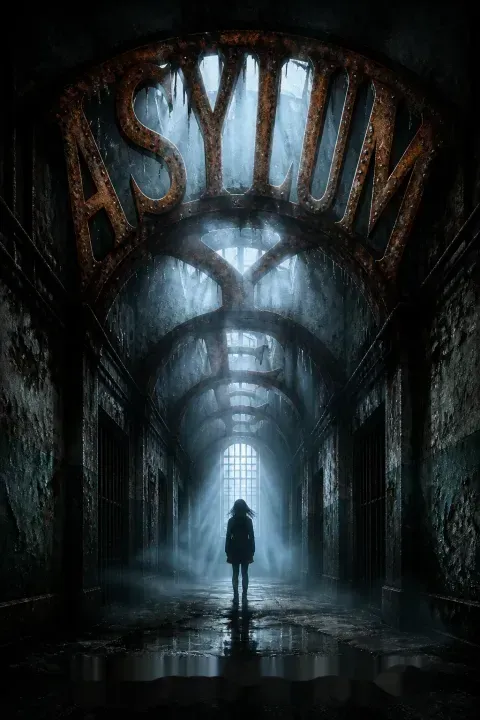
Builders used dark gray stone pried from unforgiving mountains to construct Brookline, a house meant for those who could not care for themselves. It held people who heard voices, who harbored strange thoughts, who did things the outside world refused to understand. The walls were designed to keep them in, not to heal.
Once a patient crossed the threshold, they never left. The asylum was a final destination, a repository for lives society wished to forget. Its grim purpose settled into the foundation like groundwater, a cold permanence that decades of abandonment could not diminish.
The prologue establishes Brookline as both setting and antagonist, a sentient structure with appetite. The phrase once they came, they never left operates on multiple levels: literal death within the walls, spiritual entrapment for future visitors, and the persistence of trauma across generations. The asylum is presented not as a place of healing but as a maw, a digestive system that consumes human suffering and converts it into something structural and permanent. The gray stone pried from unforgiving mountains suggests nature itself has been conscripted into the project of incarceration.
Brookline's Watching
Dan Crawford's1 taxi jolts along a gravel road through dense New Hampshire forest until Brookline appears at the end of the lane like a warning. The summer college prep program has housed students in a former mental asylum, now painted and landscaped but still radiating menace.
Dan1 climbs to room 3808 and meets his roommate, Felix Sheridan,4 a rigidly formal boy who has color-coded his bookshelves and organized every possession with surgical precision.
In his desk drawer, Dan1 discovers a faded photograph of an older man in a doctor's coat, his eyes violently scratched out. When Dan1 asks, Felix4 mentions he found an abandoned warden's9 office on the first floor, the lock broken, filled with similar images. The suggestion hangs in the air like an invitation.
The opening establishes Brookline as a liminal space where the boundary between past and present is dangerously permeable. Dan's immediate physical unease and his uncanny knowledge of which road to take both hint at a connection to this place that predates conscious memory. The defaced photograph introduces the novel's central motif: erased identity and the violence of being seen. Felix's mention of the unlocked office dangles bait before a boy whose historical curiosity will prove both his greatest asset and his deepest vulnerability.
The Photographs in the Dark
At the welcome social, Dan1 nearly faints and is caught by Abby Valdez,2 a petite artist with paint-splattered clothes and feathers woven into her hair. She introduces Jordan,3 a sharp-witted math prodigy she befriended on the bus, who fled a conversion therapy camp to secretly attend NHCP.
Dan1 mentions the warden's9 office, and despite Jordan's3 terror of getting expelled, they agree to investigate after dark. Jordan3 picks the padlock. Inside the dust-choked room, they find stacks of photographs documenting psychiatric horrors: patients in restraints, a woman in an electroshock helmet, naked victims cowering under hydrotherapy hoses.
Abby2 becomes transfixed by a framed portrait of a young girl8 with a jagged scar across her forehead and vacant, lobotomized eyes. She tries to take the photograph but Dan1 insists she leave it behind.
The photographs convert abstract institutional horror into specific, documented cruelty. Each image is a witness statement. Abby's immediate attachment to the lobotomized girl operates below conscious reasoning: she senses a connection she cannot yet name. Her attempt to rescue the photograph foreshadows her deeper mission to rescue the girl herself. Dan's insistence on leaving it reveals his instinctive respect for the dead's claim on their own history, a boundary the warden never honored.
Cells Below the Surface
Dan1 researches Brookline online and discovers a conspiracy website by Sal Weathers7 detailing the asylum's darkest chapter: serial killer Dennis Heimline, called the Sculptor, who murdered over a dozen people and posed their bodies like statues in macabre tableaux.
Heimline was committed to Brookline, but when the facility closed in 1972, his body was never recovered. After a first date with Abby2 at a local sandwich shop, interrupted by ghost emails about patient 361 that appear and vanish from his phone, the trio returns to the warden's9 office. Dan1 finds a filing cabinet sitting crooked against the wall.
Behind it, a hole in the brick opens onto a steep stairwell. He and Abby2 descend into a corridor of abandoned cells while Jordan3 keeps watch above. At the end, they enter a pristine inner office where Dan1 tries on a pair of spectacles and sees his own face reflected over the warden's9 photograph.
The descent into Brookline's subterranean levels maps onto the psychological descent Dan has already begun. The phrase patient 361 appearing in ghost emails before Dan knows its significance suggests the past is actively reaching toward him, not waiting to be discovered. When Dan puts on the warden's spectacles and sees his face superimposed, the novel announces its central thesis: Dan is not merely investigating the warden's crimes; he is being claimed by the warden's legacy.
The Warden's Shared Name
Jordan3 discovers alphabetized cabinets of patient record cards. Every card shows a Y for Homicidal and an N for Recovered, except one that Dan1 secretly pockets while Joe the hall monitor10 interrupts them. The card belongs to Dennis Heimline, patient 361, and the Recovered box is marked Y.
Abby2 fakes a tearful breakdown to convince Joe10 not to report them. Back in his room, Dan1 examines a leather folder he took from the inner office. Inside, a torn journal page written in dense cursive describes the warden's9 determination to find the root of madness through experimental surgeries, to leave a legacy no one could fault.
The signature at the bottom reads Daniel Crawford.9 Dan1 stares at his own name written in a dead man's hand. The ghost emails, the visions, the inexplicable pull toward Brookline all snap into a single terrifying possibility.
The patient cards paint Brookline as a warehouse for the criminally insane where recovery was never the goal, making the Sculptor's Recovered: Y status an ominous anomaly. The warden's journal reveals a man who aestheticized cruelty as genius, who saw himself as a Michelangelo of the mind. The shared name is the novel's pivotal revelation: it transforms a haunted-building story into an inheritance narrative, raising the question of whether evil travels through bloodlines or through choices.
Hydra Under Attack
Dan1 visits Sal Weathers7 to learn more, but Sal's wife8 reacts with screaming violence when Dan1 introduces himself as Dan Crawford, and Sal7 throws him out. A note in spidery calligraphy appears on Dan's1 desk asking how to kill a hydra, with the answer on the back: strike at its heart.
At dinner, Abby2 reveals she found an index card for Lucy Abigail Valdez,8 her aunt, and believes the girl was committed to Brookline as a child. She describes finding letters from her grandfather apologizing for sending Lucy8 away. Jordan3 accuses her of fabricating the story for attention.
Their argument shatters the trio. Abby2 retreats to her art friends, Jordan3 obsesses over an unsolvable math problem, and Dan1 finds more anonymous notes, including one paraphrasing Ray Bradbury: insanity is relative, depending on who has who locked in what cage. The handwriting matches the first note perfectly.
The Hydra note weaponizes the trio's bond by using their professor's nickname as a threat: the stalker knows their intimate dynamics. Abby's Lucy revelation retroactively explains her fixation on the lobotomized girl's photograph and suggests larger forces orchestrated their convergence at Brookline. Jordan's skepticism is understandable but cruel, born from his own experiences of being gaslit by his parents. The notes' literary allusions give the stalker a disturbingly refined quality, as if madness and erudition are old companions.
The First Body Drops
Returning from another basement exploration, Dan1 and Abby2 find Brookline flooded with police. Felix4 discovered Joe the hall monitor10 dead on the main staircase, his body propped upright with one hand on the railing and the other holding his cell phone, posed unnaturally like a mannequin.
The arrangement mirrors the Sculptor's signature method. Dan1 and Abby2 lie to investigators about their whereabouts, claiming they were on the second floor. The program director announces counselors and refunds. A suspect is arrested in town carrying Joe's10 wallet and a garrote, but Dan1 cannot accept this easy resolution.
The pose was too deliberate, the timing too coincidental. Something is reaching out from Brookline's buried history, and the arrest of a random drifter feels like a curtain drawn across a stage where the real performance is just beginning.
Joe's murder converts the supernatural threat from atmospheric dread into lethal reality. The posing of the body is not merely a killing but a statement: the Sculptor's aesthetic has survived his physical death. Dan's instinct to lie to the police, while self-protective, also reflects his growing understanding that the truth about his connection to the warden would make him unbelievably suspect. The quick arrest provides false closure that will enable the real predator to continue.
Suspicion Falls on Dan
Jordan's3 roommate Yi11 is found unconscious and carefully posed on the same staircase. Dan1 discovers him, calls 911, and watches paramedics carry Yi11 away alive but gravely injured. Dan1 tells Abby2 and Jordan3 about the Sculptor, and they urge him to inform the police, but Officer Teague6 dismisses the theory: the Sculptor died in 1972.
Later, Jordan3 receives a text from Dan's phone asking to meet at the vending machines at 3am. Dan1 has no memory of sending it. He searches his notebooks and discovers passages written in looping script that is not his own, a handwriting he now recognizes as the warden's.9
The possibility that he is writing the threatening notes to himself during dissociative blackouts settles over him like a diagnosis: he might be the danger, not the victim.
The ambiguous nature of the ghost texts is the novel's most psychologically sophisticated element. They could represent supernatural possession, a dissociative fugue state, or a technologically sophisticated frame job. The novel refuses to resolve this ambiguity because Dan himself cannot resolve it. His dissociative disorder means he is permanently uncertain about his own agency, a state that mirrors the loss of control experienced by Brookline's original patients.
The Fifth Floor Ambush
A text from an unknown number lures Dan1 to the fifth floor, where he finds Felix4 being bludgeoned by a large man with a crowbar. Dan1 tackles the attacker, who escapes through a window. When police arrive, they find messages on Dan's phone that appear to have summoned Felix4 to the ambush.
Officer Teague6 interrogates Dan1 with his parents present. Paul and Sandy reveal that Dan1 has a mild dissociative disorder and memory lapses, a disclosure that only deepens Teague's6 suspicion. The officer notes that Dan1 shares his full name with Brookline's last warden,9 a man who performed sadistic experiments on patients.
Felix4 wakes in the hospital and tells police he does not believe Dan1 attacked him. Dan1 is released but assigned a police escort, a guard who follows him everywhere, a visible reminder that he remains a suspect.
The interrogation scene crystallizes Dan's deepest fear: that his psychological vulnerabilities will be read as criminality. His parents' well-meaning disclosure of his dissociative disorder transforms him from witness to suspect in the eyes of the law. Felix's exoneration seems generous but will prove devastating in retrospect; it was never the real Felix speaking. The shared name with the warden functions as a kind of original sin that Dan cannot escape, a mark of Cain he did not choose.
Bloodlines in a Church
Desperate for proof of his sanity, Dan1 visits the Camford Baptist Church where Abby2 found Lucy's8 baptism record. Pastor Ted Bittle12 confirms the Crawford family history: the warden9 had two younger brothers, one a mechanic named Bill who had a baby boy just before Brookline closed.
The Crawfords were driven out of town in disgrace. The warden9 was arrested, attempted an insanity defense, but was killed in prison by another inmate. The Sculptor, however, was never found.
Walking back through a downpour, Dan1 takes shelter in the woods and stumbles upon a body tied between trees: Sal Weathers,7 posed in a grotesque bow, unmistakably the Sculptor's work. Dan1 flees without reporting what he found, paralyzed by the certainty that he would be blamed for a murder he discovered but did not commit.
The church scene provides genealogical proof that Dan is the warden's blood relative, making Brookline his literal inheritance. The pastor's description of the Crawfords being run out of town for bad blood externalizes the genetic determinism Dan fears: that violence travels through bloodlines like a hereditary disease. Sal Weathers's murder punishes the one person in Camford who tried to expose Brookline's secrets, demonstrating that the past does not want to be excavated.
Midnight in the Amphitheater
That night, a note slides under Abby's2 door summoning them to the basement at midnight for treatment. Jordan3 pleads with them not to go, but Dan1 insists he must confront whoever has been terrorizing him. Abby2 refuses to let him face it alone.
They descend the familiar path to the warden's9 office, but as they pass through the hidden passage, a metallic scraping sound freezes them: someone has pushed a filing cabinet against the opening, sealing them inside. A dark shape hurtles from the stairwell. Dan1 hears a hollow thud as Abby2 collapses.
Then a blow to his own head sends him into blackness. He wakes strapped to an operating table in a vast underground amphitheater, surgical instruments gleaming on a tray beside him, rows of abandoned spectator seating encircling the platform like the ghost of an audience.
The amphitheater reveal expands the novel's moral indictment from one man to an entire medical establishment. The spectator seating proves the warden's experiments were not secret atrocities but public performances, attended by colleagues who lent their professional legitimacy to torture. The space literalizes Brookline's function as a theater where vulnerable people were displayed, violated, and discarded for the edification of men in white coats.
The Sculptor Speaks Through Felix
A figure emerges in a white doctor's coat: Felix,4 barefoot and wild-eyed, moving with a puppeteer's jerkiness. He is not Felix.4 He is Dennis Heimline, the Sculptor, who has been waiting inside Brookline for decades. He confesses to every crime: killing Joe10 as Prelude, attacking Yi11 as Chaos, murdering Sal Weathers7 as Precautionary Measures.
He staged the crowbar attack on himself to deflect suspicion. Using Felix's4 body and Dan's own phone, he planted the notes, sent the ghost texts, and orchestrated the summer's terrors. The Sculptor's revenge was meant for Warden Crawford,9 but Dan1 will serve as a substitute.
The lights cut out. Jordan3 has followed them and frees both Dan1 and Abby.2 Dan1 tackles Felix,4 overcomes his unnatural strength, and straps him to the operating table. Then Dan1 picks up a scalpel. The warden's9 voice surges inside his skull, cold and certain, demanding he complete the experiment.
The Felix reveal recontextualizes every interaction: his formality was theatricality, his fitness obsession was vessel-building, his encouragement to explore was bait. The Sculptor names his crimes like artworks, revealing a mind that has so thoroughly aestheticized violence that murder and creativity are indistinguishable. Dan's impulse to use the scalpel is the novel's crucial test: can he resist the inheritance of cruelty, or is the warden's legacy inescapable?
I Will Never Be You
Dan1 experiences a vision of the warden's9 final hour, fleeing the amphitheater as police raid Brookline, blaming a little girl for his downfall. He returns to himself with the scalpel poised above Felix.4 With effort that feels like tearing his own identity apart, Dan1 drops the blade and declares he will never be the warden.9
Police swarm the amphitheater. Outside, Sal Weathers' wife8 attacks Dan1 with a knife, screaming. Officers restrain her, and her bangs fall aside to reveal the scar on her forehead. She is Lucy Valdez.8 Abby2 shows her a chipped ballerina music box from the basement, and Lucy8 cradles it, finally recognized after decades. The summer program terminates.
Dan,1 Abby,2 and Jordan3 pack their rooms and promise to stay in each other's lives. Professor Reyes5 visits with a ring of skeleton keys, noting the old wing is now permanently sealed. As Dan1 and Abby2 leave his room, a final note waits on the floor in familiar spidery handwriting, signed Daniel Crawford,9 promising to see him again soon.
Dan's rejection of the warden constitutes a moral victory that is simultaneously a psychological defeat: he proves that blood inheritance is not destiny, yet the final note insists the battle is not over and may never be. Lucy's emergence as Sal Weathers' wife provides emotional closure for Abby's quest while underlining the tragedy: she survived Brookline only to lose her husband to the same evil decades later. Professor Reyes' keys and her ambiguous timing raise unsettling questions about who truly controls access to Brookline's darkness.
Analysis
The novel operates as a sustained exploration of inherited trauma, asking whether evil travels through bloodlines or through the institutions that enable it. Brookline itself is the central metaphor: a structure built from unforgiving stone to contain what society refuses to see, a place where the boundary between cure and harm collapsed so completely that the two became indistinguishable. The warden's9 belief that madness has a physical root he can excise mirrors a broader cultural fantasy that deviance can be surgically removed, whether it is criminality, queerness, or simply inconvenient humanity. The trio at the novel's center each arrive at Brookline carrying their own invisible wounds. Dan's1 dissociative disorder makes him vulnerable to the suggestion that he is becoming what he studies. Abby's2 search for her lost aunt8 drives her toward truths she is not prepared to face. Jordan's3 terror of exposure and rejection mirrors the institutionalized patients' vulnerability. Their friendship becomes a counterforce to the asylum's isolating power, a chosen family that resists the gravitational pull of the past. The novel's central ambiguity, whether Dan1 is being possessed by the warden's9 spirit or succumbing to a hereditary mental illness, is precisely the point. The horror of Brookline is not that ghosts are real but that trauma reproduces itself. The warden's9 experiments were designed to find the root of madness and pull it out. What he actually did was plant seeds of suffering that germinated for decades, blooming into new violence, new victims, new perpetrators. The final note promising to see Dan1 again soon is not merely a sequel hook but a thesis statement: the past is patient, and it knows your name.
Review Summary
Asylum received mixed reviews, with an average rating of 3.64 out of 5. Some readers found it creepy and enjoyable, praising the atmospheric setting and plot twists. Others criticized the underdeveloped characters, predictable storyline, and lack of genuine scares. Many felt the book didn't live up to comparisons with Miss Peregrine's Home for Peculiar Children. The inclusion of photographs was divisive, with some finding them enhancing the creepy atmosphere while others thought they were poorly integrated. Overall, opinions varied widely on the book's effectiveness as a young adult horror novel.
People Also Read




Characters
Dan Crawford
Inheritor of a dark legacyA thoughtful, socially awkward teenager from Pittsburgh, Dan spent his early childhood in foster care before being adopted by Paul and Sandy. He has a mild dissociative disorder that causes memory gaps, a condition his therapist calls harmless but which becomes increasingly difficult to dismiss as the summer unfolds. Drawn to history and psychology, he sees NHCP as a chance to prove himself among intellectual peers. His earnestness makes him easy to root for and occasionally easy to manipulate. The discovery that he shares his full name with Brookline's sadistic last warden9 transforms his summer into an investigation of whether identity is inherited or chosen.
Abby Valdez
Artist searching for lost familyA talented visual artist from New York City, Abby is warm, impulsive, and fiercely independent. She wears paint-splattered clothes and feathers in her hair, defying easy classification. Beneath her cheerful exterior, she carries a secret: she chose the New Hampshire program partly to investigate her missing aunt Lucy8, whom she believes was institutionalized at Brookline as a child. Her creative intensity sometimes bleeds into obsession, as when she becomes fixated on a photograph of a lobotomized girl8. She forms a romantic connection with Dan1 that complicates the trio's dynamic, though her loyalty to both friends remains unwavering even when tested.
Jordan
Math prodigy hiding his truthA gay math prodigy from Virginia, Jordan is witty, sarcastic, and deeply guarded. His conservative parents believe he is attending a conversion therapy camp; his uncle secretly funded his actual NHCP tuition. Fear of exposure and parental rejection drives his caution, making him the most reluctant participant in the trio's explorations. Beneath his sharp banter lies a profound fear of abandonment, triggered when Abby2 and Dan's1 romance threatens to exclude him. His mathematical brilliance becomes both refuge and obsession as the summer's horrors mount, his walls plastered with equations for an unsolvable problem that mirrors his own internal state.
Felix Sheridan
Roommate with a hidden faceDan's1 assigned roommate, Felix is rigidly formal, unnervingly precise, and seemingly incapable of casual conversation. He color-codes his bookshelves, speaks like a textbook, and maintains a workout regimen that rapidly transforms his spindly frame. His peculiarities initially read as harmless eccentricity: the starched shirts, the protein shakes, the encyclopedic knowledge of biology. He is the one who first mentions the unlocked warden's9 office to Dan1, setting the entire investigation in motion. Whether his strangeness is merely social awkwardness or something more sinister is a question that will define the summer's darkest revelations.
Professor Reyes
Keeper of the asylum's keysThe History of Psychiatry instructor, a chain-smoker who wears turquoise jewelry and speaks with conspiratorial warmth. She encourages Dan's1 interest in Brookline while warning him about local superstitions. Her possession of the skeleton keys to the old wing and her plans to archive its contents place her at the intersection of academic access and institutional secrecy.
Officer Teague
Skeptical local policemanA veteran Camford policeman with a weary skepticism and a graying mustache. He knows the town's dark history intimately but clings to rational explanations, dismissing the students' theories about the Sculptor until evidence makes denial impossible. His suspicion of Dan1 is both professional instinct and small-town prejudice against the Crawford name9.
Sal Weathers
Conspiracy blogger silenced foreverAn amateur historian and conspiracy blogger who compiled every scrap of Brookline's sordid history into a garish website. He despises the college and petitions tirelessly to have the asylum demolished. His hostility toward Dan1 upon hearing the name Crawford9 hints at knowledge he has not fully shared, knowledge that will prove fatal.
Lucy Valdez
Lobotomized aunt, lost then foundAbby's2 paternal aunt, institutionalized at Brookline as a child and subjected to a lobotomy that left her with a distinctive forehead scar. Presumed lost for decades, she survived and remained in Camford, her identity hidden even from herself. Her story is the human cost behind Brookline's clinical records.
Warden Daniel Crawford
Sadistic physician of the mindBrookline's final and most infamous director, a physician who believed he could surgically excise madness at its biological root. His experiments on patients, including children, were documented in photographs and journals that reveal a man who saw himself as a visionary artist. His signature matches Dan's1 name exactly, a connection that haunts the novel's central mystery.
Joe McMullan
Hall monitor, first victimThe redheaded hall monitor who catches the trio in the forbidden wing and lets them off with a warning. His leniency costs him his life when he becomes the Sculptor's first victim in decades.
Yi
Cellist roommate, second targetJordan's3 roommate, a cellist who dreams of studying in Paris. His friendly, talkative nature makes him an easy target. He survives the attack that leaves him posed and unconscious on Brookline's staircase.
Pastor Ted Bittle
Bearer of town's buried historyThe elderly pastor of Camford Baptist Church who helps Abby2 find Lucy's8 baptism record and reveals the Crawford9 family history to Dan1. His surname connects him to one of Brookline's homicidal patients.
Plot Devices
Patient Index Cards
Catalog of the criminally insaneThe alphabetized cabinets in the warden's9 outer office contain index cards for every patient committed to Brookline. Each card records name, birth date, admission date, whether the patient was homicidal, and whether they recovered. The cards reveal an asylum that functioned as a prison for murderers rather than a treatment facility: every single card shows Homicidal Y, and every card except Dennis Heimline's shows Recovered N. The cards provide the first concrete evidence of Brookline's true purpose and introduce the anomaly that drives the mystery: a serial killer officially pronounced cured, then never found after the asylum closed.
The Warden's Journal
Record of experimental philosophyTorn pages in dense cursive handwriting document the warden's9 private thoughts about his work. He writes of finding the root of madness, of necessary sacrifices, of building a legacy that would outlive him. The journal reveals a man who rationalized torture as scientific progress, who compared himself to Michelangelo dissecting cadavers to perfect his art. The signature Daniel Crawford9 at the bottom of one page provides the novel's pivotal revelation: the warden9 shares Dan's1 full name. The journal's language blurs the line between physician and artist, healer and predator, forcing readers to confront how easily cruelty disguises itself as conviction.
Dan's Cell Phone
Tool of psychological warfareDan's phone becomes the medium through which an unseen antagonist manipulates him. Ghost emails about patient 361 appear and vanish from his inbox. Text messages sent from his own number summon his friends to dangerous locations, messages he has no memory of composing. The phone exploits Dan's1 dissociative disorder, using his documented memory gaps to make him doubt his own innocence. It is the perfect weapon: a device that creates evidence of guilt while leaving the true sender invisible, turning Dan's1 own technology into an instrument of gaslighting and self-doubt.
The Music Box
Key to Lucy Valdez's identityA chipped porcelain ballerina music box discovered in one of Brookline's underground cells. When wound, it plays a dissonant, haunting melody. An inscription on the bottom reads To Lucy8: On your birthday with love. The music box is the only surviving artifact of Lucy Valdez's8 childhood, proof that the little girl in the lobotomy photograph was real and that someone loved her. Decades later, when Abby2 presents the music box to the scarred woman attacking Dan1, recognition flickers across her face: the ballerina is the key that unlocks Lucy's8 buried memories and proves she is Abby's2 long-lost aunt.
The Warden's Spectacles
Symbol of shared identityA pair of old, brittle spectacles found on the warden's9 desk in the hidden inner office. When Dan1 impulsively tries them on, he sees his own face reflected over the warden's9 photograph, their features merging in the glass. The spectacles function as a symbolic bridge between past and present, between the warden9 who performed atrocities and the teenager who shares his name. They recur in Dan's1 visions and nightmares as a totem of the possession gradually taking hold of his consciousness, a physical reminder that the warden's9 legacy is not merely historical but actively seeking a new vessel.
FAQ
Synopsis & Basic Details
What is Asylum about?
- A Summer Program's Dark Twist: Asylum follows Dan Crawford, a history-obsessed teenager attending a summer college prep program. Due to renovations, students are housed in Brookline, a former psychiatric hospital with a dark past, immediately unsettling Dan with its oppressive atmosphere and a strange sense of familiarity.
- Unraveling Hidden Horrors: As Dan and his new friends, Abby and Jordan, explore the forbidden areas of Brookline, they uncover chilling secrets about the asylum's unethical treatments and its most notorious patient, "The Sculptor", a serial killer who posed his victims.
- A Descent into Psychological Terror: The deeper they delve, the more their reality blurs with Brookline's history, as Dan experiences vivid nightmares, memory lapses, and receives cryptic messages, leading him to question his own sanity and his unsettling connection to the asylum's infamous director.
Why should I read Asylum?
- Immersive Psychological Horror: Readers seeking a blend of supernatural dread and psychological suspense will find Asylum compelling, as it masterfully blurs the lines between inherited madness, genuine haunting, and the characters' deteriorating mental states. The unsettling atmosphere of Brookline itself becomes a character, amplifying the internal struggles of the protagonists.
- Unique Found Footage Aesthetic: The novel is enhanced by unsettling, real-life photographs of abandoned asylums, which are integrated into the narrative, adding a chilling layer of verisimilitude and a unique visual dimension to the horror experience. This stylistic choice deepens the sense of authenticity and dread, making the fictional events feel disturbingly real.
- Exploration of Deep Themes: Beyond jump scares, Asylum delves into profound themes such as the legacy of trauma, the ethics of mental health treatment, the blurred boundaries between genius and madness, and the struggle for identity. It prompts readers to consider how the past can haunt the present, both literally and metaphorically, and the pervasive nature of institutional abuse.
What is the background of Asylum?
- A Real-World Inspired Setting: The fictional Brookline asylum is inspired by real psychiatric institutions and their often-dark histories, drawing on the historical context of antiquated and inhumane mental health treatments like lobotomies and electroshock therapy. This grounds the horror in a disturbing reality, reflecting a period when "cures" were often more torturous than the illnesses themselves.
- New England Gothic Atmosphere: Set in New Hampshire, the novel leverages the classic New England gothic tradition, with its dense forests, isolated towns (Camford), and old, imposing stone buildings. This geographical and architectural backdrop enhances the sense of isolation, decay, and lingering malevolence, typical of the genre.
- Cultural Commentary on Mental Health: The story subtly critiques historical approaches to mental health, highlighting the societal tendency to "lock away" those deemed different or dangerous, rather than truly heal them. The narrative questions the very definition of "madness" and "sanity," suggesting that the institutions themselves could be agents of psychological harm.
What are the most memorable quotes in Asylum?
- "La locura es relativa. Depende de quién tiene a quién encerrado en qué jaula." (Madness is relative. It depends on who has whom locked in what cage.): This quote, attributed to Ray Bradbury within the story, encapsulates the novel's central theme of perception and confinement, questioning who truly holds power and defines sanity within Brookline's walls. It highlights the subjective nature of mental illness and the oppressive environment of the asylum.
- "No hay genio sin un gramo de locura." (There is no genius without a touch of madness.): This Aristotelian quote, found in Dan's notes, directly links the intellectual pursuits of the students with the dark history of the asylum's director, Daniel Crawford. It foreshadows Dan's own struggle with his identity and the fine line between brilliance and psychological instability, suggesting a dangerous allure to the director's "vision."
- "Nos veremos pronto. Daniel Crawford." (We'll see you soon. Daniel Crawford.): The chilling final line of the book, left on a note for Dan, serves as a powerful, ambiguous cliffhanger. It implies that the malevolent spirit or influence of the director, and perhaps the asylum's evil, is not truly vanquished, leaving readers with a lingering sense of dread and the possibility of a continuing cycle of horror.
What writing style, narrative choices, and literary techniques does Madeleine Roux use?
- First-Person Limited Perspective: The story is primarily told from Dan Crawford's first-person perspective, immersing the reader directly into his deteriorating mental state and unreliable perceptions. This narrative choice heightens suspense and paranoia, as the reader experiences Dan's confusion and fear firsthand, blurring the lines between reality and hallucination.
- Integration of Visuals and Text: Roux uniquely incorporates actual vintage photographs of asylums and medical procedures throughout the text, creating a "found footage" or "documentary" feel. This multimedia approach enhances the horror, lending a disturbing authenticity to the fictional events and making the historical context viscerally real.
- Pacing and Atmosphere: The novel employs a slow-burn psychological build-up, gradually escalating the tension and dread through atmospheric descriptions of Brookline and Dan's internal turmoil. This deliberate pacing allows the unsettling atmosphere to permeate the narrative, culminating in bursts of intense action and shocking revelations that keep the reader on edge.
Hidden Details & Subtle Connections
What are some minor details that add significant meaning?
- Félix's Physical Transformation: Initially described as "lanky" and "scrawny," Félix rapidly gains muscle and changes his habits, drinking "Muscle Force" and exercising. This subtle physical shift, initially attributed to protein shakes, foreshadows his later possession by the Sculptor, who was known for his strength and ability to "pose" victims, hinting at the physical manifestation of the entity's power.
- The Director's Lenses and Dan's Vision: Dan finds the director's "less rusted" lenses and tries them on, seeing his own reflection as the director. This seemingly minor detail is a powerful visual metaphor for Dan's inherited connection and the blurring of his identity with the director's, suggesting that he is literally seeing the world through the director's eyes and inheriting his "vision" or madness.
- The Music Box's Recurring Melody: The "disjointed, off-key" music box found in Lucy's cell, playing an "ancient" song, reappears in Dan's vision of the Sculptor's bar massacre. This musical motif subtly links Lucy's trauma to the Sculptor's atrocities, implying a deeper, perhaps shared, source of suffering or a common thread of the asylum's influence on its victims and perpetrators.
What are some subtle foreshadowing and callbacks?
- Dan's Initial Premonition: Upon arriving at Brookline, Dan feels a voice whisper, "Regresa ahora" (Go back now), and senses the building is "observing him." This early, almost throwaway line subtly foreshadows the asylum's active, malevolent presence and its specific interest in Dan, hinting at his predetermined connection to the place.
- The "Hydra" Nickname: Professor Douglas nicknames Dan, Abby, and Jordan "the Hydra" due to their tendency to stick together. This seemingly innocuous nickname later becomes a direct callback in a threatening note ("¿Cómo matas a una Hidra?"), foreshadowing the attempts to break their bond and isolate Dan, mirroring the mythological creature's vulnerability to a "strike to the heart."
- Jordan's Fear of Expulsion: Jordan's repeated, almost obsessive, fear of being expelled ("definitely not the first day") is initially played for comedic effect but subtly foreshadows the severe consequences of their rule-breaking and the real-world stakes of their investigation, culminating in his family's disapproval and his desperate need for a safe haven.
What are some unexpected character connections?
- Pastor Bittle's Family Link: The kind pastor who helps Abby and Dan is revealed to be Ted Bittle, a relative of Frank Bittle, one of Brookline's "homicidal" patients. This connection subtly implies that the trauma and "madness" of Brookline extended beyond its walls, affecting the town's residents and suggesting a generational legacy of the asylum's influence, even on seemingly normal citizens.
- Sal Weathers's Wife and Lucy Valdez: Sal Weathers's wife, who reacts violently to Dan's name, is later revealed to be Lucy Valdez, Abby's aunt. This unexpected connection highlights the profound, lasting trauma inflicted by Brookline's experiments, showing how a victim of the asylum's past (Lucy) is still deeply affected and capable of violence in the present, directly linking the historical horrors to the current events.
- Félix's Unseen Vulnerability: Despite his meticulous nature, Félix's rapid physical transformation and his later confession of being "too easy to mold" reveal an unexpected vulnerability. This suggests that his rigid adherence to order was a fragile defense mechanism, making him a prime target for the Sculptor's possession and highlighting the psychological toll of repression.
Who are the most significant supporting characters?
- Yi, the Unwitting Victim: Jordan's roommate, Yi, initially appears as a minor character, a cello player. However, his attack, described as being "posed like a sculpture," serves as crucial evidence that the Sculptor's methods are still active, directly escalating the threat and forcing Dan and Abby to confront the reality of the danger.
- Joe McMullan, the First Casualty: The well-meaning prefect, Joe, is the first victim found "sculpted" on the stairs. His death is the catalyst that transforms the students' curiosity into genuine fear and suspicion, bringing police involvement and forcing the main trio to confront the deadly reality of Brookline's lingering evil.
- Sal Weathers, the Dismissed Prophet: The local conspiracy theorist, Sal Weathers, is initially dismissed as a "paranoid" eccentric. However, his detailed website and his violent reaction to Dan's name prove his knowledge of Brookline's true horrors, and his subsequent murder validates his warnings, making him a tragic figure whose truth was ignored.
Psychological, Emotional, & Relational Analysis
What are some unspoken motivations of the characters?
- Dan's Quest for Belonging: Beyond his academic interest in history and psychology, Dan's deep dive into Brookline's past is subconsciously driven by his own history in the foster care system. His "fascination for social machines" and systems that "make decisions for people" reflects a personal need to understand control and belonging, seeking answers about his own origins and identity in the asylum's records.
- Abby's Need for Closure: Abby's intense obsession with the lobotomized girl's photograph and her aunt Lucy is fueled by an unspoken desire for familial closure and healing. Her parents' marital strife and her father's silence about Lucy suggest a deep-seated family trauma that Abby instinctively seeks to resolve, hoping to mend her own fractured family by understanding the past.
- Jordan's Search for Acceptance: Jordan's witty sarcasm and initial reluctance to engage with Brookline's mysteries mask a profound fear of rejection, stemming from his parents' disapproval of his sexuality. His loyalty to Dan and Abby, despite his skepticism, reveals a deep-seated need for a chosen family and a safe space where he can be his authentic self, making his eventual betrayal by Félix particularly devastating.
What psychological complexities do the characters exhibit?
- Dan's Dissociative Identity Struggle: Dan exhibits a complex struggle with his identity, experiencing vivid hallucinations, memory lapses, and even writing notes to himself in the director's handwriting. This "mild dissociative disorder" (as his therapist calls it) blurs the line between his own psyche and the director's lingering influence, making him question if he is merely a victim or an unwitting participant in the asylum's horrors.
- Abby's Empathic Overidentification: Abby's strong empathy leads her to overidentify with the suffering patients, particularly Lucy. Her desire to "rescue" the photograph and her aunt's memory borders on obsession, highlighting the psychological toll of vicarious trauma and the danger of becoming too deeply immersed in another's pain, potentially losing herself in the process.
- Jordan's Coping Mechanisms: Jordan's use of humor and intellectualism (his "impossible problem") serves as a sophisticated coping mechanism to distance himself from emotional pain and the chaos around him. His nightmares, however, reveal the fragility of these defenses, showing how the asylum's horrors penetrate his carefully constructed emotional barriers, forcing him to confront his deepest fears.
What are the major emotional turning points?
- Dan's First Vision of the Cell: When Dan first "sees" his room as a stone cell with blood-stained shackles, it's a pivotal moment that shatters his rational worldview and introduces the terrifying possibility of a supernatural or psychological connection to Brookline. This experience marks the beginning of his personal descent into the asylum's madness.
- Abby's Revelation of Lucy's Identity: Abby's discovery that Lucy Valdez, the lobotomized girl, is her aunt, is a profound emotional turning point. It transforms the abstract horror of Brookline into a deeply personal trauma, fueling her determination to uncover the truth and forcing her to confront her family's hidden history.
- Jordan's Nightmare Confession: Jordan's raw confession of his recurring nightmare—being electrocuted by faceless doctors while his parents watch—is a major emotional turning point for the trio. It reveals the depth of his personal anxieties about his sexuality and family rejection, and it also validates Dan's own terrifying visions, solidifying their shared experience of Brookline's psychological torment.
How do relationship dynamics evolve?
- The Trio's Initial Unity and Subsequent Strain: Dan, Abby, and Jordan initially form a strong, supportive bond, united by their outsider status and shared curiosity about Brookline. However, as the asylum's influence intensifies and personal secrets are revealed, their trust is severely tested, leading to arguments, suspicion, and a temporary fracturing of their friendship, as seen in their strained interactions at meals.
- Dan and Félix's Unsettling Roommate Dynamic: What begins as a seemingly innocuous, if awkward, roommate relationship between Dan and Félix subtly shifts into a predatory one, with Félix (as the Sculptor) manipulating Dan from the start. Félix's initial "help" in finding the office and his later physical transformation highlight the insidious nature of the possession and the complete subversion of their initial dynamic.
- Abby and Jordan's Shifting Alliance: Abby and Jordan's relationship evolves from casual bus acquaintances to a deeply supportive friendship, with Abby often acting as Jordan's confidante regarding his family issues. Their shared trauma at Brookline strengthens their bond, even when they disagree with Dan, demonstrating a resilient loyalty that helps them navigate the escalating horrors.
Interpretation & Debate
Which parts of the story remain ambiguous or open-ended?
- The Nature of the "Possession": The novel leaves it ambiguous whether Félix is truly possessed by the spirit of the Sculptor/Director, or if he is suffering from a severe psychological break, perhaps influenced by the asylum's oppressive atmosphere and his own repressed issues. The narrative provides evidence for both supernatural and psychological interpretations, allowing readers to debate the true source of the evil.
- Dan's Inherited Madness vs. External Influence: It's unclear to what extent Dan's dissociative episodes and his connection to the director are due to a genetic predisposition ("in his blood") or if they are purely a result of Brookline's malevolent influence and the psychological stress he endures. The ending, with the director's note, suggests a lingering, perhaps inescapable, connection.
- The Asylum's True "Closure": While the program is cancelled and Brookline is "closed indefinitely," the final note from "Daniel Crawford" implies that the asylum's evil is not truly contained or gone. This leaves the ending open to interpretation: has the cycle of trauma been broken, or is it merely dormant, waiting for new victims to return to its "twisted roots"?
What are some debatable, controversial scenes or moments in Asylum?
- The Ethics of the Director's "Cures": The director's writings, particularly his pursuit of "a truly extraordinary life" through "macabre" sacrifices and his belief that "genius is an expectation," present a highly controversial view of mental health treatment. This raises ethical debates about the historical abuses in asylums and the fine line between scientific ambition and monstrous cruelty.
- Abby's Decision to Confront Her Father: Abby's choice to immediately tell her father about Lucy, despite warnings from Dan and Jordan, is debatable. While driven by a desire for truth, it causes immense distress to her father, prompting questions about the timing and method of revealing traumatic family secrets, and whether immediate "truth" is always the best path to healing.
- Dan's Final Act of Violence Against Félix: Dan's decision to physically subdue Félix, even contemplating using the scalpel, is a controversial moment. It forces readers to question whether he is succumbing to the director's influence or simply acting in self-defense. This scene blurs the line between hero and potential perpetrator, highlighting the corrupting power of the asylum's environment.
Asylum Ending Explained: How It Ends & What It Means
- The Climax: Confrontation and Subdual: The story culminates in Dan, Abby, and Jordan confronting Félix in the surgical amphitheater. Félix, revealed to be under the influence of the Sculptor/Director, confesses to the attacks on Joe, Yi, and Sal Weathers, seeking "revenge" on "Daniel Crawford." Dan, struggling with the director's influence, nearly succumbs to violence but ultimately resists, and the trio subdues Félix, who is then taken to a psychiatric hospital.
- Partial Resolution and Lingering Trauma: Abby successfully reunites with her aunt Lucy, who is revealed to be Sal Weathers's traumatized wife, providing a glimmer of hope and closure for her family. The police arrest the man who killed Joe (though his connection to the Sculptor is dismissed), and the summer program is cancelled. However, the ending leaves many questions unanswered, particularly regarding the true nature of Félix's condition and the extent of the asylum's supernatural influence.
- The Unbroken Cycle: "Nos veremos pronto. Daniel Crawford.": The final, chilling note found by Dan, signed "Daniel Crawford," signifies that the malevolent presence or legacy of the director is not truly gone. This suggests that the "madness" of Brookline is cyclical and perhaps inescapable, implying that Dan, despite his resistance, remains connected to its dark history. The ending serves as a powerful warning that some traumas, once unleashed, can never be fully contained, leaving the characters, and the reader, forever haunted.
About the Author
Other books by Madeleine Roux
Download PDF
Download EPUB
.epub digital book format is ideal for reading ebooks on phones, tablets, and e-readers.








































