
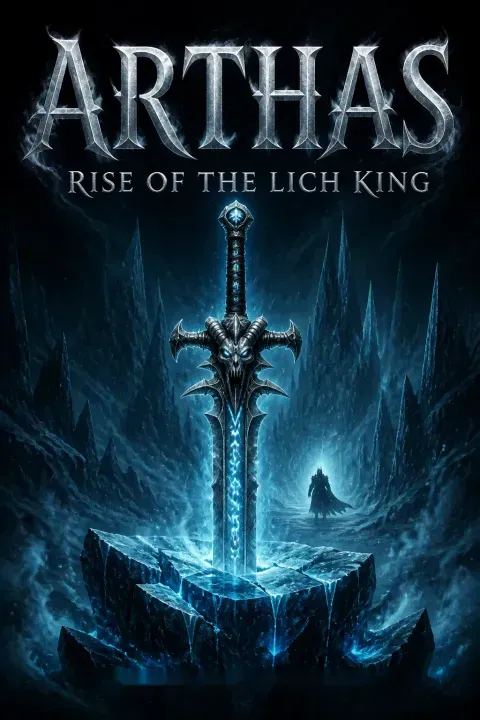


Plot Summary
Prologue
The wind shrieks like a child in pain outside a great hall where three figures sit at a carved table: a man,1 an orc with a skull painted on his face,9 and a sickly boy.13 The man1 understands he is dreaming and has been dreaming for a very long time. The orc9 insists the boy13 will not last and urges the man1 to eliminate this last fragment of weakness.
The boy,13 emaciated with oozing pustules and sunken sea-green eyes, struggles to speak, insisting the battle is not yet won. The man1 grows weary of their endless struggle and demands it end. The hall transforms, the door slams open, snow whirls inside, and the boy13 is knocked from his chair. Still, he whispers that all is not lost. The man1 hears him despite the chaos.
The prologue externalizes the Lich King's fractured psyche as three competing entities sharing a single consciousness. The man represents Arthas's dominant will, the orc embodies Ner'zhul's influence (the original Lich King's spirit, signified by the shamanic skull paint), and the sickly boy personifies the lingering remnants of Arthas's humanity: compassion, love, guilt, and conscience. The boy's sickness reflects how starved and near-extinguished these qualities have become. The orc's demand for elimination mirrors the psychological process of radicalization, where empathy is reframed as weakness to be purged. The setting (a great feast hall) ironically evokes warmth and community, values Arthas has systematically destroyed. The wind's shrieking is the collective anguish of his victims rendered audible, a permanent atmospheric pressure in the Lich King's dreamscape.
The Price of Arrogance
At nine years old, Prince Arthas Menethil1 sneaks away from the palace to the Balnir farmstead, where he witnesses the birth of a foal. The colt, gray and damp and trembling, locks eyes with him, and Arthas1 names him Invincible.
He waits impatiently for two years while the horse matures, but at eleven, ignoring the horsemaster's warnings about growing bones, he rides the stallion alone through the Tirisfal Glades. On a familiar icy jump, Invincible's hind hooves slip. The horse crashes down, both forelegs shattering. Arthas,1 bruised and sobbing, drags himself to the screaming animal.
No healer is near, and the winter storm howls. He draws his sword and stabs Invincible through the heart. Found later by the Balnirs, he lets them believe it was an accident, and secretly vows to never fail to protect anyone again, whatever the cost.
This childhood trauma functions as the psychological template for Arthas's entire arc. The guilt over Invincible fuses with his royal sense of duty to create a toxic compound: any failure to protect becomes a moral catastrophe requiring absolute redress. His secrecy about his culpability establishes a lifelong pattern of concealing shame behind a heroic façade. The vow to do 'whatever it takes' begins nobly but contains the seeds of utilitarianism that will later rationalize Stratholme. Psychologically, Invincible becomes the first sacrifice Arthas makes for his own mistakes, foreshadowing how he will sacrifice others while believing himself the victim of circumstance rather than the author of his own disasters.
Jaina's First Snowball
Arthas's1 warrior training begins in earnest after Muradin Bronzebeard,6 the dwarven ambassador, catches the eleven-year-old flinging a practice sword across the armory. Instead of mockery, Muradin6 offers to teach him properly.
Years of brutal sessions follow, leaving Arthas1 bloodied and bruised, but by fourteen he finally defeats his teacher and earns Muradin's6 gruff respect. Meanwhile, Jaina Proudmoore2 enters his life during a family prayer service. He arranges to escort the admiral's daughter to Dalaran, and on the journey they sneak to spy on an orc internment camp at night, cementing their friendship.
Years later, at Dalaran, their bond ignites. During a summer ride, Arthas1 pelts Jaina2 with snowballs gathered from high mountain slopes. Laughing and shivering, she steps into his arms, and their first kiss transforms a friendship into something far deeper.
The twin influences of Muradin and Jaina establish the competing poles of Arthas's character. Muradin's training valorizes endurance and winning at any cost; Jaina offers intellectual curiosity and measured compassion (she pities the imprisoned orcs despite her brother's death at their hands). The snowball kiss scene captures their essential dynamic: Arthas creates spontaneous adventures that draw Jaina out of her scholarly shell, while she provides the emotional grounding he craves but fears. Their stolen moments in alcoves and corridors speak to a relationship built on genuine affection but conducted in shadows, unable to withstand the public scrutiny and moral crisis that will eventually tear them apart at Stratholme.
The Light's Hesitation
At nineteen, Arthas1 rides through Stormwind in sweltering plate armor toward the Cathedral of Light for his induction into the Order of the Silver Hand. King Terenas,7 Uther the Lightbringer,3 and dignitaries from every Alliance kingdom fill the cathedral. Jaina's2 smile steadies his nerves.
Archbishop Alonsus Faol asks the assembled paladins and clerics to bestow their blessing. Glowing hands lift, beams of holy light converge on the kneeling prince, and for a terrible moment nothing happens. Arthas1 sweats alone in the silence. Then finally, light pours through him, scouring like a blade and settling into warmth.
He lifts the ceremonial hammer with preternatural ease, the Light making it weightless. Afterward, he impulsively embraces Jaina2 in the crowd, the celebration blurring into relief. But the Light's delay has planted a seed of doubt: was it testing him, or warning him?
The Light's hesitation is the narrative's most explicit supernatural omen. It externalizes an internal truth: Arthas fundamentally misunderstands what it means to serve. He treats the Light as a tool (like a sword) rather than a relationship requiring humility and surrender. The moment stretches because the Light, in this cosmology, possesses discernment; it senses the pride and impatience that will curdle into tyranny. Arthas's interpretation (that no one feels worthy) dismisses the warning as universal imposter syndrome. The contrast between the sacred ritual and his impulsive embrace of Jaina reveals his compartmentalization: he can receive holy power and immediate gratification without integrating them. This dis-integration is the fault line that will eventually split him apart.
The Broken Promise at Winter Veil
Following his induction, Arthas1 spends months at Dalaran ostensibly studying history, but truly pursuing Jaina.2 Their secret romance deepens. At Lordaeron's Hallow's End festival, Jaina2 spectacularly ignites the great wicker man with a fire spell, and that night they become lovers in Arthas's1 chambers, bathed in the orange glow of the burning effigy.
But when Winter Veil arrives and Jaina2 appears in a gown of white and ice-blue, speaking casually of their future blond-haired children, Arthas1 panics. He tells her he is not ready, that he needs more training, that they should remain friends for now.
Jaina,2 pale and composed, agrees without protest. Arthas1 hugs her, relieved, and does not understand that he has just broken something irreplaceable. He tells himself this is for the best, that he is not closing the door, merely not opening it yet.
Arthas's rejection of Jaina reveals a profound terror of emotional vulnerability disguised as practicality. When confronted with the reality of commitment (embodied in her unguarded talk of children), he experiences the same panic that later grips him before the Frozen Throne: fear of a binding choice that limits future options. Psychologically, he cannot reconcile his public self (future king, paladin) with his private self (lover, equal partner). The breakup pattern will recur throughout his life: Arthas preemptively destroys relationships before they can constrain him. Jaina's composed acceptance, while dignified, reveals her own fatal pattern of suppressing needs to accommodate his volatility. He mistakes her composure for agreement rather than devastation, a misreading that will haunt them both.
Dead Farmers and Sweet Bread
Assigned jointly by King Terenas7 and Archmage Antonidas, Arthas1 and Jaina2 investigate a mysterious plague sweeping Lordaeron's northern villages. Their first reunion since the breakup is tentative, but duty overrides awkwardness. Approaching a silent farmstead, they catch the stench of carrion.
The dead burst from the farmhouse: rotting corpses wielding pitchforks and scythes. Jaina2 burns the building to ash. Moving toward Andorhal, they find granaries surrounded by dead, barren soil. Jaina2 touches the earth and recoils: the land itself is dying. They deduce the grain carries the plague, not merely killing victims but transforming them into undead.
When villagers in Hearthglen collapse and reanimate before Arthas's1 eyes after eating bread baked from tainted flour, the mechanism becomes horrifyingly clear. Black-robed necromancers direct the attacks from the shadows, and Arthas1 identifies their leader: the disgraced former archmage Kel'Thuzad.5
The plague investigation represents the collision of Arthas's paladin ideals with a horror that exceeds any training. His instinct to protect Jaina (healing her hand with the Light after she touches the dead soil) shows his humanity still intact. But the discovery that grain, the staff of life, has been weaponized into death shatters his fundamental assumptions about the world's order. The undead are not an enemy army to be fought honorably; they are a cancer that turns the innocent against themselves. This ontological rupture demands an extreme response, and Arthas's psychology, already primed for absolutism by his childhood vow, begins calcifying. Jaina's analytical approach and Arthas's physical one complement each other perfectly at this stage, making their eventual schism a tragedy of complementary strengths becoming irreconcilable differences.
Mercy by Massacre
Riding toward Stratholme, Arthas1 and Jaina2 smell the sweet scent of plagued bread baking. The grain has already been distributed; thousands have eaten it. Arthas1 calculates the horror: within hours, every man, woman, and child will die and rise as undead. He announces the city must be purged before they transform.
Uther3 refuses, citing his oath to protect the innocent. Jaina2 begs for time to find a magical cure. Arthas1 relieves Uther3 of command and brands him a traitor. Jaina,2 weeping, cannot watch and rides away. Arthas1 leads his loyal soldiers through the gates into the city.
A boy asks why his prince is killing him. A mother shields her child. Homes burn with the living locked inside. When the dreadlord Mal'Ganis8 finally appears, taunting from a rooftop, Arthas1 finds his vindication: the demon was here, the threat was real, and the terrible choice was necessary.
Stratholme represents the moral event horizon beyond which Arthas never returns. His utilitarian calculus (kill the infected to save the uninfected) is logically coherent but requires the psychological mechanism of dissociation: he redefines the citizens as 'already dead' to bypass his empathy. Both Uther and Jaina's refusals are not merely rejections of his plan but of his authority to redefine murder as mercy. Their departures sever his last connections to moral guidance. The scene's genius lies in its ambiguity: Arthas might even be right that no alternative exists, but his readiness to leap to mass slaughter without exhausting other options reveals a deeper truth about his character. The need for decisive action masks an inability to tolerate uncertainty and helplessness.
The Fleet in Flames
Pursuing Mal'Ganis8 across the sea, Arthas1 lands the Lordaeron fleet on Northrend's frozen coast. He reunites with Muradin Bronzebeard,6 who leads an expedition searching for the legendary runeblade Frostmourne. But when an emissary arrives with King Terenas's7 recall order (prompted by Uther3 ), Arthas's1 captains prepare to abandon the hunt.
Rather than return, Arthas1 hires mercenaries to douse the ships with oil and set them ablaze. He watches the fleet become a wall of fire on black water, then turns to his horrified troops and accuses the mercenaries of sabotage, leading the charge to slaughter them.
Muradin6 confronts him afterward, his voice thick with disbelief. Arthas1 insists necessity justified the betrayal. Muradin6 looks at the man he trained from boyhood and says he no longer recognizes the prince he once knew. Arthas1 does not waver.
The burning of the fleet represents a psychological point of no return more definitive than Stratholme. Stratholme could be debated as a brutal but potentially necessary military decision; the murder of the mercenaries is purely instrumental evil. Arthas does not merely disobey his father; he destroys the means of retreat, forcing total commitment to his path, and then lies to his own soldiers to maintain their loyalty. The deception introduces a new moral technology: Arthas weaponizes trust itself. Muradin's horror is the last external mirror held up to Arthas's conscience, and Arthas's dismissal of it signals he has stopped caring how others see him. The only audience that matters now is the voice beginning to whisper through the bond forming between him and the blade he has not yet found.
Frostmourne's Frozen Price
With Mal'Ganis8 pressing the camp and his forces dwindling, Arthas1 follows Muradin6 to a hidden cavern where Frostmourne floats suspended in a block of unnatural ice. A ghostly elemental guardian warns them away. Muradin6 translates an inscription: the blade grants eternal power but scars the wielder's spirit.
He begs Arthas1 to leave it. Arthas1 replies that his spirit is already scarred beyond saving. He calls out to whatever spirits will listen, offering anything to save his people. The ice explodes. A shard strikes Muradin,6 who collapses bleeding. Arthas1 tries to summon the Light to heal his old friend, but the glow dies in his hands.
Frostmourne calls to him. He drops his holy hammer forever, grasps the runeblade, and cold power floods through him. Muradin6 is left behind among the shattered ice. Arthas1 emerges and slaughters Mal'Ganis,8 though the dying dreadlord's laughter suggests Arthas1 has been manipulated from the beginning.
The Frostmourne scene is the Faustian transaction that completes Arthas's transformation from paladin to death knight. He rationalizes the bargain by declaring his soul already forfeit, a self-fulfilling prophecy that excuses the final surrender. The failed attempt to heal Muradin is the death of his paladin identity: the Light does not abandon him; he abandons it by choosing the blade's cold certainty over faith's ambiguous warmth. Mal'Ganis's dying revelation that Arthas has been a pawn reframes his entire quest for vengeance as a puppet show orchestrated by a distant master. But Frostmourne quiets even this devastating truth. The blade is not merely a weapon but a psychic anesthetic, numbing the pain of self-awareness. From this moment forward, Arthas will feel no remorse because the blade consumes the part of him capable of it.
Succeeding Father by Steel
Arthas1 returns to Capital City, heralded by cheering crowds who do not see his death-pale skin and bone-white hair. Rose petals rain down on him as he strides into the throne room where King Terenas7 waits with open arms. Arthas1 kneels, rises, and seizes his father.
He tells Terenas7 he is succeeding him, then thrusts Frostmourne through the old king's heart. Blood spreads across the royal seal carved into the stone floor. Arthas1 unleashes the Scourge on the city. The courtyard celebration becomes a slaughterhouse as undead pour through the streets, cutting down nobles and commoners alike.
Later, Arthas1 runs to the Balnir farm, now a gruesome graveyard. He summons dark magic and raises Invincible from the earth: a skeletal steed with fire for eyes. Mounting the horse he once killed, Arthas1 declares that from the ashes of this kingdom, a new order will shake the world.
The patricide completes Arthas's rejection of every authority that shaped him. Terenas represents not just a father but the old order of compassion, diplomacy, and measured rule that Arthas now despises as weakness. The murder mirrors the mercy killing of Invincible: in both cases, Arthas kills what he loves because he has redefined killing as a form of succession. But where Invincible's death was genuinely tragic, Terenas's murder is ambition disguised as destiny. The raising of Invincible is a grotesque attempt to undo the past through necromancy: the horse that died for his arrogance is 'healed' through undeath. The psychological projection is complete. The boy who wept in the snow now rides a corpse and calls it redemption. The kingdom he swore to protect lies in ashes at his feet.
The Dark Lady Born
The dreadlord Tichondrius10 orders Arthas1 to recover Kel'Thuzad's5 remains and resurrect him at the Sunwell. Arthas1 invades Quel'Thalas, the golden elven homeland. Sylvanas Windrunner,4 Ranger-General of Silvermoon, mounts a ferocious defense. She destroys bridges, harasses his siege engines, and makes him fight for every league of forest.
But a traitorous elven mage reveals the Key of the Three Moons, unlocking the inner gates. In the final battle, Sylvanas4 fights to utter exhaustion. Arthas1 rides her down and impales her with Frostmourne, but refuses to grant her the peace of death.
He tears her screaming spirit from her corpse, binding her as a banshee, and forces her to use her voice to slaughter her own people. He corrupts the sacred Sunwell, plunging the radiant font into darkness. Sylvanas,4 now a spectral slave, can only watch and silently vow that somehow, across however many centuries it takes, she will destroy him.
Sylvanas's transformation from proud defender to enslaved banshee mirrors Arthas's own arc in tragic reverse. Where Arthas chose his corruption, Sylvanas has it inflicted upon her, making her the victim in a tragedy he authors. Arthas's particular cruelty in refusing a clean death reveals the sadism that has grown alongside his power: he needs not merely to defeat enemies but to break them completely, to make them complicit in their own people's destruction. The Sunwell's corruption symbolizes his talent for poisoning everything sacred, turning fonts of life into conduits of death. Sylvanas's silent vow establishes her as a narrative promise of karmic reckoning. In making her a banshee, Arthas has created his own nemesis: a being forged by his cruelty into something as relentless and unforgiving as himself.
Archimonde Unchained
Using the urn that once held his father's ashes, Arthas1 transports Kel'Thuzad's5 remains to the corrupted Sunwell. The necromancer is resurrected as a lich: a floating, horned skeleton wreathed in purple vestments. Kel'Thuzad5 then guides the Scourge to Dalaran, where he seizes the spellbook of Medivh after Arthas1 kills Archmage Antonidas.
On a hill overlooking the mage city, Kel'Thuzad5 performs a summoning ritual. The demon lord Archimonde15 materializes: towering, blue-gray, hooved and horned, radiating sickly green power. He dismisses the Lich King9 as obsolete and places the dreadlords in direct command of the Scourge.
Then, with contemptuous ease, he gestures and Dalaran crumbles to dust. Jaina,2 who had pleaded with Antonidas to evacuate, teleports away moments before the barriers seal. Later, Kel'Thuzad5 privately tells Arthas1 that the Lich King9 anticipated this betrayal and has a counter-scheme involving a night elf named Illidan Stormrage.11
Archimonde's summoning dwarfs Arthas's achievements and reduces him from king of the Scourge to a pawn of pawns. The psychological effect is infantilizing: everything Arthas sacrificed has led to being dismissed by a greater power, mirroring his childhood insecurities before Uther and Terenas. The destruction of Dalaran (his former refuge, where he courted Jaina) severs his last link to the world of learning and love he once inhabited. Kel'Thuzad's whispered conspiracy offers Arthas a path back to agency through treachery, teaching him the lesson that will culminate in the epilogue: trust no master, share power with no one. The game is now one of infinite betrayal, and Arthas is learning to play it expertly, waiting for the moment when he can discard his own puppet strings.
Poisoned by Her Hate
The Lich King's9 power begins to fail, leaking through a fracture in the Frozen Throne. Arthas1 suffers crippling seizures; his control over the undead weakens. Sensing vulnerability, Sylvanas4 (who has reclaimed her body and her independent will) conspires with the dreadlords to ambush him.
Her banshees lure a debilitated Arthas1 into a forest clearing near the Balnir farm. Sylvanas4 steps from the trees, draws her bow, and fires a poisoned arrow into his shoulder. Paralysis spreads through his limbs as she approaches with a dagger, savoring the reversal. She promises him suffering proportionate to what he inflicted on her.
But before she can strike, Kel'Thuzad5 arrives with loyal undead forces and drives her off. Arthas1 is saved by the lich's unwavering loyalty. Sylvanas4 retreats, vowing to hunt Arthas1 forever, and begins building an army of free-willed undead she names the Forsaken.
Sylvanas's assassination attempt is the narrative's karmic pivot. The pupil has learned the master's lessons (patience, cruelty, theatricality) and turns them back on him. Her use of a paralytic poison rather than instant death mirrors his own technique of extended torment, forcing him to experience the helplessness he inflicted on countless victims. The setting near the Balnir farm adds psychological resonance: Arthas nearly dies where he killed Invincible, where his cycle of guilt and overcompensation began. Kel'Thuzad's rescue reinforces a bitter irony: the undead lich is more loyal than any living ally Arthas ever had. Sylvanas's formation of the Forsaken creates a permanent, embodied consequence of Arthas's crimes: a faction that exists solely because of his atrocities and dedicates itself to his destruction.
The Demon Hunter Falls
Arthas1 returns to Northrend with Anub'arak,14 the undead nerubian king, who guides him through the ancient subterranean kingdom of Azjol-Nerub. They battle through hostile surviving nerubians and Kael'thas's12 blood elf forces. Arthas1 duels Kael'thas12 personally, the elf prince escaping through a last-second teleport after Frostmourne nearly takes his head.
Finally, Arthas1 reaches Icecrown Glacier, where Illidan Stormrage11 awaits. The night elf has been transformed by the Skull of Gul'dan into a horned, winged demon wielding the Twin Blades of Azzinoth. Their duel rages across the bloody snow. Illidan11 blasts Arthas1 with fel fire, nearly overwhelming him.
But Arthas,1 drawing on the Lich King's9 waning power, finds an opening and drives Frostmourne deep into Illidan's11 torso. The demon hunter collapses, bleeding into the snow. Arthas1 leaves him there without delivering the killing stroke, then turns toward the spire that holds his destiny.
The duel with Illidan is a battle of dark mirrors. Both are princes who sacrificed everything for power; both were manipulated by greater forces; both now inhabit bodies marked by supernatural transformation. Arthas's victory demonstrates his complete integration of his death knight identity: he fights not with the rage that drove him against Mal'Ganis but with cold, mechanical certainty. Leaving Illidan alive rather than claiming the kill reveals how far Arthas has moved beyond personal vengeance. He no longer needs to destroy enemies; he needs only to remove obstacles from his path to the throne. The ascent that follows this battle is a vertical pilgrimage toward an apotheosis that promises resolution to the restless hunger that has driven him since Stratholme.
We Are One No Longer
Arthas1 climbs the winding spire of the Frozen Throne, past the voices of the dead and the memories of everyone he betrayed. At the summit, he faces the Lich King's9 ice prison: a jagged block encasing an armored figure. The voice commands him to return Frostmourne and complete the circle.
Arthas1 swings the blade with all his strength. The ice shatters, and the armored form collapses into empty pieces. The Lich King9 was a spirit trapped within, not a body. Without hesitation, Arthas1 lifts the spiked helm and lowers it onto his head.
Power crashes through him, filling him with Ner'zhul's9 memories, knowledge, and will. He braces for a battle of minds, but there is no struggle, only a seamless merging of identities. The cavern crumbles around him. His lips move, and a new voice, neither fully his nor Ner'zhul's,9 speaks: now they are one.
The merger with Ner'zhul represents the dissolution of Arthas's remaining selfhood. The Lich King's emptiness (mere armor and spirit) reveals that power has no intrinsic identity; it is a vessel awaiting occupancy. Arthas's willing donning of the helm is his final act of agency before becoming something post-human. Psychologically, the merger answers the loneliness that has plagued him since pushing Jaina away: instead of human connection, he chooses symbiosis with a being of pure will. The crumbling cavern suggests apocalyptic rebirth, a world destroyed to make way for his new order. But the epilogue will reveal this union is temporary. Arthas has learned the lesson his entire journey has taught: never share power with anyone, even the being who gave you that power.
Epilogue
In the dream, Arthas1 once more sits in the great hall with the orc9 and the boy.13 The sickly child,13 now radiating fragile strength, tells Arthas1 that goodness still exists within him. He extends his arms like a child asking to be held.
Arthas1 touches the boy's13 cheek, smiles into his own sea-green eyes, and drives Frostmourne through him. The boy13 vanishes. Arthas1 feels marvelous, purged of every weakness. Ner'zhul9 crows in triumph, but Arthas1 turns and impales the orc9 as well, whispering that no one commands him now.
He alone is the Lich King.1 In Theramore, Jaina's2 teacup shatters as cold grief pierces her. In Lordaeron, Sylvanas4 senses the shift and knows time has grown short. On the Frozen Throne, Arthas's1 eyes open, ice cracking from them like frozen tears. A smile forms beneath the helm.
The double murder completes Arthas's psychological trajectory into absolute self-sovereignty. By annihilating the boy (his humanity, his love for Jaina, his capacity for guilt), he extinguishes the final remnant that Frostmourne could not fully consume. But killing Ner'zhul is the true revelation. Arthas has internalized his entire life's lesson: trust no master, share power with no one, eliminate any voice that might dissent or claim ownership over him. The Lich King who awakens is neither Arthas nor Ner'zhul but a third entity born from their mutual destruction: pure, unified, solitary will. Jaina and Sylvanas sensing the shift across continents creates a ripple of consequence, linking Arthas's apotheosis to the women who defined his humanity. The 'frozen tears' suggest the old Arthas is not entirely gone but has been entombed, a remnant that future stories might excavate or that might never thaw.
Analysis
Arthas:1 Rise of the Lich King constructs a tragedy of incremental corruption disguised as a hero's journey. Each terrible decision follows logically from the last: childhood guilt over Invincible creates a vow to protect at any cost; the vow justifies the ruthlessness at Stratholme; Stratholme's trauma numbs him to subsequent atrocities; the numbing enables him to claim Frostmourne; the blade strips his remorse; without remorse, patricide becomes merely another strategic move. Christie Golden builds a psychological chain where every link is forged by Arthas's1 choices, even as the Lich King's9 whispers and the dreadlords' schemes manipulate his circumstances. The book's central insight is that evil rarely arrives as a sudden conversion. Arthas1 never decides to become a monster. At every step, he believes he is making the hardest, most principled choice available. This makes him terrifying: not his otherness but his recognizability. Readers can see their own capacity for self-justification reflected in his descent. The three women who define his arc illuminate different facets of his tragedy. Jaina2 represents the love he cannot accept without feeling trapped; Sylvanas4 embodies the defiance he cannot crush despite killing her; Taretha17 shows the compassion he once possessed and forfeited. Their survival (in some form) means his crimes have permanent witnesses, permanent accusers who will never let the world forget what he became. The framing device of the Lich King's1 dream elevates the narrative from fantasy action to psychological allegory. The epilogue's double murder is the book's most shocking moment: Arthas1 destroys not just his lingering humanity but the orc9 who believed himself the master. The Lich King1 who awakens is a third entity, self-created through annihilation, neither Arthas1 nor Ner'zhul,9 chilling in its singularity of purpose and utterly alone atop a throne built from everyone he once loved.
Review Summary
The reviews for Arthas: Rise of the Lich King are mixed. Many fans of World of Warcraft appreciate the deeper dive into lore and character background. The book is praised for its faithful adaptation of game events and dialogue. However, some readers find the character development lacking, particularly in Arthas' transition to evil. The pacing is criticized as rushed in later sections. Overall, WoW players tend to enjoy the book more than general fantasy readers, with some considering it the best Warcraft novel to date.
Characters
Arthas Menethil
Crown prince turned death knightArthas begins as a charismatic, hotheaded prince who loves his people genuinely but carries a secret guilt over his horse Invincible's death. This guilt fuses with his royal duty to create an obsessive need to protect at any cost. His training under Muradin Bronzebeard6 teaches him relentless determination; his romance with Jaina Proudmoore2 reveals both his craving for emotional connection and his terror of vulnerability. As a paladin of the Silver Hand, he struggles with the Light's demands for humility and patience, values that chafe against his impulse toward decisive action. He is not innately cruel but dangerously convinced of his own righteousness. Each hard choice makes the next one easier, each rationalization builds the next, until the boy who wept for a dying horse can commit atrocities and call them necessary. His tragedy is not that he is evil but that he believes he is good.
Jaina Proudmoore
Brilliant mage and Arthas's loveThe daughter of Admiral Daelin Proudmoore of Kul Tiras, Jaina is sent to study magic at Dalaran under Archmage Antonidas, where her natural talent flourishes. Despite her scholarly dedication, she possesses a playful, adventurous side that Arthas1 uniquely draws out. Her curiosity leads her to spy on orc camps and later investigate the plague with him. She sees Arthas1 more clearly than anyone, recognizing both his deep goodness and his dangerous impulsivity. Her refusal to participate in the Stratholme purge is not cowardice but moral clarity: she cannot redefine murder as mercy even for the man she loves. She carries the wound of losing him long before he becomes the Lich King1, and her maturity allows her to grieve what might have been while continuing to lead and protect those who depend on her.
Uther the Lightbringer
Paladin mentor and moral compassA veteran of the Second War and one of the first paladins of the Silver Hand, Uther embodies the Light's virtues: patience, humility, and unwavering principle. He loves Arthas1 like a son, having watched him grow from a mischievous child into a promising young man. His refusal to purge Stratholme costs him his command and his relationship with his protégé, but he cannot betray his oath even for his prince. Uther represents the moral clarity Arthas1 abandons, the uncomfortable voice that insists some actions are wrong regardless of their justification. His steadfastness becomes both his greatest strength and, in Arthas's1 eyes, his unforgivable weakness.
Sylvanas Windrunner
Ranger-General turned Banshee QueenRanger-General of Silvermoon, Sylvanas is fiercely devoted to her elven homeland. A master archer and tactician, proud and sharp-tongued, she has already lost her sister Alleria to war when Arthas's1 Scourge arrives. Her defense of Quel'Thalas is brilliant but ultimately futile against an enemy that raises her own fallen as reinforcements. What distinguishes her from Arthas's1 other victims is her absolute refusal to break, even in undeath. The hatred that sustains her is not hot rage but cold, patient, calculating fury. She becomes the Banshee Queen not by choice but by force, and her survival instinct transforms into a singular purpose: Arthas1 must answer for what he has done, no matter how long it takes.
Kel'Thuzad
Loyal necromancer and lichFormer archmage of the Kirin Tor, expelled from Dalaran for forbidden necromantic experiments. He serves the Lich King9 with absolute, almost affectionate loyalty, orchestrating the plagued grain distribution that creates the Scourge. His death at Arthas's1 hands is a prearranged step in the Lich King's9 plan, and his resurrection as a lich makes him more powerful than ever. Unlike the demons who view Arthas1 as a disposable tool, Kel'Thuzad treats him as a genuine ally and future king. He is the only being in Arthas's1 life who never betrays or abandons him, a dark inversion of the friendship Arthas1 destroyed with Jaina2 and Uther3. His loyalty is chilling precisely because it is genuine.
Muradin Bronzebeard
Dwarven trainer and explorerThe dwarven ambassador to Lordaeron and Arthas's1 combat trainer from boyhood. Muradin teaches the young prince not just swordplay but the dwarven philosophy of endurance and pragmatic fighting. Their bond is genuine and warm, built on years of grueling training sessions and mutual respect. His later role as leader of the Explorer's League brings him to Northrend in search of Frostmourne, where he becomes the last voice of warning before Arthas's1 final transformation. His horror at Arthas's1 escalating ruthlessness represents the perspective of everyone who once loved and believed in the prince.
King Terenas Menethil II
Wise ruler and devoted fatherThe beloved king of Lordaeron and Arthas's1 father. Terenas raised his son with genuine affection but perhaps too much sheltering, hoping to protect Arthas1 from the harsh realities of rule until he was ready. He is a just and compassionate monarch who genuinely listens to his people's concerns. His faith in his son is absolute and tragically misplaced. Terenas represents the old order of diplomacy and measured judgment that Arthas1 will come to despise as weakness, making their final confrontation not just a personal tragedy but a symbolic one.
Mal'Ganis
Dreadlord of the ScourgeA dreadlord demon who serves as the field commander of the Scourge in Lordaeron. He taunts Arthas1 to Northrend as part of a larger plan to deliver the prince to Frostmourne. Mal'Ganis is arrogant and cruel, delighting in psychological torment as much as physical destruction. His revelation at the moment of his death (that Arthas1 has been a pawn of the Lich King9 all along) reframes the entire quest for vengeance as a manipulated performance.
Ner'zhul
The original Lich KingAn orc shaman whose spirit was bound into the Frozen Throne by the demon lord Kil'jaeden as punishment. He speaks through Frostmourne, guiding Arthas1 with whispers and promises. His true agenda is to use Arthas1 as a vessel for his own liberation from the icy prison. In the Lich King's1 dreams, he appears as the orc with a skull painted on his face, constantly urging the elimination of the sickly boy13 who represents Arthas's1 lingering humanity.
Tichondrius
Arrogant dreadlord overseerA dreadlord who oversees the Scourge after Archimonde's15 arrival. He dismisses Arthas1 as a mere instrument, a mistake that costs him when Arthas1 engineers his death by manipulating Illidan Stormrage11 into taking the Skull of Gul'dan. Tichondrius represents the institutional arrogance of the Burning Legion, unable to imagine that their mortal tools might develop ambitions of their own.
Illidan Stormrage
Demon hunter and rivalA night elf driven by a hunger for power and a bitter rivalry with his brother. Arthas1 manipulates him into killing Tichondrius10 and claiming the demonic Skull of Gul'dan, transforming Illidan into a horned, winged demon. Illidan later becomes Arthas's1 final opponent before the Frozen Throne. Both are princes who sacrificed everything for power, making their duel a clash of dark mirrors. Each sees in the other a distorted reflection of his own choices.
Kael'thas Sunstrider
Elven prince and spurned rivalThe prince of Quel'Thalas and a powerful mage of the Kirin Tor. He loved Jaina2 and lost her to Arthas1, a personal wound that compounds the devastation of watching Arthas1 destroy his homeland and corrupt the Sunwell. His hatred for Arthas1 is as refined and intense as his magic, and he pursues vengeance across continents, leading the blood elves (sin'dorei) in a campaign against the death knight.
The Boy
Arthas's remaining humanityAppearing only in the Lich King's1 dreams, this sickly child with sea-green eyes represents the last fragment of Arthas's1 compassion, his love for Jaina2, and his capacity for guilt. The orc (Ner'zhul9) constantly urges Arthas1 to eliminate him, framing empathy as a terminal weakness.
Anub'arak
Undead nerubian kingThe resurrected king of the nerubians, a race of intelligent spider-beings. He guides Arthas1 through the subterranean kingdom of Azjol-Nerub and fights beside him at Icecrown. His absolute loyalty to the Lich King1 makes him a reliable but unsettling ally.
Archimonde
Devastating demon lordA vast demon lord summoned by Kel'Thuzad5 to lead the Burning Legion's invasion of Azeroth. He dismisses the Lich King9 as obsolete and destroys Dalaran with a single gesture, representing the terrifying scale of power Arthas1 ultimately seeks to surpass.
Varian Wrynn
Boyhood friend and fellow kingThe young prince of Stormwind whose father was assassinated during the First War. His boyhood friendship with Arthas1 is forged in shared grief and later renewed at Arthas's1 paladin induction. Varian grows into a confident king, a path Arthas1 might have followed.
Taretha Foxton
A servant girl shown mercyThe daughter of a servant at Durnholde Keep. When Blackmoore offers her to Arthas1 during a state visit, the prince refuses to exploit her, instead spending the evening talking with her. She represents the compassion Arthas1 once possessed and eventually forfeits.
Plot Devices
Frostmourne
Soul-devouring runebladeForged by demons and embedded in the Frozen Throne, the Lich King9 thrust this runeblade into the world to find a champion. The blade consumes the souls of those it slays and, upon first claiming its wielder, steals their soul as well. It whispers with the Lich King's9 voice, hungers endlessly for death, and numbs its bearer to remorse. Arthas1 finds it in a Northrend cavern, ignores explicit warnings of its curse inscribed in the elemental language, and trades his paladin's hammer for its frozen power. The blade becomes his primary weapon, the instrument of his transformation from prince to death knight, and ultimately the key that shatters the Frozen Throne itself to complete the circle of his dark destiny.
The Plagued Grain
Biological weapon of mass conversionInfected grain, distributed from Andorhal throughout Lordaeron by the Cult of the Damned, does not merely kill its victims but transforms them into undead servants of the Scourge. When baked into bread, the plague becomes undetectable until symptoms manifest, converting entire populations into armies within hours and making traditional defense nearly impossible. The terrain around infected granaries becomes barren and dead, as if the land itself is being killed. Arthas's1 discovery of this weapon's true nature forces his terrible decision at Stratholme: kill the infected before they turn, or face an exponentially growing undead horde that will consume the entire kingdom.
The Sunwell
Sacred font of elven magicLocated on the Isle of Quel'Danas, the Sunwell is the source of magical energy that has sustained the high elven civilization for millennia. It is a radiant, golden pool of immense power. Arthas1 corrupts it by using its energies to resurrect Kel'Thuzad5 as a lich, transforming the luminous font into a dark, swirling vortex. The corruption of the Sunwell is both a symbolic and practical atrocity: it not only enables the summoning of the demon lord Archimonde15 but also severs the elves from their source of magical sustenance, rendering their civilization functionally extinct and creating the desperate 'blood elves' who will later seek vengeance against Arthas1.
The Helm of Domination
Vessel of the Lich King's essenceWhen Arthas1 shatters the Frozen Throne with Frostmourne, he finds only empty armor inside. The spiked, ornate helm contains the Lich King's9 living spirit. By donning it, Arthas1 merges with Ner'zhul9, absorbing his vast memories, necromantic power, and iron will. The helm is the true seat of the Lich King's1 authority, not the ice itself. It represents the culmination of Arthas's1 journey: the final surrender of his individual identity to become something greater and more terrible than either Arthas1 or Ner'zhul9 alone could ever be.
The Frozen Throne
Prison and power conduitCreated by the demon lord Kil'jaeden to contain the spirit of the orc shaman Ner'zhul9 while simultaneously channeling his power to control the Scourge across vast distances. The throne sits atop a spire in the Icecrown Glacier, its ice visibly fractured where Frostmourne was forcibly ejected to find Arthas1. As the throne cracks, the Lich King's9 power bleeds away, weakening both him and his death knight Arthas1, which enables Sylvanas's4 rebellion. The throne's shattering releases Ner'zhul's9 spirit, allowing the merger with Arthas1. It functions as both cage and conduit, symbolizing how immense power can simultaneously imprison and enable its wielder.
FAQ
```markdown
Synopsis & Basic Details
What is Arthas: Rise of the Lich King about?
- A Prince's Dark Descent: The novel chronicles the transformation of Prince Arthas Menethil of Lordaeron from a noble, idealistic paladin into the malevolent Lich King, a journey driven by his unwavering desire to protect his people, which ultimately leads him to commit unspeakable atrocities.
- The Scourge's Genesis: It details the origins and spread of the undead plague, orchestrated by the dreadlord Mal'Ganis and the necromancer Kel'Thuzad, forcing Arthas to make increasingly desperate and morally compromising decisions, culminating in the infamous purge of Stratholme.
- A Fateful Destiny: The narrative follows Arthas's relentless pursuit of Mal'Ganis to the frozen continent of Northrend, where he claims the cursed runeblade Frostmourne, sacrifices his soul, and eventually merges with the spirit of the orc shaman Ner'zhul to become the all-powerful Lich King.
Why should I read Arthas: Rise of the Lich King?
- Deep Character Exploration: Readers gain unparalleled insight into Arthas's complex motivations, fears, and internal struggles, offering a sympathetic yet unflinching look at how a hero can fall, making his transformation into the Lich King profoundly tragic and understandable.
- Rich Lore Expansion: The book significantly expands upon the established Warcraft universe, providing crucial backstory for iconic characters like Jaina Proudmoore, Uther the Lightbringer, Sylvanas Windrunner, and Kel'Thuzad, enriching their roles in the broader narrative.
- Themes of Sacrifice and Corruption: It masterfully explores the heavy cost of power, the blurred lines between good and evil, and the seductive nature of vengeance, prompting readers to ponder the moral dilemmas faced by its characters and the ultimate price of "doing what it takes."
What is the background of Arthas: Rise of the Lich King?
- Post-Second War Azeroth: The story is set in the aftermath of the Second War against the Orcish Horde, with the Alliance grappling with the logistics and morality of internment camps for the defeated orcs, a political backdrop that influences King Terenas's decisions and Arthas's early worldview.
- Emergence of the Scourge: It delves into the nascent stages of the Scourge, an undead plague secretly orchestrated by the Burning Legion, which serves as the primary antagonist force and the catalyst for Arthas's descent, introducing dreadlords and necromancers as key players.
- Northrend's Ancient Secrets: The narrative introduces Northrend, a largely unexplored and ancient continent, as a pivotal location, revealing its role as the prison of the Lich King and the resting place of powerful artifacts like Frostmourne, tying into the deep history of Azeroth.
What are the most memorable quotes in Arthas: Rise of the Lich King?
- "I would gladly bear any curse to save my homeland.": Arthas's declaration in Chapter 15, just before claiming Frostmourne, encapsulates his desperate idealism and foreshadows the ultimate sacrifice of his soul, highlighting his tragic conviction that any price is worth paying for his people's salvation.
- "No one tells me what to do. I've got everything I need from you—now the power is mine and mine alone. Now there is only I. I am the Lich King. And I am ready.": Spoken in the Epilogue, these chilling words mark Arthas's complete assimilation and dominance over Ner'zhul, signifying his absolute control and the final, terrifying birth of the Lich King as a singular, unchallengeable entity.
- "The dead demand vengeance.": This recurring whisper, heard by Arthas in Chapter 15, serves as a powerful internal justification for his increasingly brutal actions, symbolizing the seductive call of retribution that ultimately consumes his moral compass and drives him to embrace Frostmourne.
What writing style, narrative choices, and literary techniques does Christie Golden use?
- Third-Person Limited Perspective: Golden primarily employs a third-person limited point of view, mostly focusing on Arthas, which allows for deep immersion into his thoughts, emotions, and internal justifications, making his tragic fall more intimate and psychologically resonant for the reader.
- Foreshadowing and Symbolism: The narrative is rich with subtle foreshadowing, such as the recurring motif of winter and coldness associated with Arthas's darker turns, and potent symbolism like Invincible representing his lost innocence and Frostmourne embodying corrupting power, enhancing the thematic depth.
- Emotional and Sensory Detail: Golden excels at conveying intense emotional states and vivid sensory details, particularly the horrific sights and smells of the plague and the undead, which grounds the fantastical elements in a visceral reality and amplifies the impact of Arthas's moral compromises.
Hidden Details & Subtle Connections
What are some minor details that add significant meaning?
- The Prophet's Consistent Warnings: The mysterious raven prophet appears to Terenas, Antonidas, Arthas, and Jaina, always offering the same advice to abandon the corrupted lands and head west. This consistent, unheeded warning across multiple key characters underscores the theme of fate versus free will and the tragic consequences of pride and stubbornness in the face of overwhelming evil, as seen in Chapter 11 and 13.
- Invincible's Foreshadowing Death: Arthas's beloved horse, Invincible, dies due to Arthas's impatience and a slip on ice (Chapter 4), forcing Arthas to deliver a mercy killing. This event is a direct, painful foreshadowing of the purge of Stratholme, where Arthas believes he is delivering a "kindness" to his infected people, and his later reanimation of Invincible symbolizes his complete embrace of necromancy and rejection of natural life cycles (Chapter 16).
- Taretha Foxton's Brief Appearance: The serving girl Taretha Foxton (Chapter 4) briefly interacts with Arthas, revealing Blackmoore's abusive nature and Arthas's initial kindness. Her later, off-screen death and Blackmoore's downfall (mentioned in Chapter 9) subtly highlight the pervasive corruption and violence in the world, and how Arthas's early compassion is slowly eroded by the harsh realities he faces.
What are some subtle foreshadowing and callbacks?
- Winter as a Harbinger of Doom: From the "chilling storm" in the prologue to the "bitter winter day" of Invincible's birth and death (Chapter 1, 4), and the "coldness" Arthas feels after breaking up with Jaina (Chapter 8), winter consistently accompanies moments of loss, difficult decisions, and the onset of darkness, subtly linking the season to Arthas's internal and external descent into the icy embrace of the Lich King.
- The Light's Hesitation: During Arthas's paladin induction (Chapter 5), the Light's blessing is delayed, making him feel "unworthy." This subtle moment foreshadows his eventual abandonment of the Light, suggesting an inherent conflict or doubt within him even at his most devout, and hints that his connection to it was never as absolute as Uther's.
- Kael'thas's Prophetic Insults: Kael'thas's angry outburst to Jaina after Quel'Thalas falls (Chapter 20), calling Arthas a "butcher" and accusing him of raising corpses, not only reveals the extent of Arthas's atrocities but also foreshadows Sylvanas's later transformation and her own vengeful pursuit, linking the suffering of the elves directly to Arthas's actions.
What are some unexpected character connections?
- Arthas and Varian's Parallel Trauma: Both Arthas and Varian Wrynn experience profound childhood trauma: Varian loses his father to assassination and his kingdom to orcs (Chapter 1), while Arthas later loses his kingdom and kills his father. This parallel highlights the cyclical nature of violence and loss in Azeroth, and how early experiences of helplessness can shape future leaders, though they diverge drastically in their responses.
- Muradin's Unspoken Doubts: Despite his loyalty and affection for Arthas, Muradin expresses "bad feelings" about Frostmourne and even about Arthas himself (Chapter 15) before Arthas claims the blade. This reveals Muradin's deep intuition and moral compass, showing that even those closest to Arthas sensed his darkening path, making his eventual "death" (and later, his survival) a poignant moment of consequence.
- Kel'Thuzad's Affectionate Loyalty: Kel'Thuzad, the necromancer Arthas kills and later resurrects, displays an almost paternal or devoted loyalty to Arthas, calling him "my king" and expressing concern during his seizures (Chapter 22). This unexpected bond between the death knight and the lich contrasts sharply with Arthas's transactional relationships with the dreadlords, suggesting a unique, albeit twisted, form of allegiance born from their shared service to the Lich King.
Who are the most significant supporting characters?
- Invincible, the Steadfast Steed: More than just a mount, Invincible is Arthas's first true companion, symbolizing his innocence, his capacity for love, and his first profound failure. His death and subsequent reanimation as a skeletal steed (Chapter 16) mark a critical turning point, representing Arthas's complete embrace of undeath and his ability to twist life and death to his will, a powerful symbol of his transformation.
- The Raven Prophet (Medivh): This mysterious figure, later revealed to be Medivh, serves as a crucial, albeit unheeded, moral and strategic guide. His warnings to Terenas, Antonidas, Arthas, and Jaina (Chapter 11, 13) highlight the theme of destiny versus free will and the tragic consequences of ignoring wisdom, setting the stage for the divergent paths of the main characters.
- Captain Falric: As one of Arthas's most loyal captains, Falric represents the unwavering devotion of Arthas's men, even as their prince descends into madness. His presence throughout Arthas's campaign, from Hearthglen to Northrend, underscores the human cost of Arthas's decisions and the blind loyalty that enables his atrocities, making him a poignant figure of the common soldier's fate.
Psychological, Emotional, & Relational Analysis
What are some unspoken motivations of the characters?
- Arthas's Fear of Impotence: Beneath his desire to protect his people, Arthas harbors a deep-seated fear of being powerless, stemming from his inability to save Invincible (Chapter 4) and the initial helplessness against the plague. This unspoken motivation drives his relentless pursuit of power, leading him to embrace Frostmourne and commit extreme acts, believing "whatever it takes" is the only way to avoid future failures.
- Jaina's Lingering Hope for Arthas's Redemption: Despite her logical decision to leave Arthas at Stratholme (Chapter 12) and heed the prophet's warning, Jaina's continued emotional turmoil and her internal struggle to believe he's "under some sort of influence he could not resist" (Chapter 20) reveal her unspoken hope that the Arthas she loved is not truly lost, highlighting the enduring power of their bond.
- Uther's Burden of Failed Mentorship: Uther's deep regret and self-blame for Arthas's fall (Chapter 17), admitting he "prayed you would find your own path to see the error of your judgment," reveal his unspoken guilt. He feels responsible for not guiding Arthas away from his destructive path, showcasing the profound emotional toll of his student's betrayal on his own moral integrity.
What psychological complexities do the characters exhibit?
- Arthas's Justification of Atrocity: Arthas exhibits a chilling psychological progression where he rationalizes increasingly horrific acts as "grim necessity" (Chapter 12), believing he is saving souls by killing the infected. This self-deception, fueled by his desire to avoid failure and his growing hatred for Mal'Ganis, demonstrates a profound moral erosion, where his initial good intentions become twisted into monstrous deeds.
- Sylvanas's Calculated Vengeance: Sylvanas, as a banshee, displays a complex psychological state of pure, burning hatred (Chapter 19, 21) that is both her torment and her driving force. Her ability to suppress her emotions and strategically manipulate others, like the dreadlords, for her own revenge against Arthas, showcases a cold, calculating mind forged by extreme suffering, making her a formidable and morally ambiguous figure.
- Jaina's Conflict of Logic vs. Emotion: Jaina consistently grapples with the conflict between her logical, scholarly mind and her deep emotional ties, particularly to Arthas. Her initial reluctance to believe the plague is magical (Chapter 9) and her desperate attempts to find a cure for Stratholme (Chapter 12) highlight her compassionate nature, while her eventual, painful decision to abandon Arthas demonstrates her capacity for difficult, rational choices despite immense personal cost.
What are the major emotional turning points?
- Invincible's Death and Arthas's Vow: The accidental death of Invincible (Chapter 4) is a pivotal emotional turning point for young Arthas. His profound guilt and the vow to himself—"Whatever it takes"—to never again be powerless to protect those he cares for, lays the emotional groundwork for his later, more extreme decisions, including the purge of Stratholme and claiming Frostmourne.
- Jaina's Departure at Stratholme: Jaina's agonizing decision to leave Arthas at Stratholme (Chapter 12), unable to witness the slaughter of innocents, marks the definitive emotional break in their relationship. This moment is a profound turning point for both, solidifying Arthas's isolation and Jaina's commitment to a path of compassion, despite her enduring love for him.
- Arthas's Embrace of Frostmourne: The moment Arthas claims Frostmourne (Chapter 15), sacrificing Muradin and his own soul, is the ultimate emotional and spiritual turning point. His bitter laughter and declaration, "My spirit is already scarred...I would gladly bear any curse to save my homeland," reveal his complete surrender to vengeance and power, severing his ties to his former self and the Light.
How do relationship dynamics evolve?
- Arthas and Uther: From Mentorship to Mortal Enemies: The relationship between Arthas and Uther transforms from a loving mentorship, where Uther guides Arthas in the ways of the Light (Chapter 2, 8), to one of bitter betrayal and ultimately, mortal combat (Chapter 12, 17). Arthas's dismissal of Uther as "not my king yet" and Uther's heartbroken defiance underscore the tragic breakdown of their bond due to Arthas's radical choices.
- Arthas and Jaina: From Childhood Sweethearts to Tragic Estrangement: Their relationship evolves from a playful childhood friendship (Chapter 1, 2) into a deep, passionate love (Chapter 6, 7), only to be tragically severed by Arthas's fear of commitment (Chapter 8) and irrevocably broken by his actions at Stratholme (Chapter 12). Jaina's enduring love, despite her horror, and Arthas's later attempts to suppress memories of her, highlight the profound and painful nature of their estrangement.
- Arthas and His Men: From Loyalty to Mindless Obedience: Initially, Arthas inspires fierce loyalty and affection from his troops (Chapter 13), who follow him out of respect and love. However, after the burning of the ships and the betrayal of the mercenaries (Chapter 14), his relationship with his men shifts towards manipulation and, eventually, the mindless obedience of the undead (Chapter 16, 22), reflecting his own loss of humanity and his transformation into a tyrannical commander.
Interpretation & Debate
Which parts of the story remain ambiguous or open-ended?
- The Lich King's True Identity and Intentions: While the epilogue reveals Ner'zhul's essence merging with Arthas, the extent of Ner'zhul's control versus Arthas's dominance remains a point of ambiguity until Arthas explicitly states, "No more Ner'zhul, no more Arthas—only this one glorious being" (Epilogue). The initial visions and whispers from the Lich King could be interpreted as either Ner'zhul's direct manipulation or a manifestation of Arthas's own subconscious desires for power, leaving readers to debate the true architect of his fall.
- The Prophet's Allegiance and Foresight: The mysterious raven prophet's true allegiance is never explicitly stated within the novel, nor is the source of his prophetic abilities. While he consistently warns against the Scourge, his advice to abandon Lordaeron could be seen as a pragmatic solution or a subtle manipulation to guide events towards a specific outcome, leaving his role in the grand scheme open to interpretation.
- The Nature of Frostmourne's Influence: The novel presents Frostmourne as a cursed blade that "steals souls" and whispers to Arthas, but the degree to which it compels his actions versus amplifies his existing desires is debatable. Arthas's internal monologue often aligns with the blade's whispers, raising questions about whether he was truly a victim of the sword or a willing participant in his own corruption, making Frostmourne's symbolism complex.
What are some debatable, controversial scenes or moments in Arthas: Rise of the Lich King?
- The Purge of Stratholme's Justification: Arthas's decision to purge Stratholme (Chapter 12), slaughtering thousands of innocent, un-turned citizens to prevent their transformation into undead, is highly controversial. Readers debate whether this act, though horrific, was a necessary evil to contain the plague, or an unforgivable atrocity driven by fear and a nascent lust for power, highlighting the moral complexities of leadership in extreme circumstances.
- Arthas's Betrayal of His Troops and Mercenaries: The burning of his own ships and the subsequent murder of the mercenaries (Chapter 14) to prevent his men from abandoning him is a deeply unsettling moment. This act sparks debate about Arthas's descent into tyranny: was it a desperate measure to ensure his mission's success, or a cold-blooded betrayal that solidified his moral corruption and disregard for human life?
- Jaina's Decision to Abandon Arthas: Jaina's choice to leave Arthas at Stratholme (Chapter 12), despite her love for him, is a point of contention. Some argue it was a morally courageous act, upholding her principles, while others might view it as a betrayal of their bond, leaving him alone in his darkest hour. This moment forces readers to consider the limits of loyalty and the weight of personal conviction.
Arthas: Rise of the Lich King Ending Explained: How It Ends & What It Means
- The Final Sacrifice of Humanity: The ending of Arthas: Rise of the Lich King culminates in Arthas reaching the Frozen Throne, shattering the ice prison, and donning the Lich King's armor. In a profound dream sequence (Epilogue), he confronts the last vestiges of his humanity, personified as a sickly boy. Arthas, now fully committed to his new identity, brutally slays this boy, signifying the complete eradication of his compassion, love, and remorse. This act is the ultimate sacrifice, ensuring no weakness remains to hinder his power.
- Merging with Ner'zhul and Absolute Dominance: After destroying his humanity, Arthas turns Frostmourne on the spectral form of Ner'zhul, the original Lich King, who had been guiding him. Arthas declares, "No more Ner'zhul, no more Arthas—only this one glorious being. With my knowledge, we can—" before impaling Ner'zhul. This act signifies Arthas's absolute dominance; he doesn't merely merge with Ner'zhul but subsumes him, becoming the singular, all-powerful Lich King. The ending means that the entity on the Frozen Throne is not a puppet or a shared consciousness, but Arthas, fully in control and utterly
World of Warcraft Series Series
Download PDF
Download EPUB
.epub digital book format is ideal for reading ebooks on phones, tablets, and e-readers.








































