


Plot Summary
Prologue
On a sun-stilled college campus, Amos1 watches athletic prospects cross the grass and fixes on one boy, pushed and caught by the group, a natural whose presence needs no announcing. Everyone calls him Ford,2 but he turns out to be Amos's1 assigned roommate.
Amos,1 who arrived that morning hauling lamps, insists from the first on using the boy's fuller name, Emerson.2 From that small act of seeing someone truly, a friendship begins that will run for more than five decades, binding two men and eventually two families across a lifetime of dinners, confidences, and clutched, unironic embraces.
The opening establishes the founding myth of a male friendship built on recognition. Amos, the outsider arriving with borrowed domesticity, confers identity by refusing the crowd's easy nickname. That gesture, naming Emerson rather than Ford, becomes the emotional currency of their bond and, later, its exposed nerve. Ebbott frames intimacy as the act of being truly perceived, a hunger that will drive every character. The idyllic athleticism and belonging also introduce class: Emerson owns his world effortlessly, while Amos studies it, striving. The prologue quietly asks whether the friendship is love or a transaction, a question the novel spends its length answering.
The Birthday Weekend Upstate
Amos,1 a Manhattan therapist, drives his physician wife Claire3 and their sixteen-year-old daughter Anna4 to the country house of Emerson,2 his oldest friend, for Emerson's2 fifty-second birthday. That morning Amos1 had panicked over a swelling in his jaw, certain it was cancer; the coolly rational Claire3 was proven right when the dentist found nothing.
Emerson2 and his wife Retsy5 welcome them warmly, Retsy5 nervously shattering the gift wine on the floor. Over drinks and dinner, Emerson2 recounts hitting a woman with his car on the drive up, a suicidal stranger who, it emerges, had been waiting for a teacher who drove the same model. The gathering brims with easy intimacy and old jokes, the days smooth as pebbles.
Ebbott loads the ordinary with dread. The dentist scare rehearses the book's real subject: how comfortable people misjudge which threats are real. The roadside suicide, retold as amusing luck and improbable coincidence, exposes the group's habit of converting a stranger's anguish into dinner theater. Only Amos flinches at the cruelty of their fascination. The chapter maps a closed social ecosystem, two families braided by history and money, where warmth and complacency are indistinguishable, and where the safety everyone feels is precisely what makes them unable to imagine harm arriving from inside the circle.
A Wounded Host
The weekend curdles privately for Emerson.2 In bed, Retsy5 begins to make love to him, then stops and says flatly that she is bored, leaving him staring at the ceiling, convinced of his own mortality. The next morning, playing tennis with Amos,1 he chases a shot and rolls his ankle with an audible pop, and must be carried inside and tended like an invalid on his own birthday.
Claire's3 gentle care of the injury secretly stings Amos,1 who craves the tenderness she withheld over his tooth. Emerson,2 meanwhile, seethes: at his bored wife, his failing body, his age. When Anna4 teases him at dinner about taking smaller sips and Amos1 laughs along, Emerson2 silently tallies every favor he believes his guests owe him.
Ebbott anatomizes wounded male entitlement in real time. Emerson's grievances are minor, a bored wife, a sprained ankle, a joke, yet he experiences each as existential theft. His compulsive accounting of debts owed reveals a man who has always equated love with tribute and who reads his own world as property. The novel withholds judgment while letting his interiority indict him. Aging terrifies him not as death but as the loss of centrality, the day when no one needs him. That dread, curdling into resentment, is the pressure building beneath the weekend's polished surface.
The Laundry Room
On the last evening, Anna4 slips off alone to wash a barely stained shirt, half hoping to glimpse more of the adult world she has begun sensing. Emerson,2 wandering upstairs, finds her bent over the machine. Something in her unearned ease ignites his rage and appetite at once. He seizes her arm and neck and forces his hand into her shorts, stopping only when she manages a single pleading word.
Then, with monstrous composure, he reaches past her to change the wash setting, remarks that a small load needs no extra rinse, and walks out. Downstairs he rejoins the fire and the family as if nothing happened. Amos,1 entirely oblivious, invites him to fetch birthday bagels together in the morning.
The assault is rendered through Emerson's self-justifying interiority, the book's most chilling formal choice. He assures himself he had no plan, that he meant only to warn her, that the world is forever misunderstood. The casual adjustment of the dial, domestic and unhurried, dramatizes how power reasserts normalcy over violation and how a predator launders atrocity into the mundane. Ebbott refuses spectacle; the horror lives in the smoothness of the aftermath, and in the fact that the crime is instantly folded back into the warm choreography of friendship, unseen by the man who loves both perpetrator and victim.
The Secret That Bound Them
The men leave for bagels wrestling like boys, their bond apparently seamless. But the weekend has quietly resurrected the friendship's founding debt. In his late twenties, Amos1 was caught shoplifting small items, a compulsion rooted in a childhood of poverty and a mother who shrieked about unpaid bills.
He phoned Emerson2 from the store's back room, and Emerson2 drove to collect him, absorbed the confession, and, crucially, agreed never to tell Claire, whom Amos1 was then dating. That mercy let Amos1 marry into Claire's3 moneyed world and build the dependable life he craved. Ever since, Amos1 has been grateful, believing Emerson2 alone truly saw and forgave the frightened, hungry person beneath his composed, witty surface.
Ebbott plants the weapon that will fire in the third act. The theft is not merely backstory but the emotional collateral of the friendship: Amos owes Emerson his marriage, his class ascension, his self-image as forgivable. The scene reframes their intimacy as an exchange of held secrets, a mutual custody of shame. What once felt like grace, being known and kept, will be revealed as leverage. The tenderness of the bagel morning is genuine and doomed at once, because the very confidence that binds these men can be spent, and Emerson is a man who spends whatever he holds.
The Girl Who Runs and Steals
By mid-May, Anna4 has become a stranger to herself, running the city to numbness and shoplifting objects she often abandons on sidewalks to watch strangers claim them, twin rituals meant to reclaim a body and mind no longer hers. She cannot form the words for what happened, cannot decide whether telling would heal her or only make it real, and dreads the family's planned August visit to the Fords.
Lingering too long in an antique shop, she pockets a worn pewter lighter and a man catches her, demanding she phone her father. Waiting, she thinks only of the pale crescent of skin at the back of Emerson's2 neck, a detail she cannot stop seeing and cannot bring herself to hate.
This is trauma's phenomenology rather than its plot. Ebbott renders dissociation as a set of compulsions that mimic agency: theft as control, running as self-erasure. Anna's obsession with Emerson's neck, and her horror at her own lingering tenderness, capture the survivor's cruelest bind, the impossibility of clean hatred. Abuse, the novel insists, does not delete love; it contaminates it, making memory recursive and speech impossible. Her elaborate fantasies of a future self, opulent and solitary, are scaffolding against collapse, and their persistent coldness signals how far she has drifted from the warm, curious girl she was.
Confession in a Parked Car
Amos1 leaves a strained lunch with Claire's3 chilly father, John,7 to retrieve Anna.4 In the parked car he refuses her deflections, pressing gently until, to reach her, he confesses his own history of stealing, admitting he too once used theft to manage a fear too large for language. The disclosure cracks Anna4 open.
Haltingly, she says something happened during the October weekend, and finally names Emerson2 as the one who did it. Amos,1 at first unable to grasp that so familiar a name could carry such horror, breaks apart, weeping and clutching her, begging to be certain. She insists she knows exactly what was done to her. He drives them home gripping her hand, her secret now his, both of them altered.
The novel's structural masterstroke is that Amos's buried shame becomes the key to his daughter's. Vulnerability offered, not authority imposed, is the only currency that reaches her. Yet the same scene seeds catastrophe: the confessed theft that earns Anna's trust will soon be turned against his credibility, converting his one act of paternal honesty into the lever that pries his family apart. Ebbott stages recognition and doom in a single gesture. Amos, who spent a life fearing he was only a guest, finally becomes indispensable to someone, at the precise moment that role will cost him everything.
The Story That Survives
Amos1 tells Claire,3 who receives it with clinical calm and declares it makes no sense; children lie, girls especially, when caught stealing. She extracts a promise from Amos1 and then breaks it, going alone to Emerson's2 office. He denies everything, claims he merely moved Anna4 roughly aside, then plays his card: he reveals that Amos stole as a grown adult, implying his judgment on such matters cannot be trusted.
Claire,3 aching to believe, bends toward him. Walking home, she feels not grief but revulsion toward her husband, and remembers the deeper bond tying her to Emerson:2 their shared, inherited world of money and old families, a country Amos1 entered only as a naturalized guest, never truly a native.
Ebbott exposes how class solidarity masquerades as reason. Claire's insistence that it makes no sense is not logic but loyalty to a social order too vast and central to indict. Emerson's genius is intuitive predation: he betrays Amos's oldest secret precisely because it will make Claire recategorize her husband as the unreliable outsider whose fragility explains everything. Belief, the novel argues, follows not evidence but cost. To credit Anna would require dismantling a life, a lineage, a marriage; to doubt her requires only a small, well-placed reminder that Amos was always the one who did not quite belong.
The Families Close Ranks
Retsy5 has noticed Emerson2 strangely enlivened for weeks and privately misreads the cause; when he mentions Claire's3 visit, she knows instantly that he is guilty, then, within a single breath, decides not to know, because leaving would unmake her daughter Sophie's6 life and her own. She comforts him instead.
Meanwhile Sophie,6 wounded by years of Anna's4 subtle condescension, cuts a lunch short and lets the friendship quietly die, afterward encouraged by Retsy,5 who gently counsels her daughter that people are simply allowed to grow apart. All around Anna,4 the adults and peers who might have believed her instead perform the small, deliberate labor of not seeing, sealing her more completely inside her solitude.
The chapter widens the indictment from a single predator to an entire ecosystem of willed blindness. Retsy's instantaneous knowing, then unknowing, is the book's most devastating portrait of complicity as arithmetic: she prices the truth and finds it unaffordable. Sophie's petty severance, dressed as maturation and blessed by her mother, shows the machinery reproducing itself in the next generation. Ebbott argues that abuse endures not through monsters alone but through the ordinary calculations by which comfortable people decide that seeing clearly would cost more than they are willing to lose.
We Might Not Survive It
Learning Claire3 broke her promise, Amos1 concludes with cold certainty that Emerson2 is guilty; why else exhume a decades-old secret? Their confrontation turns wrenching. Claire3 argues that staging what Anna4 wants, a face-to-face reckoning, would only deepen the wound and could shatter everything they have built.
She proposes instead a healing month in a small French town, the three of them together, and warns that their marriage might not survive his insistence on the truth. Amos,1 who married Claire3 to escape a lonely, chaotic childhood, feels the terror of losing the family that finally made him feel wanted. Yet he cannot accept doing nothing while his daughter is ground down by the doubt of the world.
The marriage becomes a referendum on what love owes the truth. Claire's France is seductive precisely because it promises continuity, the preservation of a life Amos knows he is too fragile to rebuild alone. Ebbott sharpens the tragedy by turning Amos's deepest wound, the dread of being only a guest, into the very fault Claire's ultimatum exploits. To defend his daughter he must gamble the belonging he spent a lifetime securing. Her tears are genuine, which makes them more coercive than any threat: she is not attacking him but mourning, in advance, a family she is asking him to help her keep intact by staying silent.
The Last Conversation
Shaken by realizing how completely he depends on Amos1 to feel he possesses a self worth having, Emerson2 comes to Amos's1 office. He denies once more, then abandons denial for a confession of a different kind: he is unbearably lonely, cannot face aging and death without his friend, and insists that without Amos1 his life would only ever be lived partway.
He asks why Amos always used Emerson rather than Ford, the name everyone else preferred. Amos,1 seeing at last the cold, predatory vacancy behind the familiar face, answers simply that he wanted to, and refuses to trade his daughter for the friendship. He tells Emerson2 he cares only what happens to Anna,4 and that a life that cannot survive this was never his to begin with.
The confrontation inverts the prologue. The name once bestowed in love becomes the thing withheld. Emerson's plea, stripped of charm, reveals the void Amos long mistook for strength: a man who collected people to furnish an empty center, who needed a witness to believe himself real. Amos's refusal is his first act of authentic selfhood, choosing the terrifying integrity of loss over the counterfeit belonging he clutched since college. When he says the life was never his, he finally names the truth beneath decades of gratitude: he was always renting a self from others.
What Could Have Happened
With his eyes closed, Amos1 conjures the confrontation he wishes he had engineered: a restaurant lunch to lure Emerson,2 then Anna4 walked in to face her abuser herself. In the fantasy she sits before him for a few minutes, glimpses fear cross his face, and walks out reclaimed, thirsty, laughing, restored to her own body; Amos1 imagines defending the act to a furious Claire,3 insisting he had no choice.
Then he opens his eyes. The reality is quieter and bleaker. The family is aboard a plane to France, the trip Claire3 wanted and Retsy5 recommended, Anna4 in a cast from her compulsive running. Amos1 reaches across the aisle to hand her a pen, cannot quite reach, and the plane lifts off.
Ebbott ends on the chasm between moral imagination and lived cowardice. The vivid confrontation is revealed as consolation fiction; the truth is the sanctioned amnesia of a French escape, arranged by the very people who buried the crime. Anna's cast confirms she is still running, still uncured, carried toward a resolution that resolves nothing. The unreachable pen, that small failed gesture across an aisle, distills the book's grief: a father who saw exactly what his daughter needed and, when the plane finally rose, still could not close the distance between intention and act. Belonging, purchased, has cost him the truth.
Analysis
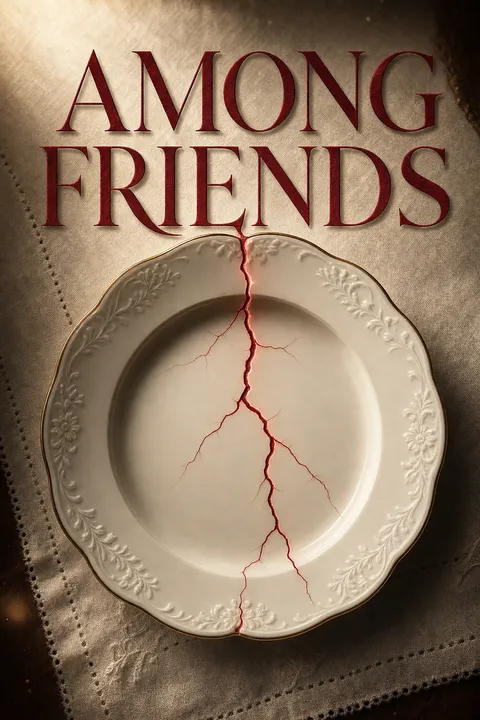
Among Friends is a scalpel-clean study of how comfortable people decide what is true. Ebbott stages a single atrocity, a man assaulting his best friend's teenage daughter, and then follows the wound outward through an ecosystem engineered to absorb it. The novel's radical formal choice is intimacy with every consciousness, including the predator's, so that evil appears not as aberration but as entitlement's logical extension. Emerson2 does not experience himself as a monster; he experiences himself as misunderstood, aggrieved, owed. That ordinariness is the horror. The book argues that belief follows cost rather than evidence: Claire3 cannot credit her daughter because doing so would dismantle a lineage, a marriage, a class identity, so she reaches instead for the reassuring conclusion that girls lie. Emerson's2 genius is to weaponize exactly this, exhuming Amos's decades-old shame to reclassify the husband as the unreliable outsider. Class is the novel's deep grammar. Amos,1 risen from poverty into old money, is forever a naturalized citizen, tolerated but never native, and his terror of losing that hard-won belonging becomes the pressure Claire's3 ultimatum exploits. Ebbott suggests that the wealthy protect their world the way one guards fine china, sensing without articulating that there can be no visible cracks. Against this, the novel sets the fragile possibility of true seeing, embodied in the founding gesture of a name given in love and finally withdrawn. The devastating ending refuses catharsis: the confrontation that would restore Anna is revealed as fantasy, while reality is a French escape that resolves nothing, her body still running itself to fracture. The unreachable pen is Ebbott's final image of moral failure, a father who understood precisely what his daughter needed and, when the moment rose, still could not reach her across the aisle.
Characters
Amos
Therapist, devoted fatherA Manhattan psychotherapist in his early fifties, Emerson's2 college roommate and best friend of decades, married to Claire3 and father to Anna4. Raised in wrenching poverty by a mentally ill mother and a neglectful father who died of gangrene, Amos1 escaped into a life of books, wit, and self-deprecating charm. He interprets everything symbolically and forgives easily, sometimes to a fault. His governing wound is the fear of being merely a guest, tolerated but not rooted, in the moneyed world he married into. He loves Anna4 with a consuming, almost frightened intensity, and he built his adult life chasing quiet, stability, and the sense of finally being wanted. Kindness is both his virtue and his hiding place.
Emerson
Charismatic old-money hostHandsome, wealthy, and effortlessly commanding, a lawyer turning fifty-two who hosts the birthday weekend at his country house. Known to most as Ford, he is old-money grace layered over a ruthless, intuitive intelligence that senses weakness before it thinks. Shaped by a cold, cruel father, he carries a vacancy at his core that he furnishes with people, favors, and admiration, equating love with tribute paid to him. He is generous and warm when unthreatened, but experiences ordinary slights as existential theft. Aging terrifies him not as death but as the loss of centrality. Beneath the dazzling smile lives a man who inhabits the world like a restaurant, ordering, consuming, and leaving without a thought for who cleans up.
Claire
Composed, clinical wifeA physician, Amos's1 wife and Anna's4 mother, born into the old, moneyed world that Emerson's2 family also inhabits. Precise, detached, and allergic to displays of emotion, she brings a doctor's triage to intimacy, laying problems out like garments to see what fits. She loves Anna4 fiercely but complicatedly, and she prizes above all the durable life she has built and enabled. Her sense of money and lineage is elemental, absorbed rather than taught, and it quietly governs her loyalties. Capable of great tenderness and great coldness in the same breath, she believes love means safeguarding the future, even when that means refusing to look too closely at the present. Her calm is both strength and defense.
Anna
Watchful teenage daughterSixteen, the only child of Amos1 and Claire3, artistic and acutely observant, given to painting, anxious overthinking, and a newly possessive adolescent confidence in her own body and taste. She has known the Ford family her whole life and shares a long, prickly friendship with Sophie6. Anna4 moves through the world appraising it, at once superior and uncertain, hungry to be seen as an adult. Beneath the poise runs a mind that spirals when frightened, one that most needs her father to steady it. Her closeness to both families is genuine, which is precisely what makes her position so precarious. She is a girl on the threshold of selfhood, still deciding who she will become.
Retsy
Overlooked, insecure wifeEmerson's2 wife and Sophie's6 mother, who sits on a theater board and hoards small worthwhile facts to hold her own among sharper company. Intelligent but conditioned since girlhood to believe she is dull, she inhabits a clear-eyed, largely unaffectionate marriage while nursing a quiet hope that age might soften it into real love. Perceptive when she allows herself to be, she is also expert at calculating what she cannot afford to know.
Sophie
Sharp-tongued childhood friendEmerson2 and Retsy's5 daughter, sixteen, Anna's4 longtime friend. Socially aspirational and quick to wound, she wields meanness as a proof of cleverness while secretly craving to be genuinely wanted. Alternately needy and cruel, she resents Anna's4 poise and mistakes withdrawal for strength. Shaped by her father's withholding and her mother's example, she is learning, too young, how comfortable people quietly decide whom to keep.
John
Claire's cold fatherClaire's3 wealthy, self-assured father, cordial to Amos1 with the warmth of a spare sweater lent to a guest. He embodies the inherited world Amos1 married into, a steady, unquestioning citizen of money whose mere presence recalibrates Claire3 toward her family's instincts.
Plot Devices
Emerson versus Ford
Naming as intimacy and weaponFrom their first day as roommates, Amos1 alone calls his friend Emerson2 rather than the universal nickname Ford, an act that Emerson2 experiences as being truly, tenderly seen. The name becomes the sacred token of their bond, proof to Emerson2 that he possesses a real inner self beneath the handsome, hollow surface everyone else responds to. Ebbott threads this small choice through the whole novel, so that when the friendship finally breaks, the withholding or granting of the name carries the full weight of decades. It transforms an ordinary detail into the book's most precise instrument for measuring love, recognition, and their withdrawal, the difference between being known and being merely used.
The kept secret of theft
Buried shame turned leverageLong before the main events, Amos1 was caught shoplifting as an adult and phoned Emerson2, who rescued him and vowed never to tell Claire3. This mercy allowed Amos's1 marriage and class ascension and anchored his lifelong gratitude. Ebbott holds the secret in reserve, letting it function first as evidence of a beautiful loyalty. Then it detonates: the same confidence, once a gift, is deployed to discredit Amos's1 judgment at the moment his daughter most needs to be believed. The device dramatizes how intimacy accrues collateral, and how a shared secret is never neutral, always potential ammunition in the hands of the one willing to spend it.
The roadside suicide story
Mirror of casual crueltyEmerson's2 account of nearly killing a suicidal woman who mistook his car for her ex-lover's is served at dinner as an amusing coincidence, and the group marvels at the luck rather than the anguish. The anecdote establishes, early, the families' reflex to convert others' pain into entertainment and to prize their own comfort over another's suffering. It becomes a template the reader recognizes later, when a wound arrives inside the circle and is met with the same instinct to minimize, explain away, and preserve normalcy. Ebbott uses the story as a tuning fork for the novel's moral frequency.
Running and stealing
Trauma rendered as compulsionAfter the assault, Anna4 runs the city to numbness and shoplifts objects she frequently discards, twin rituals that stage control and self-erasure. Ebbott makes her interior collapse legible through behavior rather than exposition, so the reader understands before any character does that something catastrophic has happened. The compulsions also rhyme pointedly with Amos's old thieving, allowing father and daughter to recognize each other and permitting his confession to unlock hers. The device carries the novel's argument that trauma lives in the body and its habits, and its persistence into the final pages quietly reveals that no reckoning has truly healed her.
The imagined ending
Unreliable, wishful resolutionThe final section blurs what Amos1 does with what he only dreams. He vividly conjures a restaurant confrontation in which Anna4 faces Emerson2 and reclaims herself, then defends the act to Claire3, before the frame breaks and reveals him seated on a plane, eyes closed, the family bound for a healing month in France that Claire3 wanted and Retsy5 recommended. Ebbott uses the device to expose the gap between moral imagination and action. The confrontation is consolation fiction; the reality is sanctioned forgetting. The closing failure to hand Anna4 a pen across the aisle crystallizes a father's inability to close the distance between what he intends and what he dares.
Download PDF
Download EPUB
.epub digital book format is ideal for reading ebooks on phones, tablets, and e-readers.








































