
Key Takeaways
1. American democracy is defined by a perpetual struggle between privilege and equal justice.
America has been defined by the perennial struggle between the appetites of the few and the privileged and the aspirations of the many who have rightly insisted that the nation live up to its self-professed creed of sacred rights and equal justice under law.
The core conflict. American history is not a linear march of progress, but a continuous battleground between elite self-interest and the democratic ideals of the masses. This tension is the animating force of the nation's history, requiring constant vigilance to ensure that the promises of the Declaration of Independence are extended to all citizens rather than a select few.
A human undertaking. Because democracy is a human creation, it remains perpetually vulnerable to greed, prejudice, and systemic cruelty. The anthology highlights how the nation's finest hours occur when it chooses to build bridges instead of walls, expanding the circle of inclusion. Key historical moments of this struggle include:
- The abolitionist crusade against chattel slavery
- The suffragist battle for women's right to vote
- The labor movement's fight for fair wages and working hours
- The civil rights marches of the mid-twentieth century
Rejecting historical complacency. We do ourselves a disservice by viewing American history through a lens of pure triumph or unyielding darkness. Recognizing the flaws of past generations allows modern citizens to find the courage to face contemporary crises. History serves as an essential guide, arming us against despair by showing that previous generations overcame seemingly insurmountable injustices.
2. Liberty and oppression have coexisted in the American experiment from its very inception.
The selections that follow illustrate how liberty and enslavement coexisted from at least 1619.
The founding paradox. The year 1619 represents a profound contradiction at the heart of the American origin story. In the very same summer that the first representative legislative assembly met in Jamestown, Virginia, the first enslaved Africans were brought to the colony's shores. This dual birth of representative self-government and chattel slavery established a systemic hypocrisy that would plague the nation for centuries.
A flawed covenant. Early American documents, from the Mayflower Compact to John Winthrop's "City upon a Hill" sermon, articulated a noble sense of divine mission and covenant. However, this ideal of innate human equality was strictly limited in practice, excluding Black people, Native Americans, and women. The early economy and social structure of the colonies relied heavily on the exploitation of the very people denied these sacred rights.
The early resistance. Despite the dominance of oppressive systems, the moral protest against slavery began early in American history. Voices like Samuel Sewall in The Selling of Joseph and the poet Phillis Wheatley challenged the religious and moral justifications of enslavement. They argued that:
- All humans are of "one blood" and coheirs to liberty
- Enslavement is a direct violation of Christian charity
- Black people are equal spiritual beings deserving of respect
- The gap between American ideals and practice must be closed
3. The U.S. Constitution is a flexible, living document designed to check human frailty.
If men were angels, no government would be necessary—and given that men were so self-evidently unangelic, the American government was designed to check our passions and to balance our failings.
Checking human nature. The American Founders held a deeply realistic, almost skeptical view of human nature, recognizing that individuals are driven by ambition, passion, and self-interest. Rather than designing a system that relied on the perfect virtue of its leaders, they constructed a constitutional framework of checks and balances. This system of divided sovereignty was specifically engineered to prevent any single faction from seizing absolute control.
The power of faction. In The Federalist No. 10, James Madison argued that the latent causes of faction are sown in the very nature of man. Since the causes of faction cannot be removed without destroying liberty itself, the government must be structured to control their effects. The Constitution achieves this by:
- Dividing power between the federal government and the states
- Establishing three distinct branches of government with overlapping checks
- Creating a representative republic rather than a pure democracy
- Encouraging a multiplicity of interests to prevent a majority tyranny
The necessity of compromise. As Benjamin Franklin noted at the close of the Constitutional Convention, the document was far from perfect, but it represented the best possible compromise among competing interests. The Constitution's strength lies in its ability to adapt to changing times while maintaining its core principles of liberty and the rule of law. It is a "Glorious Liberty Document" that provides a platform broad enough to support the ongoing elevation of all people.
4. Union and federal supremacy must repeatedly be defended against sectionalism and nullification.
To say that any State may at pleasure secede from the Union, is to say that the United States are not a nation because it would be a solecism to contend that any part of a nation might dissolve its connection with the other parts, to their injury or ruin, without committing any offense.
The nullification crisis. In the late 1820s and early 1830s, the American Union faced a severe existential threat when South Carolina, led by John C. Calhoun, asserted the right to nullify federal laws. While the immediate dispute concerned a federal protective tariff, the underlying issue was the preservation of the Southern slave-owning interest against federal overreach. This crisis forced a fundamental debate over the nature of the Union and the limits of state sovereignty.
Defending the Union. President Andrew Jackson stood firm against the nullifiers, issuing a powerful proclamation asserting that the Union is a single nation, not a loose league of independent states. He argued that secession was a revolutionary act that would destroy the nation's unity and ruin its prosperity. This defense of federal supremacy was echoed by Daniel Webster, who passionately argued for:
- The supremacy of the federal Constitution over state laws
- The concept of American citizenship as a unified identity
- The preservation of the Union as the essential safeguard of liberty
- The famous motto: "Liberty and Union, now and forever, one and inseparable"
A precedent for Lincoln. The resolution of the nullification crisis established a vital precedent for the preservation of the Union. Decades later, Abraham Lincoln would study Jackson's proclamation and Webster's speeches to formulate his own defense of the Union during the secession crisis. The struggle proved that the federal government must possess the authority to enforce its laws, or the nation would dissolve into chaotic fragments.
5. Progress is never inevitable; it is contingent, fragile, and constantly contested.
That things worked out in the past—slavery fell; Hitler was defeated; legalized segregation was undone—does not mean that things will work out in the present or in the future.
The illusion of inevitability. It is a dangerous historical fallacy to assume that American democracy is on an automatic, upward trajectory toward greater justice. Every major advancement in human rights—from the abolition of slavery to the defeat of fascism—was the result of intense struggle, sacrifice, and contingent choices. Progress can easily be halted, or even reversed, if citizens become complacent and fail to actively defend their democratic institutions.
The threat of backsliding. History is replete with periods of significant democratic regression, often following eras of rapid social progress. The end of Reconstruction in 1877, for example, led to the systematic disenfranchisement of Black Americans and the rise of Jim Crow segregation, effectively undoing many of the Civil War's democratic gains. This pattern of progress and reaction is characterized by:
- The rise of the "Lost Cause" myth to justify white supremacy
- The Supreme Court's codification of segregation in Plessy v. Ferguson
- The resurgence of nativist and anti-immigrant legislation in the 1920s
- The periodic erosion of civil liberties during times of national panic
The duty of each generation. Because democracy is inherently fragile, each generation must take up the task of preserving and expanding it. The "arc of the moral universe" may bend toward justice, as Theodore Parker wrote, but it only bends when active citizens pull it down. Conscientious citizenship requires a clear-eyed understanding of past failures and a willingness to engage in the difficult, ongoing work of reform.
6. Nativism, xenophobia, and political fear are recurring undercurrents in American history.
Nativism, xenophobia, cultural populism, and broad political fear have shaped the Republic from the beginning, and always will.
The politics of fear. Throughout American history, periods of rapid demographic, economic, or social change have triggered powerful waves of nativism and xenophobia. These movements exploit the anxieties of the dominant culture, portraying immigrants, racial minorities, and political dissidents as existential threats to the American way of life. This recurring pattern of political fear has repeatedly led to the passage of exclusionary laws and the erosion of civil liberties.
Historical manifestations. From the Alien and Sedition Acts of 1798 to the anti-immigrant rhetoric of the twentieth century, the fear of the "other" has been a potent political tool. In the late nineteenth and early twentieth centuries, writers and politicians warned of "unguarded gates" and the "mongrelization" of the American stock, leading to restrictive immigration quotas. Key examples of this nativist impulse include:
- The Know-Nothing party of the mid-nineteenth century
- The Chinese Exclusion Act of 1882
- The resurgence of the Ku Klux Klan in the 1920s
- The internment of Japanese Americans during World War II
The challenge of pluralism. The true test of American democracy is its ability to resist these exclusionary impulses and remain committed to its pluralistic ideals. As Emma Lazarus wrote in "The New Colossus," America's greatness lies in its willingness to welcome the "huddled masses yearning to breathe free." Overcoming nativism requires a constant reassertion of the principle that American identity is defined by a commitment to shared democratic values, not by race, religion, or national origin.
7. True democratic change requires the slow, persistent persuasion of public sentiment.
Change in democracies requires persuasion—the molding of what Lincoln referred to as "public sentiment."
The power of persuasion. In a popular government, lasting social and political change cannot be achieved by force or executive fiat alone; it requires the slow, difficult work of persuading the public. Leaders and reformers must engage in open debate, appeal to shared moral values, and build broad coalitions to shift public opinion. This process of persuasion is the essential foundation upon which all enduring democratic reforms are built.
Molding public opinion. Throughout American history, the most effective reformers have been those who understood how to articulate their cause in ways that resonated with the national conscience. From Thomas Paine's Common Sense to Martin Luther King Jr.'s "I Have a Dream" speech, the power of the written and spoken word has been a primary instrument of change. This work of persuasion involves:
- Appealing to the founding principles of the Declaration of Independence
- Exposing the moral inconsistencies of existing laws and practices
- Utilizing the mass media to bring hidden injustices to light
- Engaging in nonviolent protest to dramatize the need for reform
The necessity of consensus. Without a basic consensus on facts and values, the political process degenerates into a destructive clash of interests, making progress impossible. Doing better as a nation requires a willingness to compromise, respect the legitimacy of democratic institutions, and engage in civil discourse. As Lincoln told Congress during the Civil War, "We can succeed only by concert."
8. The weaponization of fear and conspiracy theories periodically threatens the rule of law.
Today our country is being psychologically divided by the confusion and the suspicions that are bred in the United States Senate to spread like cancerous tentacles of "know nothing, suspect everything" attitudes.
The paranoid style. American politics has periodically been convulsed by a "paranoid style" characterized by conspiracy theories, suspicion of government, and the demonization of political opponents. During the Cold War, this impulse found expression in the Red Scare and the rise of McCarthyism, as Senator Joseph McCarthy and others used unsubstantiated charges of treason to destroy reputations and stifle dissent. This weaponization of fear created a climate of suspicion that deeply damaged the nation's democratic fabric.
Resisting the demagogues. The rise of demagogues like McCarthy was met with courageous resistance from a few principled leaders who refused to be silenced by fear. Senator Margaret Chase Smith's "Declaration of Conscience" and Edward R. Murrow's television broadcasts challenged McCarthy's tactics, reminding the nation of the danger of confusing dissent with disloyalty. These acts of resistance highlighted the importance of:
- Defending the right to independent thought and protest
- Upholding the constitutional guarantee of due process
- Demanding evidence and truth over wild accusations
- Refusing to allow political parties to exploit fear for partisan gain
The danger of polarization. When political leaders exploit fear and division, they play directly into the hands of those who wish to weaken democratic institutions. The lessons of the McCarthy era are highly relevant to our own polarized moment, warning us that a society divided by mutual suspicion is vulnerable to authoritarian overreach. Preserving the rule of law requires a shared commitment to truth, civility, and the defense of our democratic heritage.
9. The expansion of civil rights and suffrage is a continuous battle to realize the founding promise.
The project of each generation is to bridge the meaning of those founding words with the realities of changing times—a never-ending quest to ensure those words ring true for every single American.
Realizing the promise. The history of the United States is, in large measure, the history of the expansion of basic civil rights and the right to vote to those who were originally excluded from the founding covenant. This expansion has never been easy; it has required decades of organized struggle, legal challenges, and courageous activism. The battle to secure these rights is a continuous effort to bring the nation's practices into alignment with its self-professed creed of equality.
The civil rights revolution. The mid-twentieth century witnessed a powerful, nonviolent revolution that succeeded in bringing down the legal barriers of Jim Crow segregation. Led by figures like Martin Luther King Jr., John Lewis, and Fannie Lou Hamer, this movement used civil disobedience, mass demonstrations, and moral persuasion to force a national reckoning. Key milestones of this struggle include:
- The Supreme Court's desegregation ruling in Brown v. Board of Education
- The passage of the Civil Rights Act of 1964
- The Selma to Montgomery marches for voting rights in 1965
- The passage of the Voting Rights Act of 1965
The ongoing struggle. The work of securing civil rights and equal opportunity is far from complete. As Barack Obama noted on the occasion of the Supreme Court's marriage equality decision, each generation must work to extend the full promise of America to all its citizens. The future of American democracy depends on our continued willingness to stand up for the rights of others, recognizing that "the rights of every man are diminished when the rights of one man are threatened."
10. Modern populism and polarization risk sliding the nation into competitive authoritarianism.
U.S. democracy will likely break down during the second Trump administration, in the sense that it will cease to meet standard criteria for liberal democracy: full adult suffrage, free and fair elections, and broad protection of civil liberties.
The threat of backsliding. In the twenty-first century, American democracy faces a severe crisis of polarization and the rise of a populist movement that openly challenges democratic norms and institutions. Scholars warn that the nation is at risk of sliding into "competitive authoritarianism"—a system in which the formal architecture of democracy remains intact, but the incumbent party systematically abuses its power to tilt the playing field against the opposition. This form of democratic breakdown is characterized by the weaponization of the state, the politicization of the bureaucracy, and the harassment of critics.
The weaponized state. The second Trump administration has signaled a clear intention to purge professional civil servants and replace them with loyalists, effectively dismantling the post-Watergate safeguards designed to prevent the partisan use of government power. This weaponization of the state can be used to target political rivals, co-opt business and media leaders, and shield allies from prosecution. Key indicators of this trend include:
- The reinstatement of Schedule F to strip civil servants of protections
- The use of the Justice Department and the FBI to prosecute political opponents
- The deployment of tax authorities and regulatory agencies against critics
- The pressure on media owners and universities to engage in self-censorship
The path to resilience. Despite these grave threats, American democracy possesses significant sources of resilience, including a strong civil society, an independent judiciary, and a decentralized federal system. However, the opposition can only succeed in defending democracy if its leaders and citizens refuse to be sidelined by fear or resignation. Preserving the American experiment requires a courageous, collective commitment to upholding the rule of law, defending civil liberties, and demanding accountability from our leaders.
Review Summary
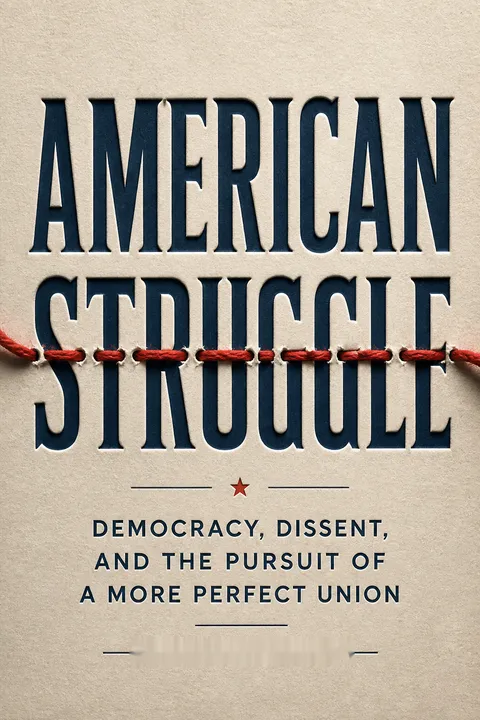
Reviews for American Struggle are generally positive, averaging 4.2 stars. Most readers praise Meacham's thoughtful curation of 115 primary sources spanning 1619 to 2025, appreciating the anthology's diverse voices and relevance to modern America. The audiobook version received particular acclaim for its varied narrators. Common criticisms include the book feeling dry or academic, better suited as a reference than leisure reading, and some readers wishing for more of Meacham's own commentary. The politically charged ending, focusing on authoritarianism, drew mixed reactions depending on readers' political leanings.
About the Author
Other books by Jon Meacham

Download PDF
Download EPUB
.epub digital book format is ideal for reading ebooks on phones, tablets, and e-readers.








































