Key Takeaways
1. Immigrant Origins and Rapid Ascent: The Foundation of Two Dynasties
With a few years of work,” Piketty wrote, “the new arrivals were able to close the initial gap between themselves and their wealthier predecessors.
Humble beginnings. Both the Kushner and Trump families began with ambitious immigrants seeking fortune in America, a land where social mobility was still possible in the late 19th and mid-20th centuries. Joseph Kushner, a Holocaust survivor, arrived penniless in 1949, building a real estate empire from a carpenter's wages and a $5,000 investment. Friedrich Trump, Donald's grandfather, arrived in 1885, making his initial fortune by providing services (food, liquor, and sex) to gold prospectors in the American West and Yukon.
Real estate empires. Both families quickly recognized the potential of real estate, leveraging federal programs and a booming population to expand their holdings.
- Joseph Kushner built thousands of suburban homes in New Jersey, benefiting from federal housing acts and highway construction.
- Friedrich Trump invested in Queens real estate, capitalizing on infrastructure improvements like the Queensboro Bridge.
- His son, Fred Trump, became a millionaire by building thousands of FHA-backed homes in Brooklyn, earning the moniker "Henry Ford of the home-building industry."
A new generation. By the time Donald Trump and Charles Kushner took over their respective family businesses, they inherited substantial wealth and a blueprint for aggressive expansion. Their stories, initially emblematic of the American Dream, would increasingly highlight the widening gap between that ideal and the reality of entrenched dynastic wealth.
2. Transactional Politics: Leveraging Influence for Personal Gain
Trump had trained the political class to understand that their ever-ravenous political machines should compete for some of his purported billions lest he mete it out to their opponents.
Cultivating connections. Both the Trump and Kushner families mastered the art of transactional politics, using campaign donations and personal relationships to secure favorable government decisions. Donald Trump, for instance, leveraged his ties with Brooklyn Democratic bosses like Frank V. Kelly to gain crucial approvals and assignments for his father's early FHA-backed projects.
High-stakes deals. Donald Trump's entry into Manhattan real estate during the city's 1970s fiscal crisis exemplified this approach.
- He secured a 40-year, $4 million/year tax abatement for the profitable Commodore Hotel renovation by cultivating Mayor Abe Beame and Governor Hugh Carey.
- His lawyer, Roy Cohn, a master of political maneuvering, played a key role in pushing through the deal, demonstrating the power of connections over conventional processes.
- Charles Kushner similarly became New Jersey's largest Democratic donor, showering politicians like Governor Jim McGreevey with millions, expecting "payback" in the form of board appointments and influence.
Blurring lines. This pattern of donations for favors, and access for influence, became a hallmark of both families' operations, demonstrating how political connections were integral to their business success, often at the expense of public interest.
3. The Art of Financial Maneuver: Debt, Deception, and Tax Avoidance
Fred Trump and Donald Trump engaged in secret schemes to avoid paying taxes that the New York Times called “outright fraud.”
Aggressive tax avoidance. The Trump family, from Fred to Donald, systematically employed "dubious tax schemes" and "outright fraud" to transfer vast wealth across generations, largely untaxed.
- Fred Trump transferred land titles to trusts benefiting his children, then leased the land back, funneling profits to them tax-free.
- He set up sham corporations, like All County Building Supply & Maintenance, in his children's names to inflate costs and divert untaxed revenue.
- Donald Trump, as a toddler, was already receiving the equivalent of $200,000 annually from these schemes, becoming a millionaire by age eight.
High-risk debt and deception. Donald Trump's business model relied heavily on massive debt and a willingness to make misleading statements.
- His Atlantic City casinos, built with substantial debt, repeatedly faced bankruptcy, yet regulators often granted him more leeway.
- The Trump SoHo project involved "fraudulent misrepresentations" about sales figures to secure financing and close deals, leading to a criminal investigation against Ivanka and Don Jr.
- Charles Kushner's $1.8 billion purchase of 666 Fifth Avenue was financed with minimal equity and high-interest, short-term debt, nearly collapsing during the 2008 financial crisis.
Exploiting loopholes. Both families consistently exploited legal and regulatory loopholes, from FHA loan rules to campaign finance laws, to maximize personal profit and minimize accountability, often leaving a trail of unpaid vendors, defrauded partners, and legal disputes.
4. Media as a Tool: Shaping Narratives and Attacking Opponents
His son had acquired a newspaper whose province was “an Island paradise with fiefdoms, rulers, turf battles, borders and a brutal hierarchy,” as its longtime editor, Peter Kaplan, once wrote.
Brand building and self-promotion. Donald Trump masterfully used media to cultivate his image as a successful, wealthy entrepreneur, most notably through "The Apprentice."
- The show presented a carefully crafted persona, proclaiming him "the largest real estate developer in New York" and a "master" of business, despite his actual financial struggles and bankruptcies.
- This "infomercial" for his brand allowed him to license his name globally, generating millions without direct development risk.
Controlling the narrative. Jared Kushner's acquisition of the New York Observer provided a platform to influence elite opinion and protect family interests.
- He pushed for "hit jobs" on perceived enemies, like Chris Christie and Richard Mack, and used the paper to promote his family's business partners.
- The Observer's editorial stance shifted to align with Jared's increasingly conservative views, including opposing paid sick leave and minimum wage increases.
- Ivanka Trump leveraged her celebrity status and "women who work" brand to defend her father against accusations of misogyny, using her image to soften his public perception.
Undermining truth. During his presidential campaign, Trump escalated media manipulation by labeling unfavorable coverage "fake news," undermining the very notion of objective truth and creating an environment where facts were secondary to loyalty and narrative control.
5. Global Capital: Questionable Foreign Money Fuels Expansion
The Trumps also learned an important lesson about new ways foreign capital could keep them in the black, even when the world was falling apart.
Post-recession pivot. After the 2008 financial crisis, mainstream American banks largely ceased lending to Donald Trump due to his history of defaults and lawsuits. This forced the Trump Organization to increasingly rely on foreign capital, often from opaque sources.
- Deutsche Bank, a German institution with its own history of money laundering, became a primary lender, providing hundreds of millions in loans even after Trump sued them.
- Russian buyers became a "disproportionate cross-section" of purchasers in Trump properties like Trump World Tower and Sunny Isles, Florida.
International licensing deals. The Trumps expanded their licensing model globally, often partnering with individuals and entities from countries with weak regulatory controls or ties to corruption.
- The Trump Ocean Club Panama, a hotel-condo project, relied on questionable presales tactics and anonymous shell companies, with buyers from former Soviet countries.
- The Trump Tower Toronto was financed by Alex Shnaider, who made his fortune in Ukrainian steel and was involved in a deal with the Russian state-owned Vnesheconombank.
- The Trump Tower Baku project in Azerbaijan involved partners with ties to Iran's Revolutionary Guard Corps, raising significant corruption red flags.
Kushner's foreign connections. Jared Kushner's family business also increasingly sought foreign capital, securing loans from Israeli banks and partnering with individuals like Raz Steinmetz, whose family had faced bribery allegations. These international dealings created a complex web of financial interests that would later pose significant conflicts during their time in the White House.
6. The American Oligarchy: Wealth Translates Directly to Power
Twenty years into the twenty-first century, we live in age of oligarchs, where the very richest Americans hold vast sway not only over their elected officials—and by extension, the courts—but also the election process itself.
Erosion of campaign finance. The Citizens United Supreme Court decision in 2010 opened "floodgates" for unlimited, often undisclosed, spending in elections, allowing wealthy individuals and corporations to exert unprecedented influence. This decision, coupled with decades of deregulation and tax cuts favoring the rich, accelerated the shift towards an American oligarchy.
The presidency as a business. Donald Trump's campaign and presidency became an "infomercial" for his brand, blurring the lines between public service and private profit.
- His inaugural committee raised a record $107 million, with significant portions unaccounted for, and charged his own hotel $700,000 for events.
- The Trump International Hotel in Washington, D.C., became a hub for lobbyists, foreign officials, and political groups seeking favor, effectively operating as a "new dark money" channel.
- His administration scrapped plans to relocate the FBI headquarters, which would have created competition for his hotel, demonstrating a direct use of presidential power for personal business gain.
Family in power. Jared Kushner and Ivanka Trump, as senior White House advisors, maintained significant financial interests in their family businesses, creating inherent conflicts of interest.
- Jared's family business received large loans from banks (Citigroup, Apollo) after he met with their CEOs in the White House.
- Ivanka's brand secured new trademarks in China and received a marketing boost in India during her official government trips.
- Their refusal to fully divest or establish blind trusts meant that their government roles were inextricably linked to their private financial gains, raising questions about whose interests they truly served.
7. Justice Undermined: Evading Consequences and Assaulting the Rule of Law
Trump was rewriting the rules; he would lie and the world would know he was lying, and the press and the public would be powerless to stop him.
Escaping accountability. Both families developed a pattern of evading legal consequences, often through aggressive legal tactics, political influence, or by simply outlasting investigations.
- Charles Kushner was convicted of tax fraud, witness tampering, and campaign finance violations, but served a relatively short prison sentence after a plea deal.
- Donald Trump and his children faced a criminal fraud investigation for the Trump SoHo project, but the Manhattan DA ultimately declined to prosecute, citing a lack of victim cooperation and a "tough case."
- Trump's lawyer, Michael Cohen, later pleaded guilty to campaign finance violations, admitting he made hush-money payments "at the direction of" Trump to influence the election.
Assault on institutions. During his presidency, Donald Trump systematically attacked the institutions designed to uphold the rule of law.
- He repeatedly called the Mueller investigation a "witch hunt" and attempted to fire the Special Counsel, actions detailed in the Mueller Report as potential obstruction of justice.
- He publicly attacked prosecutors, judges, and the FBI, undermining public trust in law enforcement.
- His personal attorney, Rudy Giuliani, engaged in efforts to discredit the Mueller probe and solicit foreign interference in the 2020 election, using corrupt Ukrainian officials.
The erosion of truth. Trump's constant use of "fake news" and "alternative facts" served to dismantle the notion of objective truth, making it difficult for the public to discern reality from politically motivated narratives. This created an environment where accountability was elusive, and power was asserted through sheer will and disregard for norms.
8. Perverting the Legacy: From Holocaust Survival to Restrictive Policies
Jared Kushner’s wife, Ivanka Trump, daughter, granddaughter, and great-granddaughter of immigrants, has faced her own questions on US immigration policy.
A legacy of escape. The Kushner family's story is rooted in the harrowing escape of Rae and Joseph Kushner from the Holocaust, a journey that involved sneaking across borders and bending immigration rules to find refuge in America. Rae emphasized the importance of remembering this history to "warn the rest of the world to be careful: who is coming up on top of your government?"
Contrasting interpretations. While some of Rae's grandchildren, like Marc and Melissa Kushner, interpret this legacy as a call to fight hate and build inclusive communities, Charles and Jared Kushner have adopted a different, more transactional and exclusionary view.
- Charles Kushner, despite his own family's history, expressed no remorse for his actions against his siblings, viewing them as "jealousy, hatred and spite."
- Jared Kushner, invoking his grandparents' persecution, dismissed concerns about Trump's anti-Semitic imagery as "political points," and defended his father-in-law's policies.
Undermining immigrant rights. As a senior White House advisor, Jared Kushner has played a key role in implementing policies that drastically cut refugee intake and penalize legal immigrants, directly contradicting the circumstances that allowed his own family to thrive.
- He dismissed the impact of reduced refugee numbers, stating, "It doesn't make a difference one way or the other."
- Ivanka Trump, also a descendant of immigrants, defended family separation policies by emphasizing "a country of laws" and her mother's "legal" immigration, ignoring the complex realities faced by many asylum seekers.
Oligarchy and "superfluous" people. The book argues that the Trump administration's policies, driven by an oligarchic mindset, create a system where certain groups are deemed "superfluous," mirroring the marginalization Rae Kushner warned against. This perversion of the immigrant narrative serves to justify policies that benefit the powerful few while eroding the rights and dignity of others.
Review Summary
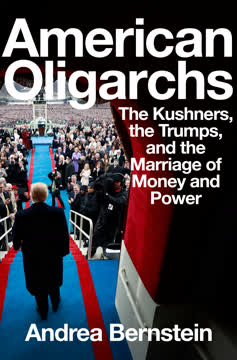
American Oligarchs by Andrea Bernstein traces the histories of the Trump and Kushner families from their immigrant roots to their current wealth and political power. Reviewers praise the book's thorough research and documentation of tax evasion, corruption, and questionable business practices spanning generations. Many found it well-written yet deeply disturbing, describing how both families exploited government programs and manipulated laws for personal enrichment. While the book contains no major revelations, readers appreciated seeing decades of public information compiled chronologically. Most reviewers recommend it as essential reading for understanding American democracy's current challenges, though they acknowledge its depressing nature.