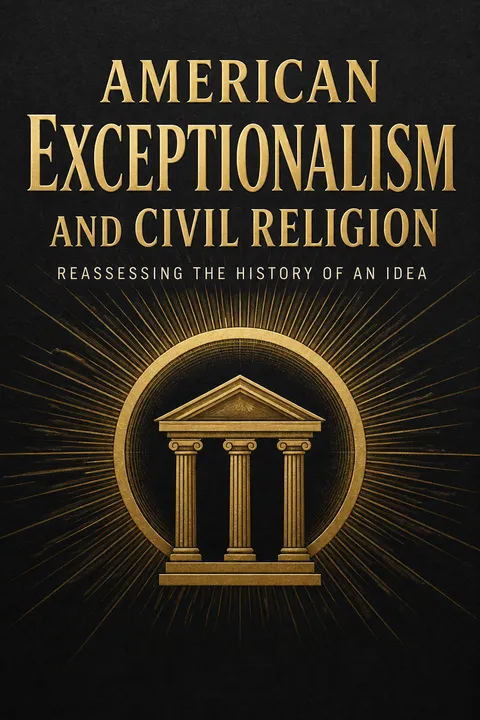

Key Takeaways
1. American Exceptionalism: A Two-Sided Coin
In this book, I will argue that a high view of American exceptionalism is, at significant points, at odds with the Christian gospel.
Defining exceptionalism. American exceptionalism, a core aspect of civil religion, posits that the United States is unique, set apart, and qualitatively different—even superior—to other nations. This idea, though not always termed "exceptionalism," has persisted since colonial times, shaping American self-identity and engagement with the world. It's a powerful concept, as evidenced by its frequent use in public discourse and high public agreement on America's unique character.
Two forms emerge. The author introduces two distinct forms: "closed" and "open" exceptionalism. Closed exceptionalism, often expressed in strongly providential terms, imports theological themes from Christianity and applies them to America, potentially making the nation an object of worship and a necessary player in redemption history. This form is seen as conflicting with the Christian gospel and leading to idolatry.
Open exceptionalism's role. In contrast, open exceptionalism carries a more limited political/cultural meaning, where America strives to be a paragon of justice, freedom, and equality among nations. This form, while still part of civil religion, serves as a beacon for moral and civil example, fostering compassion, justice, and human flourishing. It acknowledges America's flaws and encourages improvement, chastening sectarianism and advancing religious freedom.
2. The Deep Roots of American Exceptionalism
The tree’s root system is intricate and deep.
Multifaceted origins. American exceptionalism, like a multistemmed maple tree, draws from four main intellectual roots: theological, political, exegetical, and historiographical. These roots nourished the idea that America was a break from the past, destined for progress, and uniquely significant in human history. This foundational framework allowed the concept to diverge into its "closed" and "open" forms during the 19th century.
Puritan theological bedrock. The Puritan worldview, particularly their understanding of covenant, typology, and millennialism, formed the deepest theological root. They saw themselves as God's chosen people, establishing a "city upon a hill," and interpreted their colonial experience through biblical narratives, believing they were active agents in salvation history preparing the world for Christ's millennial reign. This provided a coherent scaffolding for American self-identification.
Enlightenment and historical influences. Political roots stemmed from English liberalism (Locke, Real Whig ideology) and Christian republicanism, emphasizing consent, natural rights, and religious freedom. Exegetical roots were evident in sermons that applied Old Testament narratives (like Exodus) to American struggles. Historiographical roots, exemplified by George Bancroft, presented American history as a providential plan for universal liberty, further solidifying the nation's exceptional narrative.
3. Manifest Destiny: Closed Exceptionalism's Imperial Vision
Manifest destiny defined a palpable attitude of expansionism in America during the antebellum period, and again during the 1890s with the acquisition of colonial overseas territories after the Spanish-American War (1898).
Expansion and slavery's impact. The rapid territorial expansion of the United States in the 19th century, particularly the Louisiana Purchase and the Mexican-American War, fueled a specific articulation of exceptionalism: manifest destiny. This concept, popularized by John L. O’Sullivan, asserted that God ordained America to spread across the North American continent, bringing civilization and democratic principles.
O'Sullivan's core tenets. O'Sullivan's manifest destiny rested on two pillars:
- Providential certainty: An unwavering belief that God meticulously ordered history to culminate in American supremacy.
- Anglo-American supremacy: The conviction that the white race was destined to complete human history by ushering in a democratic order, leading to the predicted disappearance of African and Native Americans.
Theological hijacking and hypocrisy. This closed exceptionalism appropriated Christian theological themes, such as divine providence and the dominion mandate (Genesis 1:28), to justify territorial conquest and racial exclusion. O'Sullivan even equated democracy with Christianity, suggesting salvation was found in democratic principles rather than Christ. This system, while extolling democratic virtues, simultaneously denied them to non-whites, betraying the Declaration of Independence and counterfeiting the gospel.
4. Lincoln's Vision: Open Exceptionalism for a Reborn Nation
Lincoln’s vision of an America reborn, cleansed from the abomination of slavery, became the animating quality of open American exceptionalism.
Crisis and rebirth. The deepening crisis of slavery, exacerbated by territorial expansion, challenged America's exceptionalist claims, leading to disunion and civil war. Abraham Lincoln, in contrast to O'Sullivan's manifest destiny, articulated an "open" form of exceptionalism rooted in justice and the Declaration of Independence. His vision was one of an America reborn, cleansed of the hypocrisy of slavery.
Justice as the foundation. Lincoln's exceptionalism was grounded in an objective understanding of right and wrong, particularly regarding slavery. He consistently appealed to the moral authority of justice, viewing the Declaration's "all men are created equal" clause as universally applicable, even to African Americans, despite the prevailing racist views of his time. He saw unjust laws, like the Dred Scott decision, as needing to be overturned to align with a higher standard of justice.
Nuanced providence and self-reflection. Unlike O'Sullivan's certainty, Lincoln approached divine providence with humility, acknowledging that God's purposes in the Civil War were inscrutable and might even be chastisement for slavery. He famously stated, "God cannot be for and against the same thing at the same time." Lincoln's open exceptionalism allowed for self-criticism and a commitment to aligning the nation with God's moral laws, rather than presuming God was always on America's side.
5. The Chosen Nation: A Misguided Theological Claim
The exceptionalist expression of national/ethnic election is not equal to that found in the Bible.
Biblical roots, national application. The concept of national/ethnic election, or chosenness, is deeply rooted in the Old Testament's Abrahamic and Mosaic covenants, where Israel was chosen to be a holy nation. Puritans adopted this, believing England, and later New England, existed in a special covenant with God. This idea persisted, with Americans seeing themselves as a "new Israel" uniquely blessed by God.
Racism as a logical corollary. This civil theology of chosenness often led to racism, as it defined non-white groups (Native Americans, African Americans, Mexicans) as "Inferior Others" outside the divinely favored nation. This dehumanization justified exploitation, land seizure, and slavery, as seen in the forced removal of Native Americans, the plantation system, and the Mexican-American War. Even Lincoln struggled with acknowledging full racial equality.
Theological conflict. From a Christian perspective, national/ethnic election is problematic because it conflicts with the gospel. In the New Testament, election is salvific and fulfilled in Christ, extended universally to all who believe, forming the "chosen race" of the church (1 Peter 2:9). Equating national chosenness with biblical election misappropriates Christian theology, potentially making the nation an object of worship and diverting loyalty from Christ.
6. The Commissioned Nation: Hubris in Global Mission
This Nation was conceived with a sense of mission and dedicated to the extension of freedom throughout the world.
From continental to global mission. The idea of a divine national commission, a logical extension of chosenness, expanded significantly in the 20th century, particularly after World War II. Figures like John Foster Dulles, Secretary of State during the Cold War, articulated America's mission as a global imperative to spread democracy and confront "godless communism."
Dulles's Manichaean worldview. Dulles's vision was underpinned by:
- Manichaeism: A view of the world as a cosmic battle between equally powerful forces of good (America, freedom, spirituality) and evil (Soviet communism, atheism, totalitarianism).
- Religious faith: A belief that America's Christian heritage and active faith were its strongest weapons.
- Activism: A conviction that America was divinely tasked to actively roll back communism and liberate oppressed peoples, even through covert operations.
Ethical and theological pitfalls. This closed exceptionalist mission is problematic. Theologically, Manichaeism is heretical, denying Christ's unique salvific work. Ethically, it fosters hubris, leading to overreach (e.g., Vietnam) and stifling dissent by framing opposition as treasonous. It often appropriates Christ's Great Commission for nationalistic ends, diverting attention from the church's true mission. A responsible mission, as advocated by Martin Luther King Jr., would prioritize justice, self-examination, and humility, aligning with Micah 6:8.
7. The Innocent Nation: A Delusion of Moral Purity
This is the “empire” of which the prophetic voice declared “Westward the Star of Empire takes its Way”—the star of the empire of liberty and law, of commerce and communication, of social order and the Gospel of our Lord—the star of the empire of the civilization of the world.
The myth of blamelessness. The notion of America as an innocent, regenerate nation, free from decadence and perpetually rising, has deep roots, from Thomas More's Utopia to Winthrop's "City upon a Hill." This idea was reinforced by America's self-perception as a virtuous republic, contrasted with the perceived evils of its 20th-century enemies (Germany, Japan, Soviet Union).
Reagan's articulation of innocence. Ronald Reagan, a master of civil religious rhetoric, consistently portrayed America as pure and upright. He celebrated American history as unequivocally righteous, extolled the Constitution as a divinely inspired document, and depicted American foreign policy and military as inherently good and reluctant to use force. He believed in the innate goodness of the American people and a uniquely American God who specially blessed the nation.
The irony of American history. This closed exceptionalist belief in innocence is a delusion, as Reinhold Niebuhr famously argued. America, despite its high ideals, has often betrayed them, exhibiting moral ambiguities and injustices (e.g., slavery, racism, Iran-Contra). True patriotism requires acknowledging flaws and working for correction, rather than denying guilt or wishing problems away. Du Bois's critique of American racism highlighted this "schizophrenic personality," where professed ideals clashed with practiced antitheses.
8. The Land: Conquered Resource or Sacred Stewardship?
How curious a land is this,—how full of untold story, of tragedy and laughter, and the rich legacy of human life; shadowed with a tragic past, and big with future promise!
The power of place. The North American continent's vastness and wildness profoundly shaped American identity, often seen as physical evidence of its exceptionalism. Early European settlers, lacking categories for such a primeval landscape, often superimposed their worldview, viewing the land as something to be conquered and exploited rather than nurtured.
Contrasting views of dominion. Two main perspectives emerged regarding the land:
- Conquest and exploitation (Closed Exceptionalism): This view, prevalent in the plantation system and manifest destiny, saw the land as a resource to be stripped for wealth, often justifying the displacement and subjugation of Native Americans and enslaved Africans. Jefferson, despite his ideals, succumbed to this, leading to soil depletion and environmental degradation.
- Cultivation and stewardship (Open Exceptionalism): This perspective, championed by figures like George Washington Carver and John Muir, saw the land as a divine gift requiring careful nurturing for the benefit of all. Carver's "copartnership" with God emphasized responsible manipulation of nature for human flourishing, while Muir advocated for preserving wilderness for both physical and spiritual sustenance.
Theological implications. While both views acknowledged God as the giver of the land, the closed exceptionalist approach often misused the dominion mandate (Genesis 1:28) to justify conquest and racial exclusion. A Christian view, however, recognizes God's omnipresence and that Christ fulfills sacred land theology. The land is a gift for universal human flourishing, demanding just stewardship rather than theological exceptionalism.
9. Glorifying the Past: Ethnohistory vs. Critical Reflection
The scars and foibles and contradictions of the Great do not diminish but enhance the worth and meaning of their upward struggle.
History as a battleground. The "culture wars" of the late 20th and early 21st centuries often used history as a battlefront, particularly in Christian school and homeschool curricula. These texts (e.g., A Beka, BJU, Veritas) frequently presented American history through a closed exceptionalist lens, aiming to instill a "Christian worldview" that equated American identity with divine favor and moral purity.
Ethnohistorical narratives. These curricula often engaged in ethnohistory, presenting a "usable past" that idealized America's "golden age" and minimized its flaws. They were:
- Ethnohistorical: Explicitly framing American history as a "positive, patriotic approach" with a "special emphasis on our Christian heritage," often comparing America favorably to other nations (e.g., French Revolution) and downplaying internal injustices like slavery.
- Morally censorious: Quick to condemn contemporary moral decline (e.g., gay rights, Lewinsky scandal) while offering little historical moral reflection on past wrongs (e.g., slavery's "problems" as merely economic/social).
- Lacking historical thinking: Failing to consistently account for change over time, complexity, and contingency, instead promoting a fixed, providential narrative that reinforced American exceptionalism.
The call for historical integrity. Responsible historical thinking, as advocated by historians, requires acknowledging the past's foreignness, understanding context, causality, and contingency, and embracing complexity. It avoids drawing normative moral judgments from history, instead fostering moral reflection and humility. For Christians, this means distinguishing between a historical faith rooted in Christ and an ethnohistorical narrative that idolizes the nation, avoiding the "Christianity And" trap.
10. Dissent as Patriotism: The Core of Open Exceptionalism
At the heart of what it means to be an American is the act of calling America back to faithfulness to its first principles motivated by authentic patriotism.
Beyond "team spirit." American exceptionalism, whether closed or open, generates powerful assumptions about national identity. Closed exceptionalism, by linking the nation with God, fosters harmful assumptions that divide people into "Chosen" and "Inferior Other," leading to injustice and spiritualizing ideals into rigid doctrines. Open exceptionalism, however, provides a framework for unity amidst diversity, fostering positive civic engagement.
Dissent as a virtue. Open exceptionalism recognizes that dissent is not only allowed but is a virtue in America, as the nation itself was birthed from dissenting colonists. This framework encourages citizens to acknowledge, address, and rectify national flaws as an expression of true love for country. W. E. B. Du Bois, a member of a persecuted minority, exemplified this by challenging Secretary Dulles to uphold American ideals of liberty and dignity, even while criticizing the nation's shortcomings.
Reforming tradition. America has a strong tradition of reform, continually striving towards ideals of justice, equality, and freedom. Open exceptionalism aligns with this, allowing for critical self-examination and a commitment to improving the national community. It fosters unity through shared values like liberty, democracy, peace, and tolerance, understood as perennial pursuits rather than fixed, unassailable doctrines.
11. Distinguishing Faith from Nation: The Christian Imperative
America is not the kingdom, and American patriotism does not equate to godly devotion.
Separating church and state (of mind). For Christians, a crucial aspect of open exceptionalist civic engagement is differentiating the church from the nation. This understanding prevents patriotism from equating to spirituality and allows Christians to maintain their unique confession of faith and prophetic voice when the nation acts unjustly, without sacrificing loyalty.
Justin Martyr's model. The early Christian apologist Justin Martyr demonstrated this by affirming Christians' loyalty to the Roman Empire—even to absurd lengths like paying extortionate taxes—while unequivocally stating that worship and ultimate obedience belonged to God alone. He warned that rulers who prioritize opinion over truth would ultimately fail, as they too were under God's rule. This model allows Christians to be devoted citizens without idolizing the state.
Du Bois's prophetic warning. W. E. B. Du Bois, in his "Christian, Gentleman, American, White Man" progression, warned against a counterfeit Christianity that, by denying its true ethical demands, logically leads to closed exceptionalism and militant white supremacy. He argued that true Christian ethics, exemplified by African Americans enduring oppression, demanded justice and brotherhood, not racial hubris or uncritical nationalism. Christians must avoid conflating patriotic fervor with Christian spirituality, recognizing that Christ alone is the "last and best hope of humankind," not America.
People Also Read






Download PDF
Download EPUB
.epub digital book format is ideal for reading ebooks on phones, tablets, and e-readers.








































