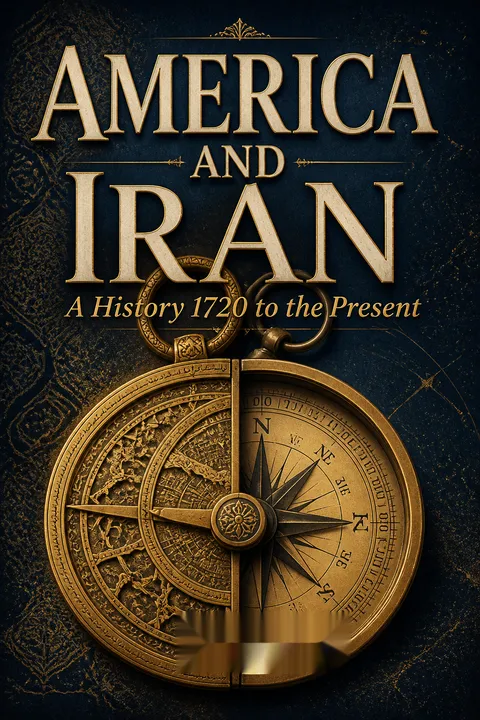

Key Takeaways
1. The historical relationship began with mutual admiration and a search for a "third force."
Well before governments in Tehran and Washington began to step on each other’s toes in our own lifetimes—well before the “Great Satan” and “Axis of Evil” speeches, well before Mosaddeq and the hostage crisis and Ayatollah Khomeini—relations between these two countries were animated by a spirit of common respect and mutual understanding.
Early mutual fascination. Long before modern geopolitical conflicts, the peoples of America and Persia viewed each other with deep admiration. In the 1720s, colonial American newspapers dedicated significant coverage to the Persian Empire's struggle against Afghan rebels, consistently taking the Persian side due to biblical romanticism and shared hostility toward the Ottoman Empire.
Founding inspiration. America's Founding Fathers, including Thomas Jefferson and John Quincy Adams, studied ancient Persian history to guide their new republic. They were particularly inspired by Cyrus the Great's Cyropaedia, which modeled a benevolent, just leadership style based on the consent of the governed rather than tyrannical force.
The third force. As Persia entered the 19th century, it found itself squeezed by the imperial ambitions of Britain and Russia. Persian reformers looked to the distant United States as a "third force"—an idealistic, anti-imperialist power that could help modernize the country without compromising its sovereignty.
- Colonial newspapers devoted up to 30% of their space to Persian affairs in the 1720s.
- Thomas Jefferson owned two copies of the Cyropaedia.
- The first U.S.-Persian Treaty of Friendship and Commerce was signed in 1856.
2. American missionaries established the first deep cultural bonds of soft power.
In all my journeys I have seen no people as willing to accept the gospel as the Assyrians of Persia... This field is white and ready for the harvest.
Presbyterian soft power. Starting in the 1830s, American Presbyterian missionaries arrived in northwestern Persia, establishing schools, clinics, and printing presses. Rather than converting Muslims, they focused on revitalizing ancient local Christian communities, such as the Assyrians and Armenians, introducing Western education and medicine.
Deepening cultural ties. For a century, these missionaries acted as the primary face of America in Persia, building immense goodwill. Generations of Iranian elites, including future cabinet ministers and diplomats, were educated in American mission schools like the legendary Alborz College in Tehran.
The missionary legacy. This extensive missionary network created a unique foundation of soft power that defined U.S.-Persian relations until the mid-20th century. However, during World War I, the missionaries' decision to arm Christian militias against Ottoman forces sowed seeds of sectarian resentment among the local Muslim majority.
- Justin and Charlotte Perkins established the first American school in Urmia in 1836.
- By 1895, 117 American schools with over 2,400 pupils operated in Persia.
- Dr. Joseph Cochran founded Persia's first Western-style medical school in 1878.
3. The Constitutional Revolution of 1906 birthed Asia's first Muslim democracy.
In Persia, in other words, the world’s first Muslim democracy had been born.
A democratic awakening. Between 1906 and 1911, Iran underwent the Constitutional Revolution, a popular uprising that successfully limited the absolute power of the Qajar monarchy. This historic movement united an unlikely coalition of progressive intellectuals, bazaar merchants, and Shia clerics who demanded a written constitution and an elected parliament.
Clerical leadership. Uniquely, Shia clerics were at the forefront of this democratic struggle, arguing that constitutional limits on tyranny were entirely in harmony with Islamic principles of justice. This alliance created a progressive framework that established Asia's first functioning Muslim democracy.
Imperialist backlash. The young democracy faced immediate hostility from Britain and Russia, who feared a strong, independent Iran would threaten their imperial spheres of influence. In 1907, the two European powers signed a secret agreement partitioning Iran into zones of foreign domination, ignoring the newly established parliament.
- The first Majles (parliament) was established in October 1906.
- Muzaffar al-Din Shah signed the constitution on December 31, 1906, days before his death.
- The 1907 Anglo-Russian Agreement partitioned Iran without the government's knowledge.
4. Morgan Shuster's brief tenure cemented the image of America as a noble defender of liberty.
It may be the will of Allah that our liberty and our sovereignty shall be taken from us by force, but let us not sign them away with our own hands!
The American savior. Desperate to escape the financial stranglehold of Britain and Russia, the Iranian parliament requested an American financial adviser. In 1911, W. Morgan Shuster arrived in Tehran as treasurer-general, immediately capturing the hearts of the Iranian public with his uncompromising defense of Iranian sovereignty.
Defying the empires. Shuster centralized tax collection and established a treasury gendarmerie to enforce fiscal discipline, directly challenging Russian and British influence. His refusal to bow to imperial pressure culminated in a Russian military invasion and a brutal ultimatum demanding his dismissal.
A lasting martyrdom. Although Shuster's tenure lasted only seven months, his defiant stand made him a national hero and cemented the image of America as a noble defender of liberty. His best-selling book, The Strangling of Persia, exposed the duplicity of European imperialism to the American public.
- Shuster was appointed treasurer-general of Persia in May 1911.
- American missionary Howard Baskerville was martyred fighting for the constitution in Tabriz in 1909.
- The second Majles unanimously rejected the Russian ultimatum before being dissolved by a pro-Russian coup.
5. The 1953 CIA coup was the "original sin" that shattered Iranian trust in American idealism.
It begins with that hot afternoon in August 1953, when the CIA engineered a coup against Mosaddeq, the elected—and wildly popular—prime minister of Iran.
The oil crisis. In 1951, the charismatic nationalist Mohammad Mosaddeq became prime minister and successfully nationalized the British-owned Anglo-Iranian Oil Company. The British responded with a devastating economic blockade, plunging Iran into a severe financial crisis as its oil revenues plummeted to near zero.
Cold War anxieties. While the Truman administration initially tried to mediate the dispute, the incoming Eisenhower administration viewed Mosaddeq through the lens of Cold War containment. Fearing that economic chaos would drive Iran into the arms of the Soviet Union, the CIA authorized a covert operation to overthrow him.
Operation Ajax. In August 1953, CIA operative Kermit Roosevelt orchestrated a military coup that deposed Mosaddeq and restored the young Shah, Mohammad Reza Pahlavi, to absolute power. This intervention shattered Iran's image of America as a benevolent, anti-imperialist power, leaving a permanent scar of resentment.
- Mosaddeq nationalized the Anglo-Iranian Oil Company in May 1951.
- The CIA-engineered coup, Operation Ajax, took place on August 19, 1953.
- The coup ushered in 25 years of royal dictatorship backed by U.S. military aid.
6. The Nixon Doctrine transformed the Shah into an autocratic, heavily armed U.S. client.
By 1978, Iran was spending $10 billion a year on U.S. arms (around $50 billion in today’s money) and had amassed the most powerful military in the Middle East.
The client state. Following the 1953 coup, the Shah consolidated his autocratic rule, systematically dismantling the democratic institutions of the Constitutional Revolution. Backed by billions of dollars in U.S. military aid and training, he established SAVAK, a brutal secret police force that tortured and imprisoned political dissidents.
The Nixon Doctrine. In 1972, President Richard Nixon gave the Shah a "blank check" to purchase any non-nuclear American weapons systems he desired. In exchange, the Shah agreed to act as America's policeman in the Persian Gulf, protecting Western oil supplies and containing Soviet influence in the Middle East.
An island of stability. The massive influx of American weapons and advisers created a superficial veneer of modernization, which President Jimmy Carter famously toasted as an "island of stability." However, the Shah's rapid, top-down secularization and economic inequality alienated both religious traditionalists and liberal intellectuals, setting the stage for his downfall.
- SAVAK was established in 1957 with assistance from the CIA and Mossad.
- By 1978, Iran was spending $10 billion annually on U.S. military hardware.
- The Shah hosted the lavish 2,500-year anniversary of the Persian monarchy at Persepolis in 1971.
7. The 1979 hostage crisis became America's unforgiven "original sin."
The Iran hostage crisis of 1979 has become a kind of original sin—the moment the serpent slipped into the Garden of Eden and brought an end to the comfortable illusion of American global invincibility.
The Islamic Revolution. In 1979, a massive, popular revolution led by Ayatollah Ruhollah Khomeini swept the Shah from power, bringing an end to the Pahlavi dynasty. The revolution united a diverse coalition of religious traditionalists, leftists, and liberals who were united in their hatred of the Shah's U.S.-backed dictatorship.
The embassy takeover. In November 1979, after President Carter admitted the exiled Shah to the United States for medical treatment, outraged Iranian students stormed the U.S. embassy in Tehran. Fearing a repeat of the 1953 coup, the students took fifty-two Americans hostage, demanding the return of the Shah to face trial.
The original sin. The 444-day hostage crisis became America's "original sin," shattering the comfortable illusion of American global invincibility and permanently poisoning relations. The crisis led to a complete break in diplomatic ties, the freezing of billions of dollars in Iranian assets, and decades of mutual hostility.
- The Shah fled Iran on January 16, 1979; Khomeini returned on February 1, 1979.
- Radical students seized the U.S. embassy in Tehran on November 4, 1979.
- The 52 American hostages were released after 444 days, on January 20, 1981.
8. The Iran-Iraq War consolidated the Islamic Republic through a culture of martyrdom.
Cursed am I that I remain alive to drink from the poisoned chalice and to accept this resolution.
Saddam's invasion. In September 1980, Iraqi dictator Saddam Hussein invaded Iran, hoping to exploit the post-revolutionary chaos and seize the oil-rich province of Khuzestan. The invasion triggered an eight-year war of attrition, the longest conventional conflict of the twentieth century, which consolidated the power of the Islamic Republic.
The culture of martyrdom. Faced with overwhelming Iraqi military superiority, Iran's leaders mobilized the population through a powerful religious narrative of self-sacrifice and martyrdom. Thousands of young volunteers, including child soldiers, joined the Basij militia, launching human wave attacks to defend the homeland.
International isolation. Throughout the war, the international community, including the United States, actively supported Iraq to prevent the spread of the Islamic Revolution. Despite Saddam's extensive use of chemical weapons against Iranian troops and civilians, the UN failed to condemn Iraq, leaving Iran with a deep sense of global abandonment.
- Iraq invaded Iran on September 22, 1980; the war ended in August 1988.
- The United States removed Iraq from its list of state sponsors of terrorism in 1982 to facilitate aid.
- At least 123,000 Iranians died in the war, with some estimates reaching 400,000.
9. Post-9/11 cooperation in Afghanistan was derailed by the "Axis of Evil" rhetoric.
The Iranian revolution is a fact of history, but between American and Iranian basic national interests there need be no permanent conflict.
A brief opening. Following the 1997 election of the reformist president Mohammad Khatami, Iran pursued a policy of "Dialogue Among Civilizations," hoping to ease tensions with the West. In the aftermath of the September 11 attacks, Iran quietly provided crucial tactical and intelligence support to the United States in its war against the Taliban.
The Geneva Channel. Through a secret diplomatic channel in Geneva, U.S. and Iranian officials cooperated to establish a stable post-Taliban government in Afghanistan. Iran's assistance was comprehensively helpful, facilitating the rise of Hamid Karzai and offering to cooperate in the broader War on Terror.
The Axis of Evil. This historic opening was abruptly derailed in January 2002, when President George W. Bush labeled Iran a member of the "Axis of Evil" in his State of the Union address. The hostile rhetoric stunned Iranian reformers, empowered hard-liners in Tehran, and brought an end to the secret channel of cooperation.
- President Khatami proposed the "Dialogue Among Civilizations" at the UN in 1998.
- Iran provided crucial intelligence and logistical support to the U.S. military in Afghanistan in 2001.
- President Bush's "Axis of Evil" speech took place on January 29, 2002.
10. The nuclear standoff and sanctions became a proxy for perpetual geopolitical hostility.
The production, stockpiling and use of nuclear weapons are forbidden under Islam and the Islamic Republic of Iran shall never acquire these weapons.
The nuclear dispute. In 2002, revelations of secret nuclear facilities in Natanz and Arak triggered a major international crisis over Iran's nuclear ambitions. While Iran insisted its program was entirely peaceful and legal under the NPT, the United States and Israel accused it of pursuing a nuclear weapon.
The sanctions regime. Under the presidency of the hard-liner Mahmoud Ahmadinejad (2005-2013), Iran defiantly expanded its uranium enrichment program, prompting the United States to orchestrate a devastating international sanctions regime. The sanctions crippled Iran's economy, cutting it off from global banking and causing severe inflation.
The JCPOA and its collapse. In 2015, the Obama administration and Iran signed the Joint Comprehensive Plan of Action (JCPOA), a historic agreement that limited Iran's nuclear program in exchange for sanctions relief. However, the deal was short-lived; in 2018, President Donald Trump withdrew the United States from the agreement, reinstating a policy of "maximum pressure."
- The IAEA referred Iran's nuclear file to the UN Security Council in February 2006.
- The JCPOA was signed on July 14, 2015, by Iran and the P5+1 powers.
- President Trump withdrew the United States from the JCPOA on May 8, 2018.
Review Summary
Reviews of America and Iran are largely positive, averaging 4.36/5. Many praise it as a thorough, engaging, and accessible history of US-Iran relations spanning 300 years, highlighting its balanced early sections and illuminating coverage of figures like Mossadegh. Readers appreciate the Iranian perspective often absent in Western media. Common criticisms include perceived bias favoring Iran in later chapters, insufficient attention to Iran's human rights abuses and support for terrorism, repetitive writing toward the end, and an overly optimistic conclusion regarding potential reconciliation.
Download PDF
Download EPUB
.epub digital book format is ideal for reading ebooks on phones, tablets, and e-readers.








































