
Key Takeaways
1. Nurture Your Early Influences and Inquisitiveness
‘From a very early age, perhaps the age of five or six, I knew that when I grew up I should be a writer.’
Childhood roots. Many renowned writers trace their calling back to early childhood, often finding solace and escape in books or the act of storytelling. George Orwell, Alexander McCall Smith, and Howard Jacobson all recall a profound, almost destined, connection to words from a young age, shaping their sensibilities and ambitions. This formative period, whether solitary or encouraged, laid the groundwork for their future literary careers.
Diverse inspirations. Early influences are wide-ranging, from comic books to classics, and can stem from personal circumstances like illness or a quiet household. Tracy Chevalier found refuge in libraries, while Ruth Ozeki, an only child of professors, saw books as her companions. Patrick Kingsley's fascination with journalism began at age six, dissecting newspapers with his mother, demonstrating that the spark can ignite from unexpected sources.
Never too late. While some writers appear destined from youth, others discover their passion later in life, often after a chance encounter or finding the right mode of expression. Ian McEwan's teenage rebellion involved immersing himself in poetry and classical music, while Mark Haddon found his literary calling at 14 through poetry after years of scientific interest. These diverse paths remind aspiring writers that the journey to authorship can begin at any age.
2. Ideas Emerge from Deep Observation and Specialization
‘My advice is to get some form of speciality. It can be anything - anything you’re interested in.’
Organic emergence. While some ideas, like Ian Rankin's Inspector Rebus, appear almost fully formed, most inspiration is a process of convergence over time. Aminatta Forna's novel A Memory of Love percolated for years after a chance conversation, demonstrating how seemingly small encounters can grow into significant narratives. Travel writer Colin Thubron often finds his next destination suggesting itself as one journey concludes.
Deliberate hunting. For many, generating ideas is a deliberate, active process. Jay Rayner, in the pre-digital age, scoured niche magazines and legal records for overlooked stories, a practice echoed by Samanth Subramanian who now sifts through Reddit forums and news websites. This proactive approach involves looking for the "bigger story" behind everyday occurrences, honing an intuitive skill to spot potential narratives.
Specialization's power. Developing a specialty, anything that genuinely interests you, can provide a fertile ground for stories to organically lead one to another. Oliver Bullough emphasizes that once you start with a niche, the narratives become interconnected and self-generating. Rory Stewart's ambitious global walk, though not fully completed, yielded a hugely successful book about Afghanistan, illustrating how deep engagement with a specific area can unlock profound stories.
3. Balance Plotting with the Joy of Discovery
‘A book, in my opinion, should not be planned out beforehand, but as one writes it will form itself, subject, as I say, to the constant emotional promptings of one’s personality.’
Plotter's precision. Plotters meticulously plan their narratives, outlining story arcs, turning points, and character movements before writing. William Boyd, a staunch plotter, credits this method for never abandoning a novel, as it provides confidence and a clear roadmap. This structured approach helps avoid "baggy monsters" and maintains motivation by allowing writers to tackle different sections as inspiration strikes.
Plunger's spontaneity. Plungers, conversely, dive straight into writing with a kernel of an idea, allowing characters and story to reveal themselves organically. Jeffrey Archer embraces this, recounting how a character, Lady Virginia, unexpectedly won a court case against his initial plan, leading to a thrilling, unplanned development. Howard Jacobson plots "absolutely nothing," believing that writing with "light hands" allows characters to dictate the narrative, fostering surprise and authenticity.
The "plonger" middle ground. Many writers find themselves somewhere between these two extremes, adopting a "plonger" or "platter" approach. David Mitchell describes it as a road journey with known points but unknown routes between them, allowing for both structure and improvisation. Ian McEwan, a "stumbler," has a vague idea but lets the novel teach him how to write it, embracing discovery while having a sense of the journey's ultimate destination.
4. Rigorous Research is the Foundation of Authenticity
‘Good writing lives or dies on context, in colour.’
Accumulation and breakthrough. Research is a crucial stage for both fiction and non-fiction, involving the accumulation of facts, anecdotes, and details. Robert Douglas-Fairhurst likens it to collecting jigsaw pieces, hoping for a special one that unlocks the whole puzzle. Maggie Fergusson's discovery of George Mackay Brown's unseen letters and Orlando Figes's infiltration of Soviet archives exemplify such breakthroughs, making long hours of archival work worthwhile.
Methods and rigor. Research methods vary, from William Dalrymple's paper index-card system to Niall Ferguson's use of research assistants for material gathering. Rebecca Mead's experience as a fact-checker instilled rigorous verification skills, emphasizing the importance of cross-referencing and double-sourcing. Sam Knight advocates for library research, believing that deep reading allows for more interesting conversations and a richer understanding of any subject.
Fueling the story. For fiction writers, research is vital for creating authentic mood and believable characters, especially in historical or unfamiliar settings. Tracy Chevalier takes painting classes or hunts for fossils to accurately describe her characters' experiences, calling it a "shortcut to writing better." Kate Mosse immerses herself in historical details before writing, ensuring that her first draft can flow as a pure storytelling act, fueled by a deep understanding of the world she's creating.
5. Cultivate Your Unique Voice Beyond Genre Constraints
‘Don’t let the quality of your wordsmithery obscure the true aim of writing - which is to say something.’
Genre's commercial role. Literary taxonomy, often driven by publishers for marketing, can sometimes impose value judgments, with "genre" fiction historically seen as less meritorious. Louise Doughty experienced her early novels, despite serious themes, being mislabeled as "chick lit" due to market trends. Jeffrey Archer, a prolific "genre" novelist, notes the literary establishment's evolving, albeit tentative, acceptance of his work, prioritizing his 275 million sales over critical snobbery.
Audience and intention. Professional writers typically have a clear sense of their audience, which informs their genre, tone, and style. Playwright James Graham aims to draw audiences in with narrative, contrasting with experimental theatre that might alienate. Merve Emre distinguishes her academic writing, aimed at experts, from her general readership criticism, highlighting the different protocols and purposes for each.
Authenticity and experimentation. The most successful writing aligns genre, style, and subject to create an authentic voice. Sophie Elmhirst believes pieces often reflect their subject's tone, while Giles Hattersley notes how his journalistic voice mellowed from "savage" takedowns to a kinder approach, mirroring broader media shifts. Ben Judah advocates for stylistic experimentation, especially when young, to develop a unique voice, emphasizing that the true aim of writing is always "to say something," not just to display wordsmithery.
6. Strategic Persistence is Essential for Publication
‘You only need one ‘yes’.’
Beyond the slush pile. Acquiring a literary agent is usually a critical step, as major publishers rarely accept unsolicited manuscripts. The common method of sending query letters often lands work in the "slush pile," with rare success. Nikesh Shukla advises tailoring submissions, finding personal connections with agents, and ensuring the manuscript is polished, as "a ‘no’ is the easiest thing to get in the publishing industry."
Alternative pathways. While direct submissions can be challenging, other strategies prove effective. Many authors find agents by checking acknowledgements in similar books. Writing competitions, like the Northern Writers’ Awards that helped Andrew Hankinson, or Granta's non-fiction proposal competition won by Samira Shackle, can provide crucial introductions and funding. Leaf Arbuthnot's prize for a novella, though not directly published, led to an agent and eventually her debut novel.
Navigating early hurdles. Even with an agent, the path to publication is rarely smooth. Amanda Craig faced her first novel being dropped after an editor was sacked, and then her agent lost the manuscript. Andrew Hankinson was dropped by two agents before finding one who believed in his vision. Irvine Welsh famously lied about having a novel ready after short story success, forcing him to write Trainspotting in a "white heat," demonstrating that sometimes, audacious persistence is required.
7. Embrace Feedback and the Power of Relentless Revision
‘That rewriting and self-criticism, and the ability to take criticism from editors and friends you trust, that in a sense is I think the thing that makes great writers rather than good writers.’
The editor's role. Being edited is central to a writer's life, though it can be challenging, as seen in the contentious relationship between Raymond Carver and his editor, Gordon Lish. Simon Akam, like most writers, learned to appreciate the process, recognizing that a clear, collaborative relationship with an editor is deeply fulfilling. Rachel Lloyd, an editor herself, understands both sides of this crucial dynamic.
Beyond the ego. Merve Emre highlights the importance of removing ego from the editing process, believing that everyone involved aims for the best possible piece of writing. William Dalrymple asserts that the willingness to accept criticism and relentlessly rewrite, polish, and re-edit is what distinguishes great writers. He advises showing work to trusted friends and ordinary readers, as their consistent feedback on problematic areas is invaluable.
Continuous refinement. Feedback isn't just for formal editors; David Nicholls encourages aspiring writers to "take a deep breath and show the work" to friends, peers, or mentors. Ruth Ozeki, after struggling with narrative flow, learned to "cut, to edit, to compress time" from her experience in television editing, realizing that storytelling is often created in the editing room. Elif Shafak emphasizes that writing involves not just adding layers but also "destroying what you have written," letting go of beloved but ineffective chunks.
8. View Failure and Rejection as Instructive Allies
‘Don’t worry if it’s no good. Just keep going.’
The universal experience. Every writer, from debutantes to Booker Prize winners, experiences failure and rejection, whether it's a clumsy phrase, writer's block, or outright dismissal. Charlotte Brontë's manuscripts, including Wuthering Heights, faced "ignominious and abrupt dismissal," yet she and her sisters persevered. Charles Dickens's struggles with Little Dorrit illustrate the common frustration and restlessness inherent in the writing process.
Learning from setbacks. Failure, though often humiliating, is profoundly instructive. Tessa Hadley realized her early, rejected novels were "awful" because she was trying to write other people's books, not her own. This realization led her to find her authentic voice by focusing on her own "small terrain." Simon Lancaster, a "failed songwriter," found his sense of rhythm and lyricism invaluable in speechwriting, demonstrating how perceived failures can redirect talents.
Resilience and perspective. Some writers learn that their efforts were misdirected. Sebastian Junger, after a decade of failed fiction writing, realized journalism was a more impactful and less "self-indulgent" path, calling it an "important failure." Marlon James, after 78 rejections for his first novel, initially gave up and burned the manuscript, only to have it rescued and published by a persistent mentor, highlighting that sometimes, the strength to carry on comes from unexpected external belief.
9. Understand the Complex Financial Realities of Writing
‘I think Dr Johnson had it right when he said that a man is a blockhead who writes other than for money.’
The unspoken truth. Money is often the "Voldemort" of the literary world, rarely discussed openly, yet it profoundly shapes writers' lives. While Oscar Wilde's cynical view highlights its importance, the reality for most writers is far from glamorous. The latest ALCS report shows professional authors earn a median of just £7,000 annually, making other work essential for survival.
From struggle to stability. Many successful authors recall periods of financial hardship. Ian Rankin's wife supported him while he wrote two books a year, one under a pseudonym, just to make ends meet before Black and Blue became a breakout success. Anne Enright, after quitting her day job, "starved" for a decade, taking on small freelance gigs to afford childcare, emphasizing that writing time often comes at a significant personal cost.
Diverse income streams. Writers often combine various forms of work to sustain themselves. Niall Ferguson, propelled by family expenses, diversified into journalism and television to boost book sales and create financial breathing room. Jack Thorne notes the differing pay structures in film (by draft), TV (by product), and theatre (ongoing royalties if successful). Patrick Radden Keefe supported his early journalism with a full-time job at a think tank and screenwriting, viewing the "hustle" as an inherent part of the "greatest job imaginable."
10. Craft a Sustainable Routine That Fuels Your Creativity
‘Be regular and orderly in your life, so that you may be violent and original in your work.’
Early bird or night owl. Writing routines are highly personal, ranging from Shelley's industrious early mornings to Byron's late-night creative bursts. William Dalrymple rises at 6 AM to edit the previous day's work before starting new material, while Peter Moffat decamps to a coffee shop with his dog. Elif Shafak, a "metal head," listens to heavy metal on repeat to concentrate, often writing day and night like Toni Morrison.
Fitting it in. Many writers, especially those with other jobs or family responsibilities, fit writing into any available time. Candice Carty-Williams wrote Queenie on weekends while working full-time, fueled by grime music. Christina Lamb negotiated a seven-month work year with her newspaper to dedicate time to books, acknowledging the challenge of switching between journalistic and book-writing modes. Sophie Elmhirst breastfed her newborn during a Keira Knightley interview, illustrating the creative juggling act of freelance motherhood.
The "binge" approach. Some writers, like Kiran Millwood Hargrave, identify as "cats" rather than "oxen," working in intense bursts when deadlines loom, allowing ideas to ferment before a concentrated attack. Rosie Nixon finds hotel rooms to be her "happy place" for binge writing, free from home distractions. While consistency is often lauded, these examples show that finding a routine that aligns with one's natural working style, even if unconventional, is key to sustained output.
11. Resilience and Inner Faith Are Your Greatest Motivators
‘I think we need to build an inner garden and to learn to retreat into that inner garden.’
Overcoming the blank page. The "terror of the blank page" is a real challenge for writers, requiring immense stamina and self-belief. Colum McCann, after producing "absolute gibberish" in his early attempts, realized the importance of desire and perseverance, wallpapering his bathroom with rejection slips. Ferdinand Addis combats procrastination by setting tiny, achievable goals, like writing a single word, to overcome initial aversion.
Rage and ambition as fuel. Motivation can stem from powerful emotions. Nikesh Shukla was so outraged by an anti-immigrant poster that it fueled a significant edit of his novel, wrestling with the narrative of immigration. Terri White's ambition was born from "desperation and panic," driven by a childhood desire to prove herself and achieve financial independence, creating a space where hard work was rewarded.
Cultivating inner strength. Elif Shafak emphasizes the need to "nurture an inner garden," an internal sanctuary to retreat to amidst external difficulties and self-doubt. This inner faith is crucial because writing is a solitary task, and the energy must come from within. Lennie Goodings, a veteran publisher, stresses that authors need "tremendous resilience and toughness at the core" to navigate criticism and the competitive literary world, believing in their work even when the world is not always welcoming.
12. Writing Demands Deep Engagement with Life's Realities
‘To hold a pen is to be at war.’
Life's intertwining. Writing is rarely detached from "real life"; it often intertwines with personal joys and sorrows. Lucy Hughes-Hallett recalls receiving news of a major literary prize while simultaneously clearing out her deceased mother's house, highlighting how personal life and literary career are not always in sync. Oliver Bullough chose his now-wife over a foreign correspondent career, demonstrating the profound choices writers make for their personal lives.
Navigating relationships. Writing about living subjects, especially family or friends, necessitates difficult conversations and ethical considerations. Kit de Waal consulted her siblings extensively for her memoir, ensuring their comfort with her portrayal of their shared childhood. Terri White deliberately limited mentions of her brother and sister in her memoir, respecting their stories as their own. Christina Lamb faced challenges reporting on Benazir Bhutto, a friend, balancing access with journalistic integrity.
Danger and trauma. The pursuit of stories can be dangerous and transformative. Patrick Kingsley faced surveillance and arrests while reporting in Egypt, enduring constant pressure. Alex Perry, reporting from Afghanistan, survived a friend being shot nearby and later realized he'd developed PTSD, highlighting the profound psychological toll of war reporting. Sebastian Junger, after the death of his co-director Tim Hetherington, stopped war reporting, recognizing the selfish gamble with loved ones' emotional lives and the "avalanche of trauma reactions" he experienced.
Review Summary
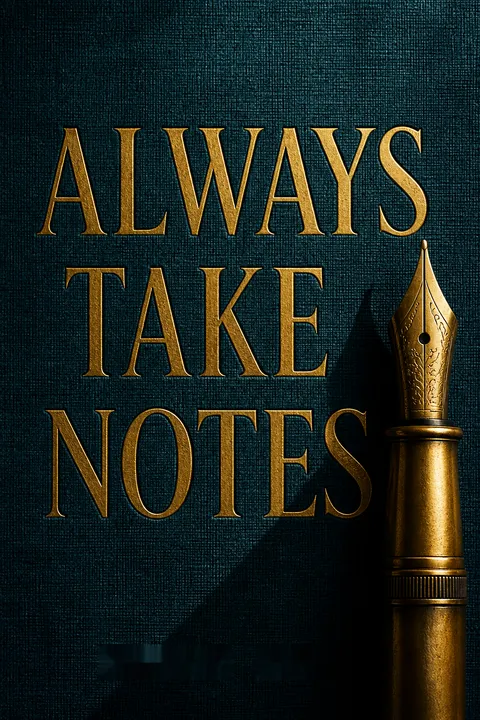
Always Take Notes receives mixed reviews averaging 3.55/5 stars. Readers appreciate the diverse insights from numerous established authors and find the anecdotes inspiring and entertaining. However, many criticize the repetitive format and choppy structure, with interviews sliced thematically rather than presented whole. Several note it offers more anecdotes than practical advice, though some find it motivating for aspiring writers. The audiobook format receives praise, though audio quality varies. Overall, readers suggest it's better for dipping in and out than reading straight through.
People Also Read


Download PDF
Download EPUB
.epub digital book format is ideal for reading ebooks on phones, tablets, and e-readers.








































