


Plot Summary
Prologue
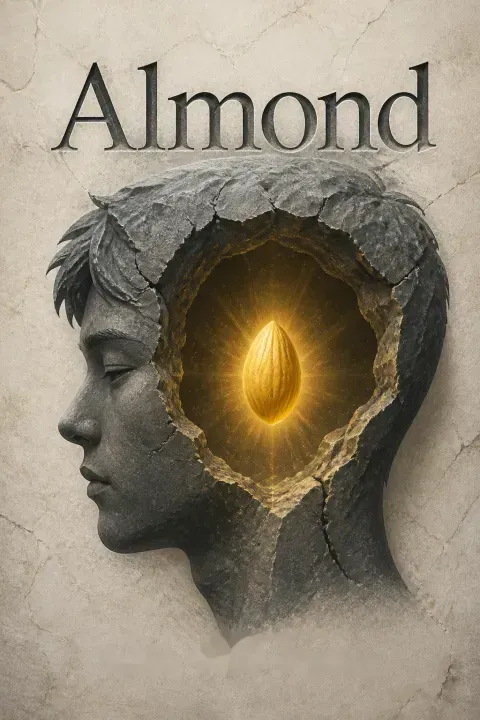
Seon Yunjae1 announces that everyone has almonds inside their head. He means the amygdalae, two almond-shaped clusters of neurons that process fear, joy, anger, and love. His own almonds are unusually small, leaving him unable to identify or express emotions.
He frames the story as a monster meeting another monster, refusing to say whether it ends happily or tragically. No one can ever really know, he argues, since life resists neat categorization. One of the monsters is him. The other is a boy named Gon.2
Yunjae sets up a paradox: he will narrate a deeply emotional story from a consciousness that claims to feel nothing. The almond metaphor grounds the novel's central question in biology while refusing biological determinism. By declaring the ending unknowable, Yunjae shifts focus from outcome to process, from 'what happens' to 'what it means to happen.' The word 'monster' is reclaimed here, stripped of its purely negative connotation. Granny used it affectionately. The prologue invites readers to reconsider who or what deserves such labels.
The Boy Who Never Smiled
From birth, Yunjae1 baffles his mother.3 He does not smile at rattles or silly dances. At one year old, he reaches for a red kettle of boiling water, screams when burned, then reaches for it again the next day. He stares into a neighbor's milky-white eye without flinching and approaches the man's growling dog even after seeing another child bitten bloody.
At four, brain scans reveal the cause: his amygdalae are abnormally small, leaving him unable to feel fear or identify emotions. Researchers offer to study him; his mother3 refuses.
Instead, she covers the walls with colored paper bearing instructions: when cars approach, run; when people smile, smile back; when given food, express gratitude. She quizzes him nightly on emotional scenarios like multiplication tables. Granny4 traces the Chinese characters for joy, sorrow, love, and anger onto paper and hangs them throughout the house like talismans.
Yunjae's mother faces an impossible dilemma: she can accept her son as he is or attempt to retrofit him for survival. Her choice, the training regime, is both loving and violent. She treats emotion as a foreign language Yunjae can memorize without comprehension. This mimics what neurotypical people do unconsciously, but making it explicit reveals how much of social life is performance. The house becomes a classroom for humanity, its walls papered with rules that other children absorb through osmosis. The tragedy is that her love manifests as an insistence that her son pass for normal, even at the cost of authenticity.
Granny Blocks the Glass Door
On Yunjae's1 fifteenth birthday, he goes with Mom3 and Granny4 for naengmyeon as a rare heavy snow blankets the city. After the meal, Yunjae1 lingers at the counter collecting plum candies while Mom3 and Granny4 step outside to watch carolers.
A man in a suit lurches into view, hammer in one hand, knife in the other. He swings at Mom's3 head repeatedly. Granny4 throws herself against the restaurant's glass door from outside, barricading it, screaming at Yunjae1 to stay inside. The man turns on her. Through the glass, Yunjae1 watches red splatter across the pane.
Six die that night, including the attacker, a laid-off salesman who wrote a note vowing to kill anyone he saw smiling. Mom3 survives but her brain sinks into a coma from which doctors say she will never wake. Granny4 is gone. Yunjae1 is alone.
The massacre crystallizes the novel's inquiry into helplessness. Yunjae's inability to act mirrors the frozen bystanders outside, yet his paralysis stems from neurology while theirs stems from fear. Granny's final act, blocking the door while shouting 'go,' is the purest expression of love in the book: she uses her body as a barrier between violence and her grandson. At the time, Yunjae cannot recognize this as love. He registers only the facts: blood, screaming, stillness. The scene establishes the central wound around which all subsequent relationships will form, and the question that will haunt Yunjae: what would Mom have wanted him to do?
A Bookstore of Ghosts
At the joint funeral, relatives and strangers sob while Yunjae's1 face remains blank. Whispers circulate: perhaps he is still in shock, perhaps he is a psychopath. Yunjae1 feels only questions. What were Mom3 and Granny4 laughing about just before the attack? Why did no one intervene?
He reopens the family's used-book store, dust swirling as he walks the aisles. Dr. Shim,6 the baker upstairs whose sign simply reads 'Bread,' asks Yunjae1 to visit. Over cream bread, the former heart surgeon, a man who quit medicine after his own wife died of cardiac arrest on a vacation where he could not save her, offers Yunjae1 wages to keep the bookstore running.
He owns the building. He was Mom's3 close friend, perhaps more. Yunjae1 accepts. When school resumes, his homeroom teacher announces his tragedy to the class. A boy asks how it felt to watch his grandmother die. Yunjae1 answers: nothing. The word spreads.
Yunjae's grief, or its absence, becomes a public spectacle. His affectless response to unimaginable loss reads to others as monstrosity, yet his interior life is filled with unanswered questions. He wants to understand causality, motive, meaning. These are not the queries of someone who doesn't care; they are the desperate mapping of someone who cares but lacks the emotional vocabulary to express it. Dr. Shim enters as a surrogate parent figure who, crucially, asks nothing of Yunjae emotionally. His own dead wife, his abandoned scalpel, his quiet bread-making: he has built a life around loss and offers Yunjae the same possibility without demanding performance.
Pretending to Be Leesu
At the hospital, a silver-haired man keeps watching Yunjae.1 Professor Yun7 finally approaches with a desperate request. His wife is dying. Their son Leesu2 vanished thirteen years earlier at an amusement park. The age-progressed sketch resembles Yunjae.1
The real son has been located, he explains, but is in no condition to meet his mother. Would Yunjae1 pretend, just once, so she can die believing her child returned? Yunjae1 agrees. In a private room overflowing with flowers, Mrs. Yun strokes his cheeks with skeletal hands.
She calls him her son, her love, and apologizes for everything they never did together. She wraps him in a frail hug that somehow burns with intensity. She dies days later, having seen her dream son one last time. Yunjae1 has no idea yet what he has stolen.
This episode introduces the novel's exploration of identity as performance. Yunjae has spent his life acting normal; pretending to be Leesu is merely an extension of that skill. Yet the act has real consequences. Mrs. Yun receives closure built on a lie. The real Leesu is denied his mother's final moments. Yunjae's emotional blankness makes him the perfect counterfeit because he feels no guilt about the deception. The scene also foreshadows the novel's recurring pattern: people project their needs onto Yunjae precisely because he offers no resistance. He is a mirror, and Mrs. Yun sees in him the son she prayed for.
Gon Spits on the Floor
Mrs. Yun's funeral is disrupted by a skinny, hollow-eyed boy who shoulders through mourners, spits on the floor, and glares at everyone with black-pebble pupils. This is Gon,2 the real Leesu.2 He transferred to Yunjae's1 school earlier, introducing himself by spitting in the classroom while the homeroom teacher stammered.
Within thirty minutes, the class has excavated his past: Daerim-dong with an elderly Chinese couple, a string of foster homes, juvenile detention. Gon2 begins bullying Yunjae1 with two sidekicks. He trips him in hallways, punches him at lunch, hides around corners to ambush him.
Yunjae1 never reacts. Gon's2 frustration mounts; he has built his identity around provoking responses, and this blank-faced boy offers him nothing. The incinerator showdown is announced: a public beating scheduled for lunch the next day, or Yunjae1 can skip it and be labeled a coward.
Gon's violence is his native language. Every foster home renamed him, every institution stripped more of his agency, until aggression became the only communication that produced reliable results. His spitting is both territorial marking and a test: who will flinch, who will turn away, who will stay? Yunjae's non-reaction threatens Gon's entire worldview. If he cannot provoke fear or pain in someone, his power is illusory. Their dynamic becomes a pressure cooker. Gon needs Yunjae to crack; Yunjae cannot crack because he lacks the emotional infrastructure that cracking requires. Each boy represents what the other most fears: Gon is all feeling without control, Yunjae is all control without feeling.
Mirror Game at the Pizzeria
At the incinerator, Gon2 beats Yunjae1 to the ground while Yunjae1 tells him calmly that he cannot give the reaction Gon2 wants. Professor Yun7 arranges a reconciliation meal and apologizes endlessly until Yunjae1 asks him to leave so Gon2 can speak for himself. Alone, Yunjae1 begins mirroring Gon:2 every word, every gesture, every facial twitch.
Gon2 tells him to stop. Yunjae1 repeats the command exactly. Gon2 threatens violence; Yunjae1 echoes the threat. This mirror play escalates until Gon,2 completely undone, flips tables, hurls pizza and sauce bottles, and screams at Yunjae1 to follow. When Yunjae1 finally walks out, Gon2 is left raging in the wreckage.
Outside, Professor Yun7 slaps Gon2 repeatedly. But something shifts. Gon2 begins visiting Yunjae's1 bookstore, buying old adult magazines, returning them, making crude jokes, loitering. The visits become daily. He tells no one, least of all himself, that he has found the first person who looks at him without flinching.
The mirroring scene transforms their relationship because it inverts the power dynamic. Gon has always been the aggressor who dictates terms; now Yunjae's imitation makes Gon see himself through a glass darkly. Every insult Yunjae repeats strips the insult of its power by exposing it as mere sound. Gon's subsequent tantrum is not anger at Yunjae but horror at his own reflection. The bookstore visits that follow represent Gon's first voluntary, non-violent approach to another person. He cannot articulate why he returns. He buys magazines he doesn't want, talks about nothing, and leaves. What he is really doing is testing whether this space, and this strange unfeeling boy, might be safe.
Empathy Training With a Needle
Gon2 arrives with a butterfly in a plastic container, calling it 'empathy training.' He pulls the butterfly out, gripping its wings, and asks Yunjae1 what he feels. Yunjae1 says it looks uncomfortable. Gon2 demands more. He stretches the wings slowly until one tears.
When Yunjae1 still cannot produce the anguish Gon2 wants, Gon2 pulls out a sewing needle. He pierces the butterfly's body, then rips off the remaining wing. Yunjae1 watches, able to recognize suffering conceptually but unable to feel it viscerally.
It is Gon2 whose face contorts, whose hands tremble, whose voice cracks. He finally stomps the butterfly to death and storms out, leaving Yunjae1 alone with the smear on the floor. Gon2 does not return for days. Yunjae1 later learns that Gon2 came back that evening and cried while scrubbing the remains away.
The butterfly scene is the novel's darkest mirror. Gon is trying to force Yunjae to feel what Gon himself cannot bear to feel. He externalizes his own self-loathing onto the insect, then demands Yunjae validate the performance by reacting. When Yunjae fails, Gon is forced to confront the truth: he is not the unfeeling monster he pretends to be. He feels too much, and that excess of empathy is unbearable. The butterfly's death is a sacrifice on the altar of Gon's shame. That he returns to clean it up, weeping, reveals the tenderness beneath the violence. He desperately wants someone to stop him, to care enough to intervene. Yunjae's passivity, while neurologically innocent, feels to Gon like the same abandonment he has always known.
What Was She Like?
Following Dr. Shim's6 advice, Yunjae1 visits Gon's2 penthouse apartment overlooking the Han River. Over noodles, Gon2 opens up about his past: earliest memories with an elderly Chinese couple in Daerim-dong who called him Zhēyáng, multiple foster homes, a couple who gave him back when their biological child arrived, juvenile detention.
His father has never asked about any of it. Then Gon2 asks the question he has been unable to voice: what was his mother like at the end? Yunjae1 describes Mrs. Yun's face, the resemblance to Gon2 in the eyes and smile dimples, her last act.
She hugged him very tight, he says, and it was warm. Gon's2 body shakes. His head sinks against his chest. He cries without sound, a fifteen-year-old boy who has survived abandonment, violence, and institutions, finally mourning a mother he never really knew. Yunjae1 stands there, feeling uselessly, terribly tall.
This is the novel's emotional fulcrum. Gon's question represents the first time he has asked for something rather than taken it. His entire life has been defined by what others did to him; here he risks vulnerability by wanting something specific: knowledge of his mother's love. Yunjae's answer is the first genuine emotional gift he gives anyone. He does not understand what the hug means, but he understands that it meant something to Mrs. Yun, and that Gon needs to hear it. The description of Yunjae feeling 'uselessly tall' is his first articulation of something resembling empathy: awareness that his presence, however inadequate, matters. Their friendship solidifies here, built on shared recognition of mutual lack.
A Scent Like Fallen Leaves
Dora5 first appears as a blur of motion: a girl sprinting down the empty hallway during the opening ceremony, silver glasses tossed aside. At Field Day, Yunjae1 sees her without glasses and registers slanted eyes, light brown pupils, the way she snaps her frames back on after crossing the finish line first.
She begins visiting the bookstore, curious about the boy who claims to feel nothing. One fall afternoon, a gust of wind whips Dora's5 hair across Yunjae's1 face. That night, he cannot sleep. His heart pounds, his skin prickles, his temples throb.
He describes the symptoms to Dr. Shim,6 who smiles and says it might be a crush. Soon Yunjae's1 body begins reacting before Dora5 even arrives at the store, backbone aching like an animal sensing an earthquake. She kisses him among the empty bookshelves. Through the window, Gon2 watches, then vanishes into the evening.
Yunjae's crush on Dora marks the first crack in his emotional armor. Tellingly, the awakening is somatic before it is psychological. His body registers attraction as illness: sleeplessness, fever, agitation. He lacks the vocabulary for desire, so he experiences it as pathology. This is a profound insight into alexithymia: emotion exists in the body whether or not the brain can interpret it. Dora herself is an ideal counterpart. She runs for no reason except that she must, echoing Yunjae's own condition of being without being able to explain why. Her kiss is the first physical affection Yunjae receives that is not familial obligation. Gon's witnessing of it introduces the novel's love triangle element, though it is less about romance than about the pain of being replaced.
The Jeju Island Setup
Yunjae1 stays home from the school trip to Jeju to care for Mom.3 On the final night, money collected for class snacks disappears. Teachers search bags and find the envelope, half empty, in Gon's2 backpack. He has an alibi: he spent the night at a PC bang. No one believes him.
Professor Yun7 reimburses the money without asking Gon's2 side. Days later, Gon2 disrupts Korean class. When Dora5 tells him to get lost and calls him a piece of trash, Gon2 trashes the classroom and vanishes. He visits the bookstore that night, asking if Yunjae1 thinks he stole the money. He says he is done trying to fit in.
He plans to become strong the only way he knows: by hurting before he can be hurt. He mentions a figure named Steel Wire,8 someone from his detention center past who he believes understands true strength. He flips Yunjae1 off with a soft, sad smile and disappears. The real thief later confesses it was a prank.
The theft incident crystallizes how society creates the monsters it fears. Gon is guilty of many things: violence, disruption, cruelty to a butterfly. But he did not steal the money, and no one, not even his father, asks or believes him. The presumption of guilt is total because Gon has been categorized as irredeemable. Dora's insult, while understandable as defense of Yunjae, demonstrates how even kind people participate in scapegoating. Gon's turn toward Steel Wire is not a sudden corruption but a logical conclusion: if the world will treat him as a monster regardless, he might as well become one. The real thief's confession, coming too late, highlights the damage done by snap judgments.
The Angel-Faced Predator
Yunjae1 realizes he owes Gon2 multiple apologies: for pretending to be his mother's son, for hiding his friendship with Dora,5 and most of all, for never saying clearly that he believed Gon2 about the stolen money.
He seeks out Steamed Bun, a gangly teen with disproportionately huge hands who points him toward a port town and a dance-shoe store at the end of a farmer's market. In a basement behind a rusted iron gate, Yunjae1 finds Gon2 huddled alone, bruised and hollow-eyed. Before they can speak, Steel Wire8 enters.
He has the face of a Renaissance angel: fair skin, rosy lips, light brown hair, deep clear eyes. From his coat he draws a thin, glinting knife. He is the figure Gon2 admired, someone who carved a road beyond society's rules. He hands Gon2 the blade and tells him to have fun with it.
Yunjae's decision to find Gon is his first morally autonomous act. Until now, his choices have been reactive or pragmatic. Seeking Gon requires him to want something: reconciliation, understanding, the preservation of a friendship he cannot name as friendship. Steel Wire represents the novel's third monster. If Yunjae is a monster by neurological absence and Gon by traumatic excess, Steel Wire is a monster by choice. His angelic beauty masking absolute amorality is a deliberate inversion: the most dangerous predator wears the most innocent face. The knife he hands Gon is a test of allegiance, an initiation into a world where violence is the only currency that matters.
Yunjae Takes the Blade
Gon's2 hand shakes around the knife. Yunjae1 tells him this is not strength, just a costume. Gon2 screams at him to leave and kicks him. Steel Wire,8 amused by Yunjae's1 unwavering expression, offers a deal: Yunjae1 can take Gon2 if he proves his friendship means something tangible. Yunjae1 agrees to whatever the man demands.
The beating is methodical and savage. Through blurred consciousness, Yunjae1 sees Gon2 weeping, begging Steel Wire8 to stop, offering himself instead. When Steel Wire8 finally turns the knife toward Gon,2 Yunjae1 pushes Gon2 aside and takes the blade in his own chest.
As blood pools beneath him, a memory surfaces: Granny4 outside the glass door, screaming at him to go away. Now he understands. She was in agony but relieved that her body, not his, absorbed the pain. A tear lands on his face. Something inside him ruptures. I feel it, he whispers. After fifteen years, the dam breaks just as the world fades.
The climax delivers the novel's thesis: empathy is not learned through instruction but through sacrifice. Yunjae does not suddenly understand feelings because someone explains them. He understands because, for the first time, he chooses to absorb pain for another person. This reenacts Granny's sacrifice, which he can now retroactively comprehend. The dam breaking is not a sentimental conversion but a neurological event triggered by extreme experience, consistent with the novel's earlier suggestion that amygdalae can be trained. His vision of Granny reframes her final act: what looked like chaos was actually love made visible through bodily sacrifice. The tear that falls, noticed only because it burns, signals the arrival of a capacity that has been physically present but dormant.
Sorry. Thanks. Truly.
Yunjae1 survives. In the hospital, Dr. Shim6 explains what happened afterward: Professor Yun7 arrived with police, Gon2 stabbed Steel Wire8 in self-defense (Steel Wire8 survived and faces trial), and Gon2 is now in therapy.
Dora5 left a card with a photograph of herself mid-stride at a track meet; she transferred to a school with a real team and won second place in her district. A letter arrives from Gon,2 containing only three small words on a folded white page: 'Sorry. Thanks. Truly.' with a period after the last word that Yunjae1 stares at for a long time.
Then Dr. Shim6 wheels in Mom.3 She woke from her coma while Yunjae1 was unconscious. She touches his hair and cries. At first Yunjae1 does not cry. Then she wipes something from his cheeks and he realizes tears are streaming down his face. He cries and laughs simultaneously, and so does she.
The resolution brings together all the novel's threads without forcing false closure. Gon's three words are a complete emotional arc in miniature: acknowledgment of harm done, gratitude for being seen, and the word 'truly' that Yunjae once analyzed for its fading meaning through repetition. Now it carries the full weight of sincerity. Mom's awakening is the miracle the book has earned through accumulated small acts of care: Yunjae's daily visits, his decision to talk to her after Dora's prompting, his refusal to give up. The tears Yunjae finally sheds are not just relief but the embodied proof that his brain has changed. He has become, in Dr. Shim's terms, more colorful, more capable of registering the world's complexity.
Epilogue
Yunjae1 is eighteen now, an adult riding a bus through spring to visit Gon.2 Not for any special reason. Just to see a friend. Flowers bloom outside the window, whispering their arrival. He reflects that this is now an entirely different story, completely new and unpredictable.
Neither he nor anyone can ever really know whether a story is happy or tragic. Life takes on various flavors as it flows. He has decided to confront whatever comes, to feel however much he can feel: nothing more, nothing less.
The epilogue refuses the neat closure a lesser novel might provide. Yunjae does not declare himself cured, nor does he claim to understand love or happiness. He has simply gained the capacity to register experience as it happens, without categorizing it prematurely. The bus journey to Gon is an ordinary act of friendship, remarkable precisely because it is unremarkable. When Yunjae says the story is 'completely new and unpredictable,' he is describing both his future and the nature of consciousness itself. The epilogue echoes the prologue's claim that stories resist categorization as happy or tragic. What matters is not the ending but the willingness to stay present for whatever flavor life offers next.
Analysis
Almond explores a paradox that sits at the heart of human connection: we cannot teach someone to feel, yet feeling can be learned through the right kind of relationship. Yunjae's1 alexithymia literalizes what many people experience metaphorically. He is a boy who has been given every instruction manual for humanity except the one that matters: the experience of being loved without condition and learning to love in return. The novel argues that empathy is not primarily a cognitive skill but an embodied practice. Yunjae1 doesn't learn to feel because his mother3 quizzes him on facial expressions. He learns through Gon's2 mysterious loyalty, through Dora's5 kiss, through Dr. Shim's6 patient companionship, and ultimately through his own choice to absorb a knife meant for his friend. The body leads; the brain follows.
The book also mounts a quiet critique of how society treats those who deviate from emotional norms. Yunjae1 and Gon2 are both labeled monsters, but for opposite reasons: Yunjae1 feels too little, Gon2 feels too much. Neither is given the grace to simply be different. Mom's3 elaborate training regime is both an act of love and a tragedy. She dedicates herself to making Yunjae1 seem normal rather than helping him discover what his own way of being might look like. The school, the police, the foster system, the teachers: all are complicit in demanding conformity or punishing its absence.
Yet the novel is not a polemic. It is, finally, a story about the stubborn persistence of connection. Two boys, each broken in his own way, find in each other something no adult could provide: a witness. Gon2 needs someone who will not flinch at his ugliness. Yunjae1 needs someone whose emotions are large enough for both of them. Their friendship is not healthy by any clinical standard. It involves beatings, a tortured butterfly, and near-fatal violence. But it is real, and that realness changes them. Gon's2 three-word letter and Yunjae's1 final tears represent a hard-won emotional literacy that neither could have achieved alone. The book suggests that becoming human is not a developmental milestone but a continuous process, shaped by the people brave enough to stay close when closeness is costly.
Review Summary
Almond is a thought-provoking novel about a boy with alexithymia, a condition that prevents him from feeling emotions. Readers praise the unique perspective, character development, and exploration of human nature. Many find it emotionally impactful despite the protagonist's lack of feelings. The writing style is described as simple yet beautiful. While some criticize the ending as too convenient, most reviewers highly recommend the book for its fresh take on coming-of-age stories and its powerful messages about empathy and acceptance.
People Also Read









Characters
Seon Yunjae
Emotionless narrator born with alexithymiaAt sixteen, Yunjae cannot identify or express feelings due to abnormally small amygdalae, the almond-shaped brain structures that process emotion. He experiences physical sensations (pain, temperature, tickling) but cannot translate them into joy, fear, or sorrow. Raised by a mother3 who trained him with emotional scripts and a grandmother4 who called him an 'adorable little monster,' Yunjae navigates the world through memorization and mimicry. He loves books for their blank spaces, which allow him to insert himself between lines. His voice is precise, observant, and startlingly honest because he lacks the instinct to soften truth with tact. His arc traces the gradual awakening of emotional capacity, triggered not by instruction but by friendship, sacrifice, and bodily experience that precedes understanding. He is both neurologically atypical and profoundly human in his longing to comprehend what others feel instinctively.
Gon (Yun Leesu)
Violent, traumatized real sonKidnapped or lost at age three, Gon spent thirteen years cycling through an elderly Chinese couple's home in Daerim-dong, multiple foster families, and juvenile detention. He has been named Zhēyáng, Donggu, and finally Leesu, but he chose 'Gon' for himself. He expresses every emotion through aggression because it was the only language anyone responded to. Beneath the spitting and violence lies an almost unbearable sensitivity: he weeps after killing a butterfly, cries silently when asking about his mother, and cannot stomach the suffering he tries to inflict. His arc moves from antagonist to friend, from someone who tests whether Yunjae1 can be broken to someone who learns that not breaking can be a form of care. His three-word letter at the end signals a capacity for gratitude and remorse he could not previously access.
Mom (Jieun)
Fiercely protective single motherYunjae's mother fell in love with an accessories seller at her college, got pregnant, and left home when Granny4 threatened to disown her. After Yunjae's father died in an accident before the birth, she raised Yunjae1 alone for seven years before reconciling with Granny4. Practical yet romantic, she opened a used-book store as her dream. Her response to Yunjae's1 diagnosis was not grief but action: she created elaborate training systems, emotion charts, and scripts to help him survive. She loved him ferociously, though her love often manifested as terror that his difference would make him a target. The Christmas Eve attack leaves her in a coma, her body surviving but her consciousness absent. Her eventual awakening coincides with Yunjae's1 emotional breakthrough, as if his becoming fully human called her back.
Granny
Loud, loving grandmother and protectorA large woman with enormous hands and an even larger presence, Granny raised Mom3 alone after Grandpa died of cancer during her pregnancy. She sold tteokbokki and sweet potatoes at the Express Bus Terminal, adorning her stall with lotus lanterns and Christmas ornaments year-round. Reunited with Yunjae1 when he was young, she immediately dubbed him an 'adorable little monster' and loved him without condition. She traced Chinese characters for emotions onto paper, even learning calligraphy by heart, and argued that cramming emotional rules was pointless while still helping Mom3 cut out arrows. Her death during the Christmas Eve attack, blocking the glass door with her body while screaming at Yunjae1 to stay inside, becomes the novel's central image of sacrificial love, only fully understood by Yunjae1 at the climax.
Lee Dora
Runner who becomes Yunjae's first loveNamed Dora by parents who now call her 'dorai' (freak) for her obsession with running, Dora is the sole member of the school's unofficial track team. She runs not for purpose or glory but because she must, like breathing. Calm and self-contained, she wears thick silver glasses that hide her slanted, light-brown eyes until she tosses them aside to race. Her parents want her to choose a practical sport like golf; she refuses. She befriends Yunjae1 through the school library, where she practices sprinting between shelves. Her kiss in the empty bookstore marks Yunjae's1 first romantic experience. She is fiercely loyal, telling Gon2 to leave Yunjae1 alone, but also capable of cruelty in that loyalty. Her arc ends with her transferring to a school with a real track team and winning second place in her district.
Dr. Shim
Former heart surgeon turned guardian bakerThe owner of the bakery above the bookstore, Dr. Shim was once a successful heart surgeon at a university hospital. He quit after his wife died of sudden cardiac arrest during a vacation on a remote island, where he could do nothing but pump her chest uselessly while waiting an hour for an ambulance. Now he bakes bread alone, finding in its aroma the nostalgia of his wife's love. He was Mom's3 close friend, perhaps more, and she asked him to look after Yunjae1 if anything happened. He becomes Yunjae's1 guardian after the massacre, offering financial support without demands, answering Yunjae's1 questions about emotion and friendship with patient wisdom. He believes the heart can prevail over the brain and encourages Yunjae's1 growth without forcing it. His own grief makes him unusually equipped to accept Yunjae1 exactly as he is.
Professor Yun Kwonho
Gon's estranged, guilt-ridden fatherA college business professor whose son Leesu2 vanished at an amusement park thirteen years ago when his wife briefly let go of the child's hand to answer a phone call. He spent over a decade searching, his marriage crumbling under shared guilt. When Gon2 is finally found, Professor Yun cannot bridge the gap between the traumatized teenager before him and the innocent three-year-old he lost. He tries to shape Gon2 into a respectable student, enrolls him in elite schools, and when those fail, a decent humanities school. He beats Gon2 twice, then despises himself for it. His apologies are excessive, his efforts misguided. By the novel's end, he takes leave from his career to focus entirely on Gon2, determined to try again, however long it takes.
Steel Wire
Angel-faced predator from Gon's pastA figure from Gon's2 juvenile detention center whose exploits were legend. He earned his nickname through crimes involving a steel wire, though the specifics remain shadowy. He appears as a man in his twenties or thirties with the face of Michelangelo's David: fair skin, rosy lips, light brown hair, long lashes, deep clear eyes. The beauty is a mask for complete moral vacancy. He has constructed a philosophy in which conventional society is meaningless and true strength lies in fearlessness and willingness to harm. He draws vulnerable teenagers into his orbit, including Gon2, whom he tests with a knife. His trial, where he smiles throughout, suggests a mind utterly untouchable by remorse. He represents the monster by choice, in contrast to Yunjae1 (by neurology) and Gon2 (by trauma).
Plot Devices
The Amygdalae and Almonds
Biological metaphor for emotional capacityThe amygdalae are two almond-shaped clusters of neurons in the brain that process emotional responses, particularly fear. Yunjae's1 are unusually small, causing alexithymia, the inability to identify or express feelings. His mother3 feeds him literal almonds daily, hoping to grow the figurative ones inside his head, a folk remedy born of desperation. The almond becomes the novel's central metaphor: everyone has them, no one can feel them, you just know they are there. Yunjae's1 elaborate almond-eating ritual, involving scent, texture, and precise timing before the final crunch, parallels his approach to life itself: methodical, sensory, searching for something he cannot access directly. His eventual emotional awakening suggests that the brain can change through experience, not just almonds.
Mom's Emotion Scripts
Social survival training systemAfter Yunjae's1 diagnosis, Mom3 creates a comprehensive behavioral curriculum. Colored paper sheets on walls list cause-and-effect rules: when cars approach, run; when people smile, smile back; when given food, express gratitude. She invents a 'human emotion game' where she proposes scenarios and Yunjae1 must identify the correct emotional response. Granny4 traces Chinese characters (joy, love, anger, sorrow) onto paper that they hang throughout the house. As Yunjae1 ages, the scripts become more sophisticated, teaching him to recognize bragging, to choose between 'thank you' and 'it's nothing,' and to occasionally perform anger or sadness so he doesn't stand out. The training keeps Yunjae1 alive socially but also traps him in performance. He literally cannot tell when he is being authentic because he has never been allowed to discover what authenticity would mean.
The Used-Book Store
Setting as repository of stories and meeting groundJieun's Bookstore, in a residential alley in Suyu-dong, is both home and livelihood. Mom3 handpicks used volumes, specializing in vintage editions, children's books, and even a hidden collection of erotic classics that Granny4 insisted would sell. After the massacre, Yunjae1 reopens it, and it becomes the neutral ground where Gon2 begins his strange visits and Dora5 later appears. Books serve Yunjae1 as emotional surrogates: he reads by chewing on words until their meanings dissolve, finding comfort in the blank spaces between lines where he can insert himself. The store's eventual closure, books donated to the school library, marks the end of childhood and the dissolution of the family unit. Its emptiness becomes a 'grave of books,' a place haunted by the voices of Mom3 and Granny4 that once filled it.
Plum-Flavored Candy
Taste memory linking love and painWhite candy with a red stripe across its surface, plum-flavored, beloved by both Mom3 and Granny4. The red stripe, which melts faster than the white, often cuts their tongues, combining sweetness with the metallic taste of blood. Granny4 said the salty blood actually enhanced the sweetness. The candy represents the fusion of love and suffering that defines Yunjae's1 family. It appears at the Christmas Eve restaurant when Yunjae1 grabs two fistfuls from a counter basket moments before the attack. In his near-death dream, Gon2 places a translucent marble-like piece of plum candy in Yunjae's1 palm, the red line flipping between a smile and a frown as he rolls it. When Yunjae1 tastes it in the dream, the sensations are complex: sweet, sour, salty, sharp, bitter, with a sweet scent that keeps him sniffing hungrily.
The Glass Door
Symbol of separation and sacrificial loveThe glass door of the naengmyeon restaurant becomes the central traumatic image. During the Christmas Eve attack, Granny4 blocks it from outside, pressing her body against it to keep Yunjae1 inside. She screams at him to go, to get out of the way, phrases Yunjae1 has been trained to interpret as rejection. Through the glass, he watches blood splatter across the pane, turning his view red. He interprets her actions as abandonment, not understanding that she is sacrificing herself. The memory resurfaces at the climax, when Yunjae1 takes the knife for Gon2. In his near-death vision, he finally grasps what Granny4 meant: she was in pain but relieved it was her body absorbing the violence, not his. The glass door transforms from a symbol of helpless separation into an image of love made visible through sacrifice.
FAQ
Synopsis & Basic Details
What is Almond about?
- A boy's emotional journey: Almond tells the story of Yunjae, a boy with alexithymia, a condition that makes it difficult for him to feel and express emotions. The narrative follows his life after a tragic event, exploring his relationships and his gradual journey towards understanding and experiencing emotions.
- Navigating a complex world: The story delves into how Yunjae learns to navigate a world that is driven by emotions he doesn't naturally possess. He relies on learned behaviors and rules to interact with others, highlighting the challenges of living with a condition that sets him apart.
- Themes of connection and change: The novel explores themes of friendship, empathy, and the possibility of change. It examines how relationships can impact personal growth and how even those who seem emotionally detached can learn to connect with others on a deeper level.
Why should I read Almond?
- Unique perspective on emotions: Almond offers a rare and insightful look into the world of someone who struggles with emotions. It challenges readers to consider the importance of empathy and the complexities of human connection.
- Compelling character development: The novel features well-developed characters, each with their own struggles and motivations. Yunjae's journey is particularly compelling, as he evolves from an emotionally detached boy to someone capable of experiencing a range of feelings.
- Thought-provoking themes: Almond tackles profound themes such as loss, trauma, and the search for identity. It prompts readers to reflect on their own emotional experiences and the ways in which they connect with others.
What is the background of Almond?
- Alexithymia as a focus: The novel is grounded in the concept of alexithymia, a real psychological condition, which is explored through Yunjae's experiences. The author uses this condition to examine the nature of emotions and how they shape human interactions.
- Social commentary: Almond subtly critiques societal pressures and expectations, particularly those related to emotional expression. The story highlights how individuals who deviate from these norms can be marginalized and misunderstood.
- Korean cultural context: While not explicitly a cultural commentary, the novel is set in a contemporary Korean context, which influences the characters' experiences and the social dynamics within the story.
What are the most memorable quotes in Almond?
- "I have almonds inside me.": This opening line, repeated in the prologue, introduces the central metaphor of the amygdalae and sets the stage for Yunjae's exploration of his emotional landscape. It highlights the physical basis of emotions and the core of his condition.
- "Luck plays a huge part in all the unfairness of the world. Even more than you'd expect.": This quote reflects Yunjae's understanding of the world's randomness and the role of chance in shaping individual lives. It underscores the theme of fate and the challenges of navigating an unpredictable world.
- "There is no such person who can't be saved. There are only people who give up on trying to save others.": This quote, attributed to the fictional P.J. Nolan, encapsulates the novel's message of hope and the potential for redemption. It emphasizes the importance of empathy and the power of human connection to transform lives.
What writing style, narrative choices, and literary techniques does Sohn Won-Pyung use?
- Detached first-person narration: The story is told from Yunjae's perspective, using a detached and observational tone that reflects his alexithymia. This narrative choice allows readers to experience the world through his unique lens, highlighting his emotional distance and gradual awakening.
- Simple and direct language: Sohn Won-Pyung employs a simple and direct writing style, which enhances the clarity of Yunjae's voice and makes the story accessible to a wide audience. The straightforward language contrasts with the complex emotional themes explored in the novel.
- Symbolism and metaphors: The author uses symbolism and metaphors, such as the almonds representing the amygdalae, to deepen the meaning of the story. These literary techniques add layers of interpretation and enhance the reader's understanding of Yunjae's internal world.
Hidden Details & Subtle Connections
What are some minor details that add significant meaning?
- The plum-flavored candy: The recurring mention of plum-flavored candy, loved by both Mom and Granny, symbolizes their shared bond and the bittersweet nature of their relationship. It also represents the small joys they found in life, even amidst hardship.
- The used-book store: The used-book store, a dream of Mom's, represents her love for stories and her desire to connect with others through literature. It also serves as a space where Yunjae encounters different perspectives and begins to explore his own emotions.
- The placement of emotion hanja: The placement of emotion hanja around the house, with negative emotions in the bathroom, reveals Mom's attempt to teach Yunjae about feelings. The fading of the negative characters in the bathroom symbolizes the gradual shift in Yunjae's emotional state.
What are some subtle foreshadowing and callbacks?
- The man in the suit: The man in the suit seen lurking before the Christmas Eve tragedy foreshadows the violence to come. His presence creates a sense of unease and hints at the impending danger.
- The "human emotion game": Mom's "human emotion game" foreshadows Yunjae's later struggles to understand and express emotions. It also highlights the artificiality of his early attempts to mimic feelings.
- Granny's "monster" nickname: Granny's affectionate nickname for Yunjae, "adorable little monster," foreshadows his later interactions with Gon, who is also seen as a "monster" by society. It also hints at the duality of human nature and the potential for both good and bad within each individual.
What are some unexpected character connections?
- Dr. Shim and Mom's friendship: The close friendship between Dr. Shim and Mom, revealed after her death, adds depth to both characters. It shows that Mom had a support system beyond her family and that Dr. Shim was more than just a neighbor.
- Gon and Mrs. Yun's connection: The revelation that Gon is Mrs. Yun's missing son creates a complex dynamic between Yunjae, Gon, and Professor Yun. It highlights the themes of loss, identity, and the search for belonging.
- Dora's understanding of Yunjae: Dora's ability to see beyond Yunjae's emotional detachment and recognize his true nature is unexpected. It shows that empathy can exist even in the absence of shared emotional experiences.
Who are the most significant supporting characters?
- Dr. Shim: As a mentor and guardian, Dr. Shim provides Yunjae with stability and guidance. His own experiences with loss and regret make him a compassionate and understanding figure in Yunjae's life.
- Gon: As Yunjae's unlikely friend, Gon challenges his understanding of emotions and forces him to confront his own limitations. Their relationship is a catalyst for change and growth for both characters.
- Dora: As a source of inspiration and support, Dora encourages Yunjae to embrace his emotions and pursue his passions. Her vibrant personality and zest for life have a transformative impact on Yunjae's journey.
Psychological, Emotional, & Relational Analysis
What are some unspoken motivations of the characters?
- Mom's desperation for Yunjae's normalcy: Mom's relentless efforts to teach Yunjae emotions stem from her deep-seated fear of his difference and her desire for him to fit into society. Her actions are driven by a mother's love, but also by her own anxieties.
- Gon's yearning for acceptance: Gon's violent behavior and tough exterior mask his deep-seated desire for acceptance and understanding. He seeks validation through his interactions with others, but his past experiences make it difficult for him to form genuine connections.
- Dr. Shim's need for redemption: Dr. Shim's decision to help Yunjae is partly driven by his own guilt and regret over his wife's death. He sees in Yunjae an opportunity to make amends for his past mistakes and find meaning in his life.
What psychological complexities do the characters exhibit?
- Yunjae's internal conflict: Yunjae's struggle with alexithymia creates a complex internal conflict. He is torn between his desire to understand emotions and his inability to experience them naturally. This conflict drives his journey of self-discovery and his gradual emotional awakening.
- Gon's self-destructive tendencies: Gon's self-destructive tendencies stem from his deep-seated feelings of worthlessness and his inability to cope with his past trauma. He sabotages his own chances at happiness, believing that he is destined to be an outcast.
- Professor Yun's guilt and regret: Professor Yun's guilt and regret over his son's disappearance and his wife's death lead to his emotional detachment and his inability to connect with Gon. He is haunted by his past mistakes and struggles to find a way to make amends.
What are the major emotional turning points?
- The Christmas Eve tragedy: The violent attack that kills Mom and Granny is a major emotional turning point for Yunjae. It forces him to confront the harsh realities of the world and the limitations of his emotional understanding.
- Yunjae's first experience of empathy: Yunjae's first experience of empathy, triggered by his interactions with Gon and Dora, marks a significant shift in his emotional development. It opens him up to a new world of feelings and connections.
- Gon's breakdown at the hideout: Gon's emotional breakdown at the hideout, where he finally admits his vulnerability, is a turning point in his journey. It shows that he is capable of experiencing deep emotions and that he is not as tough as he pretends to be.
How do relationship dynamics evolve?
- Yunjae and Gon's evolving friendship: Yunjae and Gon's friendship evolves from a tentative connection to a deep bond based on mutual understanding and acceptance. They challenge each other's perspectives and help each other grow.
- Yunjae and Dr. Shim's mentor-mentee relationship: Yunjae and Dr. Shim's relationship evolves from a simple arrangement to a deep bond based on mutual respect and trust. Dr. Shim provides Yunjae with guidance and support, while Yunjae helps Dr. Shim find meaning in his life.
- Yunjae and Dora's romantic connection: Yunjae and Dora's relationship evolves from a casual acquaintance to a deep romantic connection. Dora's influence helps Yunjae embrace his emotions and explore the complexities of love.
Interpretation & Debate
Which parts of the story remain ambiguous or open-ended?
- The nature of Yunjae's emotional growth: While Yunjae experiences significant emotional growth, the extent of his transformation remains somewhat ambiguous. The novel leaves it open to interpretation whether he fully overcomes his alexithymia or simply learns to navigate it more effectively.
- Gon's future: Gon's future is left open-ended, with the novel suggesting that he is on a path towards change but not providing a definitive resolution. This ambiguity reflects the complexities of real life and the challenges of overcoming past trauma.
- The meaning of "normal": The novel questions the meaning of "normal" and whether it is a desirable goal. It leaves it up to the reader to decide whether Yunjae's journey is about becoming normal or about embracing his unique identity.
What are some debatable, controversial scenes or moments in Almond?
- The butterfly scene: The scene where Gon tortures a butterfly is disturbing and controversial. It raises questions about the nature of empathy and the limits of human cruelty. It also highlights the different ways in which Yunjae and Gon experience and express emotions.
- Steel Wire's actions: Steel Wire's violent behavior and his manipulation of Gon are controversial. They raise questions about the nature of evil and the influence of negative role models.
- Yunjae's lack of reaction: Yunjae's lack of reaction to the violence and tragedy he witnesses is often debated. Some readers may see it as a sign of his emotional detachment, while others may interpret it as a form of resilience or a coping mechanism.
Almond Ending Explained: How It Ends & What It Means
- Yunjae's emotional awakening: The ending sees Yunjae experiencing a range of emotions for the first time, triggered by the near-death experience. This signifies a major shift in his emotional development and his ability to connect with others.
- Hope for the future: The ending offers a sense of hope for the future, with Yunjae, Mom, and Gon all on paths towards healing and growth. It suggests that even after experiencing great loss and trauma, it is possible to find meaning and connection in life.
- The cyclical nature of life: The final scene, with Yunjae on a bus, suggests the cyclical nature of life and the ongoing journey of self-discovery. It implies that life is a continuous process of change and growth, with both happy and tragic moments.
Download PDF
Download EPUB
.epub digital book format is ideal for reading ebooks on phones, tablets, and e-readers.








































