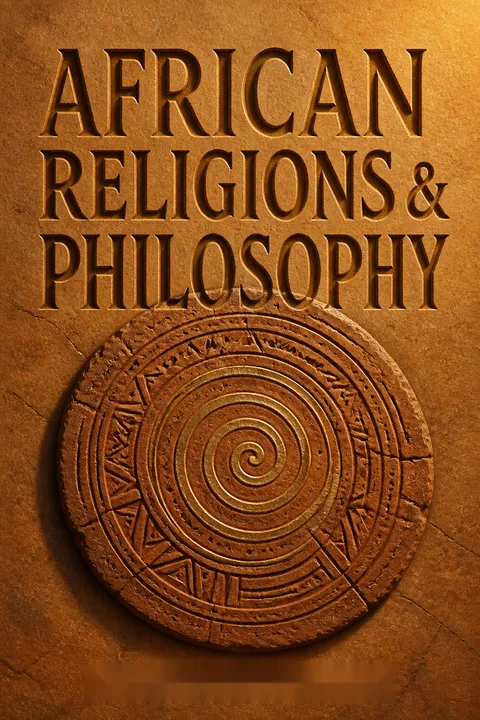

Summary Temporarily Unavailable
This summary is temporarily unavailable and is currently being updated. You can still explore the FAQs and other metadata below.
Key Takeaways
1. African Existence is Fundamentally Religious
Wherever the African is, there is his religion: he carries it to the fields where he is sowing seeds or harvesting a new crop; he takes it with him to the beer party or to attend a funeral ceremony; and if he is educated, he takes religion with him to the examination room at school or in the university; if he is a politician he takes it to the house of parliament.
Pervasive spirituality. For African peoples, religion is not a separate compartment of life but an ontological phenomenon, deeply interwoven into every aspect of existence. This means that the universe itself is perceived as religious, and human life is a continuous participation in a spiritual drama, from before birth to long after physical death. There is no formal distinction between the sacred and the secular.
Community-centric faith. Traditional African religions are not individualistic but communal, binding individuals to their entire community, including the living, the departed, and those yet to be born. To be human is to belong, and this belonging necessitates participation in the community's beliefs, ceremonies, and rituals. Detaching oneself from this religious fabric is akin to self-excommunication, severing one's roots and context of security.
Living creeds. Unlike many world religions, African traditional faiths lack sacred scriptures or systematic dogmas. Instead, their "creeds are written in the heart of the individual, and each one is himself a living creed of his own religion." Beliefs are assimilated through family and community, passed down orally, and constantly adapted to historical situations and needs, making every person a "religious carrier."
2. Time is Two-Dimensional: Sasa (Present) and Zamani (Past)
The linear concept of time in western thought, with an indefinite past, present and infinite future, is practically foreign to African thinking.
Experiential time. African time is primarily a two-dimensional phenomenon, composed of events that have occurred (Zamani) and those currently happening or immediately about to occur (Sasa). The distant future is largely absent as "actual time" because it has not yet been experienced or realized, making it "No-time." This orientation means people focus on the present and the experienced past.
Phenomenon calendars. Time is reckoned not mathematically, but by significant events and natural rhythms. Days are marked by cattle activities, months by seasonal changes like "hunting month" or "dirty mouth" (when new grain is eaten), and years by agricultural cycles. This makes numerical calendars largely irrelevant, as the event itself, rather than a precise mathematical moment, defines time's meaning.
Backward movement. This unique time concept means that time "moves 'backward' rather than 'forward'." The Sasa (now-period) constantly feeds into the Zamani (long past), which acts as the "graveyard of time" and the "final storehouse for all phenomena and events." This orientation means there is no concept of history progressing towards a future climax or a "golden age" in the distant future; instead, the "golden age" lies in the Zamani.
3. God is Both Transcendent and Intimately Involved
God is thus simultaneously transcendent and immanent; and a balanced understanding of these two extremes is necessary in our discussion of African conceptions of God.
Ultimate origin and sustainer. Across nearly 300 African peoples studied, the universal belief is in God as the Supreme Being, the ultimate explanation for the genesis and sustenance of all things. He is "older" than Zamani, existing beyond creation, yet personally involved in it. This dual nature is a paradox: God is so "far" (transcendent) yet so "near" (immanent).
Omni-attributes. God is widely conceived as omniscient ("the Wise One," "He Who knows or sees all"), omnipresent ("He Who is everywhere," like wind or air), and omnipotent ("the All-powerful," "He Who clears the forest"). His power is seen in controlling nature (wind, sun, rain) and spirits, placing Him at the top of the ontological hierarchy. He is also self-existent, pre-eminent, and Spirit, often described anthropomorphically as Father or Mother.
Benevolent yet punitive. God is generally regarded as essentially good, merciful, and the source of blessings like rain, fertility, and health. However, afflictions like epidemics, droughts, and death are sometimes attributed to His anger or will, often as punishment for human misdoings or contravening customs. This doesn't imply an "evil" God, but rather a rationalization for inexplicable suffering, with God as the ultimate, just Judge.
4. The Living-Dead Maintain a Vital Link Between Worlds
So long as the living-dead is thus remembered, he is in the state of personal immortality.
Bridge to the spirit world. The "living-dead" are physically deceased individuals (up to four or five generations back) who are still remembered by name by their living relatives. They exist in a state of "personal immortality," bridging the human world (Sasa) and the spirit world (Zamani). They are considered part of the family, retaining their personality and interest in family affairs.
Guardians of ethics. These living-dead act as invisible guardians of family traditions, ethics, and activities. Offenses against these norms are ultimately offenses against the forefathers, who may bring misfortune or illness as a form of "punishment" or demand rectification. This reinforces social cohesion and moral conduct within the community.
Intermediaries and transition. The living-dead are the primary intermediaries between living humans and God or more distant spirits. Through libations, food offerings, and prayers, the living maintain fellowship and remembrance, ensuring the departed are not "forgotten" – the worst possible fate. Once the last person who knew them dies, they transition to "collective immortality" as ordinary spirits, losing personal ties and becoming "its."
5. Corporate Identity Defines the Individual's Being
The individual can only say: ‘I am, because we are; and since we are, therefore I am’.
Interdependent existence. In traditional African societies, the individual does not exist in isolation but is inextricably linked to the corporate group. This profound sense of kinship, extending to past and future generations, forms a vast network that governs social relationships, marital customs, and individual behavior. One's identity, duties, privileges, and responsibilities are all defined by this collective belonging.
Life as a shared journey. From birth, through initiation, marriage, and even death, the individual's journey is a communal one. Physical birth is merely the start; ritual incorporation throughout life integrates the person into society. When an individual suffers or rejoices, it is a shared experience with kinsmen, neighbors, and relatives, both living and departed.
Genealogical roots. Kinship extends vertically through genealogies, linking the living (Sasa) to the departed (Zamani) and the unborn. These genealogies provide a sense of historical belonging, deep rootedness, and a sacred obligation to perpetuate the lineage. Clans, as major subdivisions, further localize this kinship, often with totemic symbols reinforcing unity and common affinity.
6. Mystical Power Permeates the Universe
African peoples know that the universe has a power, force or whatever else one may call it, in addition to the items in the ontological categories which we discussed in chapter three.
Dynamic, living universe. Africans perceive the universe as dynamic and powerful, imbued with a mystical force that is ultimately from God but also inherent in physical objects and spiritual beings. This power manifests in various ways, often defying scientific explanation, and is a constant reality in village life, influencing beliefs, fears, and actions.
Dual manifestations. This mystical power can be used for "good magic" or "evil magic."
- Good magic: Employed by specialists like medicine-men, diviners, and rainmakers for curative, protective, productive, and preventive purposes. This includes charms, amulets, and rituals to ensure health, fortune, and prosperity.
- Evil magic (sorcery/witchcraft): Used maliciously to harm individuals or property, often through poisonous ingredients, curses, "evil eye," or sending malevolent agents (animals, spirits). This is blamed for illnesses, misfortunes, and accidents, leading to widespread fear and the need for protective measures.
Hierarchical access. Access to this power is hierarchical: God has absolute control, spirits and the living-dead possess portions, and certain human specialists know how to tap and manipulate it. This belief system provides explanations for life's adversities and offers avenues for intervention, making medicine-men and diviners crucial figures in communities.
7. Ethics and Justice are Rooted in Social Conduct and Hierarchy
Something is considered to be evil not because of its intrinsic nature, but by virtue of who does it to whom and from which level of status.
Societary morality. African ethics are primarily "societary" rather than "spiritual," focusing on outward conduct and its impact on community relationships. Actions are deemed "good" if they conform to communal customs and regulations, and "bad" (evil) if they disrupt the accepted social order and peace. There is little concept of "secret sin," as morality is largely public and observable.
Hierarchical offenses. Moral offenses are understood within a strict social hierarchy, where a person of lower rank or age typically offends against one of higher status. God, being the highest, cannot commit evil against creation; misfortunes from Him are seen as punishment for human misdoings. Similarly, elders or living-dead are generally not seen as offending juniors, but rather as upholding the established order.
Restitution and punishment. Breaches of moral or ritual conduct are believed to bring misfortune, not just to the offender but to the entire corporate group. Punishment, often administered in this life, ranges from death for severe offenses (murder, sorcery) to fines for minor ones. Curses, potent when uttered by a higher-status individual, and oaths, which bind mystically, serve as powerful deterrents and mechanisms for maintaining social harmony and justice.
8. Rapid Modern Change Creates Profound Dilemmas for African Societies
The speed of casting off the scales of traditional life is much greater than the speed of wearing the garments of this future dimension of life.
World revolution's impact. Africa has been abruptly plunged into a dynamic world revolution, driven by science, technology, and global influences, for which it was largely unprepared. This rapid change, initiated by external forces like Christianity and European colonialism, has profoundly disrupted traditional life, leading to "detribalization" and the erosion of established social structures.
Individual alienation. Modern change often alienates individuals from their traditional roots and corporate identity, forcing them into unfamiliar urban or industrial environments where traditional solidarity holds little meaning. This creates a psychological vacuum, leaving many "uprooted but not necessarily transplanted," caught between a receding past and an uncertain future.
The future dimension dilemma. The most dynamic and dangerous aspect of this change is the sudden "discovery" of a future dimension of time, replacing the traditional Sasa-Zamani orientation. This stirs hopes for progress and immediate realization, but the rapid pace of discarding old ways far outstrips the ability to fully embrace new ones, leading to instability and a "deep illusion" in political, economic, and social spheres.
9. World Religions Adapt to, and are Shaped by, African Realities
But a careful scrutiny of the religious situation shows clearly that in their encounter with traditional religions, Christianity and Islam have made only an astonishingly shallow penetration in converting the whole man of Africa, with all his historical-cultural roots, social dimensions, self-consciousness and expectations.
Indigenous yet foreign. Christianity and Islam, while having ancient roots in parts of Africa, experienced modern expansion largely through foreign missionaries and colonial powers, imbuing them with a "western" or "Islamic" cultural image. This often resulted in a superficial conversion that failed to deeply penetrate African religiosity, leaving many feeling like "complete foreigners" in mission churches.
Syncretism and adaptation. Both world religions have, to varying degrees, accommodated traditional African beliefs and practices.
- Islam: Often adopted by rulers for prestige, it frequently coexists with traditional customs, incorporating spirits, divination, and ancestor veneration (living-dead) into a "Muslim guise." Islamic law often yields to traditional customary law, especially in family and inheritance matters.
- Christianity: Independent African Churches, breaking from mission control, represent attempts to "indigenize" Christianity, incorporating African rhythms, healing, and community focus. Mission churches, while offering organizational strength and social services, have struggled to spiritually relate their message to African outlooks.
Religious turbulence. Africa's religious landscape is characterized by dynamic processes:
- Conversion: To Christianity, Islam, or Baha'ism.
- Reconversion: Between Christian/Muslim sects.
- Apostasy: Backsliding to traditional religions or secularism, signaling dissatisfaction.
- Religious concubinage: A blending of beliefs from multiple traditions.
- Acculturation: A mutual shaping of foreign and indigenous cultures and religions.
10. Africa's Search for Identity is a Deeply Religious Journey
I maintain that African peoples experience modern changes as a religious phenomenon, and respond to it in search of a stability which is fundamentally coloured by a religious yearning or outlook.
Foundations shaken. The erosion of traditional solidarity has left African individuals and communities searching for new values, identity, and security. This quest is predominantly religious, as religion permeates all levels of society, unlike new ideologies which are often confined to a small elite.
New myths of the future. While traditional religiosity was rich in Zamani myths, modern changes have introduced "future myths" – expectations of paradise, African unity, economic prosperity, and the collapse of oppression. Religion is deeply involved in this shift, providing narratives and frameworks for understanding and navigating these new aspirations.
Religion's enduring role. Despite the challenges to institutionalized religion, its underlying principles offer crucial tools for addressing modern dilemmas. It can provide:
- Ethical guidance: Cultivating reconciliation, peace, and dignity in the face of dehumanization.
- Human value: Affirming man's physical and spiritual dimensions, and his infinite worth.
- Continuity: Offering comfort and security in the face of death and uncertainty.
Three levels of influence. The future of religion in Africa will likely manifest in:
- Contact Religion: A blend of beliefs from multiple traditions.
- Instant Religion: A turning to faith during crises or significant life events.
- Transfused Religion: A pervasive, often unconscious, influence on morals, ethics, and societal standards, shaping the "total image of the individual."
Last updated:
Report IssueReview Summary
African Religions & Philosophy receives mixed reviews, averaging 3.86/5 stars. Readers praise Mbiti's groundbreaking exploration of African philosophical and religious traditions, particularly his insights on concepts of time, community, and spirituality. Many value it as foundational scholarship that treats African thought as complete systems rather than Western appendices. However, critics note its Christian bias, with Mbiti positioning Christianity as superior to traditional religions. Reviewers also mention outdated terminology, Pan-African generalizations, and dismissiveness toward preserving indigenous beliefs. Despite limitations, most recommend it as essential introductory reading.
People Also Read

About the Author
John Samuel Mbiti was a Kenyan-born Christian religious philosopher and writer who became one of the most influential voices in African theology and philosophy. He served as an Emeritus professor at the University of Bern from 2005 until his death in 2019, while simultaneously ministering as a parish minister in Burgdorf, Switzerland. His dual roles as academic scholar and Christian minister shaped his unique approach to studying African religions and philosophy, blending rigorous intellectual analysis with theological perspectives. Mbiti's work pioneered the academic study of African religious thought, though his Christian background influenced his interpretive frameworks.
Download PDF
Download EPUB
.epub digital book format is ideal for reading ebooks on phones, tablets, and e-readers.








































