

Key Takeaways
One friend saying "this is messed up" could have stopped everything
The whole catastrophe hinged on silence. Dashka Slater's true account traces a private Instagram account ("finsta") that a Korean American junior named Charles created in late 2016 at a grilled cheese shop, egged on by friends. He posted memes comparing Black female classmates to gorillas, drew nooses around a Black girl and her basketball coach, and captioned photos with slurs. Thirteen kids followed it. For months, nobody objected.
The group's gravity trapped everyone. Slater argues the account survived not because the boys were monsters but because breaking ranks meant social exile, the worst fate a teenager can imagine. To speak up required no speech, just a phrase like "dude, this is fucked up." That phrase never came, and an entire town of Albany, California (nicknamed "Smallbany"), shattered.
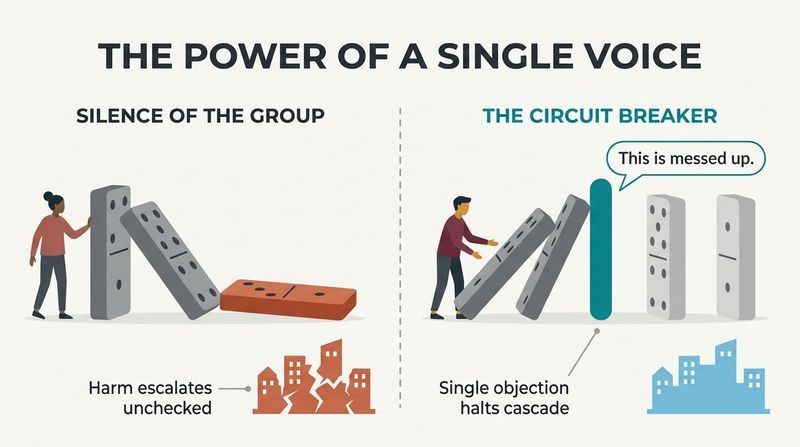
What's striking is how the book reframes moral courage as a social-cost calculation rather than a character trait. This aligns with Solomon Asch's conformity experiments, where individuals denied obvious visual truths to match a group, and with Latane and Darley's bystander research. The insight that intervention requires minimal words but maximal status security is genuinely useful. One nuance: the book's counterfactual ("one phrase would have done the trick") may underestimate how the group would have punished a dissenter, potentially escalating rather than dissolving. Still, naming the exact microscript people need makes the abstraction of "courage" concrete and teachable.
"Ironic" racist humor is a deliberate on-ramp into real hatred
Edgelord culture manufactures desensitization. Charles traced his humor to online spaces like League of Legends chat, Reddit, and 4chan, where laughing at jokes about lynching, the Holocaust, and disability was the price of belonging. The logic: the more transgressive, the funnier. To be offended marked you as a "snowflake" who didn't belong.
Hate groups exploit this ambiguity as strategy. The neo-Nazi site The Daily Stormer's leaked style guide instructed writers to keep the tone light so readers "should not be able to tell if we are joking or not." Its editor called it "non-ironic Nazism masquerading as ironic Nazism." Researchers found the most viral memes originated on a tiny number of hate-dominated forums, then spread to mainstream platforms with their origins (and intentions) erased. Poe's Law captures it: online, sincerity and parody become indistinguishable.
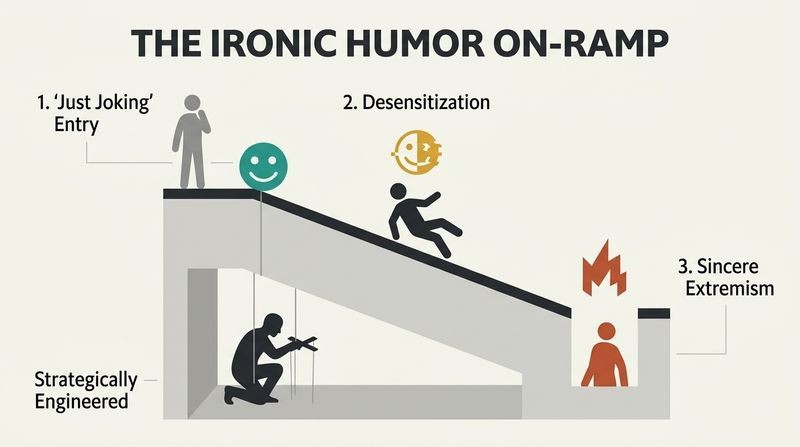
This is the book's most important cultural diagnosis. The "just joking" defense is not incidental but load-bearing: it lets participants disavow belief while absorbing the belief's content. Scholars of radicalization call this the "redpill funnel," where humor lowers cognitive defenses. The parallel to gateway conditioning is apt. A worthwhile challenge: not every edgy teenager becomes a white nationalist, and conflating adolescent shock-humor with organized extremism risks overreach. Yet the book's evidence that algorithmic feeds reward engagement with escalating extremity (75% of youth had encountered extremist content by 2016) suggests the environment, not just the individual, is the real accelerant worth targeting.
Punishment and accountability are opposites, not synonyms
Shaming feels like justice but rarely produces change. Slater draws on Brene Brown's distinction: guilt says "I did something bad" and motivates repair, while shame says "I am bad" and paralyzes. Restorative justice practitioners define accountability as understanding a harm happened and owning your part, a conversation about what and why, not a quantity of suspension days.
The research is damning for shaming. Criminologist John Braithwaite found people reform when treated with respect, not humiliation. Shamed people have three escape routes: accept the verdict (leading to depression and repeat offense), shift blame, or find communities that praise the shamed behavior. A 2021 study found suspensions increased future bad behavior. When Albany publicly branded fourteen kids "Harmers" and a school-wide mob formed, several boys became suicidal, and none of the targeted girls felt healed.
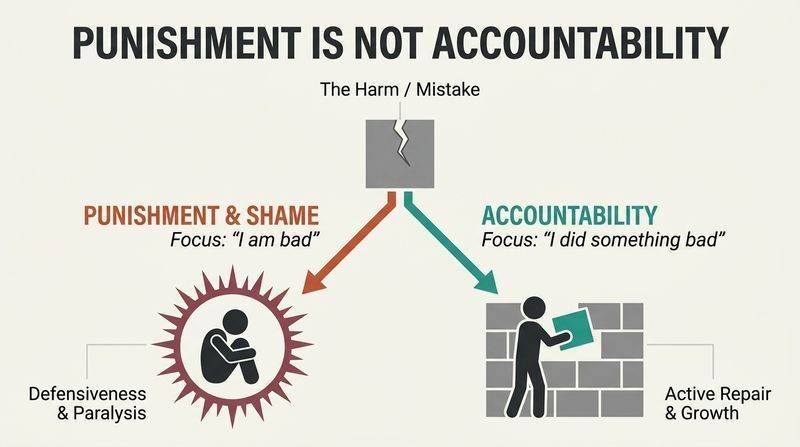
The book's sharpest intellectual contribution is separating the emotional satisfaction of punishment from its actual efficacy. This maps onto decades of criminology showing incarceration's poor rehabilitation record. Loretta Ross's "calling in" versus "calling out" adds nuance: shaming may be legitimate when "punching up" at the powerful but corrosive when aimed at peers. The honest tension the book holds, and does not resolve cheaply, is that restorative justice can feel like letting privileged kids off easy, especially when Black communities have historically received only punitiveness. Aishatu Yusuf's line reframes it: conflating a better world with docility is the error. Accountability is harder than punishment, not softer.
A noose and a gorilla image carry centuries of terror in one click
Symbols are compressed history. Slater devotes lyrical chapters to explaining why these images detonate. Between 1882 and 1930, a Black person was murdered by a white mob nearly once a week; at least 4,384 lynchings occurred, often as advertised public spectacles with souvenir photos. Congress didn't pass an anti-lynching law until 2022. A noose says: I could kill you, and no one would stop me.
The gorilla trope dates to the 1600s. Europeans cast Africans as subhuman apes to justify slavery. Scholar Moya Bailey coined "misogynoir" for the specific dehumanization of Black women, visible in medicine (less pain treatment), dating apps, and "adultification," where adults perceive Black girls as young as five as older and less innocent. A meme is never just a meme; it reactivates the wound.
This section performs a crucial epistemic move: it refuses the "it's just a picture" frame by restoring historical mass. The scholarship is solid and the framing (a symbol "tells a story") is pedagogically elegant. What deepens it is the physiological research the book cites elsewhere: targets of racial hate show elevated blood pressure, cellular aging, and immune suppression, echoing Robert Sapolsky's baboon studies on low-status stress. The takeaway for readers outside the incident is transferable: understanding why certain speech lands as violence, even when legally protected, requires historical literacy that most "free speech" debates conveniently skip.
Being targeted by hate injures the body, not just the feelings
Hate lives in the cells. Slater compiles research showing that hate-crime victims suffer more than victims of comparable non-bias crimes: twice the rates of anxiety, panic attacks, depression, and loss of confidence, plus a shattered belief in the benevolence of others. The account wasn't legally a hate crime, but its impact mirrored one.
The targeted girls unraveled. Andrea, biracial and already struggling, stopped eating and sleeping and dreamed of the boys chasing her. Billie, a Black and Jewish freshman, saw her 4.0 collapse to D's and wrote poems wishing she were white. Chronic racial discrimination correlates with higher blood pressure, premature cellular aging, and (for Black women across all incomes) higher rates of premature birth. Shame and powerlessness raise cortisol, the same stress cascade Sapolsky documented in low-status baboons who face constant petty aggression.
This reframing (from hurt feelings to measurable pathology) is scientifically well-supported and politically consequential. It undercuts the common dismissal "words can't hurt you." The weathering hypothesis of public-health researcher Arline Geronimus, unnamed here but clearly relevant, holds that cumulative stress from discrimination biologically ages marginalized bodies. One caveat worth flagging: correlational health data cannot fully isolate racism from confounds like poverty and access. But the convergent evidence across blood pressure, telomere length, and birth outcomes is strong enough that the burden of proof has shifted. The book makes a persuasive case that safety, not just civility, is at stake in schools.
In boy world, everything must be funny or your manhood is questioned
Humor is currency and weapon. Slater interviews Rosalind Wiseman, who studies teen boy culture, and explains that for boys, being funny is social insurance: the funny kid is never exiled. To complain about a joke is to be "a little bitch," to have your heterosexuality and masculinity challenged. Girls, Wiseman notes, get slightly more room to say "that's not funny."
Charles built his account to please the group's alphas. His stated motive was never hatred but laughter: making his highest-status friends laugh was "a shot of pleasure and power and affirmation and love." The group had a strict hierarchy. Kids like Wyatt and Jon, the designated "punching bags," objected to racist jokes but were ignored precisely because they lacked standing. Only an alpha's objection would have registered as legitimate.
This gendered analysis explains a mechanism most coverage of such incidents ignores: why the objectors were structurally powerless. It connects to Michael Kimmel's work on how masculinity is policed through the constant threat of feminization. The insight that a group only accepts moral correction from high-status members has organizational parallels: whistleblowers without institutional standing are routinely dismissed. A practical implication the book gestures toward: interventions should cultivate courage in popular kids, since they alone can shift group norms. The limitation is that framing this as "boy culture" may naturalize what is also a specific product of unsupervised online spaces and particular peer ecosystems.
Lumping all offenders together erased the difference between clicking and creating
Zero-tolerance destroyed proportionality. Albany's administrators, overwhelmed and unversed in social media, eventually gave all thirteen followers the maximum five-day suspension. Because everyone got the same punishment, the community concluded everyone bore equal guilt. Officials began calling them collectively "the Harmers," fusing the creator, the commenters, the passive followers, and one boy who never interacted with a single post into one category.
A federal judge saw the distinction clearly. In the resulting lawsuits, Judge James Donato applied the Tinker test (the 1969 Supreme Court standard letting schools discipline speech only if it foreseeably causes substantial disruption). He ruled the school properly punished those who created, liked, or approvingly commented, but improperly disciplined four students whose involvement showed no endorsement. California law, he noted, doesn't even require adults to report a crime they witness; students aren't obligated to be snitches.
The tension here is real and unresolved: the girls experienced the group as a single hostile mass, so gradations of guilt felt like evasions ("who cares who drew the noose?"). Yet justice systems depend on precisely those gradations. The book stages this collision without cheap resolution. Donato's reasoning highlights a genuine free-speech dilemma schools face in the digital age, where off-campus private speech bleeds onto campus. The administrative failure was less about severity than about refusing to do the hard, individualized work, then compounding it by exposing minors' identities, which fueled a mob and, predictably, a wave of expensive litigation.
Public shaming spirals beyond anyone's control and rarely reaches the guilty
The mob became its own catastrophe. After a false rumor that a noose hung in the park (it was a Boy Scout knot-tying rope reused as a swing), the botched mediation collapsed into a school-wide sit-in. Hundreds of students surrounded the followers, forced a "walk of shame," broke one boy's nose, and rocked a minivan full of teenagers and their mothers while chanting. The three most responsible boys weren't even present.
Shaming has no off-switch. Legal scholar James Q. Whitman argues public shaming is uncontrollable: "no rhyme or limit to the terms the public may impose." Eric Posner adds that shamers often participate to burnish their own reputations, not to reform the offender. Three years later, when the George Floyd protests erupted, the account resurfaced on Twitter via "tweet me the receipts" campaigns, threatening the now-adult participants' jobs and colleges anew.
The book's treatment of digital shaming is prescient and balanced. Jon Ronson's reporting on public shaming reached similar conclusions: online mobs deliver punishments wildly disproportionate to offenses and immune to expiration. The irony the book underscores (the same engagement-maximizing algorithm that spread the racism later powered the revenge) is a sharp systems observation. Social platforms profit from outrage regardless of its moral direction. A fair critique: the book risks drawing a false equivalence between the original racist harm and the shaming response. It mostly avoids this by keeping the girls' suffering central, but readers should resist collapsing perpetrator and overzealous avenger into moral equals.
"Race science" is 18th-century bigotry rebranded with each era's shiniest data
Jon called himself a "realist," not a racist. One follower, a math prodigy, googled his way into websites ranking races by IQ and believed he'd found suppressed truth. Sociologist Reanne Frank calls this "the forbidden knowledge discourse": claiming your ideas are rejected not because they're wrong but because they're too hot to handle.
Genetics flatly refutes it. Any two humans share 99.9% of their DNA, and about 95.7% of human variation occurs within populations, not between them. Over 140 population geneticists signed a 2014 letter rejecting any genetic basis for racial IQ gaps. The Flynn effect (IQ scores rising throughout the 20th century) proves environment, not genes, drives measured intelligence. Carl Linnaeus ranked four color-coded races in the 1700s while Switzerland profited from the slave trade; today's "race realism" is that same taxonomy wearing a lab coat.
This chapter is the book's public-service core, arming readers against pseudoscience that circulates precisely because it mimics rigor. Education researcher Brian Donovan's experiment is especially valuable: teaching sickle-cell as a "Black disease" made students more likely to see race as biological, while teaching it as a malaria-adaptation trait shared across regions produced the opposite. This shows racism can be inadvertently manufactured by careless pedagogy. The NFL "race-norming" scandal (assuming Black players had lower baseline cognition, denying concussion claims) demonstrates the stakes are not academic. The one thing to add: debunking rarely persuades believers directly, because, as the book shows, the belief serves identity needs, not evidentiary ones.
Charles never spoke about his father's arrest, his mentor's suicide, or anything
The account grew in emotional soil no one tended. Slater refuses the "racist family" explanation the community craved. Charles's home was defined by the unspoken: his father was arrested for child pornography when Charles was twelve (the family never once discussed why), and his beloved middle-school coach died by suicide after being arrested for molesting students. Charles processed neither. He was emotionally sealed, comparing himself unfavorably to his high-achieving sister, fighting his mother over video games.
Powerlessness sought power. His sister Eliza, watching him rebuild his life in Florida, concluded bullying is about power: "Powerless people bully because they want power over others." Stripped of any control over his fracturing family, Charles found it in the one currency he could mint: making the group laugh. The cruelty was a symptom of a boy who had never been allowed, or able, to feel.
This is the book's riskiest and most humane move: refusing to let readers file Charles under "monster." It echoes bell hooks's epigraph question about holding people accountable while believing in their capacity to transform. The danger is that psychologizing a perpetrator can slide into excusing him, and the book knows this, letting Charles himself admit "it sounds like I'm making excuses." The redemption arc (Florida, a Korean Subway manager, Kendrick Lamar lyrics, teacher roommates who accepted him) illustrates Braithwaite's thesis in action: acceptance plus honest questioning, not exile, produced genuine reflection. The unresolved ache is that his growth required leaving town, which the girls could not do.
There is no clean justice, only new pages added to your story
Everyone paid; no one was made whole. Slater tracks the survivors years out. Andrea sued, settled for a modest sum, then leaped off a platform into a Guatemalan lake, learning she could fly in her dreams. Billie became a pre-med student dissecting cadavers, telling her younger self simply to love her skin. Brutsri, who nearly staged a suicide-by-cop at a dark lake with a replica pistol, became a school-board member. Eren, asked if he'd unfollow the account given a do-over, wasn't sure, because the ordeal made him more introspective than his old trajectory would have.
Time doesn't heal, it accumulates. The book's closing image rejects tidy resolution: time doesn't erase pain, it just adds new pages so that when you look back, there's something else to read. Justice, restorative-justice practitioner Elizabeth Riles says, can't be quantified, but taking a stand has worth regardless of outcome.
The refusal of catharsis is the book's mature final position. Real harm, it insists, doesn't balance on a ledger. This resonates with trauma research showing recovery is nonlinear and identity-reorganizing rather than a return to baseline. What elevates the ending is that growth appears on both sides: targets and followers alike had to construct new selves. The uncomfortable asymmetry the book preserves is that the followers could relocate and start over while the targeted girls carried the weight in the bodies and town they couldn't leave. That honesty (naming an injustice the narrative cannot fix) is more valuable than a false reconciliation would have been.
Analysis
Accountable is narrative nonfiction operating as moral philosophy in disguise. Dashka Slater, a veteran criminal-justice reporter steeped in restorative-justice practice, spent four years reconstructing a single 2017 incident at Albany High School from hundreds of interviews, court records, and social media artifacts. The book's genius is structural: by fragmenting the story into dozens of short, kaleidoscopic chapters (poems, lists, historical essays, second-person interludes, verbatim testimony), Slater forces readers to inhabit every vantage point without collapsing them into false equivalence. This is journalism engineered to resist the very polarization it documents.
The book's central provocation, drawn from its bell hooks epigraph, is whether we can hold people accountable while preserving belief in their capacity to change. Slater's answer is a qualified yes, but only if we abandon the reflexive equation of accountability with punishment. Her most durable contribution is diagnostic rather than prescriptive: she shows how "ironic" online racism functions as a radicalization on-ramp, how group hierarchy determines whose conscience gets heard, and how institutions armed only with suspension matrices convert a manageable harm into a community-wide trauma with a decade-long tail.
Where the book is vulnerable is its ambition to humanize everyone. Critics could argue that granting Charles a psychological backstory risks softening genuine racial violence, and that the extended sympathy for the followers' post-shaming suffering occasionally rivals the attention given to the girls they degraded. Slater largely defuses this by keeping the targeted students' embodied pain scientifically and emotionally central, and by letting perpetrators indict themselves.
Situated alongside Jon Ronson on public shaming, Bryan Stevenson on mercy, and contemporary radicalization scholarship, Accountable is best read as a case study in why our two dominant responses to wrongdoing, permissive dismissal and punitive exile, both fail. It argues for a harder third path most communities lack the patience and skill to walk: sustained, individualized, historically literate repair. The book is honest enough to admit that path was never actually taken in Albany, which is precisely its cautionary power.
Review Summary
Accountable receives mostly positive reviews, praised for its nuanced exploration of a racist social media incident and its impact on a high school community. Readers appreciate Slater's balanced approach, presenting multiple perspectives and raising thought-provoking questions about accountability, justice, and societal issues. Many recommend it for students, educators, and parents. Some criticize its length and pacing, finding it occasionally repetitive or slow. Overall, reviewers commend the book's relevance, depth, and potential for fostering important discussions about racism, social media, and teen behavior.
People Also Read
FAQ
What's Accountable about?
- True Story of Racism: Accountable by Dashka Slater narrates the true story of a racist social media account created by teenagers at Albany High School and its profound impact on their lives and community.
- Focus on Consequences: It explores the consequences of the account's creation, including public shaming, legal battles, and the emotional toll on both perpetrators and victims.
- Themes of Racism and Accountability: The book delves into themes of racism, accountability, and the complexities of teenage behavior in the digital age, highlighting how social media can amplify harmful actions.
Why should I read Accountable?
- Relevant Social Issues: The book addresses pressing social issues such as racism, bullying, and the role of social media, making it highly relevant for today’s readers.
- Insightful Perspectives: It provides multiple perspectives from both victims and perpetrators, allowing readers to understand the complexities of human behavior and the consequences of actions.
- Educational Resource: Accountable serves as an educational resource for discussions about race, accountability, and the importance of empathy in a diverse society.
What are the key takeaways of Accountable?
- Understanding Accountability: The book emphasizes the importance of holding individuals accountable for their actions while recognizing their humanity and potential for change.
- Impact of Social Media: It illustrates how social media can be a double-edged sword, providing a platform for both connection and harm, and how quickly harmful content can spread.
- Complexity of Justice: The narrative explores different forms of justice—punitive, restorative, and transformative—and questions what true justice looks like in the context of racism and bullying.
What are the best quotes from Accountable and what do they mean?
- Accountability and Humanity: "How do we hold people accountable for wrongdoing and yet at the same time remain in touch with their humanity enough to believe in their capacity to be transformed?" This quote highlights the tension between accountability and compassion.
- Symbolism of Racism: "A noose is just a rope with a knot that can be tightened, but in America, it’s a rope that delivers a message." It underscores the historical and cultural significance of the noose as a symbol of racism and violence.
- Standing Against Injustice: "I will not stand for racism or sexism or homophobia." This declaration reflects the resolve of students to confront injustice and serves as a rallying cry for activism.
How does Accountable address the role of social media in shaping behavior?
- Amplification of Harm: The book illustrates how social media can amplify harmful behaviors and attitudes, allowing them to spread quickly and widely.
- Peer Pressure Dynamics: It explores how social media creates environments where peer pressure can lead to complicity in harmful actions.
- Impact on Identity: The narrative discusses how social media influences self-perception and identity among teenagers, complicating the understanding of accountability.
What methods of justice are discussed in Accountable?
- Punitive Justice: Focuses on punishment for wrongdoing, often without addressing underlying issues or promoting healing, critiqued for not leading to meaningful change.
- Restorative Justice: Emphasizes repairing harm through dialogue and understanding between affected parties, fostering empathy and connection.
- Transformative Justice: Looks beyond individual actions to address systemic issues, encouraging a broader examination of societal structures for collective change.
How does Accountable explore the concept of identity?
- Intersectionality: The book examines how race, gender, and social status intersect to shape individual experiences, highlighting challenges faced by students of color.
- Self-Perception: Characters grapple with their identities in the wake of events, questioning their worth and place in the community.
- Community and Belonging: Emphasizes the importance of community in shaping identity, showing how solidarity can foster resilience and belonging.
What role do parents play in Accountable?
- Influence on Behavior: The book posits that children learn behaviors, including racism, from their parents, highlighting the importance of parental guidance.
- Community Meetings: Describes how parents from both sides came together to discuss the incident, illustrating potential for dialogue and healing.
- Emotional Struggles: Parents grapple with their own emotions and the implications of their children’s actions, showcasing the broader impact on families.
How does Accountable address the concept of public shaming?
- Consequences of Shaming: Discusses how public shaming can lead to severe emotional distress, often resulting in long-term mental health issues.
- Lack of Control: Illustrates that once shaming is public, the original wrongdoer loses control over the narrative, with consequences spiraling beyond initial actions.
- Alternative Approaches: Advocates for a “calling in” approach, focusing on understanding and compassion rather than humiliation, suggesting more constructive outcomes.
How does Accountable depict the legal consequences faced by the teenagers?
- Lawsuits and Settlements: Details various lawsuits filed by both victims and perpetrators, illustrating the complex legal landscape surrounding free speech and accountability.
- Judicial Outcomes: Discusses outcomes of legal battles, including settlements and implications for students involved, highlighting the intersection of law and morality.
- Long-term Effects: Emphasizes that legal consequences extend beyond the courtroom, affecting lives and futures of teenagers involved.
What lessons does Accountable offer about empathy and understanding?
- Need for Compassion: Advocates for empathy as a crucial response to wrongdoing, suggesting understanding motivations can lead to healing.
- Building Bridges: Emphasizes importance of dialogue and connection in overcoming differences, encouraging seeking common ground.
- Personal Growth: Illustrates that personal growth often comes from facing uncomfortable truths and learning from mistakes, reinforcing capacity for change.
How does Accountable address the concept of restorative justice?
- Restorative Justice Principles: Introduces restorative justice as an alternative to punitive measures, focusing on healing and accountability.
- Community Involvement: Highlights role of community in restorative justice, emphasizing healing often requires collective effort and understanding.
- Long-term Impact: Suggests restorative justice can lead to more meaningful change and reconciliation, benefiting individuals and community.
Download PDF
Download EPUB
.epub digital book format is ideal for reading ebooks on phones, tablets, and e-readers.








































