
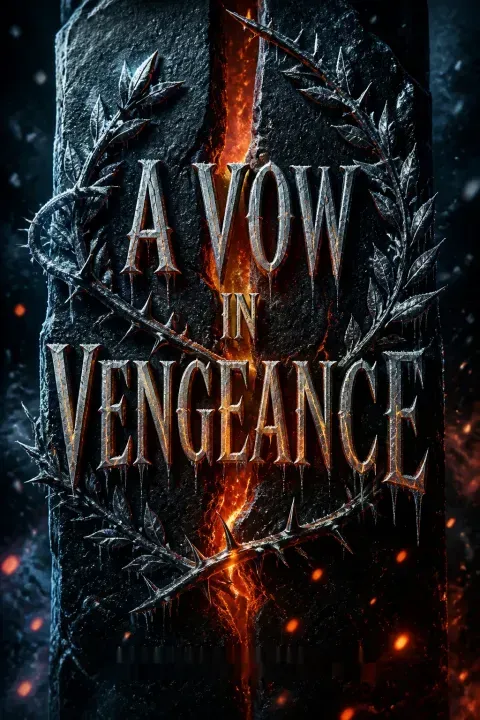


Plot Summary
Prologue
Rune,1 fourteen, hides with her mother5 in a frozen cabin, evading the druids' Selection. A blizzard rages outside; they dare not light a fire. When the knock comes, her mother5 shoves Rune1 beneath the floorboards. Druid enforcers, winged and masked, storm inside. Unwilling to see her daughter discovered, Rune's mother5 walks out to meet them.
Flames devour the cabin as Rune1 crawls through dirt and ice into the snow. Her home collapses. There is no one left to run to. She clutches her father's6 pendant and her brother's broken toy, watching the smoke rise. That night, a fourteen-year-old girl freezes in the silence and plants a seed of hatred that will take seven years to bloom.
The prologue establishes trauma as the novel's foundation. Rune's powerlessness, the destruction of shelter, and the loss of her mother create a wound that defines her. The phrase her mother whispers, 'They hold no power over me,' becomes a mantra, yet the scene reveals that fear is very much in control. The burned cabin is a baptism by fire: the child who hid beneath the floorboards will reemerge as a weapon. The broken king toy and fishhook pendant are the first relics, anchoring memory to objects, a motif that later extends to the Arcadian Artifacts themselves. Her mother's sacrifice is ambiguous: a surrender or a protection? That ambiguity haunts every choice Rune makes.
Wraith Among the Chosen
At the ruined capital of Vexamire, Rune Ryker's1 own bounty poster glares from crumbling walls. She is the Wraith of Westfall,1 worth a fortune alive, and today she must be Selected, not arrested. Druids emerge from liquid shadow, their masks identical, their familiars slinking.
King Silas3 and Queen Vesta watch as young Prince Ansel, guided by his older brother Draven,2 picks mortals one by one. When Ansel nears Rune,1 she whispers, 'Pick me.' The boy startles; Draven2 kneels beside him, intrigued. He declares it a secret between them, and the child's finger points at Rune.1 She is chosen. Draven's2 indigo eyes, already shifting violet, promise a far more dangerous game.
Rune's voluntary entrance into the Selection subverts the expected victimhood. Her agency is criminal, her motivation vengeful, yet her act requires immense courage. Draven's immediate interest is not romantic but predatory: he senses a fellow predator. The child Ansel becomes a pawn, and the Selection reveals itself as theater, a ritual where power performs mercy. Rune's whisper breaks protocol, a micro-rebellion that echoes the larger uprising the Selection was designed to suppress.
The World Decides
Forced to drink the Oath, Rune1 convulses as magic mutates her body: ears sharpen, fangs descend, and her wild curls straighten into silken sheets. She stares at her reflection and sees an enemy. At the top of the Wall, King Silas3 offers his tarot deck to reveal each changeling's Major Arcana.
When Rune's1 turn comes, invisible force yanks her hand toward the cards. The World flips out and fires into Silas's3 grip. The vizier panics; Silas3 demands a second draw. Again, The World. The highest Arcana, not seen in centuries. Draven,2 whose own rare card suddenly has a rival, watches her with new calculus.
The transformation is a violation disguised as a gift: Rune's physical identity is forcibly assimilated, her heritage erased. The World Arcana, however, recognizes something the Oath cannot touch: her ambition, her latent power. Drawing it twice is a declaration from the magic itself that she is exceptional. This moment elevates her from anonymous prisoner to political asset, drawing the attention of everyone who matters. The idea that power can be both stolen and innate runs through the entire series.
The Prince's Trophy Room
Rune1 finds her assigned Hearth, the smallest house on the Oval, occupied by a single roommate: Prince Draven.2 He explains that The World chose only them in five hundred years. When she demands return of her father's6 bone pendant necklace, confiscated by the guards, Draven2 pockets it with a flick of shadow.
Furious, Rune1 yanks off her boot and hurls it at his head. He catches it midair with the Hanged Man card, freezes her body, and straps her to a chair. Their battle of wills ends with him relenting, lacing the necklace back around her throat with a smirk: 'I'm not a monster.' She is unconvinced.
The necklace is a stand-in for Rune's past, and Draven's theft asserts dominance. Yet his eventual return, accompanied by the revelation that he protected it from destruction, hints at his own complex relationship to mementos. The boot-throwing fight is both juvenile and strategic; it tests boundaries. Draven's use of multiple Arcana so casually demonstrates the gap in their skill, but also his willingness to teach, even if through humiliation. The Hearth becomes a microcosm of the larger power struggle between them.
Sins of the Father
Late one night, Draven2 tells Rune1 the true history. Fifteen years ago, mortal rebel leader Kieran Ceres sold his soul to a goddess and unleashed a Curse that rendered all immortals unable to produce heirs. In retaliation, the three immortal kingdoms began the yearly Selection of souls to replenish their numbers.
Draven2 himself was not born a prince: he was a rebel's son, Selected at age six, adopted by King Silas3 after his real father's execution. Rune's mother,5 who avoided Selection, was sent to the Destarion prison and likely sold to the elves. Rune1 realizes the monsters and victims are not so distinct.
This exposition recontextualizes the entire world. The Curse transforms the immortals from predators into desperate survivors, while the mortals become architects of their own suffering. Draven's confession of his lineage makes him a tragic figure: a weapon forged by his father's killer. For Rune, learning her mother's complicity in the Curse plants a seed of doubt about the righteousness of her vengeance. The scene encapsulates the novel's moral center: no one is innocent, and cycles of violence demand cycles of victims.
A Halo of Thorns
At the Autumn Equinox Ball in the druid court, seraphs descend in streaks of light. King Altair,4 halo blinding, brings Princess Reva and Rune's own father Riordan,6 now a winged captain. Rune1 rushes into her father's6 arms for the first time in seven years. Altair4 demands to test her with his halo, which forces her to speak truth.
He asks about her destiny, and Rune1 sees a vision: a crown forged from all four kingdoms' regalia, wet with blood. Altair,4 recognizing her as a prophesied unifier or destroyer, summons his sword to execute her. Draven2 steps forward, shielding her, and declares, 'She is my fated mate.'
The ball crystallizes the political chessboard: the seraph king's paranoia, the druid prince's defiance, and Rune caught between them. The halo is a brutal plot device that strips illusions, yet the vision it draws from Rune is ambiguous: is she a savior or a tyrant? Her father's reunion is tainted by his oath-bound servitude to Altair, a foreshadowing of impossible choices. Draven's claim, a desperate gambit, rewrites her status from prisoner to protected mate, binding their public fates.
A Vow in Vengeance
After Altair's4 retreat, Draven2 lays out his ambition. He wants to end the Selection, unite the four kingdoms under his rule, and he needs Rune's1 rare power to do it. He tells her of the four Arcadian Artifacts: the Cup that breaks bonds, the Sword that slays demigods, the Wand that summons armies, and the Ring that bends wills.
If she helps him find them and secure the druid throne, he will return her family and grant her power. Rune,1 seeing no other path, agrees. They clasp arms and a golden magic seals their pact, burning a raven tattoo onto her forearm and a jaguar onto his.
The pact transforms the story into a quest narrative, but the terms reveal character: Draven wants a partner, not a pawn. The burning tattoos are a physical manifestation of trust, something neither gives lightly. The Artifacts function as both MacGuffins and metaphors, each representing a type of power: freedom, destruction, command, and control. Rune's acceptance is pragmatic, yet the pact's binding nature foreshadows that their partnership will exact a cost neither fully anticipates.
The Claiming Bite
At the Hollow Festival, Draven2 and Rune1 dance among masked revelers, every eye tracking them. Draven2 tells her their mingled scents are not convincing enough; to seal their ruse, they must claim each other with a bite. He draws her to a corner and sinks his fangs into her neck, injecting a venom that floods her with pleasure.
She bites him back, hard enough to scar. The exchange alters their scents permanently, a signal to all immortals that they are bound. The line between performance and genuine hunger dissolves as they cling to each other, breathless.
The claiming bite ritualizes intimacy: what begins as a deception is felt viscerally. The venom bypasses rational resistance, forcing their bodies into a state of bonding. It's a brilliant metaphor for how emotional closeness can be manufactured and still feel real. The permanent scars, visible on their necks, become external proofs of an internal entanglement. The public nature of the act also cements their political alliance; they are no longer two individuals but a single unit in the eyes of the court.
Morgan's Reckoning
Morgan,10 a changeling from Rune's1 study group, reveals himself as part of the Ascension, a mortal rebellion. After the festival, he attempts to force himself on Rune,1 but Draven2 intervenes. Later, Morgan10 and a dozen rebels ambush Draven2 in a bedroom, threatening to kill Rune's1 friends if she does not help trap him.
Rune1 lures Draven2 to the bed but embeds warnings in her performance. Draven,2 catching on, unleashes his full power, stripping Morgan's10 Arcana and turning his body to dust. The other rebels are captured. Rune1 stands amidst the ash, horrified and grateful.
Morgan is Rune's shadow: a victim of the same system whose hatred curdles into indiscriminate violence. His attempt to possess Rune echoes the Lord of Westfall's predation, making her trauma a weapon. Draven's violence is both protective and terrifying, demonstrating the ruthless side he will deploy for her. Morgan's dessication is a symbolic death: drained of the magic that gave him power, reduced to what he was before the Selection. The scene questions whether some hatreds are so consuming that they become indistinguishable from the evil they fight.
The Wraith's Scar
During the interrogation of a suspect, Draven2 presses Rune1 to reveal her past. She tells him of Kiana, the woman she loved in Westfall, who died during the Wraith trials the Lord of Westfall designed. Kiana killed herself to spare Rune,1 an act that trapped Rune1 in a cage of guilt and compliance for years.
Only when the lord brought Kiana's little sister into his manor did Rune1 finally snap, slashing his face and burning his estate. Draven2 listens without interruption. Afterward, he promises she will never have to endure such torment again, not while he lives.
This confession is the turning point of Rune's emotional arc. Kiana's death explains Rune's reluctance to let anyone close and her terror of being the cause of another loved one's suffering. Draven's response, a silent witness, is the first time someone offers her grief space without trying to fix it. The story of the Lord of Westfall parallels Draven's own relationship with King Silas: both men were shaped by abusive father figures who saw them as weapons. Recognizing this kinship allows their partnership to deepen from transactional to redemptive.
Beneath the Elf-King's Throne
Draven2 and Rune1 journey to the elven kingdom to harvest zenith crystal. King Eldarion,13 beautiful and cruel, treats mortals as livestock. At a feast, he boasts of a lava-cursed woman he once sold to a lord for her voice: a siren named Reina.5 Rune's mother.
Rage nearly betrays Rune,1 but Draven2 steers the conversation toward the Kingbreaker Trials, the deadly competition that produced Eldarion's13 heir. He looks for Rune's1 twin brother Remus, Selected years ago. The palace glitter conceals a dungeon of enslaved mortals, and Rune's1 fury finds a new target.
Alfheim externalizes the immortals' exploitation. Mortals are not just breeding stock; they are commodities. Eldarion's casual cruelty is the endpoint of absolute power unchecked by empathy. Rune's discovery that her mother was bought and sold like a object ignites a new personal stake in the rebellion. Draven's ability to navigate this hostile court while gathering intelligence on Remus demonstrates his political skill, but also the moral compromises required to operate within the system they seek to overthrow.
The Ravager's Legacy
Following a lead, Rune1 and Draven2 slip into the estate of a minor lord in Illithial. In a small bathroom, Rune1 reveals herself to her mother.5 The woman, now an elven changeling, flinches. She urgently warns that the seraphs must never find her.
Then Draven2 enters, and Reina5 recognizes him: Kallos, the son of Kieran Ceres, the rebel leader she served as alchemist. She confesses she crafted the Curse. Draven's2 eyes blaze red. Rune1 is caught between the mother5 she loves and the man she is learning to love, knowing now that her family's5 actions destroyed his.
This is the novel's most devastating revelation. Rune's identity as a victim is complicated: she is the daughter of the architect of immortal infertility. The Curse was not an act of divine punishment but a deliberate weapon created by desperate revolutionaries. Reina's guilt and Draven's fury are both justified, placing Rune in an impossible position. The scene forces her to confront the uncomfortable truth that the cycle of violence requires perpetrators as well as victims, and that love for one's family does not excuse their atrocities.
Wand of the Darkstone
While harvesting zenith in a box canyon, Rune1 follows a blue will-o'-the-wisp through a hidden passage. Behind moss, she finds a charred elf corpse clutching a carved crystal wand: the Darkstone, the legendary druid Artifact. She pockets it. But the cave is not empty; a massive drake and its spawn ambush the expedition.
Rune,1 drawing on the Star Arcana, summons a blade of starlight for the first time, fueled by hope for a future with Draven.2 Together, they battle the monster and flee, leaving the cavern to collapse behind them. Rune1 keeps the wand hidden against her ribs.
The discovery of the first Artifact validates the quest and Rune's agency; she finds it not through Draven's guidance but her own intuition. The Star Arcana, which had eluded her, finally responds when she feels hope, a profound character beat: she learns that softer emotions can be sources of strength. The drake attack tests their partnership under lethal pressure, and Draven's desperate healing afterwards deepens the reciprocity of care between them. The wand, a tool of mass destruction, now rests in the hands of someone still learning to wield her own heart.
Chalice from the Grave
Separated by political duties, Draven2 and Rune1 correspond through a magical pen. Draven2 reveals he has located the second Artifact: Oathbreaker, the Cup that can sever any magical bond, hidden in the tomb of his birth father, Kieran Ceres.
He descends into the grave, breaks the enchantment guarding it, and retrieves the Chalice. He sends it to Rune1 as a soul-day gift. With it, she can shatter her oath to King Silas,3 and even dissolve their own pact if she wishes. Rune1 holds the ancient cup, understanding the gift's meaning: he is willing to lose her to free her.
The Cup represents the ultimate power: the right to choose one's own masters. Draven's giving of it is a profound act of love, the opposite of possession. He raids his own father's tomb, violating the dead to give the living a future. The scene mirrors Rune's earlier loss of mementos; now she receives a relic that can unmake the very bonds that caused her suffering. Draven's offer is also a test: will she stay when she is no longer bound? The ghost of Kiana hovers over this choice, reminding us that the deepest chains are not always magical.
A Proposal in Starlight
Draven2 returns to the Forge for Rune's1 twenty-first soul-day. He presents three gifts: the Oathbreaker Cup, a list of potential names for her missing brother, and a crystal bracelet cuff that matches one on his own wrist. Kneeling, he tells her that a hundred years would not suffice: he loves her, and asks her to be his partner, his queen, his equal.
Rune,1 tears spilling, admits she loves him too. She accepts the bracelet, which tightens magically around her wrist, a binding of choice, not force. Their friends interrupt with a surprise party, but the promise is sealed.
The proposal is the emotional climax of their personal journey. Draven, who once declared love a weakness, lays his heart bare. Rune, who buried her capacity for love with Kiana, chooses to exhume it. The bracelet, a cuff rather than a ring, symbolizes partnership rather than ownership. The gifts correspond to her deepest desires: freedom, family, and fidelity. The interruption by friends prevents the moment from becoming saccharine; real life, and real danger, will intrude soon enough.
The Serpent's Strike
After the party, Kasper7 slips into Rune's1 bedroom and stabs Draven2 in the side. Holding a knife to Draven's2 throat, he demands the Darkstone and Rune1 as hostage. He reveals he is King Altair's4 bastard son, planted as a spy. Rune1 fetches the Wand; Draven2 goads Kasper7 into slashing his throat, creating a diversion.
Felix9 tackles Kasper7 to save Ember8 and is fatally stabbed through the heart. Kasper7 flees through a portal with the Wand, leaving Draven2 gasping and Felix9 dead in Ember's8 arms. Rune1 burns with rage and grief, unable to heal both.
Kasper's betrayal telescopes the war from the political sphere into the personal. His hunger for Altair's approval mirrors Rune's for her own family, making him a dark reflection. Felix's death is the novel's most brutal gut-punch: the kindest character, whose Arcana was Fearlessness, dies because of love. The scene redefines the stakes: magic cannot undo death, and the Artifacts are now in enemy hands. Rune's failure to save both Draven and Felix is a crucible, forcing her to accept the limits of her burgeoning power.
The Father's Fall
Altair's4 seraph army descends on the druid palace. Rune1 leads her friends in a desperate defense. She confronts the seraph king,4 who wields the stolen Wand. Her father Riordan,6 still bound by oaths to Altair,4 appears beside him. Mind to mind, he tells Rune1 to keep Altair4 distracted.
Riordan6 lunges at his king but, frozen by his oath, is impaled on Altair's4 sword. Screaming, Rune1 rips the Wand from Altair's4 belt and drives it through his eye, blinding him. Altair4 retreats, his forces taking the Wand and Rune's captured mother.5 Rune1 cradles her father6 as he dies, his final words 'I love you, Ruru.'
The battle is a crucible of loss. Riordan's death completes Rune's orphanhood, but also provides a model of how to die with agency: he broke his oath in spirit even if his body could not follow. Rune's maiming of Altair is a pyrrhic victory; she learns that even righteous fury cannot bring back the dead. The loss of both the Wand and her mother resets the quest, setting up a sequel arc. The final image, a daughter kneeling in her father's blood, serves as the novel's darkest echo of the prologue's fire.
Epilogue
Druids wear red for mourning. Rune1 stands at her father's6 pyre, Draven2 silent at her side. Felix9 is buried, too. Afterward, in their scarred Hearth, Draven2 offers the Oathbreaker Cup once more. Rune1 takes it, pours wine, and drinks. The invisible chains of her oath to King Silas3 dissolve.
She looks at the bracelet on her wrist, at Draven,2 and makes a new vow. They will take everything from Altair:4 the Wand, the Sword, her mother,5 the thrones. Together. He drinks, too, and the pact seals. Not a binding of magic this time, but of shared purpose and chosen love.
The epilogue reframes the story as the beginning of a larger campaign. Rune's use of the Cup is a symbolic death: the dissolution of her old self, shaped by forced oaths. Red mourning, rather than black, aligns with the druidic celebration of life's cycle, suggesting she is beginning to internalize her new culture. The final image is of two survivors choosing to fight rather than flee, their partnership now the bedrock that oaths once provided. The Cup that severs all bonds is the very thing that solidifies theirs, an ironic and deeply romantic conclusion.
Analysis
A Vow in Vengeance is a story about what happens when the sharpest blade of justice is wielded by the wounded. Rune1 enters Arcadia believing she is a victim of pure evil, only to discover that her own mother5 helped forge the system she despises. The novel systematically dismantles the binary of monster and martyr, revealing that the Curse, the Selection, and the ensuing cycles of violence are the children of desperation, not malice. Every character is simultaneously oppressor and oppressed, trapped in a cage of their own making.
Draven2 and Rune1's partnership is the book's answer to this moral complexity: not redemption through love, but accountability through partnership. Their pact is not a softening of edges but a sharpening. He teaches her to wield power; she teaches him to feel its cost. The romantic arc thus becomes a political thesis: lasting change cannot be imposed from above by a solitary hero, but must be forged between equals who have seen each other's ugliest truths and chosen to stay.
The Arcadian Artifacts externalize this theme. Each relic represents a form of power that can be used for liberation or oppression. The Cup breaks chains; the Wand summons armies. That Rune1 and Draven2 do not hesitate to use both signals that the novel refuses the naive pacifism of many fantasies. Vengeance, it argues, is not inherently corrupting; it is a tool, and its morality depends entirely on what is built in its wake. The story leaves them standing in the ashes of a battle lost but not a war, holding each other with bloodied hands, ready to burn the world down to make a better one.
Review Summary
A Vow in Vengeance receives largely positive reviews (4.17/5 average), praised for its unique tarot-based magic system, dark academia setting, and compelling enemies-to-lovers romance between Rune and Prince Draven. Reviewers highlight the strong chemistry, witty banter, and forced proximity dynamics. Common criticisms include insufficient world-building depth, "telling vs. showing" issues, generic MMC descriptions, and rushed pacing in the final sections. Some found the magic system complex but well-explained, while others struggled with clarity. The debut impressed many readers despite familiar romantasy tropes, with most planning to continue the series.
Characters
Rune Ryker
Wraith Turned World-BearerA 20-year-old former spy with moon-white hair, gold eyes, and a bounty on her head. Trained by the cruel Lord of Westfall after her family was taken in the Selections, she became a Wraith who traded in secrets and blackmail. Her beloved Kiana died to save her, a wound that calcified her heart. She enters the immortal realm seeking vengeance and reunion with her family. Stubborn, fierce, and haunted by guilt, she wields The World Arcana, a power that encompasses all others, forcing her to grow beyond the narrow blade of revenge.
Prince Draven Vos
Adopted Prince of DarknessThe crown prince of Sedah, chosen as a six-year-old changeling after the execution of his birth father, the rebel leader Kieran Ceres. He wields The World Arcana with lethal precision. His beauty is unsettling, his arrogance a shield for a profound loneliness. He wants to end the Selection and unite the four kingdoms under a just rule, but his methods are ruthless. He initially sees Rune1 as a threat, then a tool, but gradually recognizes her as the equal partner he never dared hope for.
King Silas
Antlered Druid KingAncient ruler of Sedah with dragon-like wings and Judgment Arcana, allowing control over living and dead. He adopted Draven2 as a political asset, keeping him at arm's length to avoid showing favor. Pragmatic and cold, he prioritizes Sedah's stability above morality, tolerating the Selection as necessary for survival.
King Altair
Seraph King of Holy FireThe golden-winged seraph king whose first wife died in the Curse attack. He harbors a genocidal hatred for mortals and seeks the alchemist5 who crafted the Curse to force its reversal. His halo compels truth and judges worth, making him seem righteous, but his obsession with purity drives him toward tyranny.
Reina Ryker
The Alchemist of the CurseRune's1 mother, once a gentle singer who crafted remedies. She was secretly the top alchemist for the mortal rebellion and, alongside Kieran Ceres, created the Curse that sterilized the immortals. Captured, she was sold to an elven lord as a siren. Her legacy of violence conflicts with her desperate love for her children.
Riordan Ryker
Father Bound by OathRune's1 father, a former rebel general who was Selected by the seraphs and transformed into a winged captain. Oaths bind him to serve King Altair4, but he covertly works to protect his family. His love for Rune1 is his compass, and his final act of defiance costs him his life.
Kasper
Altair's Bastard SpyA changeling with icy blue eyes and platinum hair. He is the illegitimate son of King Altair4, sent to infiltrate the druids and report back. Sullen and bitter, he infiltrates Rune's1 friend group while despising the immortals and himself. His desperate need for paternal approval makes him a volatile pawn.
Ember
Bright-Haired StarA changeling with fiery red hair and the Star Arcana of light and forging. She becomes Rune's1 first true friend in Sedah, her warmth a balm to Rune's1 guardedness. She loves Felix9 but hesitates, and his death devastates her, forging her resolve to fight.
Felix
Fearless FoolA sweet, clumsy changeling with the Fool Arcana, granting fearlessness. He worked in a bookshop before the Selection and finds wonder in the immortal world. His open-hearted crush on Ember8 and his instinct to protect others make his sacrifice a tragic cost of the coming war.
Morgan
Rebel and PredatorA lava-cursed changeling and member of the Ten Spires clan. His hatred for immortals fuels his involvement with the Ascension rebellion. His attraction to Rune1 turns possessive and violent, leading to his death at Draven's2 hands.
Wynter
Gentle JudgmentA handsome druid-born with silver eyes and the Judgment Arcana, granting power over life and death. His quiet kindness and soft admiration for Rune1 offer a contrast to Draven's2 intensity, though she never pursues it.
Fable
Time-Bending SisterA member of Draven's2 inner circle with the Hanged Man Arcana, allowing her to slow or freeze time. Sharp-tongued, fiercely loyal, and protective of her brother Scorpius.
King Eldarion
Cruel Elven KingThe elven king who treats mortals as chattel. He views changelings with contempt, only choosing an heir after a deadly trial. His boast about selling Rune's mother5 reveals his commodification of suffering.
Plot Devices
Tarot Cards
Siphons of Major Arcana magicEach druid and changeling receives a personal deck of 78 cards, including 22 Major Arcana that determine their magical gift. The World card, drawn by both Rune1 and Draven2, encompasses all other Arcana powers. Cards must be kept pure and attuned to their wielder; touching another's active cards can burn or corrupt. The decks are made from the sacred Eidolon Forest, linking magic to nature and the god Azazel.
The Selection
Forced annual mortal reapingEvery year, one hundred mortals are chosen to become changelings and serve the immortal kingdoms, a consequence of the Curse. The Selected undergo a painful transformation and must swear an Oath binding them to their new realm. Those who avoid Selection are sent to the Destarion prison. The Selection is the engine of Rune's1 entry into the immortal world and the source of her trauma.
The Curse
Immortal infertility spellCreated by Kieran Ceres and Reina5 using blood magic, the Curse prevents all immortals from producing biological heirs. This forced the immortal kingdoms to rely on the Selection to sustain their populations. The Curse is the root cause of the entire social and political system, and its potential reversal is Altair's4 primary motivation.
Oathbreaker (The Cup)
Bond-shattering chaliceOne of the four Arcadian Artifacts, a grail that can dissolve any magical bond or oath. It was hidden in Kieran Ceres's tomb by the enchantments protecting his grave. Draven2 retrieves it and gifts it to Rune1, who uses it to sever her oath to King Silas3. The Cup symbolizes freedom and choice, the power to unmake what was forced.
The Darkstone (The Wand)
Army-summoning zenith wandThe druids' Artifact, a wand carved from refined zenith crystal, capable of summoning armies of the dead and opening portals between realms. Rune1 finds it in a drake's lair next to a dead elf. It is later stolen by Kasper7 and taken to King Altair4, becoming a weapon in the enemy's arsenal. Its power is linked to the dark god Azazel's domain.
Download PDF
Download EPUB
.epub digital book format is ideal for reading ebooks on phones, tablets, and e-readers.








































