

Summary Unavailable
This book is not suitable for a summary (it may be a textbook, workbook, cookbook, reference book, or collection). However, you can still explore the FAQs, about author, and other metadata below!
Key Takeaways
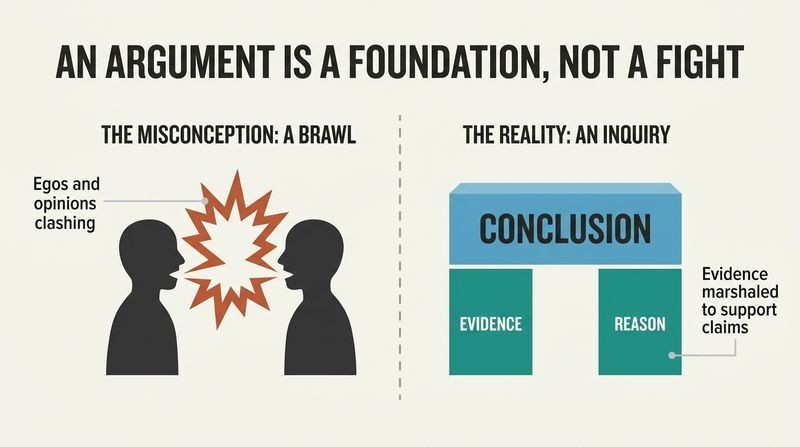
An argument isn't a fight, it's evidence marshaled toward a conclusion
Arguing means supporting claims with reasons. Most people equate arguing with a verbal brawl, two egos hurling opinions. Weston insists on a different definition: to give an argument is to offer reasons and evidence in support of a conclusion. This reframe matters because argument becomes a tool with two jobs. First, it's a method of inquiry, a way to find out which views actually hold up. Consider factory farming: you can't settle whether it's immoral just by consulting your gut. You have to weigh obligations to animals, human dietary needs, and whether vegetarians actually live longer at higher rates.
Strong views need backing. Second, once you've reasoned to a conclusion, arguments let you explain and defend it so others can decide for themselves. Having strong opinions isn't the mistake. Having nothing behind them is.
What's striking is how this definition quietly dissolves the false choice between conviction and open-mindedness. Weston echoes the classical rhetorical tradition (Aristotle's logos) but strips away jargon. The move resembles what psychologists call the difference between motivated reasoning and genuine inquiry: most people treat conclusions as fixed and hunt for supporting ammunition. Weston asks readers to hold conclusions loosely enough to test them. The framing also anticipates modern findings on the illusion of explanatory depth, the discovery that people who feel certain about policies often cannot explain the mechanisms. Forcing yourself to build an actual argument exposes the gaps in what you only thought you understood.
Separate your premises from your conclusion before you write a word
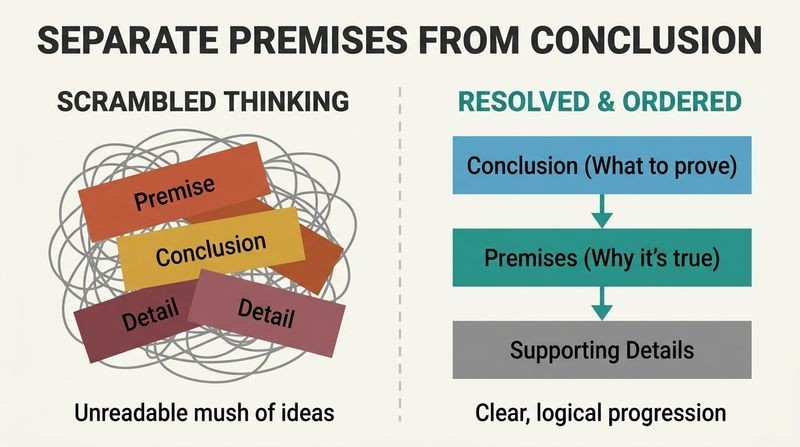
Resolve means two things. Weston's first rule tells you to resolve premises and conclusion, using a deliberate double meaning. First, distinguish them: your reasons (premises) are logically distinct from what you're trying to prove (conclusion). Keep them separate in your own mind. Second, commit to them: make sure both are claims you actually endorse. If not, revise.
Order creates clarity. Once separated, arguments must unfold in a natural order so each sentence sets up the next. Weston shows this with a mundane case, persuading someone to eat more beans. State the conclusion (eat more beans), then the main premise (they're healthy, high in fiber and protein), then supporting detail (varied and exciting, from black bean tacos to hummus). Scramble that order and strip the signpost phrases like 'one reason is,' and the same true statements become unreadable mush.
The bean example is deliberately unglamorous, and that's the pedagogy. By choosing a low-stakes claim, Weston isolates the machinery of structure from the heat of controversy. This mirrors how writing instructors teach outlining and how software engineers teach pseudocode: master the form on a trivial problem before applying it under pressure. Cognitive load theory supports the emphasis on signposting, since readers holding an argument in working memory need explicit transition cues to track what is a reason versus what is a claim. The insight that you may rearrange an argument several times before it flows resists the myth of first-draft genius.
Weak premises doom strong reasoning, so start from solid ground
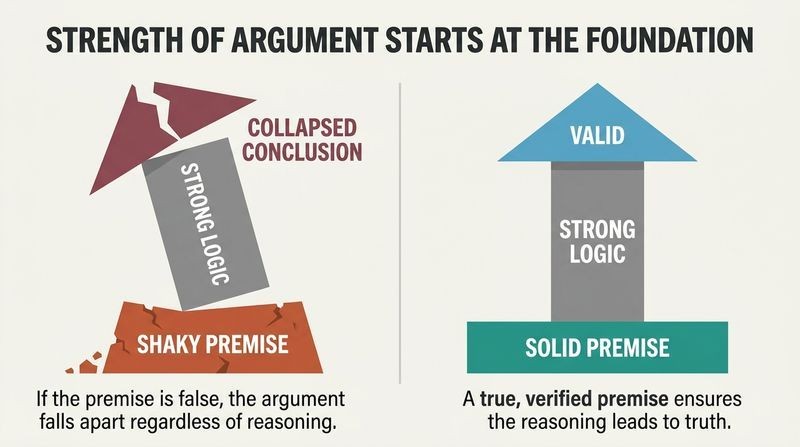
Garbage in, garbage out. No matter how flawlessly you reason from premises to conclusion, a shaky premise sinks the whole thing. Weston offers a gloomy syllogism: nobody today is really happy, therefore humans aren't made for happiness. The logic flows fine, but the opening premise is almost certainly false. Ask whether it's plausible before building on it. If a premise is uncertain, research it or give it its own supporting argument. If you can't defend it, find a different premise.
Write plainly and honestly. Two companion rules reinforce this. Be concrete and concise: 'we hiked for hours in the sun' beats 'an extended period of laborious exertion.' And build on substance, not overtone. Don't smuggle in conclusions through emotionally loaded words like calling neglected railroads a 'disgrace' America is 'honor-bound' to fix. Loaded language does no real work.
Weston's warning against overtone tracks directly onto what linguists call framing effects and what Kahneman documented as substitution, where a hard question (is passenger rail worth restoring?) gets swapped for an easy emotional one (aren't we ashamed?). The demand for concrete language echoes Orwell's Politics and the English Language, which argued that vague, inflated prose is often a symptom of vague or dishonest thinking. There's a subtle ethical dimension too: Weston insists you interpret opponents charitably, since people who question new technology probably aren't advocating a return to caves. This is the principle of charity, a norm that separates inquiry from tribal warfare.
One vivid example proves nothing without knowing how often it misses
Background rates are everything. A single bull's-eye means nothing if you don't know how many arrows missed the target. Weston calls this attending to background rates, and it's the antidote to being fooled by dramatic anecdotes. Leon's horoscope predicted a vivacious stranger, and he met one, so horoscopes work? In a class of thirty, a few Leons always surface while the other twenty-nine forgotten predictions vanish. A method that hits once in thirty tries is just occasionally lucky.
The media distorts the denominator. This is why people fear shark attacks, terrorism, and plane crashes while crime rates fall, and why lottery ads show the one jackpot winner, never the hundreds of thousands of losers. We see the hits, never the misses, so we wildly overestimate the odds. Generalizations also require more than one example, and those examples must be representative, not just the ones we happen to notice.
This rule is a plain-language version of Bayesian base-rate neglect, one of the most robust findings in decision science. Kahneman and Tversky showed that people routinely ignore prior probabilities in favor of vivid, representative stories. Weston's archery metaphor is pedagogically superior to most textbook formulations because it makes the invisible denominator visceral. The point connects to the availability heuristic: events that are easy to recall (dramatic, televised, emotional) feel more frequent than they are. One extension worth noting is survivorship bias, the World War II insight that armor should go where returning planes were not hit, because the planes hit there never came back to be counted.
Statistics carry false authority, so keep your brain switched on
Numbers are not magic. A figure like '88 percent of doctors agree' radiates authority, but numbers demand the same scrutiny as any evidence. Weston dissects a claim that colleges now graduate 'more than 50 percent' of athletes, supposedly proof things are improving. It proves nothing: there's no comparison to previous rates, no comparison to the general student graduation rate, and 'many schools' quietly excludes the worst offenders.
Watch for four traps.
1. Missing comparisons (higher than what?)
2. Over-precision (claiming exactly 412,067 wasted cups fakes authority)
3. Manipulable numbers (loaded poll questions, or 'data' on illegal activity built from guesswork)
4. Runaway extrapolation (if TV-watching keeps rising, kids will watch 36 hours a day by 2040)
Rates and percentages also need the raw counts behind them. Car thefts 'doubling' means little if one became two.
Weston is channeling the spirit of Darrell Huff's 1954 classic How to Lie with Statistics, but his over-precision point deserves emphasis because it runs counter to intuition. Spurious specificity, the 412,067 cups, exploits a cognitive quirk: people rate precise numbers as more credible than round ones, a bias documented in pricing and forecasting research. The extrapolation warning anticipates the danger of assuming linear trends in nonlinear systems, a failure that haunts everything from pandemic modeling to startup projections. The deeper meta-lesson is intellectual: quantification is a tool of clarity only when its provenance is transparent. A number without a source or a denominator is rhetoric wearing a lab coat.
Hunt counterexamples early, because they sharpen claims instead of destroying them
Exceptions don't prove rules, they refine them. Weston flips the usual dread of counterexamples. A counterexample is an instance that contradicts your generalization, and most people avoid them. Instead, seek them out early and systematically. Take the claim 'renewable energy is widely used,' supported by solar, hydro, and wind. Start hunting counterexamples and you find tidal and geothermal, which are not widely used at all. Rather than collapsing, the argument improves: narrow the conclusion to 'many forms of renewable energy are widely used.'
Counterexamples reveal what you really mean. They push you toward more subtle, defensible claims. Maybe your real point is that most every place has some renewable source available, a richer thesis than the original. The same discipline applies when evaluating others: ask whether their conclusions need limiting or rethinking. The only difference is that you get to correct your own overgeneralizations first.
This rule quietly imports Karl Popper's falsificationism into everyday reasoning. Popper argued that a theory earns its strength by surviving sincere attempts to refute it, not by accumulating confirmations. Weston domesticates that philosophy of science into a writing habit. There's also a striking connection to modern debiasing research: 'consider the opposite' is one of the few interventions shown to reliably reduce overconfidence and confirmation bias. By reframing counterexamples as a generalizer's best friend rather than an enemy, Weston makes intellectual honesty feel strategically advantageous rather than merely virtuous. The subtle payoff is that arguments refined against their strongest objections are far harder for opponents to topple.
Analogies stand or fall on relevant similarity, not surface likeness
Judge the relevant likeness. Arguments by analogy reason from one case to another: because two things are alike in known ways, they're probably alike in one further way. They needn't be alike in every respect, only in ways relevant to the conclusion. When cosmonaut Valentina Tereshkova asked why women who work Russian railroads couldn't fly in space, she was arguing that both demand physical stamina and technical skill.
Test the analogy's core. The key question is always whether the similarities are relevant. Consider Chippewa activist Adam Nordwell, who landed in Rome in 1973 and 'claimed' Italy 'by right of discovery,' just as Columbus claimed an already-inhabited America. Italy and fifteenth-century America differ enormously, but those differences (fame, transport, era) are irrelevant. The relevant point stands: you cannot discover a land already full of its own people. The analogy makes an unsettling, effective argument.
The Nordwell example is a masterclass in how analogy functions as moral argument. By transposing a familiar action into an absurd new context, it exposes a double standard we had normalized, a rhetorical move philosophers call the argument from consistency. This is the engine behind Peter Singer's drowning-child thought experiment and behind much of legal reasoning, where precedent works by analogy. The critical discipline Weston demands, isolating relevant from irrelevant similarities, is exactly where analogies are abused. Politicians love the false analogy precisely because surface resemblance persuades the inattentive. The Tereshkova case adds nuance: an analogy can be valid for its time yet weaken as circumstances change, since modern astronauts need lab skills more than raw stamina.
When citing experts, demand they be informed, impartial, and cross-checked
No one knows everything firsthand. We must rely on sources for most of what we know, but authority is risky. Weston offers a checklist for trustworthy appeals to authority.
1. Cite sources so others can verify them
2. Seek informed sources with genuine relevant expertise
3. Seek impartial sources without a stake in the answer
4. Cross-check whether qualified experts agree
Fame isn't expertise. A pop star being vegan doesn't make veganism optimal, and a PhD in one field grants no authority in another. Beware self-interested sources: a dealer recommending 300 dollars of rustproofing versus independent testers who say modern cars barely rust. Cross-checking matters most: gerontologist Aubrey de Grey argues humans could live 1,000 years, and he's genuinely credentialed, but nearly every other expert in his field disagrees. He's an outlier, so don't bet on it.
Weston's four filters map neatly onto how epistemologists distinguish legitimate from fallacious appeals to authority. The de Grey case is especially instructive in an age of credentialed contrarians who leverage genuine qualifications to lend weight to fringe positions. The cross-checking rule anticipates the problem of manufactured controversy, where a few dissenting experts create the illusion of a live debate (tobacco and climate being the textbook cases). His note that Wikipedia's openness makes it self-correcting was prescient, echoing a 2005 Nature study that found its accuracy comparable to Britannica. One tension worth flagging: impartiality is genuinely hard to assess, and 'follow the funding' can itself become a lazy ad hominem if applied selectively.
Correlation is a clue to causation, never a verdict
Every correlation has rival explanations. Causal claims start from correlations, but a correlation between E1 and E2 admits several readings. It might be coincidence (two states legalizing marijuana the year their teams reached the Super Bowl). E1 might cause E2, or E2 might cause E1. Meditators are calmer, but calm people may simply be drawn to meditation. Or a hidden third factor E3 causes both, as when a student's commitment produces both front-row seating and good grades.
Work toward the likeliest story. Don't stop at the correlation. Spell out how each candidate explanation would actually work, then compare their plausibility. Vitamin use correlates with worse health, but it's more likely that already-sick people take more vitamins than that vitamins harm them. Expect complexity: most effects have many causes, and they can loop. Smoking is the prime cause of lung cancer even though some smokers never get it.
This is arguably the single most valuable cluster of rules for navigating modern life, where headlines routinely upgrade correlations into causes. Weston's directive to 'fill in the connections' for rival explanations is essentially a lightweight version of causal inference, the discipline Judea Pearl formalized with causal diagrams. The reverse-causation trap (does marriage make people happy, or do happy people marry?) recurs across social science and is why economists prize natural experiments and instrumental variables. Weston's insistence on ruling out conspiracy and supernatural explanations invokes Occam's razor and the principle that extraordinary claims leave more unexplained than they solve. The Bermuda Triangle deflation, heavy traffic plus rough weather, is a tidy demonstration.
Valid deductive forms let true premises guarantee true conclusions
Deduction is airtight when valid. Unlike arguments by example or authority, a valid deductive argument is built so that if the premises are true, the conclusion must be true. Weston catalogs the workhorse forms, worth recognizing by name:
1. Modus ponens: If p then q; p; therefore q
2. Modus tollens: If p then q; not-q; therefore not-p
3. Hypothetical syllogism: If p then q; if q then r; therefore if p then r
4. Disjunctive syllogism: p or q; not-p; therefore q
5. Reductio ad absurdum: assume the opposite, derive an absurdity, conclude your claim
Sherlock reasons this way. The dog that didn't bark is modus tollens: a stranger would have made the dog bark; it didn't; so the visitor was no stranger. Real premises are rarely certain, so treat conclusions with appropriate caution, but these forms organize thinking with unmatched rigor.
Weston's decision to teach deduction through Sherlock Holmes is shrewd, since Conan Doyle's detective is popularly (if inaccurately) synonymous with deduction. The silver blaze case is genuine modus tollens, but many of Holmes's famous leaps are actually abduction, inference to the best explanation, which is probabilistic rather than deductive. Naming the forms matters practically: once you can spot modus tollens, you can also spot its evil twin, denying the antecedent, a fallacy that fools most people. The honest caveat Weston stresses, that validity concerns form not truth, is the crucial distinction undergraduates most often miss. A perfectly valid argument built on a false premise delivers a confidently wrong conclusion.
Detail your opponents' objections fully, then answer them
Steelman before you rebut. When building an extended argument or essay, don't just stack up support for your side. Actively seek the strongest objections, spell them out in full, and meet them. Weston contrasts a lazy dismissal ('someone might object that exchange programs are risky, but I think...') with a version that patiently reconstructs the worry: young students abroad could be exploited, targeted by terrorists, or taken hostage, and it costs real money. Only after honestly detailing the concern do you respond, perhaps noting many countries are safer than American cities, or that isolation carries its own risks.
Explore alternatives too. If you propose a solution, show it beats rival solutions. Overcrowded pools don't automatically justify building new ones; maybe extend hours, publicize off-peak times, or do nothing. Get creative and consider whether a serious alternative should change your own conclusion.
Detailing objections before answering them is not merely fair play, it is persuasively potent. Communication research on two-sided messaging finds that acknowledging counterarguments builds credibility and inoculates audiences against later persuasion by the other side. This is the opposite of the straw man, and it resembles what rationalists call steelmanning, constructing the strongest version of an opposing view. There's a Rogerian dimension here too: Carl Rogers argued that people only consider changing once they feel genuinely understood. Weston's pool example also smuggles in a lesson from policy analysis, the requirement to compare an intervention against the counterfactual and the do-nothing baseline, a discipline surprisingly absent from most advocacy.
In public debate, seek common ground and stay civil
Debate is thinking together, not a battering ram. Weston's rules for public debate counter the shrillness of modern discourse. Listen actively to understand opponents' premises, not merely to wait your turn, which earns you leverage to be heard in return. Offer something positive: Martin Luther King Jr. moved a nation with a dream, not a nightmare, and the same facts framed with possibility rather than despair change everything. Work from common ground, since most people hold nuanced in-between views. Hardly anyone wants all guns banned or all restrictions gone; most pro-life and pro-choice advocates accept some middle position.
Civility is minimalist ethics. Attacking the person rather than the argument is the ad hominem fallacy. You needn't like or agree with opponents, but describe their view fairly. And accept that debates turn slowly, like a great ship. Rarely does one argument win outright, so leave people thinking, not cornered.
Weston's public-debate rules read as a direct rebuke to social-media incentive structures, which reward dunking and outrage over understanding. His 'listen, learn, leverage' sequence mirrors negotiation research from the Harvard Program on Negotiation, where separating people from problems and seeking shared interests outperforms positional warfare. The common-ground observation is empirically grounded: political scientists have documented 'false polarization,' where partisans systematically overestimate how extreme the other side's views are. The King reframing taps into research on gain versus loss framing and collective efficacy, the finding that hope mobilizes better than doom. The one hard truth Weston concedes is bracing: if opponents genuinely fight dirty, they are better practiced at it, so good arguments remain your only real edge.
Analysis
Anthony Weston's Rulebook is deceptively slim, a philosophy professor's attempt to do for argumentation what Strunk and White did for prose: distill a craft into terse, usable rules. Its enduring value (five editions since 1986, adopted from high schools to law schools) rests on a single reframing that runs through every page. Argument is not combat but construction, a way of finding out what is true and then showing your work so others can judge for themselves.
Structurally, the book climbs a ladder of complexity. It begins with short arguments (clarity, order, reliable premises), moves through the four great families of evidence (example, analogy, authority, cause), formalizes deduction, then scales up to essays, speeches, and public debates. This architecture is itself an argument: master the atoms before the molecules. The pedagogy is shrewd in its choice of low-stakes examples (beans, pets, pools) precisely because trivial content lets structure become visible.
What dates well is the epistemology. Weston's rules on background rates, correlation versus causation, and cross-checking authorities anticipate the behavioral economics revolution of Kahneman and Tversky and the causal-inference work of Pearl, all rendered in plain English a teenager can apply. What feels freshest in the current edition is the closing chapter on public debate, a quiet intervention against the degradation of civic discourse into performance and tribalism.
The book's limitation is also its design constraint: it is a rulebook, not a theory. It offers little on the psychology of why good arguments so often fail to persuade, the motivated reasoning and identity-protective cognition that make people cling to conclusions regardless of evidence. Weston gestures at this with his ship-turning-slowly metaphor, but a reader hoping to understand persuasion's emotional machinery must look elsewhere. Still, as a portable toolkit for thinking honestly and writing clearly, few books deliver more per page. Its final counsel, leave them thinking when you go, doubles as the book's own modest ambition.
Last updated:
Report IssueReview Summary
A Rulebook for Arguments receives mostly positive reviews for its concise, clear presentation of logical reasoning principles. Readers find it useful for improving argumentative writing and critical thinking skills. Many appreciate its brevity and practical examples, though some feel it's too basic. It's recommended for students, writers, and anyone interested in constructing sound arguments. Critics note its non-Christian bias and lack of cognitive bias coverage. Overall, it's seen as a valuable introduction to logic and argumentation, comparable to Strunk and White's Elements of Style for writing.
People Also Read





FAQ
What's "A Rulebook for Arguments" about?
- Purpose: "A Rulebook for Arguments" by Anthony Weston is a concise guide to the art of making arguments. It focuses on providing clear rules and examples for constructing effective arguments.
- Structure: The book is organized around specific rules rather than lengthy explanations, making it a practical reference for students and writers.
- Audience: It is intended for anyone looking to improve their argumentation skills, from high school students to law school attendees.
- Content: The book covers various types of arguments, including short arguments, arguments by example, analogy, authority, and more.
Why should I read "A Rulebook for Arguments"?
- Practical Guidance: The book offers straightforward rules that can be easily applied to improve argumentation skills.
- Versatility: It is useful for a wide range of readers, from students to professionals, who need to construct or evaluate arguments.
- Efficiency: The concise format allows readers to quickly find and apply the rules without wading through extensive theoretical discussions.
- Relevance: The book addresses contemporary issues in public debate and argumentation, making it timely and applicable.
What are the key takeaways of "A Rulebook for Arguments"?
- Clarity and Order: Arguments should be clear and follow a natural order, with premises leading logically to a conclusion.
- Reliable Premises: Start from premises that are reliable and well-supported by evidence.
- Types of Arguments: Understand different forms of arguments, such as by example, analogy, and authority, and how to use them effectively.
- Addressing Objections: Consider and address potential objections to strengthen your argument.
How does Anthony Weston suggest structuring short arguments?
- Resolve Premises and Conclusion: Clearly distinguish between your premises and conclusion, ensuring both are claims you want to commit to.
- Natural Order: Unfold your ideas in a logical and natural sequence, making it easy for the reader to follow.
- Concrete and Concise: Use specific, concrete terms and be concise to avoid losing the reader in a fog of words.
- Substance Over Overtone: Focus on providing actual reasons rather than relying on emotionally charged language.
What are the rules for arguments by example in "A Rulebook for Arguments"?
- Multiple Examples: Use more than one example to support a generalization, as a single example may be an exception.
- Representative Examples: Ensure that your examples are representative of the group you are generalizing about.
- Background Rates: Consider the background rates to understand the significance of your examples.
- Critical Eye on Statistics: Be cautious with statistics, ensuring they are not misleading or manipulated.
How does "A Rulebook for Arguments" address arguments by analogy?
- Relevant Similarities: Analogies require examples that are relevantly similar to the case being argued.
- Evaluate Premises: Ensure the first premise about the example used as an analogy is true.
- Assess Similarity: Critically assess how relevantly similar the two cases are to determine the strength of the analogy.
- Example: The book uses Valentina Tereshkova's analogy about women being capable astronauts as an illustration.
What advice does Anthony Weston give for arguments from authority?
- Cite Sources: Always cite your sources to provide credibility to your argument.
- Informed Sources: Seek sources that are well-informed and qualified to speak on the subject.
- Impartiality: Use impartial sources that do not have a stake in the issue to avoid bias.
- Cross-Check: Cross-check sources to ensure consistency and reliability of the information.
How does "A Rulebook for Arguments" suggest handling causal arguments?
- Start with Correlations: Causal arguments often begin with identifying a correlation between two events.
- Alternative Explanations: Consider alternative explanations for the correlation to avoid jumping to conclusions.
- Most Likely Explanation: Work towards identifying the most likely explanation for the correlation.
- Expect Complexity: Recognize that causes and effects can be complex and multifaceted.
What are the deductive argument forms discussed in "A Rulebook for Arguments"?
- Modus Ponens: If p then q; p; therefore, q.
- Modus Tollens: If p then q; not-q; therefore, not-p.
- Hypothetical Syllogism: If p then q; if q then r; therefore, if p then r.
- Disjunctive Syllogism: p or q; not-p; therefore, q.
How does Anthony Weston recommend structuring extended arguments?
- Explore the Issue: Begin by exploring the issue without immediately taking a position.
- Spell Out Ideas: Frame your basic ideas as arguments with clear premises and conclusions.
- Defend Premises: Provide supporting arguments for each premise in your basic argument.
- Consider Objections: Anticipate and address objections to strengthen your argument.
What are the best quotes from "A Rulebook for Arguments" and what do they mean?
- "Arguments are efforts to support certain views with reasons." This quote emphasizes the purpose of arguments as a means to provide rational support for a viewpoint.
- "Critical thinking can be practiced in a far more constructive spirit." It highlights the constructive nature of critical thinking beyond merely identifying fallacies.
- "Argument is a means of inquiry." This underscores the role of argumentation in exploring and understanding different perspectives.
- "Leave them thinking when you go." It suggests that the goal of argumentation is to provoke thought and reflection, not just to win.
How does "A Rulebook for Arguments" address public debates?
- Do Argument Proud: Engage in public debates with well-reasoned arguments and evidence.
- Listen and Learn: Actively listen to understand opposing arguments and leverage that understanding.
- Offer Positivity: Provide positive suggestions and solutions rather than focusing solely on criticism.
- Civility: Maintain civility and respect in debates, focusing on arguments rather than personal attacks.
About the Author
Anthony Weston is a philosopher and professor emeritus at Elon University. He has authored numerous books on ethics, critical thinking, and environmental philosophy. Weston is known for his accessible writing style and ability to explain complex concepts clearly. His work focuses on practical approaches to philosophical topics, emphasizing their real-world applications. In addition to A Rulebook for Arguments, he has written books on moral philosophy, creative problem-solving, and environmental ethics. Weston's publications aim to make philosophical ideas and critical thinking skills accessible to a wide audience, from students to general readers.
Download PDF
Download EPUB
.epub digital book format is ideal for reading ebooks on phones, tablets, and e-readers.








































