
Key Takeaways
1. The Essential Foundation: Money and a Room of One's Own
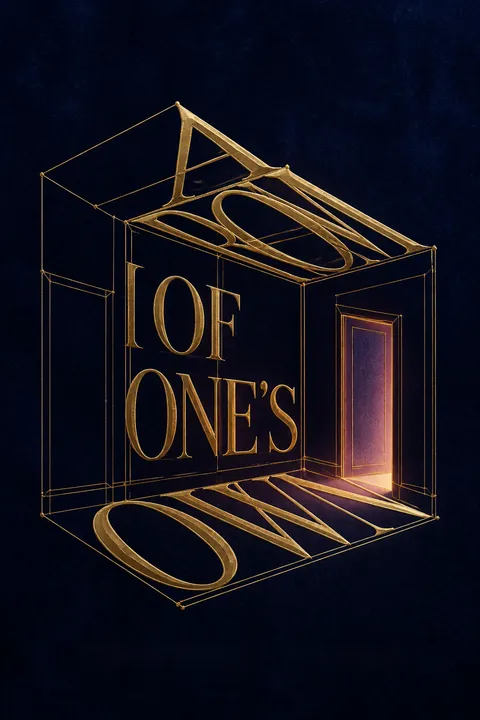
All I could do was to offer you an opinion upon one minor point – a woman must have money and a room of her own if she is to write fiction.
A simple truth. The core argument is deceptively simple yet profoundly impactful: for a woman to write fiction, she requires financial independence and a private space. This isn't merely about comfort; it's about the fundamental conditions necessary for intellectual freedom and creative work. Without these, the mind is constantly distracted, burdened, and unable to achieve the sustained concentration required for art.
Beyond the literal. While "a room of one's own" literally means a physical space, it symbolizes much more: privacy, autonomy, uninterrupted time, and freedom from domestic duties and societal expectations. Similarly, "five hundred pounds a year" represents economic independence, freeing a woman from the need to flatter, to perform unwanted labor, or to depend on others, thus liberating her mind from fear and bitterness.
The starting point. This foundational requirement is presented not as a grand philosophical conclusion, but as a practical, undeniable truth derived from observing the historical and contemporary realities of women's lives. It serves as the bedrock upon which any discussion of women and fiction must be built, acknowledging that material conditions are inextricably linked to intellectual and creative output.
2. The Unjust Disparity: Male Privilege and Female Poverty
What force lies behind that plain china off which we dined, and (here it popped out of my mouth before I could stop it) the beef, the custard and the prunes?
Contrasting experiences. The narrator vividly contrasts the lavish luncheon at the male-endowed Oxbridge college, replete with fine food, wine, and centuries of accumulated wealth, with the meager dinner of gravy soup, beef, prunes, and custard at the women's college, Fernham. This stark difference highlights the profound economic disparity between men's and women's institutions, reflecting broader societal inequalities.
Historical endowments. The male colleges were built and sustained by an "unending stream of gold and silver" from kings, nobles, merchants, and manufacturers over centuries, ensuring libraries, laboratories, and comfortable living for their scholars. In contrast, the women's college was a recent, hard-won achievement, built with immense struggle and limited funds, leaving no surplus for "amenities" like wine, partridges, or even private rooms.
The cost of poverty. This financial deprivation directly impacts intellectual life. A poor dinner, the narrator observes, hinders "good talk" and prevents the "lamp in the spine" from lighting, symbolizing the dampening effect of material hardship on intellectual vitality and creative thought. The lack of resources meant women's minds were constantly battling basic needs, rather than freely exploring ideas.
3. The Patriarchal Mirror: Men's Self-Esteem Built on Women's Inferiority
Women have served all these centuries as looking-glasses possessing the magic and delicious power of reflecting the figure of man at twice its natural size.
The professor's anger. Observing the vast, often contradictory, literature written by men about women, the narrator notes an underlying "anger" or "heat." This anger, she deduces, stems not from women's actual inferiority, but from men's need to assert and protect their own superiority. This self-assertion is crucial for their confidence in a "perpetual struggle" of life.
A magnified reflection. Men, particularly those in positions of power (patriarchs, professors), rely on the perceived inferiority of women to inflate their own sense of self-worth. Women act as "looking-glasses," reflecting men's figures "at twice its natural size." Without this reflection, men's confidence would shrink, diminishing their "fitness for life" and their ability to lead, judge, and create.
The cost of truth. This psychological dependence explains why men react with such pain and anger to women's criticism or assertions of equality. If a woman "begins to tell the truth," the man's magnified image in the mirror shrinks, threatening his vital self-confidence. This dynamic underscores the deep-seated, often unconscious, reasons behind patriarchal resistance to women's emancipation.
4. The Silent Tragedy: Suppressed Female Genius Throughout History
It would have been impossible, completely and entirely, for any woman to have written the plays of Shakespeare in the age of Shakespeare.
Judith Shakespeare's fate. To illustrate the impossibility of female literary genius in the Elizabethan era, the narrator invents Shakespeare's equally gifted sister, Judith. While Shakespeare found opportunities in London, Judith was denied education, forced into marriage, ridiculed for her theatrical aspirations, and ultimately driven to suicide due to the insurmountable societal barriers and the "heat and violence of the poet's heart when caught and tangled in a woman's body."
Unrecorded lives. History, focused on kings and wars, largely ignores the lives of ordinary women. What little is known reveals a reality of confinement, forced marriage, and lack of autonomy. Any woman born with a great gift in such an age would have been "thwarted and hindered," "tortured and pulled asunder by her own contrary instincts," leading to madness or an anonymous, unfulfilled existence.
The "Anon" writer. The narrator speculates that "Anon," the unsigned author of countless poems and ballads, was often a woman. This anonymity was a necessary refuge, a "relic of the sense of chastity" that dictated women should not seek public recognition. The societal expectation that "publicity in women is detestable" forced many talented women to suppress their names and, often, their full creative potential.
5. Forging a Path: The Rise of Women Writers and the Novel
All women together ought to let flowers fall upon the tomb of Aphra Behn, which is, most scandalously but rather appropriately, in Westminster Abbey, for it was she who earned them the right to speak their minds.
Aphra Behn's breakthrough. The Restoration playwright Aphra Behn marks a crucial turning point. As a middle-class woman forced to earn her living by her wits, she proved that writing could be a profession for women. This act, though perhaps at the "sacrifice of certain agreeable qualities," was revolutionary, demonstrating that women could achieve financial independence through their pen.
The novel's flexibility. The eighteenth and nineteenth centuries saw a surge in women writers, predominantly novelists. The novel, being a relatively new and pliable form, was more accessible than established genres like epic poetry or poetic drama. It could be written in the "common sitting-room," amidst interruptions, and drew upon women's centuries-long training in observing character and analyzing emotion within domestic spheres.
Paving the way. While early women writers often faced criticism and had to navigate societal expectations, their collective effort created a tradition. Jane Austen, the Brontës, and George Eliot, though distinct, built upon the groundwork laid by their predecessors. Their success, particularly Austen's ability to write "without hate, without bitterness, without fear, without protest," demonstrated that women could achieve artistic integrity despite their circumstances.
6. The Incandescent Mind: Achieving Creative Freedom and Integrity
The mind of an artist, in order to achieve the prodigious effort of freeing whole and entire the work that is in him, must be incandescent, like Shakespeare’s mind.
The ideal state. True creative work demands an "incandescent" mind—one that is free from internal obstacles, "foreign matter unconsumed," such as personal grievances, anger, or the need to protest. Shakespeare's mind is presented as the epitome of this state, where his poetry flows "free and unimpeded" because his personal feelings are hidden, consumed by the art itself.
Women's struggle for incandescence. For women writers, achieving this state was infinitely more difficult. Beyond material hardships like lack of a private room, they faced constant societal hostility and discouragement. The world did not say "Write if you choose"; it said, "Write? What's the good of your writing?" This external pressure often led to internal strife, making an incandescent mind almost impossible.
The cost of protest. Charlotte Brontë, for example, despite her genius, shows traces of "anger," "indignation," and "rancour" in her work, particularly in Jane Eyre. This "flaw in the centre" meant her imagination "swerved" from her story to address personal grievances, preventing her genius from being "expressed whole and entire." The constant need to protest or conciliate external criticism compromised the integrity of her art.
7. Unveiling Reality: The Need for Women to Write Their Own Truths
All these infinitely obscure lives remain to be recorded, I said, addressing Mary Carmichael as if she were present; and went on in thought through the streets of London feeling in imagination the pressure of dumbness, the accumulation of unrecorded life...
Beyond male perspectives. The narrator critiques the limited and often distorted portrayal of women in literature written by men, where women are primarily seen "in relation to the other sex." She highlights the revolutionary potential of a line like "Chloe liked Olivia," which opens up the vast, unexplored territory of women's relationships and inner lives, independent of men.
The unrecorded lives. There is an immense wealth of female experience—the "infinitely obscure lives" of ordinary women, from charwomen to shopkeepers, mothers, and old ladies—that remains unrecorded in history and often misrepresented in fiction. These lives, with their unique "profundities and their shallows, and their vanities and their generosities," are crucial for a complete understanding of humanity.
A new lens. Women writers, like Mary Carmichael, are urged to illuminate their own souls and the lives of other women, capturing "unrecorded gestures" and "unsaid or half-said words." They must also bravely describe men from a female perspective, revealing "that spot the size of a shilling at the back of the head" that men cannot see for themselves, thus enriching comedy and discovering new truths about human nature.
8. The Androgynous Ideal: A Unified Mind for Complete Artistic Creation
Perhaps a mind that is purely masculine cannot create, any more than a mind that is purely feminine, I thought.
Harmony of sexes in the mind. The narrator proposes the concept of an "androgynous mind," where the male and female elements within each individual live in harmony and cooperate spiritually. This fusion, she suggests, is the "normal and comfortable state of being" and is essential for a mind to be "fully fertilized" and use all its faculties for creation.
Shakespeare as the archetype. Shakespeare's mind is presented as the ideal "androgynous" or "man-womanly" mind, capable of transmitting emotion "without impediment," naturally creative, incandescent, and undivided. His ability to transcend gender bias in his writing allows his work to achieve universal resonance and perpetual life.
The modern imbalance. In contrast, the contemporary age is "stridently sex-conscious," leading many male writers to write only with the "male side of their brains." This imbalance results in writing that is impeded, self-conscious, and often dull, lacking the "suggestive power" that comes from a unified, androgynous perspective. True art, like poetry, needs both a "mother as well as a father."
9. The Peril of Sex-Conscious Writing: When Bias Impedes Art
It is fatal for anyone who writes to think of their sex. It is fatal to be a man or woman pure and simple; one must be woman-manly or man-womanly.
A fatal flaw. The most crucial advice for any writer, regardless of sex, is to avoid writing with conscious bias or grievance. To "lay the least stress on any grievance," to "plead even with justice any cause," or to "speak consciously as a woman" is "fatal" to art. Such writing, though perhaps brilliant and effective for a moment, is "doomed to death" because it lacks the universal fertilization of a unified mind.
The marriage of opposites. True creative art requires a "collaboration" and "marriage of opposites" within the mind, where both male and female elements contribute freely and peacefully. The writer must allow their mind to "celebrate its nuptials in darkness," without looking or questioning, to communicate experience with "perfect fullness."
Beyond "sides." The narrator dismisses the "private-school stage of human existence" where "sides" compete for superiority. In mature thought and art, such comparisons of merit between sexes are futile. The goal is not to prove one sex better than another, but to achieve a state of mind where the artist's vision is uncompromised by external pressures or internal biases.
10. The Material Basis of Intellectual Freedom: A Call to Action
Intellectual freedom depends upon material things. Poetry depends upon intellectual freedom. And women have always been poor, not for two hundred years merely, but from the beginning of time.
Reiterating the core. The essay circles back to its initial, "prosaic conclusion": intellectual freedom is not an abstract ideal but is fundamentally dependent on material conditions. For women, this means having money and a private room. Historically, women's perpetual poverty has denied them the "dog's chance" of intellectual freedom that even the sons of Athenian slaves possessed.
The cost of poverty. Without financial means, women were confined, uneducated, and constantly burdened by domesticity, making sustained creative work virtually impossible. The legacy of this historical poverty is profound, shaping not only what women could write but also how they were perceived and valued.
A hopeful future. Thanks to the efforts of past women and societal shifts (like the Crimean and European Wars opening doors), the situation is improving. The narrator's audience, women now attending college, have a greater chance of earning their own living and achieving the necessary material conditions for intellectual freedom. This progress, however, is still precarious and requires continued effort.
11. The Enduring Quest: To Live in the Presence of Reality
So that when I ask you to earn money and have a room of your own, I am asking you to live in the presence of reality, an invigorating life, it would appear, whether one can impart it or not.
Beyond fiction. The narrator encourages women to write all kinds of books—travel, adventure, research, history, biography, criticism, philosophy, and science—not just fiction. This broad engagement will not only enrich literature but also allow women to explore the world, contemplate the past and future, and let their "line of thought dip deep into the stream."
The writer's unique access. The writer, more than others, has the chance to live "in the presence of reality"—that erratic, undependable, yet profoundly invigorating essence found in everyday moments and grand experiences. It is the writer's business to "find it and collect it and communicate it to the rest of us," performing a "curious couching operation on the senses" that makes the world seem "bared of its covering."
An invigorating life. Ultimately, the call for money and a room of one's own is a call to live a life of intellectual freedom, a life "at enmity with unreality." This life, rich in observation, contemplation, and the pursuit of truth, is inherently invigorating, whether or not one chooses to impart it through writing. It is a life of profound engagement with the world, made possible by the fundamental conditions of autonomy and privacy.
Review Summary
A Room of One's Own is praised as a seminal feminist text that explores women's struggle for intellectual freedom and creative expression. Readers appreciate Woolf's insightful analysis of gender inequality in literature and society. Many find her prose beautiful and her arguments compelling, particularly regarding the need for financial independence and personal space for women writers. The book's relevance to modern discussions on feminism and privilege is frequently noted. Some criticize its focus on upper-class women, but most view it as an essential, thought-provoking work that continues to inspire readers.
People Also Read






About the Author
Other books by Virginia Woolf




Download PDF
Download EPUB
.epub digital book format is ideal for reading ebooks on phones, tablets, and e-readers.








































