
Plot Summary
Boy, Professor, and the Sea
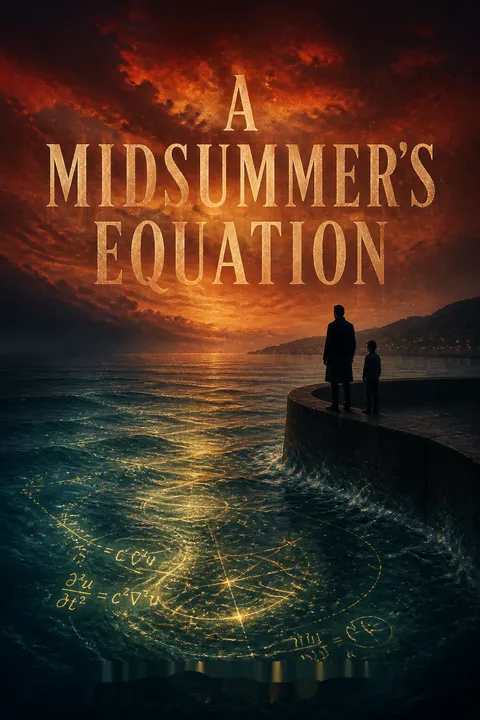
Kyohei, a sullen fifth-grader, is sent alone to the seaside town of Hari Cove while his parents work in Osaka. On the train, he meets Manabu Yukawa, a physicist with a sharp mind and a dry wit. Their initial encounter is awkward but memorable, as Yukawa helps Kyohei out of a minor scrape and later engages him in a conversation about science and TV crosswords. Both are headed to the same destination, though for different reasons—Kyohei to stay with his aunt and uncle at the Green Rock Inn, and Yukawa to attend a controversial hearing about undersea resource development. The stage is set for a summer where science, mystery, and human connection will intertwine.
The Cove's Hidden Battle
Narumi, Kyohei's cousin, is deeply involved in Save the Cove, a grassroots movement opposing the mining of undersea resources near Hari Cove. The town is divided: some see economic salvation in DESMEC's project, while others, like Narumi and her activist friends, fear irreversible environmental damage. The tension is palpable at a public hearing, where scientists, corporate representatives, and townspeople clash over the future of the cove. Yukawa, present as a scientific advisor, challenges both sides to confront the limits of their knowledge and the consequences of their choices. The battle for Hari Cove's soul is as much about identity and memory as it is about economics or ecology.
Arrival at Green Rock Inn
Kyohei arrives at the Green Rock Inn, greeted by his warm but weary aunt Setsuko and jovial uncle Shigehiro. The inn, once bustling, now struggles to attract guests. The family's history is layered with loss and adaptation—Setsuko took over after her father's stroke, and Shigehiro's health is failing. Kyohei's presence is a reminder of both continuity and change. The inn's faded charm, the family's gentle teasing, and the rituals of shared meals evoke a sense of nostalgia and melancholy. Yet beneath the surface, secrets and anxieties simmer, foreshadowing the storm to come.
Environmental Debates and Tensions
The public hearing intensifies, with Narumi and her allies pressing DESMEC on the risks to deep-sea life. Yukawa's intervention is blunt: science cannot guarantee perfect safety, and every choice has costs. The debate exposes the limits of both environmental idealism and corporate optimism. Afterward, Narumi and Yukawa cross paths at a local bar, where their conversation reveals mutual respect and philosophical differences. Yukawa's neutrality and scientific rigor unsettle Narumi, who is used to clear lines between friend and foe. The town's fate hangs in the balance, as does the trust between its people.
Fireworks and Fatal Night
Kyohei and his uncle set off fireworks in the inn's backyard, a rare moment of joy. Meanwhile, Yukawa dines alone, and the inn's other guest, Masatsugu Tsukahara, goes missing after dinner. The night is filled with small, unnoticed actions—doors left unlocked, lights in empty rooms, and the quiet movement of people through the inn's corridors. By morning, Tsukahara's body is found on the rocks below the seawall, his head split open. What appears to be a tragic accident is the catalyst for a complex investigation, as the boundaries between innocence and guilt begin to blur.
A Body on the Rocks
Detectives Nishiguchi and Hashigami arrive to investigate Tsukahara's death. The discovery that the victim was a retired Tokyo homicide detective raises the stakes. The inn's family and guests are questioned, their routines and alibis scrutinized. The town's insularity is pierced by suspicion and rumor. As the investigation unfolds, the detectives uncover layers of personal history, from Narumi's activism to the inn's declining fortunes. The case is complicated by Tsukahara's mysterious attendance at the hearing and his connections to people and places far beyond Hari Cove.
The Investigation Begins
The autopsy reveals carbon monoxide poisoning, not blunt force trauma, as the cause of death. The police search the inn for sources of the gas, but the evidence is inconclusive. Yukawa, ever the observer, notices details others miss—a misplaced sandal, a locked room, the design of the inn's boiler system. Meanwhile, Tokyo detectives Kusanagi and Utsumi begin their own parallel inquiry, tracing Tsukahara's past cases and his recent obsession with a long-ago murder. The investigation becomes a web of intersecting motives, old wounds, and scientific enigmas.
Scientists, Secrets, and Motives
Yukawa's curiosity leads him to experiment with water rockets and to probe the inn's architecture. He befriends Kyohei, teaching him about science and the joy of discovery, but also subtly investigating the events of the fatal night. Conversations with Narumi and the inn's family reveal fractures and evasions. Yukawa suspects that the truth lies not in malice but in a chain of misunderstandings, accidents, and suppressed guilt. His scientific method becomes a tool for empathy as much as for solving puzzles, illuminating the human equations at the heart of the mystery.
The Detective's Past
Tsukahara's history as a detective comes to the fore. Years earlier, he arrested Hidetoshi Senba for the murder of Nobuko Miyake, a case that never sat right with him. As Kusanagi and Utsumi dig deeper, they discover that Senba took the fall to protect someone else—possibly Setsuko or her daughter Narumi. The connections between the inn's family, Senba, and the murdered woman are tangled and painful. The past refuses to stay buried, and the sins of one generation threaten to destroy the next.
The Chain of Confessions
As the investigation closes in, Shigehiro confesses to negligence and covering up Tsukahara's death, hoping to shield his wife and daughter. Sawamura, Narumi's activist friend, claims responsibility for moving the body, trying to protect Narumi from suspicion. Each confession is an act of love and desperation, but none fully explains the circumstances of Tsukahara's death. The truth remains elusive, hidden beneath layers of loyalty, fear, and self-sacrifice. The police, eager for closure, are content to accept the simplest explanation, but Yukawa is not.
The Truth in the Chimney
Yukawa's investigation uncovers the final piece: Kyohei, following his uncle's instructions to prevent fireworks from entering the chimney, inadvertently blocked it with a damp box. This caused carbon monoxide to back up into the inn, poisoning Tsukahara as he slept in a room chosen for its proximity to the fireworks. The act was innocent, the result tragic. Yukawa realizes that exposing the full truth would only harm Kyohei, who is already burdened by guilt he cannot name. The equation of the crime is one of unintended consequences, not malice.
The Weight of Guilt
Narumi, Yukawa, and Kyohei each grapple with the aftermath. Narumi is haunted by her own past—her role in a murder as a child, the burden of being protected by adults who sacrificed themselves for her. Kyohei senses that he has done something terrible, though he cannot articulate it. Yukawa counsels both to value life and to seek understanding rather than punishment. The inn closes, the family scatters, and the town returns to its uneasy equilibrium. The summer ends, but the scars remain.
The Ocean's Silent Witness
The sea, ever-present and indifferent, witnesses the tragedies and redemptions of Hari Cove. Narumi finds solace in its beauty, dedicating herself to its protection as a way of atoning for her past. Yukawa, returning to Tokyo, reflects on the limits of science and the mysteries that remain unsolved. The cove's fate—like that of its people—hangs in the balance between exploitation and preservation, memory and forgetting. The ocean is both a source of life and a repository of secrets.
The Unraveling of Family
The Kawahata family's secrets are laid bare: Narumi is Senba's daughter, the product of a brief affair; Shigehiro has known but chosen to love her as his own. Setsuko's silence is both a shield and a wound. The family's willingness to sacrifice for one another is both their strength and their undoing. In the end, forgiveness is possible, but only if the truth is faced with courage and compassion. The bonds of family are tested but not broken.
The Sins of the Past
The official investigation concludes with charges of negligence and corpse abandonment, but the deeper crimes—murder, concealment, and the distortion of justice—go unpunished. Senba, dying in hospice, carries his secret to the grave. Tsukahara's quest for truth ends in his own death. The law is satisfied, but the moral equation remains unresolved. The characters must find their own paths to redemption, outside the structures of authority.
The Equation of Sacrifice
Yukawa's role as both detective and teacher is central. His scientific approach uncovers the truth, but his empathy prevents further harm. He recognizes that some equations cannot be solved without causing new suffering. His final advice to Kyohei and Narumi is to live with their questions, to seek understanding, and to value life above all. The story ends not with punishment, but with the hope of growth and healing.
The Summer Ends
As summer draws to a close, Kyohei leaves Hari Cove, changed by what he has experienced. Narumi remains, her commitment to the ocean deepened by loss and revelation. Yukawa returns to Tokyo, carrying with him the memory of a summer where science and humanity met at the edge of tragedy. The cove endures, its beauty undiminished, its secrets safe for another season. The story closes on a note of quiet resilience, the promise that life, like the sea, goes on.
Analysis
A Midsummer's Equation is a masterful meditation on the limits of knowledge, the burdens of guilt, and the redemptive power of empathy. Keigo Higashino uses the framework of a detective novel to explore the ways in which families and communities are shaped by secrets, sacrifices, and the desire to protect those we love. The novel's central equation is not one of physics, but of human consequence: every action, however innocent or well-intentioned, ripples outward, affecting lives in ways we cannot foresee. Science, law, and morality intersect and sometimes conflict, forcing characters to choose between truth and compassion. The story's resolution is deliberately ambiguous—justice is not fully served, and the wounds of the past are not entirely healed. Yet there is hope in the willingness of characters like Yukawa, Narumi, and Kyohei to live with uncertainty, to seek understanding, and to value life despite its imperfections. In a world where easy answers are elusive, A Midsummer's Equation offers a profound lesson: that the most important mysteries are those of the heart, and that forgiveness—of others and of oneself—is the hardest, and most necessary, solution of all.
Review Summary
A Midsummer's Equation receives generally positive reviews, averaging 3.96/5. Readers appreciate Yukawa's central role, his heartwarming friendship with young Kyohei, and the atmospheric coastal setting. Many note it falls short compared to Higashino's stronger works like The Devotion of Suspect X, citing an overly complex cast, redundant subplots around underwater mining, and a somewhat predictable mystery. However, the philosophical exchanges between Yukawa and Kyohei, authentic characters, and satisfying resolution earn consistent praise. Most agree it's an enjoyable, accessible read despite being considered a lesser entry in the series.
People Also Read
Characters
Manabu Yukawa
Yukawa, known as "Detective Galileo," is a physicist whose intellect is matched by his emotional intelligence. Initially detached, he becomes deeply involved in the mystery at Hari Cove, using scientific reasoning to uncover the truth behind Tsukahara's death. His relationship with Kyohei is both pedagogical and paternal, guiding the boy through scientific experiments and moral dilemmas. Yukawa's neutrality allows him to see through the layers of deception and self-sacrifice that cloud the case. Ultimately, he chooses empathy over exposure, protecting Kyohei and Narumi from further harm. His journey is one of moving from observation to intervention, balancing the demands of truth and compassion.
Kyohei
Kyohei is a typical preteen, resentful of being sent away for the summer but curious and adaptable. His friendship with Yukawa opens his mind to science and the complexities of adult life. Unwittingly, he becomes the agent of Tsukahara's death, following his uncle's instructions to cover the chimney. The weight of this secret shapes his emotional arc, as he senses but cannot fully grasp his role in the tragedy. Kyohei's development is marked by a growing awareness of consequence, guilt, and the need for forgiveness. His story is a meditation on the loss of innocence and the slow acquisition of wisdom.
Narumi Kawahata
Narumi is the emotional heart of the novel, torn between her activism for the cove and the unresolved trauma of her childhood. As a teenager, she killed Nobuko Miyake in a moment of panic, an act covered up by adults who loved her. Her dedication to saving the ocean is both a form of atonement and a search for meaning. Narumi's relationships—with her parents, with Yukawa, with the town—are fraught with unspoken pain and longing for redemption. Her journey is one of confronting the past, accepting responsibility, and choosing to live with the consequences rather than run from them.
Shigehiro Kawahata
Shigehiro is the inn's owner, a man whose jovial exterior masks deep sorrow and moral conflict. He is not Narumi's biological father but has chosen to love and protect her as his own. His decision to cover up Tsukahara's death—enlisting Kyohei's unwitting help—is driven by desperation to shield his family from scandal and ruin. Shigehiro's arc is one of sacrifice and self-blame, culminating in his confession and acceptance of legal punishment. His silence about the past is both a kindness and a curse, perpetuating cycles of secrecy and guilt.
Setsuko Kawahata
Setsuko is the emotional anchor of the family, carrying the weight of her affair with Senba, her daughter's crime, and her husband's sacrifices. Her life is defined by endurance and the suppression of her own needs for the sake of others. Setsuko's silence is both protective and isolating, preventing healing even as it averts disaster. Her relationship with Narumi is marked by love, regret, and the hope that her daughter can find peace where she could not.
Masatsugu Tsukahara
Tsukahara is a retired Tokyo homicide detective whose unresolved guilt over the Senba case brings him to Hari Cove. His quest to uncover the truth is both noble and self-destructive, leading to his own death. Tsukahara's empathy for Senba and his determination to right past wrongs make him a figure of tragic integrity. His death is the catalyst for the novel's central mystery and the unmasking of generational secrets.
Hidetoshi Senba
Senba is the man who took the fall for Nobuko Miyake's murder, protecting Setsuko and Narumi at the cost of his own freedom and happiness. His life is a study in endurance, regret, and the limits of self-sacrifice. Senba's final days in hospice are marked by a longing for connection and the hope that his suffering was not in vain. His silence is both heroic and tragic, ensuring the survival of those he loves but denying himself absolution.
Sawamura
Sawamura is Narumi's colleague in Save the Cove, a passionate journalist who becomes entangled in the cover-up of Tsukahara's death. His willingness to confess to moving the body is an act of devotion to Narumi, blurring the line between love and self-destruction. Sawamura's arc is one of misplaced heroism and the realization that good intentions can have unintended consequences.
Kusanagi
Kusanagi is the Tokyo detective who, with his partner Utsumi, pursues the truth behind Tsukahara's death and the old Senba case. His investigation is methodical and empathetic, uncovering the tangled web of relationships that bind the characters. Kusanagi's role is to bridge the gap between law and humanity, recognizing when justice must yield to mercy.
Utsumi
Utsumi is Kusanagi's partner, whose intelligence and intuition complement his persistence. She is instrumental in tracing the connections between the characters and in understanding the emotional stakes of the case. Utsumi's presence brings balance and perspective, reminding the reader that truth is not always synonymous with justice.
Plot Devices
Interlocking Mysteries and Layered Revelations
The novel employs a complex narrative structure, weaving together present-day investigation, flashbacks to past crimes, and the inner lives of its characters. The central mystery—Tsukahara's death—is gradually revealed to be the product of a chain of earlier secrets: Narumi's childhood crime, Senba's false confession, and the family's history of sacrifice. The use of multiple investigators (local police, Tokyo detectives, Yukawa) allows for different angles on the same events, creating dramatic irony and tension. Foreshadowing is deftly used, with small details (a misplaced sandal, a painting, a locked room) gaining significance as the story unfolds. The scientific method, embodied by Yukawa, serves as both a plot device and a metaphor for the search for truth.
Detective Galileo Series
About the Author
Other books by Keigo Higashino




Download PDF
Download EPUB
.epub digital book format is ideal for reading ebooks on phones, tablets, and e-readers.








































