
Key Takeaways
1. The Great War shattered the "Myth of Progress," revealing humanity's destructive capacity.
“The Great War differed from all ancient wars in the immense power of the combatants and their fearful agencies of destruction, and from all modern wars in the utter ruthlessness with which it was fought.”
Pre-war optimism. Before 1914, a widespread "Myth of Progress" convinced Europeans that humanity was inexorably advancing towards political, cultural, and spiritual perfection. This belief, fueled by the Industrial Revolution and technological breakthroughs, suggested that future wars would be brief, decisive, and even beneficial, or perhaps disappear entirely due to economic interdependence. Thinkers like Norman Angell, in "The Great Illusion," argued that war had become economically irrational.
A brutal awakening. The reality of the Great War brutally exposed the fallacy of this myth. Instead of a quick, "cleansing" conflict, it became a four-year-long, dehumanizing slaughter, claiming over 16 million lives and wounding 21 million. The sheer scale of casualties, the stalemate of trench warfare, and the unprecedented physical devastation of the European landscape left a generation profoundly disillusioned. Winston Churchill somberly reflected that the war inflicted "injuries... which a century will not efface."
A European suicide pact. The conflict was described as a "European suicide pact," where millions perished in mechanized slaughter that no one knew how to stop. The war's aftermath saw the collapse of empires and a pervasive sense that civilization itself was damaged "permanently for the worse." This stark contrast between pre-war hopes and post-war realities became a defining feature of the intellectual and spiritual landscape for Tolkien and Lewis.
2. Unchecked scientific and technological advancement threatened human dignity and nature.
“The tragedy, as he saw it, was the attempt to use technology to actualize our desires and increase our power over the world around us—all of which leaves us unsatisfied.”
Technology's dark side. The same technological advances that fueled the "Myth of Progress" also created unprecedented instruments of destruction, turning nature into "the handmaiden of humanity" but also into a casualty of war. Tolkien, deeply attached to the English countryside, resented the "mechanized disruption" of his day, viewing "the Machine" as a tool for dominating others. His hateful realm of Mordor, sustained by black engines and factories, directly reflects this critique.
Dehumanizing science. The belief that science could perfect human nature led to the rise of eugenics, a movement advocating for the manipulation of human reproduction and the sterilization of "defectives." This "scientific" approach, embraced by many academics and even some religious leaders, reduced individuals to mere biology, stripping them of their inherent dignity. Lewis warned that the "conquest of Nature" would ultimately lead to "the abolition of man," where some men would make others what they please.
Nature's revenge. Both authors depicted nature itself joining the war against tyranny, as seen with Tolkien's Ents and Lewis's Awakened Trees. This symbolized nature's "revenge" against humanity's industrialized exploitation, a judgment deepened by the Great War's physical devastation. Battlefields became "a landscape of sheer earth without a blade of grass," a "land defiled, diseased beyond healing," mirroring the horrors Tolkien witnessed at the Somme.
3. Religious leaders often conflated national interests with a "Holy War," fueling the conflict.
“Whatever the local agendas, Christians in all combatant nations—including the United States—entered wholeheartedly in the spirit of cosmic war.”
Sanctifying the state. The Great War quickly transformed into a conflict infused with religious themes, with clergymen across Europe and America portraying it as a "Holy War" or a "righteous crusade." This was partly due to long traditions of "national" or "established" churches, where the alliance of church and state allowed secular government goals to merge with spiritual objectives. Nationalism, the potent political ideology of the era, further replaced religion as a source of meaning, leading to "Christian nationalism."
Divine purpose. Many religious leaders believed their nations were specially chosen by Providence to fulfill progressive purposes on the world stage.
- Britain saw itself as "God’s chosen people," defending "civilized and civilizing values."
- America, a "city on a hill," was destined to lead "the upward progress of humanity."
- Germany, under Kaiser Wilhelm II, brazenly proclaimed, "Remember that the German people are the chosen of God. On me... the Spirit of God has descended. I am His weapon."
Demonizing the enemy. This crusading mindset led to the demonization of the enemy, particularly the German "Hun," who was accused of "savagery reduced to a science." Clerics dressed Jesus in khaki, firing machine guns, and portrayed the conflict as a spiritual battle against a demonic foe, with whom no compromise was possible. This fervor contributed to the war's ruthlessness and the opposition to early peace proposals.
4. The war fostered widespread disillusionment, cynicism, and a profound crisis of faith.
“When at last it was over, the war had many diverse results, and one dominant one transcending all others: disillusion.”
Post-war despair. The unprecedented butchery of the war, with its millions of dead and wounded, produced a deep sense of grief, disillusionment, and psychological gloom among survivors. Authors like Robert Graves, Siegfried Sassoon, and Erich Remarque captured this mood, depicting a generation "weary, broken, burnt out, rootless, and without hope." This cynicism extended to liberal democracy, capitalism, Christianity, and the very achievements of Western civilization.
Spiritual vertigo. The fear of civilizational decline and collapse infected nearly every cultural endeavor, leading to a "spiritual vertigo" and a frantic search for new solutions. Freudian psychology, eugenics, socialism, and scientism gained rapid ground, offering alternative explanations for human suffering and purpose. The "obscenity of belief in God" became a prevailing elite opinion, as traditional Christianity seemed irrelevant to the war's horrors and the new intellectual currents.
Erosion of belief. The 1920s and 1930s saw a real disintegration of orthodox Christian belief, with many educated Europeans and Americans dismissing "medieval" concepts like evil and sin as religious superstition. Lewis, initially an atheist, observed this "unholy muddle" of competing philosophies at Oxford, where "most tutors encouraged their pupils above all to doubt." This intellectual climate challenged the very foundations of traditional faith.
5. Tolkien and Lewis found deeper spiritual meaning, rejecting the era's pervasive despair.
“Yet for two extraordinary authors and friends, J. R. R. Tolkien and C. S. Lewis, the Great War deepened their spiritual quest.”
Against the tide. While many veterans became moral cynics or embraced anti-war sentiments, Tolkien and Lewis, both soldiers on the Western Front, responded differently. The war, rather than destroying their faith, deepened their spiritual quest. They insisted that war, despite its horrors, could inspire noble sacrifice for humane purposes and produced stories imbued with themes of guilt, grace, sorrow, and consolation, swimming "against the tide of their times."
Myth as reality. They were accused of escapism for choosing romantic myth as their genre, but they saw it as a "flight back to reality." For them, the real world possessed a mythic and heroic quality, a setting for great conflicts and quests, encompassing both violence and compassion. Their depictions of Middle-earth and Narnia were not an escape from reality, but "a return to a more realistic view of the world as we actually find it."
Moral clarity. The experience of war provided much of the raw material for their imaginative works, serving as a "guidepost to moral clarity." Lewis explained that war exposes the folly of utopian schemes, while Tolkien emerged with a profound respect for the ordinary soldier, inspiring characters like Sam Gamgee. They offered an understanding of the human story that was both tragic and hopeful, challenging both those who saw war as a solution and those who condemned all war as evil.
6. Their fantasy worlds depicted an objective, epic struggle between Good and Evil.
“The Shadow of that hideous strength,” wrote Scottish poet Sir David Lyndsay, “six miles and more it is of length.”
The presence of evil. Central to their vision was the conviction that evil was not merely a natural phenomenon but a tangible, spiritual force in the world, a "deep corruption of the human heart." This "Shadow" is a dehumanizing force that seeks to dominate or destroy, driving the conflicts in their stories. In "The Lord of the Rings," Sauron's Ring is a corrupting power, and in "The Chronicles of Narnia," Jadis, the White Witch, embodies a "force of evil" that makes it "always winter and never Christmas."
Evil as perversion. For both authors, evil is a perversion of goodness, a mutation, a parasite, an ancient Darkness that fears and despises the Light. It is an immensely powerful force waging war for individual souls, seeking to create societies "held together entirely by fear and greed." This bedrock belief in objective evil, rooted in the ancient idea of the Fall of Man, gives their fantastical stories a profound sense of realism and relevance to the human condition.
Moral landscape. Their works present a moral landscape where characters are continually tested by choices between light and darkness. This "psychology of evil" rejects the modern denial of personal responsibility, insisting that individuals, though free, can invite spiritual crisis through selfish ambitions. The conflict between Mordor and Middle-earth, or the struggle in Narnia, occurs in a world of timeless moral truths, where "Good and ill have not changed since yesteryear."
7. The corrupting allure of power is a central, ever-present danger to the soul.
“But the only measure he knows is desire,” says Gandalf, “desire for power.”
The Will to Power. At the moral heart of "The Lord of the Rings" is the ancient problem of the Will to Power—the universal temptation to exploit, dominate, and control others. The Ring, though capable of overthrowing Sauron, is inherently corrupting; "the very desire of it corrupts the heart." Tolkien insisted his story was "not an allegory of Atomic power, but of Power, exerted for Domination," reflecting the totalitarian ideologies that arose in the 20th century.
Subtle corruption. Lewis, too, was acutely aware of power's deceptive allure, illustrating how "soft and subtle compromises can initiate a total corruption." In "The Screwtape Letters," the gradual, gentle slope to Hell is the safest road. "That Hideous Strength" shows how an ordinary man's descent into darkness can occur through "intimate laughter between fellow professionals," making men do "very bad things before they are yet, individually, very bad men."
Betrayal and downfall. Characters like Boromir, who believes "true-hearted Men" cannot be corrupted by the Ring, and Saruman, who seeks to control the rising "new Power," succumb to this temptation, leading to their downfall. Nikabrik in "Prince Caspian" is willing to compromise with the White Witch for power, illustrating the "cautionary tale for the crusader in all of us." This theme underscores that noble motives can easily be twisted by the thought of glory and the taste of power.
8. Ordinary individuals possess extraordinary courage and free will against overwhelming odds.
“All we have to decide is what to do with the time that is given us.”
The burden of choice. Despite the overwhelming forces of evil and the "pitiless machinery" of war, Tolkien and Lewis steadfastly repudiated the idea that individuals are helpless victims. Their characters are continually tested by choices, affirming an "irreducible dignity" and moral responsibility. Frodo, burdened by the Ring, wishes the events "need not have happened in my time," but Gandalf reminds him that "all we have to decide is what to do with the time that is given us."
Small hands, great deeds. The quest to destroy the Ring is explicitly stated to be one that "may be attempted by the weak with as much hope as the strong," because "small hands do them because they must, while the eyes of the great are elsewhere." This highlights the unexpected heroism of ordinary people, like the hobbits, who are "not made for perilous quests" but rise to the occasion. Their freedom to fulfill or evade a "Calling" is central to their understanding of the human condition.
Resisting the Shadow. The characters are not immune to temptation, but their capacity to resist evil and choose good is paramount. Frodo, despite his weaknesses, "resisted to the last" against the Black Riders. The Cabby in "The Magician's Nephew," chosen to be Narnia's first king, humbly pledges to "try—that is, I 'ope I'd try—to do my bit" if war comes, which Aslan declares is "all that a King should do." This emphasizes that moral and spiritual growth depends on honoring these obligations.
9. Friendship and comradeship are vital for enduring adversity and finding purpose.
“Men whom the trenches cast into intimacy entered into bonds of mutual dependency and sacrifice of self stronger than any of the friendships made in peace and better times.”
Bonds forged in fire. The intense sense of comradeship experienced in the trenches of the Great War profoundly shaped Tolkien and Lewis's literary lives. They understood that heroism is not a solitary endeavor, but often a collective one, where individuals are "prepared to die for each other." This mutual dependency and sacrifice became a defining experience, inspiring the deep friendships depicted in their works.
The Fellowship's strength. Tolkien's "The Fellowship of the Ring" directly embodies this theme, showing a contentious group of hobbits, dwarves, and elves overcoming differences to fight together. Their journey transforms them from reluctant allies into a "fellowship of the noblest kind," bound by loyalty. Sam Gamgee's unwavering devotion to Frodo, inspired by the "rugged service of the batmen and soldiers in the trenches," is a testament to this bond: "I said I'd carry him, if it broke my back, and I will!"
Narnian camaraderie. Lewis, too, made friendship a significant theme in "The Chronicles of Narnia," flourishing between children, Narnians, and Aslan. He believed friendship was "the happiest and most fully human of all loves; the crown of life and the school of virtue." His own wartime friendships—with his brother Warnie, Laurence Johnson, and Paddy Moore—taught him that "better to fight beside him, read with him, argue with him, pray with him."
10. True heroism involves humility, sacrifice, and a reliance on grace, not self-sufficiency.
“The heroic ideal in their stories is not escapism, they argued, but the only realistic path available in a dangerous world.”
Beyond self-reliance. Unlike modern superhero narratives that emphasize individual strength, Tolkien and Lewis's heroic ideal is profoundly qualified. Their heroes cannot, by their own efforts, ultimately prevail against evil. The forces arrayed against them, coupled with their own internal weaknesses, make victory impossible without external aid. This tragic realism is made poignant by the "awful realism" that "all may be lost."
The gift of eucatastrophe. This is where the "mythic dimension" reaches its zenith: the "eucatastrophe," a sudden, joyous turn towards rescue and redemption, often through an unexpected act of grace. Frodo, at the brink of Mount Doom, fails in his quest, succumbing to the Ring's power. Yet, his mission is accomplished by the unlikely intervention of Gollum, driven by his own malice, who accidentally destroys the Ring. This is "a sudden and miraculous grace," a Power stronger than human weakness.
Aslan's sacrifice. In Narnia, Edmund's betrayal is redeemed by Aslan's willing sacrifice on the Stone Table, where "Death itself would start working backwards." In "The Last Battle," when all hope seems lost, the Stable becomes a portal to Aslan's Country, a new world called into being. These acts of grace, rooted in the "Myth that became Fact" of Christianity, provide consolation and hope, reminding us that "everything sad is going to come untrue" through the "Return of the King."
11. Myth, for these authors, was a profound vehicle for conveying divine truth.
“Do you mean,” Lewis asked, “that the story of Christ is simply a true myth, a myth that works on us in the same way as the others, but a myth that has really happened? In that case, I begin to understand.”
Myth as God's language. Tolkien and Lewis, deeply immersed in ancient legends and mythologies, believed that myths were not mere lies but contained intimations of divine truth. Tolkien argued that mythmaking is a way of fulfilling God's purposes as Creator, reflecting "a splintered fragment of the true light." He sought to create a mythology for England that recalled its history of struggle for noble purposes, imbued with concepts of honor and sacrifice.
The True Myth. This understanding culminated in their famous late-night debate, where Tolkien convinced Lewis that the story of Christ was a "true myth"—a myth that actually happened. It was the authentic story of the Dying God who entered history, lived a real life, died a real death, and returned to rescue his people. This realization was a "chief watershed" in Lewis's life, collapsing an intellectual barrier to faith and leading to his conversion.
Evangelization through romance. Both authors then used their literary gifts to "smuggle" theology into people's minds "under cover of romance without their knowing it." Their works, rooted in a narrative of Christian redemption, offered a "True Myth" about human dignity and its relationship to God, captivating readers worldwide. They believed that fantasy, by softening modern prejudices, allowed readers to rediscover profound truths about themselves and the world.
Review Summary
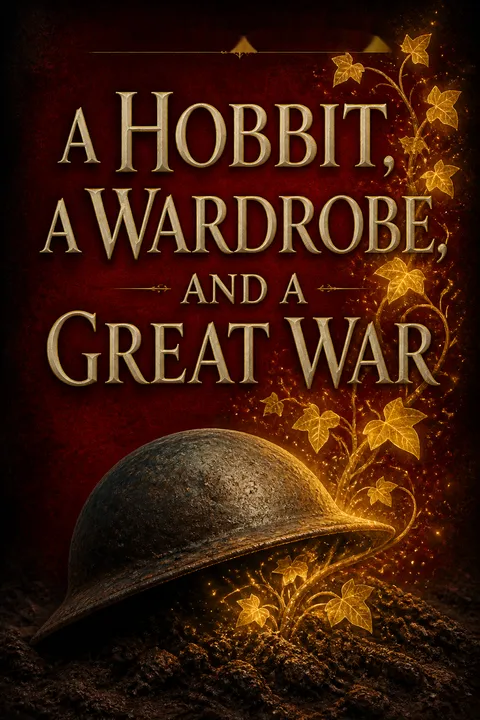
Reviews of A Hobbit, a Wardrobe, and a Great War are generally positive, averaging 4.08 out of 5. Many readers praise its fascinating exploration of how WWI shaped Tolkien and Lewis's masterpieces, highlighting vivid historical context and moving literary connections. However, critics note the book's over-reliance on speculation, repetition, and a perceived religious bias that may alienate non-Christian readers. Some feel there is insufficient depth about the authors' personal experiences and friendship. Most recommend it, particularly to those unfamiliar with Lewis and Tolkien's wartime backgrounds.
People Also Read

About the Author
Other books by Joseph Loconte
Download PDF
Download EPUB
.epub digital book format is ideal for reading ebooks on phones, tablets, and e-readers.








































