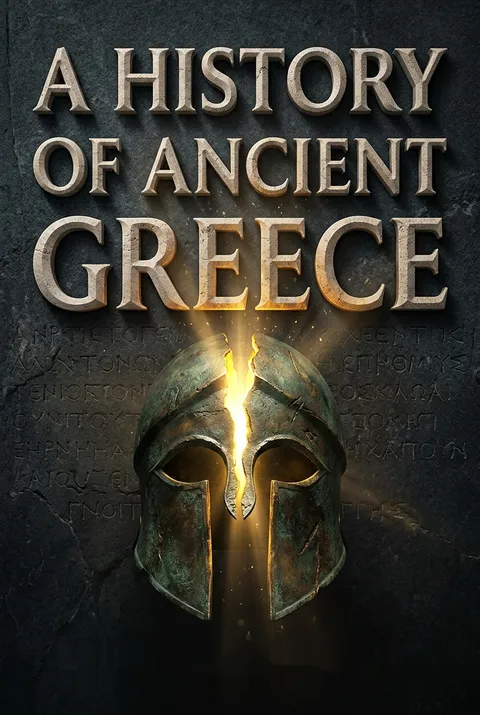

Summary Temporarily Unavailable
This summary is temporarily unavailable and is currently being updated. You can still explore the FAQs and other metadata below.
Key Takeaways
1. Early Aegean Civilizations Laid the Foundations for Greek Culture
The Greek gods, for instance, are already being worshiped back in the second millennium BCE, during the Bronze Age—by the Mycenaeans and the Minoans.
Ancient roots. While Greek history was once thought to begin with the first Olympics in 776 BCE, archaeological discoveries reveal a much older heritage. The Minoan civilization on Crete (c. 2000-1200 BCE), discovered by Sir Arthur Evans, featured grand palaces like Knossos with advanced systems, possibly inspiring myths like Theseus and the Minotaur. This sophisticated culture, with its unique architecture and bull rituals, was eventually destroyed by invaders, likely the Mycenaeans.
Mycenaean rise. On the Greek mainland, the Mycenaeans (c. 1700-1200 BCE), named after the site of Mycenae, were a powerful warrior society. Heinrich Schliemann's excavations uncovered rich shaft graves and fortified citadels, distinct from Minoan open palaces. Their Linear B writing system, deciphered as an early form of Greek, revealed they worshipped gods like Zeus and Hera, demonstrating continuity with later Greek religion.
Bronze Age collapse. Both Minoan and Mycenaean civilizations engaged in extensive international trade across the Mediterranean, as evidenced by shipwrecks like Uluburun. However, around 1200 BCE, a "systems collapse"—possibly due to drought, earthquakes, or the enigmatic Sea Peoples—brought an abrupt and dramatic end to these brilliant Bronze Age cultures, plunging the Aegean into a period of obscurity.
2. The Greek Dark Ages Gave Way to a Renaissance of City-States
Greece would not definitely come up again into the light until the beginning of the eighth century BCE.
Period of decline. Following the Bronze Age collapse around 1200 BCE, Greece entered a "Dark Age" lasting several centuries, characterized by a severe loss of advanced civilization. During this time, the Greeks lost the art of writing, ceased large-scale construction, and international trade dwindled, making them disappear from the records of Near Eastern peoples. This era was marked by simple survival, illiteracy, and a lack of communicative art.
New influences. Despite the general decline, some communities like Lefkandi in Euboea showed vestiges of contact with the Near East and ranked societies. The traditional "Dorian Invasion" theory suggests new groups introduced iron tools, cremation burials, and new ideas, though archaeological evidence for this migration is debated. It's possible Phoenician voyagers also introduced innovations like iron and the alphabet during this period.
Rebirth and organization. By the eighth century BCE, Greece began its renaissance, marked by the adoption of the Phoenician alphabet, a crucial step in its return to civilized society. This period also saw the emergence of the polis, or city-state, which became the fundamental political and social unit of Greece. Simultaneously, the first Olympic Games were held in 776 BCE, initiating a tradition of athletic festivals in honor of Zeus that would last over a millennium.
3. Sparta and Athens Developed Contrasting Societal Models
These two city-states epitomized the potential differences between individual Greek city-states.
Spartan militarism. Sparta, located in the southern Peloponnese, was a unique military society, admired and feared throughout Greece. Governed by two kings, five Ephors, and a council of elders, it was a constitutional monarchy, not a democracy. Spartan male children were removed from their families at age five to begin rigorous military training, fostering a life of discipline and communal living, while Spartan women enjoyed more rights than in other Greek city-states, often managing family property.
Athenian evolution. In contrast, Athens, identifying as Ionian, evolved from a monarchy to an oligarchy ruled by archons. Early attempts at tyranny, like Kylon's, failed, but the need for social order led to significant legal reforms. Draco's severe law code (621 BCE) was famously "written in blood," imposing the death penalty for most offenses, giving rise to the term "draconian."
Solon's reforms. A pivotal step towards Athenian democracy came with Solon's reforms in 594 BCE. As an archon, Solon revised Draco's laws, abolished debt slavery, created new citizen classes, and standardized weights, measures, and coinage. He also forbade the export of goods other than olives and olive oil, laying crucial groundwork for Athens' economic and political development, though the path to full democracy would still face challenges.
4. Athenian Reforms Pioneered the Concept of Democracy and Equality
The invention of democracy is usually dated to the year 508 BCE, when the reforms of Cleisthenes were implemented in Athens.
People power. Democracy, meaning "people power" (demos + kratia), was truly born in Athens in 508 BCE with the reforms of Cleisthenes. Equally vital was the principle of "isonomia," or equality under the law (iso + nomia), ensuring all citizens, regardless of wealth or birth, were subject to and protected by the same legal framework. This marked a radical departure from previous aristocratic rule.
Tyranny's interlude. Before Cleisthenes, Athens experienced a period of tyranny under Pisistratus and his sons, Hippias and Hipparchus. Pisistratus, after two failed attempts, seized power in 546 BCE and ruled as a benevolent tyrant, fostering peace and public works until his death. His sons, however, were less popular, and Hipparchus's assassination by Harmodius and Aristogeiton led to Hippias's exile and a brief period of anarchy, setting the stage for Cleisthenes.
Cleisthenes' innovations. Cleisthenes fundamentally restructured Athenian society by replacing four traditional tribes with ten artificial ones. He divided Attica into thirty "trittys" (ten from the shore, ten from the plain, ten from the hills) and combined three trittys (one from each region) to form a new tribe. Each tribe sent fifty men to the Council of Five Hundred, ensuring broad geographical representation and citizen participation in governance. He also introduced ostracism, allowing citizens to exile overly powerful individuals for ten years by scratching names on pottery shards (ostraca), a mechanism to prevent future tyrannies.
5. The Persian Wars United Greece Against an Empire and Forged Its Identity
Indeed, it is usually cited as the first battle fought to preserve democracy.
Ionian catalyst. The Persian Wars, chronicled by Herodotus (the "Father of History"), began with the Ionian Revolt in 499 BCE on the western coast of Turkey. Led by Miletus, the Ionians sought to overthrow Persian rule, receiving limited but crucial aid from Athens, which feared being next. The revolt's suppression by 494 BCE, culminating in the destruction of Miletus, provided Persia with a pretext to invade mainland Greece.
Marathon's miracle. In 490 BCE, a Persian force landed at Marathon, intending to conquer Athens. Despite being outnumbered, 10,000 Greeks, primarily Athenians led by Miltiades, decisively defeated 25,000 Persians using a pincer movement. The legendary run of Pheidippides, who died after delivering news of the victory to Athens, inspired the modern marathon. This battle, with its astonishing 32:1 kill ratio, became a symbol of Greek resolve and the defense of nascent democracy.
Thermopylae and Salamis. Ten years later, in 480 BCE, Xerxes led a massive Persian invasion force of 500,000 soldiers and 1,200 triremes. At Thermopylae, 300 Spartans led by Leonidas, alongside other Greeks, bravely held a narrow mountain pass against the overwhelming Persian army, fighting to the death after being betrayed. This heroic stand bought time for the Greeks to evacuate Athens and prepare for a naval confrontation. The subsequent Battle of Salamis, where the smaller, agile Greek fleet, equipped with bronze battering rams, decisively defeated the Persian navy in narrow straits, marked a turning point. The final land victory at Plataea in 479 BCE forced the Persians to retreat, ending their ambitions to conquer Greece.
6. Athens' Golden Age Flourished, Yet Its Imperial Ambitions Led to Conflict
During these years, Athens dominated much of Greek life, politically as well as commercially.
Delian League's rise. Following the Persian Wars, the Greeks, fearing another invasion, formed the Delian League in 478 BCE. Headquartered on the island of Delos, its dual purpose was to clear out remaining Persian garrisons and prepare for future attacks. Approximately 150 city-states contributed ships, men, or money, with Athens, led by Aristeides "the Just," gradually asserting its dominance, while Sparta formed its rival Peloponnesian League.
Athenian Empire. As the Persian threat receded, Athens, under the leadership of Pericles, began to transform the Delian League into an Athenian Empire. Rebellions by member states like Naxos and Thasos, seeking to withdraw, were forcibly suppressed. In 454 BCE, Athens controversially moved the League's treasury from Delos to Athens, ostensibly for safety, but soon began using its funds for its own purposes, particularly for an ambitious building program.
Periclean splendor. The diverted treasury funded the magnificent Periclean Building Program, which rebuilt the Acropolis, destroyed by the Persians. The Parthenon, dedicated to Athena, became an architectural marvel, housing a colossal gold-and-ivory statue. Other structures like the Temple of Athena Nike and the Erechtheion further adorned the Acropolis. Pericles surrounded himself with brilliant minds—historians Herodotus and Thucydides, sculptor Pheidias, philosopher Socrates, and dramatist Sophocles—making this period (478-431 BCE) the "Golden Age of Athens," a beacon of culture and intellect.
7. The Peloponnesian War Decimated Greek Power and Reshaped Its Future
Whatever one may consider it, the Peloponnesian War decimated Greece during the last part of the fifth century BCE, from 431 to 404 BCE.
Clash of titans. The Peloponnesian War (431-404 BCE), a devastating conflict between Athens and Sparta, was seen by some as a second war for democracy, by others as a civil war, or an ethnic clash between Ionians and Dorians. Chronicled by the Athenian historian Thucydides, who meticulously documented its events and even survived the plague, it was a struggle that deeply affected all of Hellas and beyond.
Prelude to war. Tensions escalated due to Athenian actions, particularly Pericles' Megarian Decree (433/432 BCE), which banned Megara from Athenian markets, crippling its economy. Sparta and its allies viewed this as an unacceptable provocation, leading to the outbreak of hostilities. The first phase, the Archidamian War (431-421 BCE), saw Pericles deliver his famous Funeral Oration, eloquently defending Athenian democracy and its values.
Plague and defeat. A devastating plague struck Athens early in the war, exacerbated by crowded conditions, claiming Pericles' life in 429 BCE. Thucydides' firsthand account of the plague's symptoms remains a medical mystery. After a period of uneasy peace (Peace of Nicias, 421 BCE), Athens' disastrous Sicilian Expedition (415 BCE) reignited the conflict. The second phase, the Deceleian War (414-404 BCE), ultimately led to Athens' defeat, forcing it to dismantle its army, navy, and Long Walls. The Athenian Empire, which had risen and fallen in just 75 years, never fully recovered its political dominance, transitioning into a center for philosophy and learning.
8. Greek Philosophers Explored the Universe and the Nature of Humanity
Socrates and Plato, the most famous of the Greek philosophers, were primarily concerned with the nature of mankind.
Pre-Socratic inquiries. Before Socrates, early Greek philosophers, primarily from the Milesian School in Miletus (6th-5th centuries BCE), focused on the fundamental nature of the universe.
- Thales (c. 546 BCE) believed all matter was water and the Earth floated on it.
- Anaximander proposed four elements (hot, cold, moist, dry) and a cylindrical Earth floating in space.
- Anaximenes suggested "aer" (a fine mist) as the underlying substance.
- Pythagoras (c. 569-475 BCE), the first to call himself a "lover of wisdom," found the key to the universe in numbers and their relation to music.
- Leucippus and Democritus (5th-4th centuries BCE) theorized that the universe was composed of indivisible "atomoi," foreshadowing modern atomic theory.
Socrates' legacy. Socrates (470-399 BCE), teaching in Athens, shifted philosophical focus to the nature of mankind and ethics. His "Socratic Method" of relentless questioning aimed to expose ignorance and stimulate critical thinking, often alienating powerful figures. Accused of impiety and corrupting the youth, he was condemned to death and famously drank hemlock, a poignant story recounted in Plato's Apology. He left no writings, his ideas preserved by his students.
Plato and Aristotle. Plato (c. 428-348 BCE), deeply affected by Socrates' death, founded the Academy in Athens. His extensive writings, including The Republic and allegories like "The Cave," explored justice, reality, and the ideal state, profoundly influencing Western thought. His student, Aristotle (384-322 BCE), founded the Lyceum, returning to a more scientific and empirical study of the universe and various disciplines, essentially synthesizing and expanding upon the philosophical traditions before him.
9. Macedonian Kings United Greece and Forged a Vast Empire
These were the Macedonians, led first by Phillip Il and then by his son Alexander—known to us now as Alexander the Great.
Philip II's rise. The Peloponnesian War left Greece fragmented, creating an opportunity for the northern kingdom of Macedon. Philip II, having studied military tactics as a royal hostage in Thebes, transformed Macedonia into a formidable power. Despite warnings from Athenian orators like Demosthenes (whose tirades are known as "Phillipics"), the Greek city-states failed to unite against him until it was too late.
Conquest of Greece. In 338 BCE, Philip's forces, with his 18-year-old son Alexander leading the cavalry, decisively defeated the Greeks at the Battle of Chaeronea. This victory marked the end of Greek independence, as Philip united all of Greece under the League of Corinth. He then set his sights on the mighty Persian Empire, planning a grand campaign to the East.
Alexander's ascension. Before he could embark on his Persian campaign, Philip was assassinated in 336 BCE, possibly orchestrated by his wife Olympias, Alexander's mother. Alexander, just twenty years old, swiftly consolidated power by quelling Greek revolts, notably destroying Thebes as a warning. He then took up his father's mantle, assembling a combined Macedonian and Greek army to confront Persia, beginning one of history's most ambitious military campaigns.
10. Alexander's Conquests Ushered in a Cosmopolitan Hellenistic World
Alexander's campaigns succeeded in spreading Greek (known as Hellenic or Hellenistic) culture across the known world.
Conquering Persia. In 334 BCE, Alexander crossed into Asia, beginning his legendary campaign against Persia. He achieved early victories at the Granicus River and famously "cut" the Gordian Knot, fulfilling a prophecy of ruling Asia. His major triumph came at the Battle of Issus (333 BCE) against Darius III, where he captured Darius's family and treated them with respect. He then conquered the Levant and Egypt, where he was crowned Pharaoh and founded Alexandria, a city that would become a beacon of Hellenistic culture. The final decisive victory over Darius III at Gaugamela (331 BCE) opened the entire Persian Empire to him.
East meets West. Alexander's campaigns, though cut short by his men's rebellion and his sudden death from fever in Babylon in 323 BCE at age 33, profoundly impacted the world. He envisioned a fusion of East and West, even presiding over mass marriages between his soldiers and local women. His conquests spread Greek language, architecture, philosophy, and medicine across a vast empire, while also bringing Eastern influences back to Greece, creating a vibrant, cosmopolitan "Hellenistic world" that lasted nearly three centuries.
Successors and legacy. Without a clear heir, Alexander's generals (the Diadochi) divided his empire, leading to centuries of conflict. Ptolemy established the Ptolemaic dynasty in Egypt, famous for the Library and Lighthouse of Alexandria, and culminating in Cleopatra VII. Seleucus founded the Seleucid Empire, encompassing much of the Near East, whose rulers like Antiochus IV sparked the Maccabean Rebellion. The Hellenistic Period ended in 30 BCE with Cleopatra's death and the Roman conquest, marking the transition from Greek to Roman history, but Alexander's legacy of cultural exchange and intellectual flourishing endured.
Last updated:
Report IssueReview Summary
A History of Ancient Greece receives an average 3.9-star rating from reviewers who describe it as a solid overview and survey of Greek history. The lecture series, narrated by the author himself, covers from the Minoans through the Hellenistic period ending with Cleopatra's death. Readers appreciate its concise narrative and usefulness as introductory material or refresher course, though some wished for more depth on certain topics like the Golden Age, arts, and Alexander the Great's successors.
People Also Read

About the Author
Dr. Eric H. Cline is Director of the Capitol Archaeological Institute at George Washington University and a National Geographic Explorer. With degrees from Dartmouth, Yale, and the University of Pennsylvania, he has 30 seasons of archaeological field experience across Israel, Egypt, Jordan, Cyprus, Greece, Crete, and the United States. He's a five-time award winner for popular archaeology books and has authored or edited 20 books and nearly 100 articles. His notable works include "1177 BC: The Year Civilization Collapsed" and "Three Stones Make a Wall: The Story of Archaeology." He frequently appears on television documentaries.
Download PDF
Download EPUB
.epub digital book format is ideal for reading ebooks on phones, tablets, and e-readers.








































