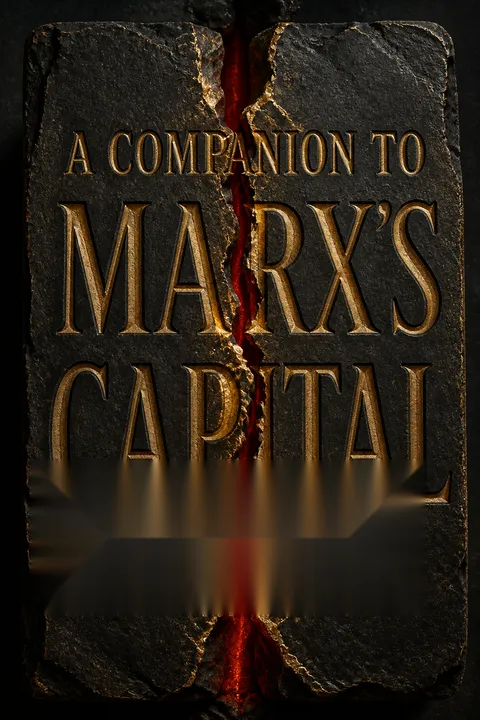

Key Takeaways
1. The Commodity is a Contradictory Unity of Use-Value and Exchange-Value
The wealth of societies in which the capitalist mode of production prevails appears as an "immense collection of commodities" the individual commodity appears as its elementary form.
The dual character. Every commodity has a dual nature: use-value and exchange-value. While use-value represents the physical utility of an object to satisfy a human want, need, or desire, exchange-value represents its quantitative exchange ratio in the market. Use-values are qualitative and material, whereas exchange-values are quantitative and relational.
The internal tension. This duality creates a permanent tension within the commodity form. To realize exchange-value, the owner must surrender the use-value to someone else. Under capitalism, use-values are produced not for direct consumption, but merely as the material bearers of exchange-value.
- Use-value: Qualitative, material, specific to human needs.
- Exchange-value: Quantitative, relational, accidental on the surface.
- The Commodity: A contradictory unity of these two opposing forces.
Methodological abstraction. Marx abstracts from the immense physical diversity of commodities to find their common denominator. This abstraction leads us from the surface appearance of market transactions to the underlying concept of value. It is through this method of descent that we begin to understand how the market system operates.
2. Value is an Immaterial but Objective Social Relation Measured by Socially Necessary Labor-Time
What exclusively determines the magnitude of the value of any article is therefore the amount of labour socially necessary, or the labour-time socially necessary for its production.
Socially necessary labor. Value is not determined by the actual time an individual worker takes to make a product, but by the average time required under normal conditions of productivity and skill. This is "socially necessary labor-time," which is constantly revolutionized by technological shifts. If a producer uses outdated methods, the extra time spent does not create value.
Immaterial but objective. Value is a social relation that cannot be physically dissected or found under a microscope. It is a "phantom-like objectivity" that only manifests itself when commodities are exchanged. It is immaterial because it contains no physical matter, yet objective because it regulates market exchange with the force of a natural law.
Concrete vs. abstract. The labor embodied in commodities has a dual character: concrete labor and abstract labor. This duality is unified in the single act of laboring, but represents different aspects of the production process.
- Concrete labor: Creates use-values through specific, qualitative work (e.g., tailoring).
- Abstract labor: Creates value through homogeneous, quantitative expenditure of human energy.
- Value: An immaterial, objective social relation that regulates capitalist exchange.
3. Commodity Fetishism Masks Social Relations as Material Relations Between Things
A definite social relation between men themselves... assumes here, for them, the fantastic form of a relation between things.
The market mask. In a capitalist society, producers only come into social contact through the exchange of their products. Consequently, the social relations of their private labors appear not as direct relations between people, but as material relations between people and social relations between things. The market hides the human labor and exploitation behind price tags.
The objective illusion. Fetishism is not a mere optical illusion or a mental mistake that can be easily wished away. It is an objective consequence of the market system; we really do make decisions based on prices on supermarket shelves, completely blind to the labor conditions of the distant producers. The lettuce on the shelf is mute about who grew it and under what conditions.
- Social relations: Disguised as price signals and market transactions.
- The supermarket: A place populated by "phantoms" of dead labor.
- Scientific critique: The tool used to break through the fetishism and reveal the material reality.
Deciphering the hieroglyphic. Marx compares the commodity to a social hieroglyphic that must be scientifically deciphered. By looking past the price tag, we can uncover the real human labor and exploitation hidden behind the market's surface. This critique is essential for understanding the true nature of capitalist wealth.
4. Money Internalizes Contradictions that Make Crises Inevitable
In a crisis, the antithesis between commodities and their value-form, money, is raised to the level of an absolute contradiction.
Dual functions of money. Money arises out of exchange to resolve the difficulties of barter, but it internalizes a fundamental contradiction. It must function simultaneously as a measure of value (requiring stability, historically gold) and as a medium of circulation (requiring rapid, frictionless movement). This tension makes the monetary system inherently unstable.
Rejection of Say's Law. Marx vigorously rejects Say's Law, which claims that every sale is a purchase and therefore a general crisis of overproduction is impossible. Because money splits exchange into two independent acts—selling (C-M) and buying (M-C)—a seller can simply hold onto money, causing a sudden drop in demand and triggering a crisis.
- C-M-C: Circulation of commodities mediated by money.
- Liquidity trap: When capitalists hoard money instead of reinvesting, halting circulation.
- Monetary crisis: The sudden, violent demand for hard cash over "profane" commodities.
The credit system. To bridge the temporal and spatial gaps in circulation, capitalism develops the credit system, turning money into a means of payment. This creates a web of debtor-creditor relations that can violently collapse during a monetary panic. When payments balance, money is nominal; but when debts fall due, only hard cash will suffice.
5. Capital is Not a Static Thing, but Value in Perpetual Motion
Value therefore now becomes value in process, money in process, and, as such, capital.
The capital circuit. Capital is not a fixed stock of physical assets or a static factor of production, but a continuous process of circulation. It exists only in motion through the circuit of M-C-M' (Money-Commodity-More Money), where value constantly changes its form from money to commodity and back again. If this flow stops, value disappears and the system collapses.
Limitless accumulation. Unlike use-values, which have physical limits of consumption, the accumulation of exchange-value in the form of money is boundless. The capitalist, as "capital personified," is driven by the rational miserliness of endlessly throwing money back into circulation to secure an increment (surplus-value).
- M-C-M': The general formula for capital.
- Value in motion: The essential definition of capital.
- The capitalist: A rational miser driven by the unceasing movement of profit-making.
The process definition. This process-oriented definition of capital distinguishes Marx's political economy from both classical and modern economic theories. It reveals that capital is not a thing, but a social relation in motion. When circulation is interrupted, the entire system is thrown into jeopardy.
6. The Exploitation of Labor-Power Solves the Contradiction of Surplus-Value
The value of labour-power, and the value which that labour-power valorizes... in the labour-process, are two entirely different magnitudes...
The exchange of equivalents. Under the rules of a perfect liberal market, commodities must exchange at their value. This poses a paradox: how can capitalists extract a surplus-value (M'-M) if they buy and sell everything at its equivalent value? The answer cannot be found in the market, but must be sought in the hidden abode of production.
The double freedom. The solution lies in the purchase of a unique commodity: labor-power. The worker must be "free" in a double sense: free to sell their labor-power as their own property, and "free" (dispossessed) of any means of production to work for themselves. This double freedom is the historical prerequisite for capitalism.
- Necessary labor: The time needed for the worker to reproduce their own wage.
- Surplus labor: The unpaid time the worker labors for the capitalist's profit.
- The secret of profit: The gap between what labor-power is worth and what it can produce.
The source of surplus. The capitalist pays the worker the value of their labor-power (the cost of subsistence goods to reproduce them). However, the use-value of labor-power belongs to the capitalist during the working day, and the worker can produce more value in a day than the cost of their daily subsistence. This gap is the source of surplus-value.
7. Class Struggle Over the Working Day Limits Capital's Boundless Drive for Absolute Surplus-Value
Between equal rights, force decides. Hence, in the history of capitalist production, the establishment of a norm for the working day presents itself as a struggle over the limits of that day...
Absolute surplus-value. Capitalists can increase surplus-value by simply lengthening the working day, a strategy Marx calls the production of "absolute surplus-value." Because capital's thirst for surplus labor is boundless, it ruthlessly oversteps the physical and moral limits of the worker's body. This drive is fueled by the coercive laws of competition.
Antinomy of rights. The capitalist asserts his right as a buyer to use the purchased commodity (labor-power) for as long as possible. The worker asserts his right as a seller to preserve his labor-power and limit the working day. This "antinomy of right against right" can only be resolved by collective class force.
- Vampire-like capital: Lives only by sucking living labor.
- Coercive laws of competition: Force individual capitalists to overexploit labor, regardless of their personal morals.
- The working day: The primary terrain of early class struggle over the control of time.
The state and regulation. The history of the British Factory Acts shows that the state was eventually forced to regulate the working day to prevent capital from destroying the nation's labor force. This class struggle over time is a fundamental, stabilizing regulator of the capitalist system. It shows that the market cannot regulate itself without destroying its own foundation.
8. The Pursuit of Relative Surplus-Value Drives Endless Technological and Organizational Innovation
The law of the determination of value by labour time makes itself felt to the individual capitalist... by compelling him to sell his goods under their social value...
Relative surplus-value. When the working day is legally limited, capitalists must find another way to increase surplus-value. They do this by reducing the "necessary labor-time" required to reproduce the worker's wage, a strategy called the production of "relative surplus-value." This requires increasing the productivity of labor.
Cheapening wage goods. To reduce necessary labor-time, productivity must rise in those industries producing the wage goods (like food and clothing) that determine the value of labor-power. If the cost of bread falls, the value of labor-power falls, and the rate of exploitation rises without changing the working day.
- Ephemeral surplus-value: The temporary extra profit reaped by technological innovators.
- Socially necessary labor-time: Reduced across the board as new technologies are generalized.
- The drive to innovate: An endogenous necessity of the capitalist mode of production.
The technological fix. Individual capitalists are driven to innovate by the search for "ephemeral" surplus-value. The first to adopt a superior technology can produce below the social average value but sell at the market price, reaping extra profits until the technology is generalized. This explains the inherent technological dynamism of capitalism.
9. Technology Coevolves with Nature, Social Relations, and Mental Conceptions
Technology reveals the active relation of man to nature, the direct process of the production of his life, and thereby it also lays bare the process of the production of the social relations of his life, and of the mental conceptions that flow from those relations.
The coevolutionary model. Marx rejects simple technological determinism. Instead, he presents an ecological model of society where six distinct moments—technology, relation to nature, production process, reproduction of daily life, social relations, and mental conceptions—coevolve in an open, dialectical manner.
- The six moments: Technology, nature, production, daily life, social relations, mental conceptions.
- Real subsumption: The complete subordination of the worker's body and mind to the machine.
- Science: Pressed into the service of capital to dominate the labor process.
Internalized relations. No single moment determines the others; rather, each moment internalizes aspects of all the others. For example, a new machine (technology) cannot be deployed without a certain division of labor (social relations) and a scientific understanding of natural forces (mental conceptions). This coevolutionary framework is essential for understanding social change.
Weapons of class struggle. Under capitalism, technology is designed and deployed as a weapon to discipline labor and suppress strikes. The machine system completes the real subsumption of labor, turning the worker into a mere appendage of a "mechanical monster." Science itself is pressed into the service of capital to dominate the labor process.
10. Capital Accumulation Systematically Produces an Industrial Reserve Army and Social Inequality
Accumulation of wealth at one pole is, therefore, at the same time accumulation of misery, the torment of labour, slavery, ignorance, brutalization and moral degradation at the opposite pole...
The general law. Marx's "general law of capitalist accumulation" models the long-term dynamics of a closed capitalist system. As capital accumulates, it adopts labor-saving technologies, which relatively reduces the demand for labor-power and produces a "relative surplus population." This population is superfluous to capital's immediate needs.
The industrial reserve army. This surplus population forms an "industrial reserve army" that is absolutely necessary for capital's expansion. It acts as a lever to keep wages down and allows capital to rapidly expand into new sectors during booms without being blocked by labor scarcities.
- Floating reserve: Unemployed or underemployed workers in industrial centers.
- Latent reserve: Rural or peasant populations waiting to be proletarianized.
- The absolute general law: Wealth concentrates at one pole, while misery accumulates at the other.
Polarization of wealth. The reserve army is divided into floating, latent, and stagnant populations. The systematic production of this reserve ensures that the accumulation of capital is accompanied by the accumulation of misery and job insecurity for the working class. This polarization is an inevitable consequence of the system.
11. Primitive Accumulation is the Violent, Ongoing Dispossession of the Commons
The spoliation of the Church's property, the fraudulent alienation of the state domains, the theft of the common lands... these things were just so many idyllic methods of primitive accumulation.
The prehistory of capital. Primitive accumulation is the historical process of divorcing the producer from the means of production. It is not a peaceful story of frugality and hard work, but a violent history of enclosure, colonization, and state-backed theft written in "letters of blood and fire." It is the necessary starting point for the capitalist mode of production.
The role of the state. The state acts as an active agent in this dispossession, using the law to steal common lands and turn them into modern private property. This process creates the two essential conditions for capitalism: concentrated money capital and a mass of "free" proletarians. The state is the midwife of this transition.
- Enclosure of the commons: Turning shared resources into private property.
- The state: The "midwife" of the transition to capitalism through organized force.
- Ongoing dispossession: Privatization of water, education, and pensions as modern primitive accumulation.
Accumulation by dispossession. Harvey extends Marx's concept, arguing that primitive accumulation is not merely a historical phase but an ongoing process. Under neoliberalism, this takes the form of "accumulation by dispossession" through privatization, financial predation, and the enclosure of public assets. It is a continuous requirement for the survival of capital.
Review Summary
Reviewers largely praise A Companion to Marx's Capital, Volume 1 as an invaluable guide for navigating Marx's dense text, highlighting Harvey's ability to contextualize difficult concepts, connect ideas to contemporary issues like the 2008 financial crisis and neoliberalism, and illuminate Marx's dialectical method. Many recommend reading it alongside Capital itself. Common criticisms include Harvey's occasionally dry writing style, shallow contemporary connections, and tendency to reiterate rather than deeply analyze. Several reviewers note his willingness to disagree with Marx as a strength, keeping the analysis intellectually honest and dynamic.
People Also Read

About the Author
Other books by David Harvey

Download PDF
Download EPUB
.epub digital book format is ideal for reading ebooks on phones, tablets, and e-readers.








































