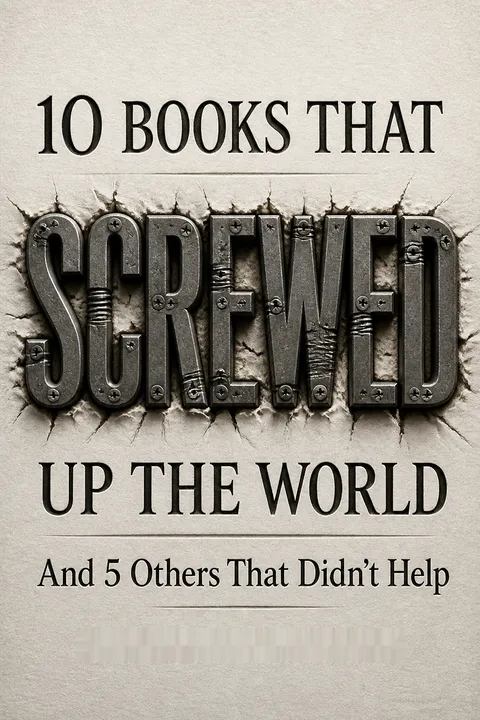

Key Takeaways
1. Ideas, especially bad ones, have devastating consequences.
Common sense and a little logic tell us that if ideas have consequences, then it follows that bad ideas have bad consequences.
Dangerous diseases. Just as deadly diseases can infect populations, dangerous ideas, once put into print, can spread through generations, increasing the world's wretchedness. The author argues that certain books have demonstrably "screwed up the world," and humanity would have been better off without them. These ideas often float undetected in the intellectual air we breathe, shaping our perceptions and actions.
Historical proof. The sheer scale of human misery caused by certain ideologies, such as Marxism, serves as undeniable proof of the destructive power of ideas. The tens of millions of corpses revealed after the collapse of the Soviet Union and the tearing of China's protective cover demonstrate that if the Communist Manifesto had never been written, immense suffering would have been avoided. This principle extends to other influential texts, even when the resulting carnage is more subtle.
Exposure, not burning. The solution to these harmful ideas is not censorship or book burning, which the author deems indefensible. Instead, the only cure is to confront them directly: to read them, understand them thoroughly, and expose their malignant core to the light of day. This intellectual engagement allows us to recognize and resist their destructive influence.
2. The rejection of God paved the way for moral relativism and ruthless pragmatism.
Hence it is necessary to a prince, if he wants to maintain himself, to learn to be able not to be good, and to use this and not use it according to necessity.
Machiavellian counsel. Niccolò Machiavelli's The Prince introduced the profoundly wicked counsel that rulers should prioritize effectiveness over goodness, making "darkly unthinkable" actions seem justifiable. This advice, offered to those who had shed moral and religious scruples, posits that evil can often be more effective than good in securing and maintaining power. It encourages rulers to appear merciful, faithful, and religious, while being prepared to act cruelly, faithlessly, and sacrilegiously when necessary.
Ends justify means. Machiavelli is identified as the original "ends-justify-the-means" philosopher, arguing that no act is so evil that necessity or benefit cannot mitigate it. This perspective is only possible for someone who has discarded the fear of hell and the notion of an immortal soul, believing that without God, one is free to be wicked if it serves a purpose. This principle directly contradicts the Christian prohibition against doing evil in the service of good.
Atheism's ultimate effect. The ultimate effect of Machiavelli's counsel is the rejection of God, the soul, and the afterlife, leading to a world where evil can be called good and good, evil. This foundational shift, initiated by Machiavelli, marks the beginning of a profound conflict between modern secularism and Christianity, influencing nearly all subsequent books examined and setting the stage for unprecedented carnage when trivial excuses justify great evils.
3. Defining human nature as amoral and driven by desire justifies any action.
Therefore, it followeth, that in such a condition, every man has a right to every thing; even to one another’s body.
Hobbes's state of nature. Thomas Hobbes, in Leviathan, posited a "state of nature" where humans are entirely without conscience, ruled solely by pleasure and pain, and ravenous in their desires. In this imaginary pre-social condition, there is no natural good or evil, right or wrong; these distinctions are merely personal preferences. This leads to a "war of every man, against every man," where force and fraud are cardinal virtues.
Rights as desires. Hobbes introduced the insidious notion that human rights are simply equivalent to human desires, meaning "I have a right to do X" is merely another way of saying "I have a desire to do X." This toxic fantasy, established by bald declaration rather than argument, has permeated modern discourse, allowing individuals to claim a "right" to morally degraded or trivial desires, and expecting government to protect them.
Society as artificial. Hobbes viewed society as an unnatural, artificial contract formed by individuals seeking to escape the chaos of the state of nature. This produces a negative view of justice, based on mutual distrust ("I won't do X to you if you won't do X to me"), rather than love or natural duty. Government's sole task becomes protecting and maximizing individual rights/desires while minimizing conflict, leading to a self-fulfilling prophecy of a fractious, rights-demanding society.
4. Utopian visions, divorced from reality, led to unprecedented human suffering.
The first person who, having fenced off a plot of ground, took it into his head to say this is mine and found people simple enough to believe him, was the true founder of civil society.
Rousseau's primitive paradise. Jean-Jacques Rousseau, in Discourse on the Origin and Foundations of Inequality among Men, imagined a "natural man" who was amoral, carefree, and libidinous, living in a primitive state without language, reason, or property. Society and morality, including love and family, were deemed artificial contrivances that led to man's fall from idyllic happiness into the miseries of civilization. This fictional state became a counter-Genesis myth, shaping modern views of human nature.
Property as original sin. Rousseau famously declared private property as the origin of all human misery and inequality, arguing that "the fruits belong to all and the earth to no one!" This idea directly influenced Marxist thought, which posited that all human conflict stems from ownership and that freedom from "crimes, wars, murders,...miseries and horrors" would only come from forcibly abolishing private property.
Marxist utopia. Karl Marx and Friedrich Engels, in The Manifesto of the Communist Party, built on Rousseau's ideas, envisioning history as a relentless class struggle culminating in a final revolution that would usher in a communist utopia. This classless, stateless society, where "the free development of each is the condition for the free development of all," was an impossible fantasy. Yet, this misty, unachievable goal was used as a justification for extreme brutality, leading to the extermination of millions in the name of historical progress.
5. Evolutionary theory was twisted to justify eugenics and racial extermination.
At some future period, not very distant as measured by centuries, the civilised races of man will almost certainly exterminate and replace throughout the world the savage races.
Darwin's eugenic implications. Charles Darwin's The Descent of Man applied the principle of "survival of the fittest" to human beings, directly leading to the concept of eugenics. Darwin argued that civilized charity, by protecting the "imbecile, the maimed, and the sick," allowed the "weak members of civilised societies [to] propagate their kind," which he believed was "highly injurious to the race of man." He explicitly stated that "hardly any one is so ignorant as to allow his worst animals to breed."
Morality as evolved trait. Darwin viewed morality, including sympathy, not as inherently good or divinely given, but as an evolved trait that contributed to group survival. However, he recognized the contradiction: while sympathy helped cohere groups, it could become maladaptive if the burden of the "unfit" became too heavy. This opened the door for "hard reason" to jettison sympathy in favor of more efficient means of "improving" the human race.
Racial hierarchy and extermination. Darwin's theory also posited a racial hierarchy, with Caucasians at the top and "the negro or Australian" at the bottom, "an evolutionary hair's-breadth away from the anthropomorphous gorilla." He prophesied that "civilised races of man will almost certainly exterminate and replace throughout the world the savage races." Adolf Hitler, in Mein Kampf, embraced this "applied biology," spiritualizing Darwinian natural law to justify the extermination of "unfit" and "inferior races" for the sake of Aryan supremacy, leading to the Holocaust and the slaughter of millions of "undesirables."
6. Sexual liberation, presented as scientific, eroded traditional morality and family.
The child of the future must have an open mind. The home must cease to plead an ethical cause or a religious belief with smiles or frowns, caresses or threats.
Mead's Samoan fantasy. Margaret Mead's Coming of Age in Samoa presented a fictionalized account of Samoan society as a carefree, sexually liberated paradise, free from the "storm and stress" of Western adolescence. She used this anthropological myth to argue that Western sexual morality and family structures were unnatural and anxiety-producing. Mead advocated for "Education for Choice," promoting an "open mind" and "tolerance" for a multitude of sexual alternatives, effectively erasing traditional moral boundaries.
Kinsey's pseudo-science. Alfred Kinsey's Sexual Behavior in the Human Male (the Kinsey Report) further eroded moral boundaries by presenting sexual perversity as scientific fact. Kinsey, a passionate Darwinist, viewed human sexuality as an endless spectrum of variations, no more perverse than gall wasp forms. He used skewed data, including interviews with prostitutes and prisoners, to normalize homosexuality, bestiality, and pre-adolescent sexuality, claiming that if something happens sexually, it must be natural.
Perversity as natural. Kinsey's work, rooted in his own profound sexual perversity, aimed to force the world to accept his unnatural sexuality as natural. He argued that there are no sexual deviations, only different responses to sexual mechanisms, and that innate sexual perversity does not exist. This pseudo-scientific approach, widely accepted due to a cultural eagerness for sexual liberation, became foundational for the sexual revolution, ultimately seeking to overthrow all sexual boundaries and extinguish opposition, particularly from Christianity.
7. Feminism, rooted in Marxist thought, demonized traditional roles and promoted abortion.
As she made the beds, shopped for groceries, matched slipcover material, ate peanut butter sandwiches with her children, chauffeured Cub Scouts and Brownies, lay beside her husband at night—she was afraid to ask even of herself the silent question—‘Is this all?’
The "feminine mystique." Betty Friedan's The Feminine Mystique launched the second wave of feminism by demonizing the role of housewives and romanticizing professional work outside the home. Friedan argued that women confined to domesticity suffered from "the problem that has no name"—a deep, unspoken misery and purposelessness, leading to neurosis, alcoholism, and despair. She presented a distorted view of suburban housewives, selectively reporting negative anecdotes to fit her thesis of widespread discontent.
Marxist roots. Friedan's analysis was fundamentally Marxist, interpreting women's roles through a historical dialectic that saw domestic labor as "private" and "unproductive," thus enslaving women. She explicitly echoed Friedrich Engels's thesis that "the emancipation of woman will only be possible when woman can take part in production on a large, social scale, and domestic work no longer claims anything but an insignificant amount of her time." Friedan, a former Marxist agitator, hid these radical roots to gain wider acceptance for her revolutionary call.
Abortion as liberation. Friedan's revolution, while initially focused on professional emancipation, quickly embraced abortion as a necessary tool for women's liberation. She co-founded NARAL, advocating for the repeal of abortion laws, believing that the "right of a woman to kill her unborn child was necessary for her emancipation from being defined as a 'mother.'" This led to a massive increase in abortions, surpassing the death tolls of communist regimes, and solidified the notion that motherhood could be a part-time endeavor, secondary to professional life.
8. The denial of sin led to a "will to power" and a "passion for destruction."
Christianity has been the most calamitous kind of arrogance yet.
Nietzsche's "God is dead." Friedrich Nietzsche's proclamation that "God is dead" was not a cry of triumph but of despair, recognizing that without God, there is no objective good or evil, only sheer human will in an indifferent cosmos. He brutally critiqued "slave morality"—which he associated with Christianity and utilitarianism—for promoting weakness, mediocrity, and a focus on comfort, thereby hindering human greatness and the "will-to-power."
Beyond good and evil. Nietzsche advocated for a "master morality" that transcends conventional good and evil, embracing the "spiritualization of cruelty" and the ruthless pursuit of greatness. He believed that all higher culture demanded suffering, harsh discipline, and the exploitation of the weak. This philosophy, combined with Darwinian ideas of the "fittest," provided a framework for the creation of the "übermensch" (over-man or super-man) through a new aristocratic caste willing to sacrifice "untold human beings" for its sake.
Lenin's destructive passion. Vladimir Ilyich Lenin, a fervent atheist and admirer of Machiavelli, embraced the Marxist vision of history as an inevitable march towards a communist utopia. He believed that the "proletariat needs state power, the centralized organization of force, the organization of violence, for the purpose of crushing the resistance of the exploiters." This denial of God, heaven, and sin, coupled with the belief in historical inevitability, removed all moral qualms about mass slaughter, transforming a "great love of mankind of the future" into a "great hatred for people" and a "passion for destruction."
9. The 20th century's carnage serves as a stark warning against secular utopianism.
Sacrificing himself for the sake of an idea, he does not hesitate to sacrifice other people for it.
Humanity devouring itself. The 20th century witnessed the horrifying spectacle of humanity devouring itself in the name of humanity. Philosophers and political leaders, driven by utopian visions, sought to "save the world" from perceived ills—political impotence, skepticism, industrial oppression, disease, poverty, male oppression—by embracing brutal effectiveness, annihilating opposition, and eliminating the "unfit." This paradox of "great love of mankind of the future" giving birth to "great hatred for people" fueled unprecedented carnage.
The illusion of salvation. The authors examined, in their rejection of God and the concept of sin, believed that if this world was our only world and this life our only life, then any means were justified to transform human misery into earthly happiness. They were "mythmakers," enthralled by fictional states of nature and impossible utopian paradises, which they falsely presented as scientific fact. These secular schemes, when put into practice, led to far greater suffering than the "myths" they sought to replace.
The enduring lesson. The core lesson from these books is that the problem lies not primarily with the world, but with human beings themselves—a "crack or deep taint" in the soul that is largely invisible but profoundly destructive. The denial of sin, and the attempt to rid the world of the very idea of a soul accountable to God, allows twisted souls to impose their warped visions on reality. The carnage of the 20th century stands as a stark reminder that the safest place to put heaven is not on earth, and that creating ourselves in the image of the savage inevitably leads to unimagined savagery.
Review Summary
People Also Read





Download PDF
Download EPUB
.epub digital book format is ideal for reading ebooks on phones, tablets, and e-readers.








































