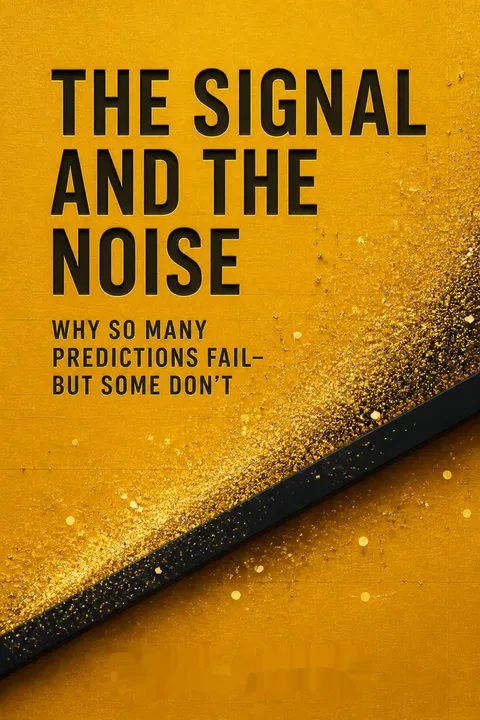

核心要点
1. 预测需要在信号与噪声之间取得平衡
信号代表真相,噪声则是干扰我们认清真相的杂音。
信号与噪声。 准确的预测在于从数据中区分有意义的模式(信号)与随机波动(噪声)。这十分困难,因为:
- 我们的大脑天生倾向于发现模式,即使它们并不存在
- 更多信息不一定带来更好的预测
- 认知偏差可能使我们关注错误的信息
成功的预测者会采用多种方法来分辨信号与噪声:
- 利用统计方法量化不确定性
- 寻求多元化的信息来源
- 持续检验并完善预测,与现实结果对比
2. 过度自信导致预测失误
我们往往高估自己对命运的掌控力,但采取相反的态度有时更有益。
过度自信的危害。 过度自信是准确预测的主要障碍,专家和普通人皆然:
- 我们倾向低估不确定性,高估预测能力
- 专家预测往往不如简单的统计模型准确
- 过度自信在金融和政治领域可能带来灾难性后果
应对过度自信的方法:
- 承认知识和预测能力的局限
- 采用概率思维,避免绝对断言
- 主动寻找挑战自身信念的信息
3. 贝叶斯思维提升预测能力
贝叶斯定理表面上是数学公式,实则要求我们以全新方式思考观点及其检验。
贝叶斯推理。 贝叶斯思维为基于新证据更新信念提供框架:
- 以已有知识为基础设定先验概率
- 随着新信息不断调整概率
- 持续完善预测,随着数据积累不断修正
贝叶斯思维的核心原则:
- 接纳不确定性,采用概率思考
- 面对新证据时勇于改变观点
- 认识到所有知识都是暂时的,随时可修正
4. 专业领域知识提升预测准确度
当我们阻碍预测者全面、明确地揭示周围世界风险时,经济及其他领域的危险便潜伏其中。
专业知识的重要性。 虽然专家也可能过度自信,但深厚的领域知识对准确预测至关重要:
- 专家理解领域的细微差别和复杂性
- 能更有效识别相关信息,剔除噪声
- 领域知识助力更准确解读数据和趋势
但专业知识必须结合:
- 对新信息和观点的开放态度
- 承认错误并更新信念的意愿
- 了解认知偏差及其缓解方法
5. 大数据放大信号与噪声
过去二十年,信息、基因组学等技术的指数级增长,使我们能测量数以百万计的潜在变量。
双刃剑。 大数据革命对预测影响深远:
- 可供分析的信息极大丰富
- 强大计算工具支持复杂建模与分析
- 但更多数据也带来更多虚假相关和错误模式
有效利用大数据预测需:
- 关注提出正确问题,而非盲目分析所有数据
- 运用严谨统计方法区分信号与噪声
- 将数据分析与领域知识及批判性思维结合
6. 成功预测依赖持续改进
最优秀的预测者不断做出渐进改进,持续自我检验。
迭代提升。 准确预测非一蹴而就,而是持续过程:
- 成功预测者不断更新模型和假设
- 主动寻求反馈,从错误中学习
- 根据新信息和变化条件不断修正预测
持续改进的关键做法:
- 详细记录预测与结果
- 定期回顾和分析过往预测
- 勇于放弃或调整失效模型
7. 预测市场有效整合知识
预测市场允许人们对特定经济或政策结果下注,如以色列是否会与伊朗开战,或气候变化导致全球气温升高多少。
群体智慧。 预测市场利用集体智慧进行预测:
- 参与者有经济激励做出准确预测
- 市场整合多元知识和观点
- 价格反映众人集体判断
预测市场优势:
- 通常优于单一专家
- 随新信息实时更新
- 可应用于政治、经济等多领域
8. 经济预测面临独特挑战
经济学是一门较软的科学。尽管经济学家对基本经济系统有合理理解,但因果关系模糊,尤其在泡沫和恐慌时,系统充满依赖人类行为的反馈回路。
复杂系统。 经济预测尤为困难,原因包括:
- 经济系统复杂,变量众多相互作用
- 人类行为和心理影响显著
- 因素间存在反馈回路和非线性关系
经济预测的挑战:
- 因果关系难以分离
- 受限于无法做受控实验
- 经济数据频繁修正
经济预测的最佳实践:
- 采用多模型和多方法
- 融合定性因素和专家判断
- 随新信息及时更新预测
9. 天气预报体现预测进步
天气预报是本书的真实成功案例。无论是飓风路径还是日间最高温度,预测比十年前或二十年前大为改进,得益于计算能力提升、数据采集改进和传统努力。
稳步进步。 天气预报展示了预测如何随时间提升:
- 计算建模和数据采集技术进步
- 对大气物理理解加深
- 人工智慧与计算模型结合
天气预报进步的关键因素:
- 计算能力大幅提升
- 卫星和雷达技术改进
- 集成预报技术的发展
对其他领域的启示:
- 技术进步与人类判断相结合
- 投资数据采集和模型优化
- 采用概率预测方法
10. 地震预测仍难以实现
霍夫的结论令人震惊。无论职业、经验或子领域,调查中的专家预测未来政治事件的准确度几乎与随机猜测无异,甚至不及基本统计方法。
预测的局限。 尽管地震学进步,准确预测地震依然困难:
- 地震源于地壳复杂非线性过程
- 地下深处条件难以直接观测
- 难以区分真实前兆与随机波动
地震预测的挑战:
- 误报代价高,影响公众信任
- 重大事件间隔长,难以验证预测
- 地震系统的混沌特性限制可预测性
当前策略聚焦于:
- 地震风险的概率预测
- 改进早期预警系统
- 加强建筑规范和基础设施韧性
11. 政治预测受益于汇聚
大量实证和理论证据表明,汇聚不同预测有益。在宏观经济预测到政治民调等多个领域,简单平均所有预测往往能减少约15%至20%的误差。
集体智慧。 汇聚多重预测常提升政治预测准确性:
- 多样观点相互抵消个体偏差
- 结合多种方法捕获更多信息
- 汇聚减少极端预测的影响
政治预测的有效方法:
- 民调汇总与加权平均
- 政治预测市场
- 多模型集成预测技术
需注意的限制:
- 群体从众或思维趋同风险
- 预测方法和来源需多样化
- 识别并加权高质量预测的重要性
12. 金融市场挑战高效预测
经济学入门教导,交易只有在双方受益时才理性。比如一支有两名优秀游击手但无好投手的棒球队,将其中一人交易给投手充足但游击手打击率仅0.190的球队。或一位准备退休的投资者卖出股票,交易给刚入市的新手。
市场非效率。 金融市场对预测提出独特挑战:
- 有效市场假说认为市场不可预测
- 但泡沫和崩盘显示市场存在非效率
- 短期关注和羊群效应导致非理性结果
金融预测的复杂因素:
- 反身性:预测影响市场行为
- 信息不对称与内幕交易
- 投资者心理偏差
金融预测方法:
- 基本面分析经济因素
- 技术面分析价格模式和趋势
- 行为金融学洞察市场心理
认识局限:
- 复杂动态市场中完美预测不可能
- 注重风险管理和概率思维
- 理解运气和随机性在短期结果中的作用
读者评价
《信号与噪声》评价不一,既有对其在预测、统计和贝叶斯思维方面见解的赞赏,也有不同声音。读者普遍认可Silver清晰的讲解和涵盖多个领域的真实案例,但也有人觉得书籍篇幅过长、内容重复,且过于聚焦美国视角。关于棒球和扑克章节,读者反应分歧明显。批评者指出文中偶有写作瑕疵,并对Silver部分论点提出质疑。总体来看,大多数评论者仍推荐此书,尤其适合对预测、数据分析及理解预测中的不确定性感兴趣的读者。
其他人还在读








常见问题
What's The Signal and the Noise about?
- Focus on Prediction: The book explores the art and science of making predictions across various fields, such as economics, politics, and sports. It examines why many forecasts fail while some succeed.
- Signal vs. Noise: Nate Silver introduces the concept of distinguishing between "signal" (truth) and "noise" (distractions or false information) in data, which is crucial for accurate forecasting.
- Human Error and Technology: The interplay between human judgment and technological advancements in prediction is discussed, highlighting how biases and errors can undermine technological benefits.
Why should I read The Signal and the Noise?
- Understanding Predictions: The book provides insights into the mechanisms behind successful predictions and common pitfalls, encouraging critical thinking about data interpretation.
- Real-World Examples: Silver uses compelling case studies, such as the financial crisis and weather forecasting, to make concepts relatable and applicable to various fields.
- Improving Decision-Making: Practical advice is offered on making better predictions and decisions by recognizing biases and understanding uncertainty, beneficial in personal and professional contexts.
What are the key takeaways of The Signal and the Noise?
- Embrace Uncertainty: Acknowledge uncertainty in predictions to improve decision-making. Silver argues that understanding and communicating uncertainty is crucial.
- Use Bayesian Thinking: Silver advocates for Bayesian statistical methods, which involve updating predictions as new information becomes available, allowing for more flexible forecasting.
- Beware of Overconfidence: The book warns against overconfidence in predictions, emphasizing humility and adaptability as essential for successful forecasting.
What are the best quotes from The Signal and the Noise and what do they mean?
- “The signal is the truth. The noise is what distracts us from the truth.”: This quote highlights the challenge of finding accurate information amidst overwhelming data, reminding us to focus on what truly matters.
- “We love to predict things—and we aren’t very good at it.”: Reflects Silver's critique of human tendencies to make predictions without sufficient evidence, underscoring the need for a thoughtful approach.
- “When the facts change, I change my mind. What do you do, sir?”: Emphasizes adaptability in forecasting, encouraging openness to new information and adjusting predictions accordingly.
How does Nate Silver define "signal" and "noise" in The Signal and the Noise?
- Signal Defined: Silver defines "signal" as meaningful information that can lead to accurate predictions, representing the underlying truth forecasters seek.
- Noise Explained: "Noise" refers to irrelevant or misleading information that can obscure the signal, including distractions, biases, and errors.
- Importance of Distinction: Differentiating between signal and noise is crucial for effective forecasting, enhancing prediction accuracy across various fields.
What is Bayesian thinking, and how is it applied in The Signal and the Noise?
- Bayesian Definition: Bayesian thinking is a statistical approach that involves updating beliefs or predictions based on new evidence, contrasting with fixed-assumption methods.
- Application in Forecasting: Silver illustrates how Bayesian methods improve predictions by allowing model adjustments as new data becomes available, essential in dynamic environments.
- Real-World Examples: The book provides examples of successful Bayesian applications in sports analytics and political forecasting, achieving more accurate predictions.
How does The Signal and the Noise address the failures of prediction in economics?
- Historical Context: Silver examines economic forecasting failures, such as the 2008 financial crisis, arguing that economists often overestimate their predictive abilities.
- Bias and Overconfidence: Discusses how biases and overconfidence lead to inaccurate forecasts, emphasizing humility and recognition of uncertainty in economic predictions.
- Call for Improvement: Advocates for a rigorous approach to economic forecasting, incorporating Bayesian methods and acknowledging model limitations for better outcomes.
What are the implications of overfitting in forecasting, as discussed in The Signal and the Noise?
- Definition of Overfitting: Overfitting occurs when a model is too complex, capturing noise rather than the signal, leading to poor predictive performance.
- Consequences for Predictions: Overfitting results in models that appear accurate in testing but fail with new data, problematic in fields like economics and earthquake forecasting.
- Avoiding Overfitting: Strategies include simplifying models and focusing on relevant variables, improving prediction reliability.
How does The Signal and the Noise illustrate the importance of communication in forecasting?
- Clear Communication of Uncertainty: Silver emphasizes effective communication of uncertainty to help decision-makers understand risks and prepare accordingly.
- Case Studies: Examples like the National Weather Service's hurricane forecasts show the impact of clear communication, saving lives and mitigating damage.
- Lessons for Forecasters: Forecasters should strive for honesty and clarity, building trust with audiences and improving forecast effectiveness.
What role does uncertainty play in forecasting according to The Signal and the Noise?
- Inherent Uncertainty: Silver asserts that uncertainty is intrinsic to predictions, encouraging readers to embrace it for accurate forecasting.
- Quantifying Uncertainty: Methods like confidence intervals and probabilistic models help quantify uncertainty, aiding forecasters in understanding possible outcomes.
- Decision-Making: Understanding uncertainty leads to informed decisions, promoting cautious and flexible approaches to predictions.
How does Nate Silver use examples from sports in The Signal and the Noise?
- Baseball Analytics: Silver uses his background in baseball analytics to show the importance of data in predictions, transforming team evaluations and strategies.
- Predicting Game Outcomes: Explores predictive models in sports, emphasizing luck versus skill, leading to better betting strategies and management.
- Broader Implications: Sports serve as a case study for applying prediction principles to other fields, making complex concepts relatable.
What is the significance of the title The Signal and the Noise?
- Distinction Between Signal and Noise: The title encapsulates the book's theme of distinguishing between meaningful signals and irrelevant noise in forecasting.
- Implications for Decision-Making: Understanding this distinction leads to better decision-making in fields like economics and politics, improving forecasting accuracy.
- Broader Context: Reflects the challenge of interpreting information in a data-driven world, emphasizing the need to filter out noise.

下载 PDF
下载 EPUB
.epub digital book format is ideal for reading ebooks on phones, tablets, and e-readers.








































